ToolsSizing calculator
Water Softener Sizing Calculator
The formula is public and simple: people x 75 gallons per day x hardness in gpg x 7 days = the grains your softener must remove per week. Enter three numbers below and get your capacity, 32,000 to 80,000 grain, with the math shown and the iron correction applied.
1 gpg = 17.1 ppm (mg/L as CaCO3). No test report yet? Start from your city's hardness data.
171 ppm reads as hard per USGS classification.
The formula assumes 75 gallons per person per day, the standard sizing figure used across the industry.
We add 3 gpg of compensated hardness per 1 ppm of iron, the standard industry sizing rule. Above 3 ppm, look at a dedicated iron filter first.
Your weekly softening load
21,000
grains per week
4 people x 75 gallons per day x 10.0 gpg compensated hardness x 7 days = 21,000 grains between regenerations.
Recommended capacity
32,000 grain
Sized so the softener regenerates about once a week while using no more than 75% of its rated capacity, a common salt-efficiency margin. Usable capacity at that margin: 24,000 grains, against your 21,000-grain week.
Some product links are affiliate links: buying through them costs you nothing extra and may earn us a commission.
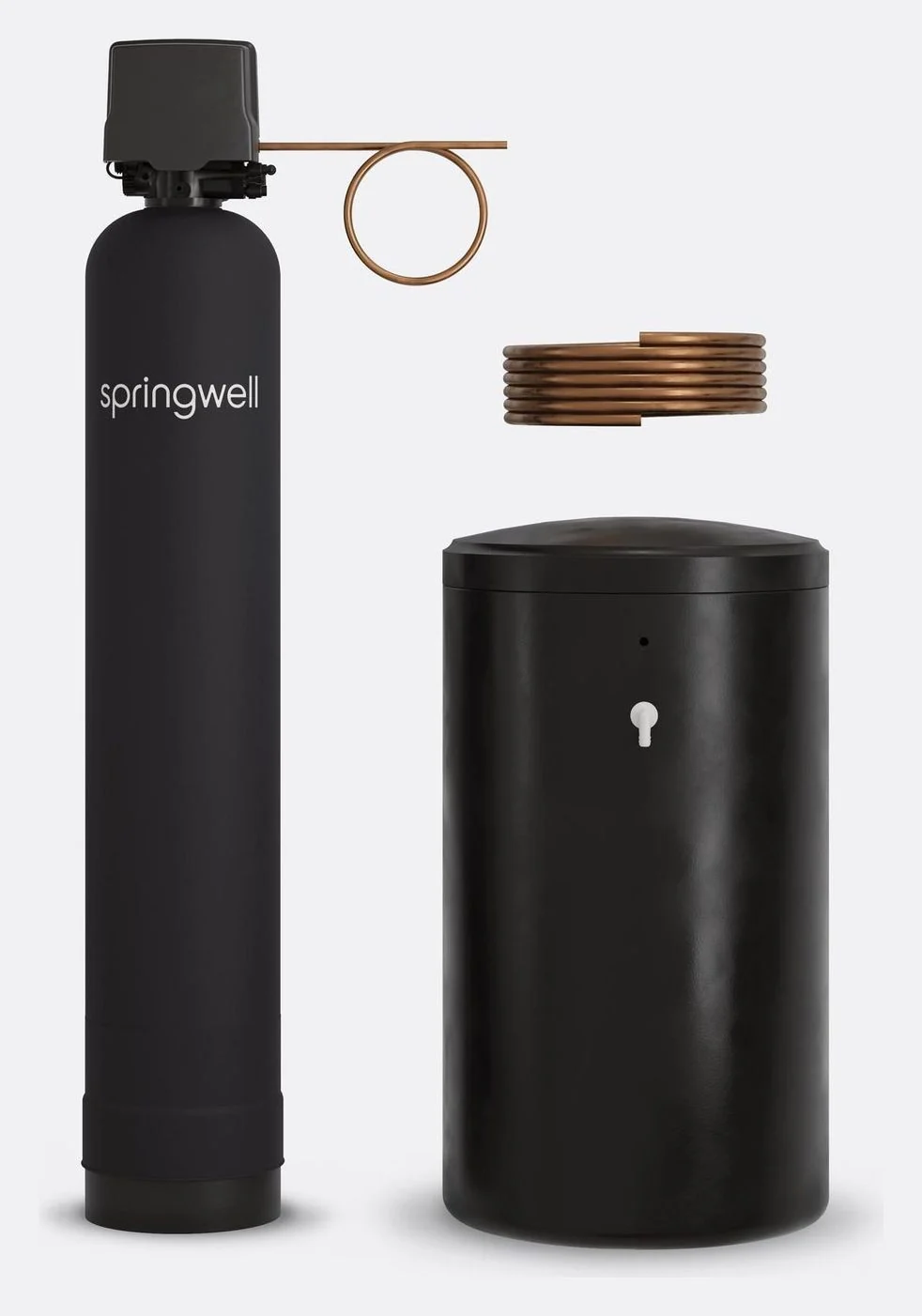
SpringWell
SpringWell SS1 Salt Based Water Softener
Best for: Homes with 1 to 3 bathrooms on hard city water that want true ion-exchange softening at a factory-direct price
- Grain capacity
- 32,000
- Service flow
- 11 GPM
- Bathrooms
- 1 to 3
- Tank
- 9" × 48" (57" with head)
- Connection
- 1"
- Brine tank
- 18" × 33" round (~200 lb salt)
On a tighter budget: the 32,000-grain Rheem RHS32 ($489 at Home Depot as of Aug 28, 2026) covers small homes, and the 44,000-grain Whirlpool WHES44 ($619 at Lowe's, same date) is the big-box pick for larger households. Both carry 1-year warranties against SpringWell's lifetime tank coverage.
Capacity is one of seven questions that decide the right system. The quiz asks all seven and shows its reasoning.
Take the 60-second quizHow Do You Calculate Water Softener Size?
Multiply the people in your home by 75 gallons per day, the standard consumption figure the water treatment industry sizes against. Multiply that by your water hardness in grains per gallon, then by 7 days. The result is your weekly softening load, and your softener's grain capacity has to cover it between regenerations.
A family of 4 on 12 gpg water carries a 25,200-grain week, which lands squarely on a 32,000-grain unit. The same family at 20 gpg needs 48,000. The full reasoning lives in our guide to what size water softener you need.
Where Do I Find My Water Hardness Number?
City water customers can read it off their utility's annual water quality report, usually stated in ppm or mg/L as CaCO3. Divide by 17.1 to get grains per gallon. Per USGS classification, anything over 121 ppm (about 7 gpg) counts as hard, and over 180 ppm as very hard.
Well owners need a test, because hardness and iron vary well to well. Our water hardness hub explains the units, and the signs of hard water guide covers what those numbers feel like at the tap.
Why Does the Calculator Add Capacity for Iron?
Dissolved iron binds to the same resin that captures calcium and magnesium, so the industry sizes for it with a standard correction: add 3 gpg of compensated hardness per 1 ppm of iron. The calculator applies that rule automatically and tells you when your iron level calls for a dedicated iron filter instead, a common situation on private wells covered in our well water hub.
Once you have your capacity, the best water softeners ranking compares the systems at each size on dated prices, and the cost calculator estimates the 10-year bill.
Capacity numbers here are manufacturer specs. The sizing conventions (75 gallons per person, the 3 gpg iron rule, the regeneration margin) are the industry's, stated as such, not lab measurements of ours. Start at the water softeners hub if you are still deciding whether you need a softener at all.
Sizing questions, answered
What size water softener do I need for a family of 4?
At a typical hard-water reading of 10 gpg, a family of 4 uses about 21,000 grains per week (4 people x 75 gallons per day x 10 gpg x 7 days), which a 32,000-grain softener covers with a healthy regeneration margin. At 15 gpg or above, the same family crosses into 48,000-grain territory. Run your own numbers in the calculator above.
How do I convert ppm to grains per gallon?
Divide ppm (mg/L as CaCO3) by 17.1. For example, 171 ppm equals 10 grains per gallon. The calculator accepts both units and converts automatically.
Does iron in my water change the softener size I need?
Yes. The standard industry sizing rule adds 3 grains per gallon of compensated hardness for every 1 ppm of dissolved iron, because iron loads the same resin. Above roughly 3 ppm of iron, a dedicated iron filter ahead of the softener is the better setup.
Is a bigger water softener always better?
No. A heavily oversized softener regenerates too rarely, which can let the resin bed foul, and you pay more upfront for capacity you never use. Sizing so the unit regenerates about once a week at around 75% of rated capacity is the common industry convention this calculator applies.
What do grain capacity numbers like 32,000 or 48,000 actually mean?
Grain capacity is how many grains of hardness minerals the resin can capture between regenerations. A 32,000-grain unit can remove 32,000 grains of hardness before it must rinse itself with brine. Your weekly load, people x water use x hardness, tells you which capacity fits.