Salt-Free Water Softeners: Scam or Legit? The Complete Guide
Salt-free water softeners cut scale by over 88% in independent testing yet remove zero grains of hardness. The TAC chemistry, verdicts, and 3 top picks.
By Home Water Lab TeamUpdated Prices verified Oct 7, 2026
This page contains affiliate links; buying through them costs you nothing extra.
Salt-free water softeners are not a scam, but they are badly named. In the most rigorous independent evaluation to date, run for the WateReuse Research Foundation by Arizona State University, template assisted crystallization (TAC) prevented more than 88% of scale buildup. What no salt-free system does is soften.
The short answer
as of Aug 30, 2026Do salt-free water softeners actually work?
Yes for scale, no for softening, and that distinction is the entire story. In the WateReuse Research Foundation evaluation run by Arizona State University, template assisted crystallization prevented more than 88% of scale, the best result of any salt-free technology tested. But nothing is removed: measure your hardness before and after and the number is identical, so soap still will not lather and glasses still spot. Buy one to protect a water heater and your pipes, not to get soft water.
Measure your water's hardness before and after one of these systems and the number is the same. Every disappointed one-star review and every "scam" thread comes down to that one mislabeled word. This guide walks through the chemistry, the honest results, and the three systems actually worth buying. If what you actually want is soft water, you want ion exchange instead, and the water softener systems hub is the right starting point.
What you hear
Salt-free water softener: softens your water without salt.
What the numbers say
It is a scale conditioner. TAC media crystallizes hardness so it stops sticking, cutting scale by over 88% in the WateReuse evaluation, but the calcium and magnesium stay in the water and your hardness test reads the same number after treatment.
Key takeaways
- TAC cut scale by more than 88% in the WateReuse Research Foundation evaluation, the best salt-free result tested.
- Measured hardness does not change: your gpg reading is identical before and after treatment.
- Plug-in electromagnetic descalers measured around 50% in that same study, roughly half of TAC.
- The SpringWell FutureSoft requires 0 ppm iron, 0 ppm manganese and pH 7.0 to 9.5, limits most wells fail.
- Installed, HomeGuide 2026 puts salt-free at $1,500 to $4,500 against $1,200 to $3,800 for salt-based.
Is a Salt-Free Water Softener a Scam or Legit?#
Legit, with an asterisk the marketing departments hope you skip. A salt-free "softener" is a scale conditioner: it changes how hardness minerals behave so they stop cementing themselves to your pipes, water heater, and fixtures. It does not remove those minerals.
The industry term is honest, the retail label is not, and both major manufacturers admit it in their own copy. SpringWell's FutureSoft page states the system "won't make water feel slick or stop spotting the way salt does." Aquasana's SimplySoft fine print says it does not need to remove hard minerals, which is another way of saying your hardness reading stays exactly where it was.
So the two common claims online are both wrong. "They do nothing" is false: the scale reduction is real and independently measured. "They soften without salt" is also false: nothing is softened. Buy one for the right reason and it is a genuinely low-maintenance piece of equipment. Buy one expecting soft water and you will join the refund queue, which is what our 10 signs of hard water page is really describing: symptoms a conditioner leaves untouched.
What Is the Difference Between a Softener and a Conditioner?#
One removes hardness, the other rearranges it. That single sentence decides which product belongs in your utility room, and it also explains why the cheaper-looking option is not actually cheaper.
Ion exchange, step by step
- Hardness arrivesCalcium and magnesium are the two ions the industry calls hardness. They are dissolved, not suspended, so no filter screen can catch them.
- The resin bedPolymer beads whose exchange sites are pre-loaded with sodium. The resin grips calcium and magnesium far harder than it grips sodium, and that difference in affinity is the whole trick.
- The trade, one for twoEvery calcium ion that sticks releases two sodium ions, because one Ca2+ carries the charge of two Na+. Nothing is strained out: hardness is swapped, ion for ion.
- Until the beads fill upSites are used up from the inlet end toward the outlet. When that front reaches the outlet, hardness starts to break through and the control valve runs a regeneration.
The swap runs both ways, which is why a bed saturated with hardness can be recharged with nothing more concentrated than salt water. A softener does not consume its resin, it rents it out and takes it back every few days.
A salt-based softener removes hardness through ion exchange. Hard water passes through a bed of resin beads charged with sodium ions; calcium and magnesium swap places with the sodium and stay behind on the resin. The result is measurably soft water: hardness near zero, soap that lathers, no spotting, and the slick shower feel people either love or hate. The trade is real maintenance: bags of salt, a regeneration cycle that uses water and a drain, and electricity for the control head.
A salt-free conditioner leaves the minerals in the water and changes their form instead. No salt, no drain, no regeneration, no electricity. Scale prevention is high, but every downstream effect of dissolved minerals (spotting, soap scum, the hard-water feel) continues. The technologies behind that word differ more than the marketing suggests, and we separate TAC from magnetic and electronic claims in our guide to water conditioners.
Salt-based softener
- Removes calcium and magnesium by ion exchange
- Hardness drops to near zero on a test strip
- Needs salt, a drain line and an outlet
- $1,200 to $3,800 installed (HomeGuide, 2026)
Salt-free conditioner (TAC)
- Crystallizes hardness so far less scale sticks
- Hardness reading is unchanged after treatment
- No salt, no drain, no power, no wastewater
- $1,500 to $4,500 installed (HomeGuide, 2026)
Bottom line
Conditioners cost more installed on published 2026 ranges and do less to the water. Buy one for scale protection where brine is restricted or where zero maintenance is the priority, not because it looks like the cheaper softener.
If the distinction is what decides your purchase, our salt-based versus salt-free head-to-head runs the full decision tree, and how to fix hard water places both on the wider ladder of options.
How Does a Salt-Free Water Softener Work?#
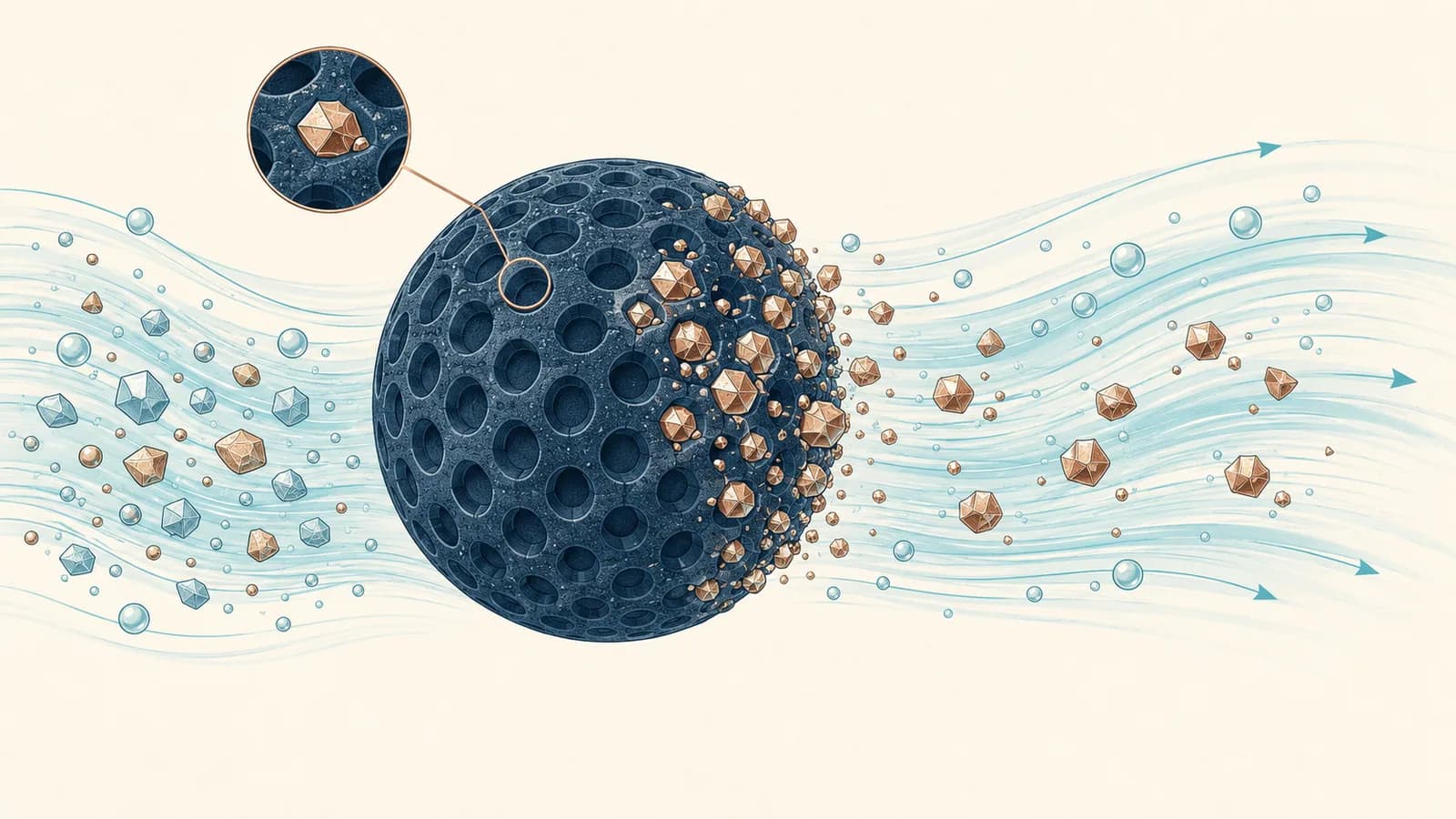
The dominant technology is TAC, template assisted crystallization. The media inside the tank is coated with microscopic nucleation sites, the "templates." As water flows past, dissolved calcium and magnesium attach to those sites and grow into microscopic crystals. Once a crystal reaches size, it detaches and rides along in the water as a stable, inert particle. Scale forms when dissolved minerals precipitate onto hot surfaces; minerals that have already crystallized have far less tendency to stick. The water carries them through the house and down the drain.
The engineering consequences are what make TAC attractive:
- No electricity and no drain line. SpringWell's FutureSoft runs upflow with no backwash cycle at all.
- No consumables on tank systems. FutureSoft media is rated for 3 to 5+ years. Cartridge-based systems like Kind's trade tank media for a yearly cartridge swap.
- No wastewater and no brine discharge, which is why conditioners remain legal where brine-discharging softeners are restricted.
What Does the Science Actually Say?#
One study carries this entire category, and it is worth knowing its name because most product pages quote its number without citing it. TAC came out on top at over 88% scale reduction; the plug-in gadgets came in at roughly half that.

The reference study is "Evaluation of Alternatives to Domestic Ion Exchange Water Softeners," WateReuse Research Foundation project 08-06, led by principal investigator Peter Fox, Ph.D., of Arizona State University, with cosponsorship from the U.S. Bureau of Reclamation and the California State Water Resources Control Board. It was presented in 2011 and published in 2014.
Over 88%
When Kind Water Systems advertises "up to 88%" scale reduction, that figure traces back to this study; cite the study, not the brand.
Some secondhand articles credit the University of Arizona. The project page and the published authors say Arizona State University.
One caution on reading vendor spec sheets: SpringWell claims FutureSoft prevents "up to 95%" of scale. That is a manufacturer figure, not a result from the WateReuse study, and we present it as such. How we separate the two is set out in our review methodology.
What Results Should You Expect? (And Not Expect)#
Less scale, same water. After installing a TAC conditioner on city water within its operating limits, here is the honest scorecard:
- Expect dramatically less new scale inside water heaters, tankless heat exchangers, and pipe runs. This is the entire value of the product.
- Expect existing scale to stop compounding. Some owners report gradual softening of old deposits; treat that as a bonus, not a promise.
- Do not expect a lower hardness test. Grains per gallon in, grains per gallon out.
- Do not expect the slick shower feel, easier lathering, or the end of water spots. SpringWell says so in its own product copy, and Aquasana notes calcium spotting on glass and fixtures can still occur.
- Do not expect it to fix iron staining, sulfur smell, or chlorine taste. Those are separate problems with separate equipment: chlorine and chloramine belong to a whole house filter, and iron actually disqualifies most TAC systems entirely.
If spotting and feel are your main complaints, stop here: only ion exchange fixes those, and no conditioner on this page will. If scale is the enemy, keep going.
Do Electronic Descalers Work?#
Partly, and far less than TAC. The same WateReuse study answered this too, and it is the part the gadget sellers never quote.
If you are going salt-free to protect a water heater you paid four figures for, the measured difference between 50% and 88-plus percent is what your money is actually buying.
How Do You Maintain a Salt-Free System?#
This is the category's quiet superpower, and it splits by design:
- Tank TAC systems like the SpringWell FS1 have no moving parts, no power, no drain, and media rated for 3 to 5+ years. There is nothing to schedule and nothing to buy in a normal year.
- Cartridge systems like the Kind E-3000 trade that for a once-a-year swap: about 15 minutes of work and roughly $124 per year in cartridges on Kind's subscription pricing (reading of Aug 28, 2026).
- Aquasana's SimplySoft advertises zero active maintenance: no salt, power, drain, or backflush.
Compare that with a salt-based system, where the monthly salt routine never stops. The one maintenance rule that actually matters here is upstream: keep the feed water inside spec. Iron, manganese, or hydrogen sulfide reaching TAC media degrades it, which is why the well-water warning below is not fine print.
SpringWell FutureSoft feed-water limits to clear before buying
6 items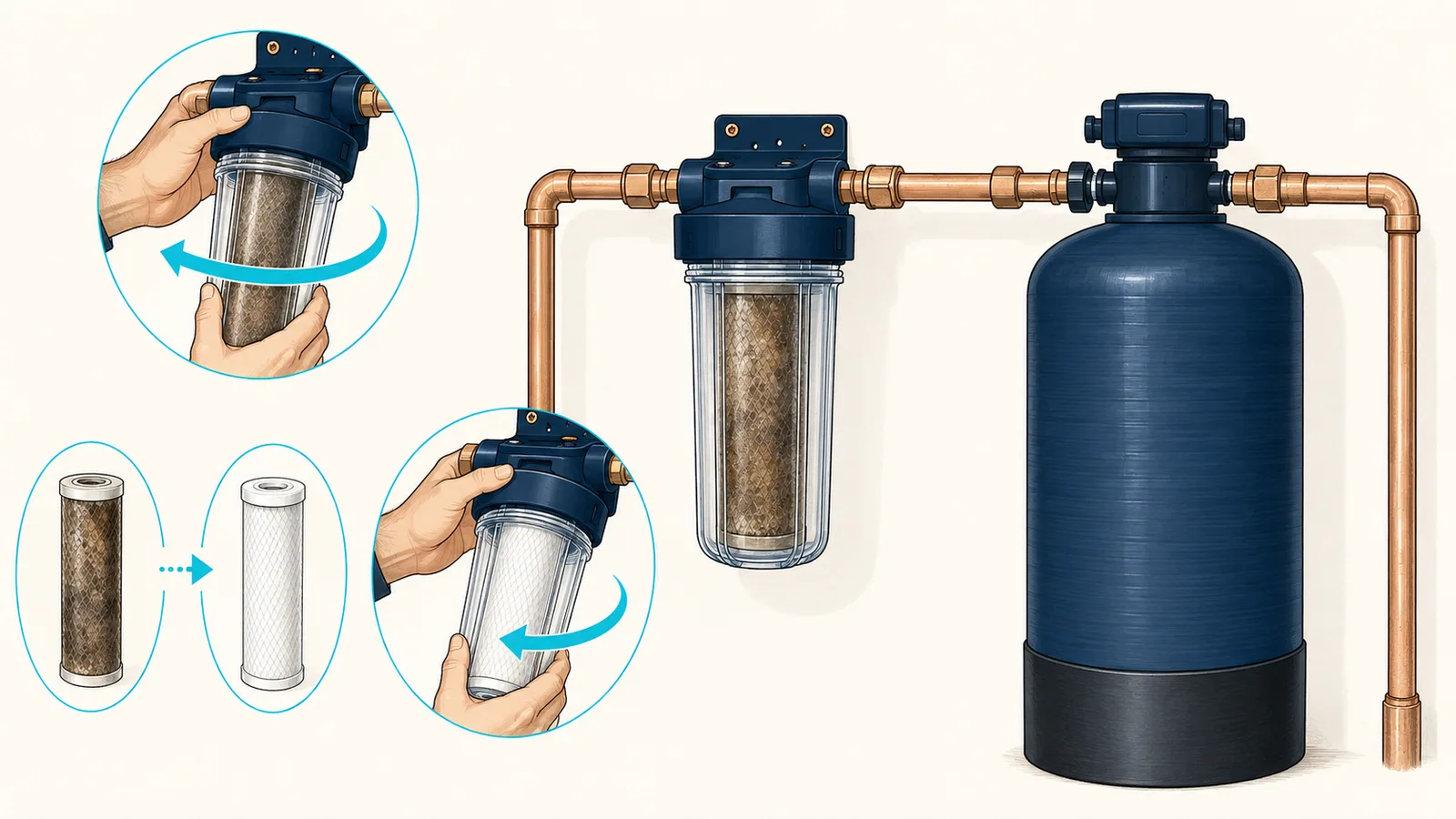
When Is a Salt-Free System the Right Choice?#
Four situations make a conditioner the rational pick, and none of them is "I want soft water for less money."
- Brine-discharge restrictions. California's AB 1366 (2009) authorizes local agencies to restrict self-regenerating salt softeners, and districts have used it. Santa Clarita banned new installations back in 2003, and its Measure S (2008) required existing units removed by mid-2009. Similar rules exist in parts of the Inland Empire and other California districts. Where brine is banned, TAC is the whole-house option that remains.
- Septic systems and drain-free locations. No regeneration means no brine load on a septic field and no drain plumbing at the install point.
- Scale-focused owners on moderate hardness. If your goal is protecting a tankless water heater on 8 to 15 gpg city water and you do not care about feel, a conditioner does that job with zero upkeep. Check what band you are in with our hardness lookup first.
- Set-and-forget preference. No salt bags, no settings, and on tank systems like the FutureSoft, no annual costs at all for years.
When Should You Buy a Real Softener Instead?#
- You want soft water, not just less scale. Only ion exchange delivers the measurable change. See our ranking of current softeners for the field, and the SS1, SS4 and SS+ teardown for the system most often cross-shopped against the FutureSoft.
- Your water is on the extreme end. SpringWell rates FutureSoft to a remarkable 81 gpg, but the harder the water, the more the untouched minerals still show up on every surface. Buyers at 25+ gpg expecting visible results are the core of the disappointed-review demographic. The sizing calculator shows what capacity that hardness would need in a real softener.
- You are on a well with iron or sulfur. The checklist above is the screen, and most wells fail it. Start at the well water treatment guide to sequence the equipment correctly, or diagnose your water from scratch at the hard water hub.
Which Salt-Free Systems Are Worth Buying?#
Three systems clear the credibility bar: the SpringWell FutureSoft FS1 on build and warranty, the Kind E-3000 when you want filtration bundled in, and the Aquasana SimplySoft as the cheap way in. The full ranked list with more budget options lives in the best salt-free water softener roundup.
SpringWell
FutureSoft FS1
- Technology
- TAC (Template Assisted Crystallization)
- Flow rate
- 12 GPM
- Bathrooms
- 1 to 3
- Tank
- 6" × 35"
- Max hardness
- 81 GPG
- Scale prevention
- Up to 95% (manufacturer claim)
- Operation
- Upflow, no electricity, no drain, no backwash
- Media life
- 3 to 5+ years
- Type
- N/A
- Maintenance
- N/A
- Capacity
- N/A
Kind Water Systems
Kind E-3000
- Technology
- TAC, no electricity, no wastewater, no salt
- Flow rate
- N/A
- Bathrooms
- N/A
- Tank
- N/A
- Max hardness
- N/A
- Scale prevention
- N/A
- Operation
- N/A
- Media life
- N/A
- Type
- Whole-house filter + TAC salt-free conditioner combo (best seller)
- Maintenance
- Yearly cartridge replacement (~15 minutes)
- Capacity
- N/A
Aquasana
SimplySoft
- Technology
- SCM (Scale Control Media)
- Flow rate
- 7.0 GPM nominal / 15.3 GPM peak
- Bathrooms
- N/A
- Tank
- N/A
- Max hardness
- N/A
- Scale prevention
- N/A
- Operation
- No salt, no electricity, no drain, no backflush
- Media life
- N/A
- Type
- N/A
- Maintenance
- N/A
- Capacity
- 1,000,000 gallons / 10 years
Prices checked Oct 9, 2026.
SpringWell FutureSoft FS1 is the reference pick: true TAC media rated for 3 to 5+ years with no consumables, 12 GPM service flow, an 81 gpg hardness rating, and a lifetime warranty on tank and media. The catch is the strict feed-water requirement above and a price near the top of the category. Our full FutureSoft review covers the fine print, including SpringWell's return policy.
Kind Water Systems E-3000 bundles a whole-house filter with a TAC conditioner in one wall-mounted unit. Maintenance is a roughly 15-minute yearly cartridge swap at about $124 per year, which makes it the pick for HOA-constrained homes that also want chlorine filtration. It is a young brand (in business since 2021, per its BBB profile), so the service track record is short.
Aquasana SimplySoft is the budget door into the category at $879 as of Sep 12, 2026, with the same honest limitation printed on its own page: it does not reduce hardness. Its 7 GPM nominal flow suits smaller homes, and Aquasana's Trustpilot score sat at 1.5 out of 5 across 170 reviews as of Aug 28, 2026, a service-reputation discount you should price in.
How Much Does a Salt-Free System Cost?#
Equipment runs from $879 to about $2,094.10, and installation adds $300 to $1,500 on top of any of them. The running costs are where conditioners genuinely win, because there is no salt to buy.
Ten years of ownership
as of Aug 28, 2026- EquipmentBig-box is the middle of Angi's 2026 range for a 48,000-grain unit, $600 to $1,200. Factory-direct is SpringWell's SS1 at $1,606.50. The dealer column is a Culligan system installed, middle of $1,800 to $6,500.
- Installation$900, the middle of the $300 to $1,500 a plumber charges in the 2026 Angi, HomeGuide and Fixr guides. Doing it yourself takes this line to zero. Dealer quotes already contain it.
- Salt, ten years$100 a year, the middle of HomeGuide's 2026 range of $50 to $150, times ten. Hard water and a thirsty household push this to the top of the range.
- Regeneration water, ten years$20 a year on city water, the middle of $10 to $30, times ten. On a private well the water itself costs nothing, so this line disappears.
Equipment prices read Sep 21, 2026 (SpringWell SS1 $1,606.50, SpringWell FS1 $1,785, Aquasana SimplySoft $879 under a half-off banner, $1,758 at list). Installation is $900, the middle of the $300 to $1,500 professional range in the Angi, HomeGuide and Fixr 2026 guides, which applies across system types. Salt is $100 a year and regeneration water $20 a year, the middles of HomeGuide's 2026 ranges, times ten. Media cartridges on cartridge-based conditioners are not in this chart; the water conditioner cost guide carries them.
Equipment runs from $879 (Aquasana SimplySoft, on sale) through $1,785 (SpringWell FS1) to $2,094.10 (Kind E-3000), all as of Sep 12, 2026. Installed, HomeGuide's 2026 guide puts salt-free systems at $1,500 to $4,500, against $1,200 to $3,800 for salt-based ion exchange. The install itself is simpler than a softener's (no drain line, no power outlet), and professional installation across system types runs $300 to $1,500 per Angi, HomeGuide, and Fixr 2026 data. Dealer-installed systems sit above that band, and our breakdown of what Culligan charges for its salt-free conditioner shows what its $3,000 to $3,500 quote range per Modernize does and does not include.
The running-cost math is where conditioners win. A salt-based system consumes $50 to $150 of salt per year plus $10 to $30 of regeneration water on city supply (HomeGuide and Angi, 2026). A FutureSoft consumes nothing for years; a Kind system consumes one cartridge set. The full 10-year breakdown lives in our water conditioner cost guide, and the softener cost pillar carries the same math for ion exchange if you are comparing the two totals.
The Verdict#
A salt-free water softener is a legitimate scale conditioner wearing a misleading costume. The chemistry works, the federal-cosponsored testing backs it, and the maintenance story is the best in water treatment. Just buy it for what it does: keeping minerals from sticking, not removing them.
Frequently asked questions
Do salt-free water softeners really work?
For scale prevention, yes. An independent evaluation run for the WateReuse Research Foundation by Arizona State University found template assisted crystallization (TAC) reduced scale by more than 88 percent, the best result of any salt-free technology tested. For softening, no: the calcium and magnesium stay in the water, and a hardness test reads the same before and after.
How does a salt-free water softener work?
TAC media is coated with microscopic nucleation sites. As hard water flows past, dissolved calcium and magnesium attach to those sites and form stable microcrystals that stay suspended in the water instead of sticking to pipes and heating elements as scale. Nothing is removed, no salt or electricity is used, and there is no drain line or wastewater.
Will salt-free conditioned water feel different?
No. SpringWell's own product page says its FutureSoft system won't make water feel slick or stop spotting the way salt does, and Aquasana's fine print states the SimplySoft does not reduce hardness. Expect less scale buildup inside pipes and appliances, not the soft-water feel, better soap lather, or spot-free glassware that a salt-based softener delivers.
Can I use a salt-free water softener on well water?
Usually not without pretreatment. The SpringWell FutureSoft spec sheet requires 0 ppm iron, 0 ppm manganese, 0 ppm copper, and 0 ppm hydrogen sulfide, with pH between 7.0 and 9.5. Most private wells fail at least one of those limits, which fouls TAC media. Well owners generally need iron treatment first, or a salt-based softener instead.
Why do some areas ban salt-based softeners?
Self-regenerating salt softeners discharge brine into the sewer, which complicates wastewater recycling. California's AB 1366 (2009) lets local agencies restrict them, and Santa Clarita went further: new installs were banned in 2003, and Measure S (2008) required existing units removed by mid-2009. In those districts, a salt-free conditioner is the practical whole-house option.
Published in this section
Best Water Conditioner 2026: Top Whole-House Systems Compared
Read the buyer's guide
Water Conditioners: The Complete Guide (Types, Costs, What They Really Do)
Read the guide
Best Salt-Free Water Softener 2026: Top 5 Systems That Actually Reduce Scale
Read the buyer's guide
Salt-Based vs Salt-Free Water Softener: Which One Should You Buy?
Read the head-to-head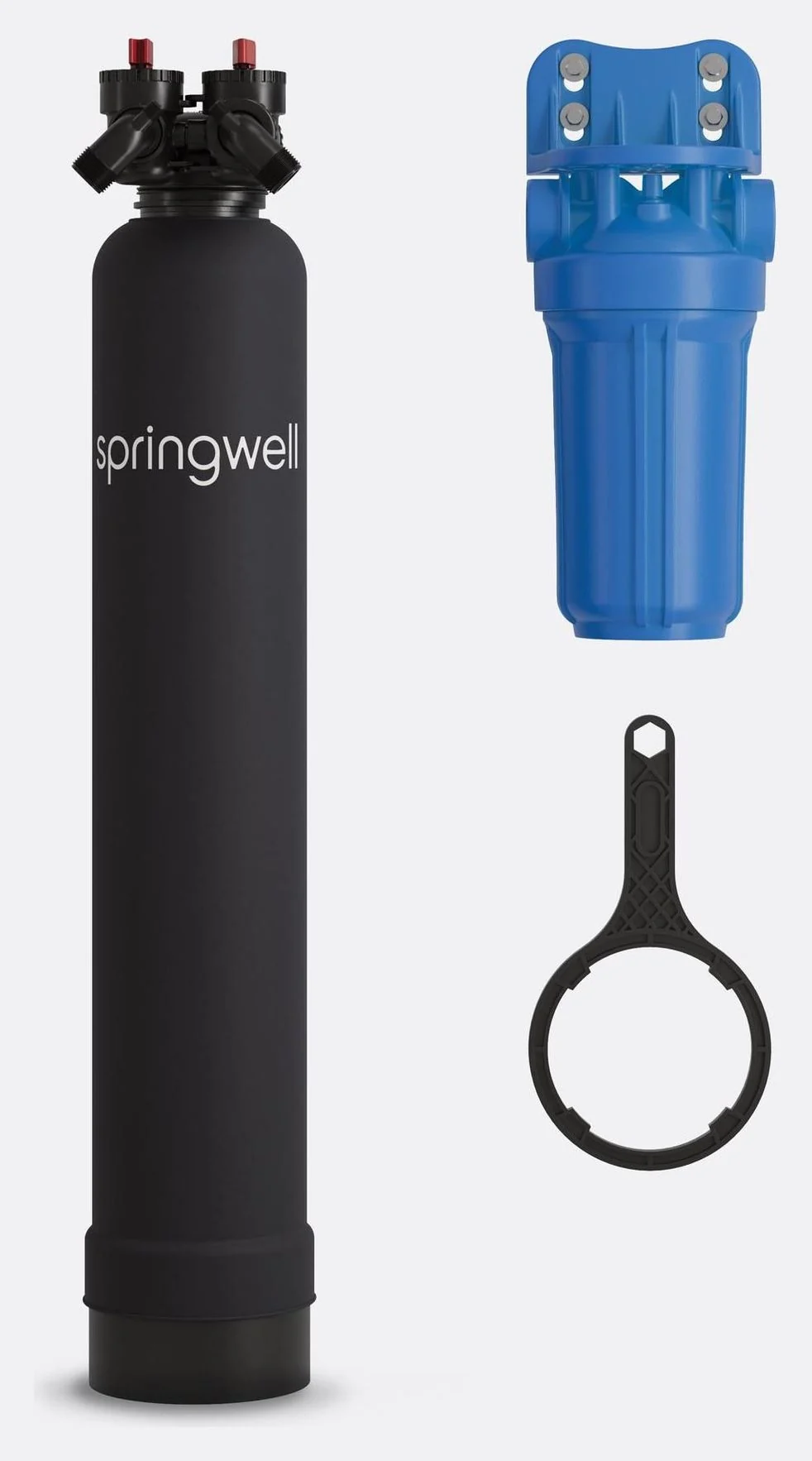
SpringWell FutureSoft Review 2026: The Salt-Free System Under the Microscope
Read the review
Water Conditioner Cost in 2026: Real Prices From $500 to $3,000
Read the cost breakdownKeep reading
Best Water Conditioner 2026: Top Whole-House Systems Compared
Read the buyer's guideWater Conditioners: The Complete Guide (Types, Costs, What They Really Do)
Read the guideBest Salt-Free Water Softener 2026: Top 5 Systems That Actually Reduce Scale
Read the buyer's guideNot sure what you need?
Answer 5 questions, get the right system for your water.
City or well, budget, household size, our quiz matches your answers against every system we track.