What Size Water Softener Do I Need? Calculator, Chart and Grain Guide
Multiply people by 75 gallons a day, by your hardness in gpg, by 7 days. That is your weekly grain load, and it picks your size. Chart, iron rule, traps.
By Home Water Lab TeamUpdated Prices verified Sep 12, 2026
This page contains affiliate links; buying through them costs you nothing extra.
Multiply the people in your home by 75 gallons a day, then by your water hardness in grains per gallon, then by 7 days. That number is your weekly grain load, and it picks your softener size. A family of four on 10 gpg water works out to 21,000 grains a week, which a 32,000 grain system handles with margin.
That is the whole method, and it is the same arithmetic the industry uses. It is also the one page on our water softener hub where getting the answer wrong costs you every month for a decade, in salt rather than in a single bad purchase.
The short answer
as of Aug 28, 2026What size water softener do I need?
People x 75 gallons per day x hardness in gpg x 7 days gives the grains your softener must remove between weekly regenerations. Buy the smallest capacity whose 75% usable figure covers that load. A family of four on 10 gpg water needs 21,000 grains a week, so a 32,000 grain unit fits with margin. Add 3 gpg for every 1 ppm of dissolved iron before you multiply.
Key takeaways
- The formula is people x 525 x gpg for a week. Everything else is margin rules.
- Use no more than 75% of a rated capacity between regenerations, so a 32,000 grain unit gives 24,000 usable grains.
- Iron loads resin like hardness: add 3 gpg per 1 ppm, and switch to a dedicated iron filter above about 3 ppm.
- Most American households land on 32,000 or 48,000 grains, far below what a dealer quote implies.
- Undersizing shows up on the salt bill every month; oversizing wastes salt per grain removed.

The rest of this guide covers what the formula does not say out loud: how iron changes the answer, which capacity fits which household at which hardness, and the two ways people get this wrong in opposite directions. If you would rather have the number computed for you, our sizing calculator runs the same formula with the iron correction built in.
21,000 grains
What Size Water Softener Do I Need?#
The formula has four terms, and only one of them has to be yours.
The sizing formula, term by term
Count the people, not the bathrooms
Softening load follows water used, and water used follows occupants. A 4-bathroom house with two people in it needs less capacity than a 2-bathroom house with six.Multiply by 75 gallons per person per day
The standard household water use figure the treatment industry sizes on. It is an assumption rather than a measurement of your house, and it is deliberately generous, so it builds margin in before any other rule does.Multiply by your hardness in grains per gallon
The only term that must be yours. One gpg equals 17.1 mg/L, so a lab report in mg/L divides by 17.1. Per the USGS classification, water above 121 mg/L (roughly 7 gpg) is hard and above 180 mg/L (roughly 10.5 gpg) very hard.Multiply by 7 days, then apply the 75% rule
A softener sized to regenerate about once a week is the efficient rhythm. Then buy the smallest capacity whose 75% usable figure clears your weekly load, because running a resin bed to its rated number is a lab condition, not a household one.
Do not size off symptoms. If you have no hardness number yet, start with your state's hardness data or the 10 signs of hard water, then confirm with a test strip. The unit conversions themselves are in hard water explained.
How Does Iron Change the Size You Need?#
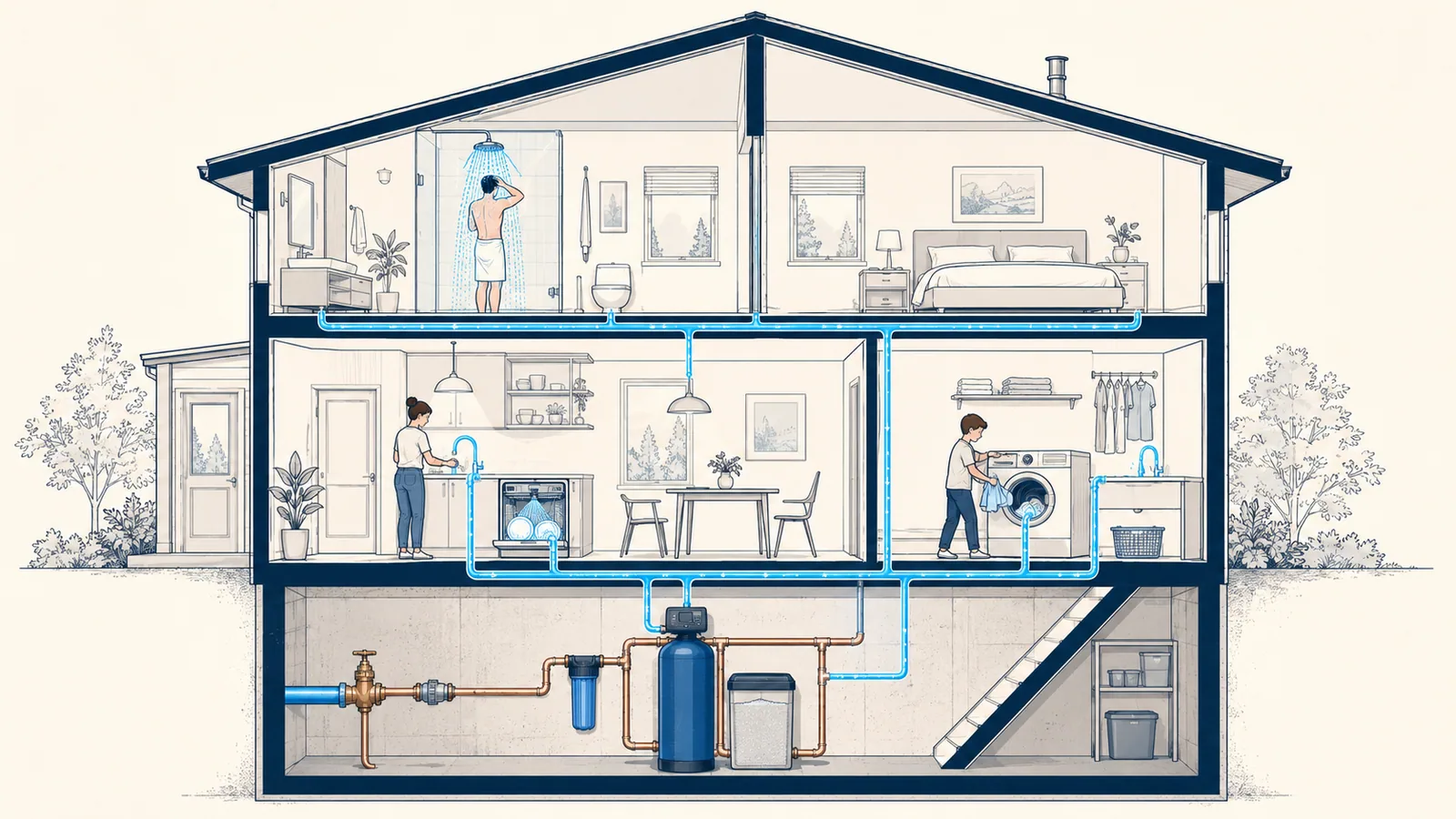
Dissolved iron loads the resin exactly like hardness does, so it has to be added before you multiply. The standard industry compensation rule adds 3 gpg for every 1 ppm of dissolved iron.
An example: 12 gpg water with 2 ppm of iron sizes like 18 gpg water, because 12 + (2 x 3) = 18. For a family of four that turns a 21,000 grain week at 10 gpg into a 37,800 grain week, which is the difference between a 32,000 grain unit and a 64,000 grain one.
What Size for Your Household and Hardness?#
The chart below applies the formula and the 75% usable capacity margin to every common combination. It is our arithmetic, not a manufacturer table, so you can check every cell yourself with people x 525 x gpg.
| Hardness | 2 people | 4 people | 6 people |
|---|---|---|---|
| 5 gpg | 32,000 grain | 32,000 grain | 32,000 grain |
| 10 gpg | 32,000 grain | 32,000 grain | 48,000 grain |
| 15 gpg | 32,000 grain | 48,000 grain | 64,000 grain |
| 20 gpg | 32,000 grain | 64,000 grain | Beyond a single tank |
| 25 gpg | 48,000 grain | 80,000 grain | Beyond a single tank |
Two readings of that chart are worth more than the cells themselves.
First, 32,000 grains covers far more American homes than the market implies. Two people at 20 gpg still fit it. That is the size big-box retail is built around, and Angi's 2026 capacity table prices a 32,000 grain unit at $400 to $1,000 for the machine alone against $800 to $1,500 at 64,000 grains. Buying capacity you will never use is one of the quiet ways a quote inflates, and it is the first thing to look for in our quote decoder.
Second, "beyond a single tank" is a real answer, not a failure. Six people on 20 gpg water carry 63,000 grains a week, past what an 80,000 grain unit delivers at a sane margin. That is twin-tank or commercial territory, and it is also the point where a water test for iron and manganese stops being optional. Our well water hub covers that end of the range.
Sizing, by the week
- The size to buyThe smallest tank whose usable capacity still covers a full week, so the unit recharges about weekly. That is the rhythm resin is happiest at.
- More than you needIt will work, but you paid for resin that never gets used, and a bed that sits idle for a fortnight can channel and lose efficiency anyway.
- The 25 percent held in reserveThe dark tail on every bar is rated capacity left deliberately unused. Running resin down to its last grain costs far more salt per grain removed, so the industry sizes to about 75 percent.
4 people x 75 gallons a day x 10.0 gpg hardness x 7 days = 21,000 grains between regenerations, against usable capacity capped at 75 percent of nominal. Change any of those assumptions and the recommended size moves.
Which Size Matches Which System?#
The market ladder mirrors the chart. SpringWell tiers its salt-based line in exactly these steps, which makes it the cleanest mapping to show.
SpringWell salt-based line, by capacity
as of Aug 28, 2026- SS1, grain capacity
- 32,000
- SS1, service flow / bathrooms
- 11 GPM / 1 to 3
- SS4, grain capacity
- 48,000
- SS4, service flow / bathrooms
- 13 GPM / 4 to 6
- SS+, grain capacity
- 80,000
- SS+, service flow / bathrooms
- 20 GPM / 7 or more
Specs read from the manufacturer's table on Aug 28, 2026. Note the gap: the line jumps from 48,000 straight to 80,000, so a 64,000 grain load buys the SS+ or a competitor's 64,000 grain unit.
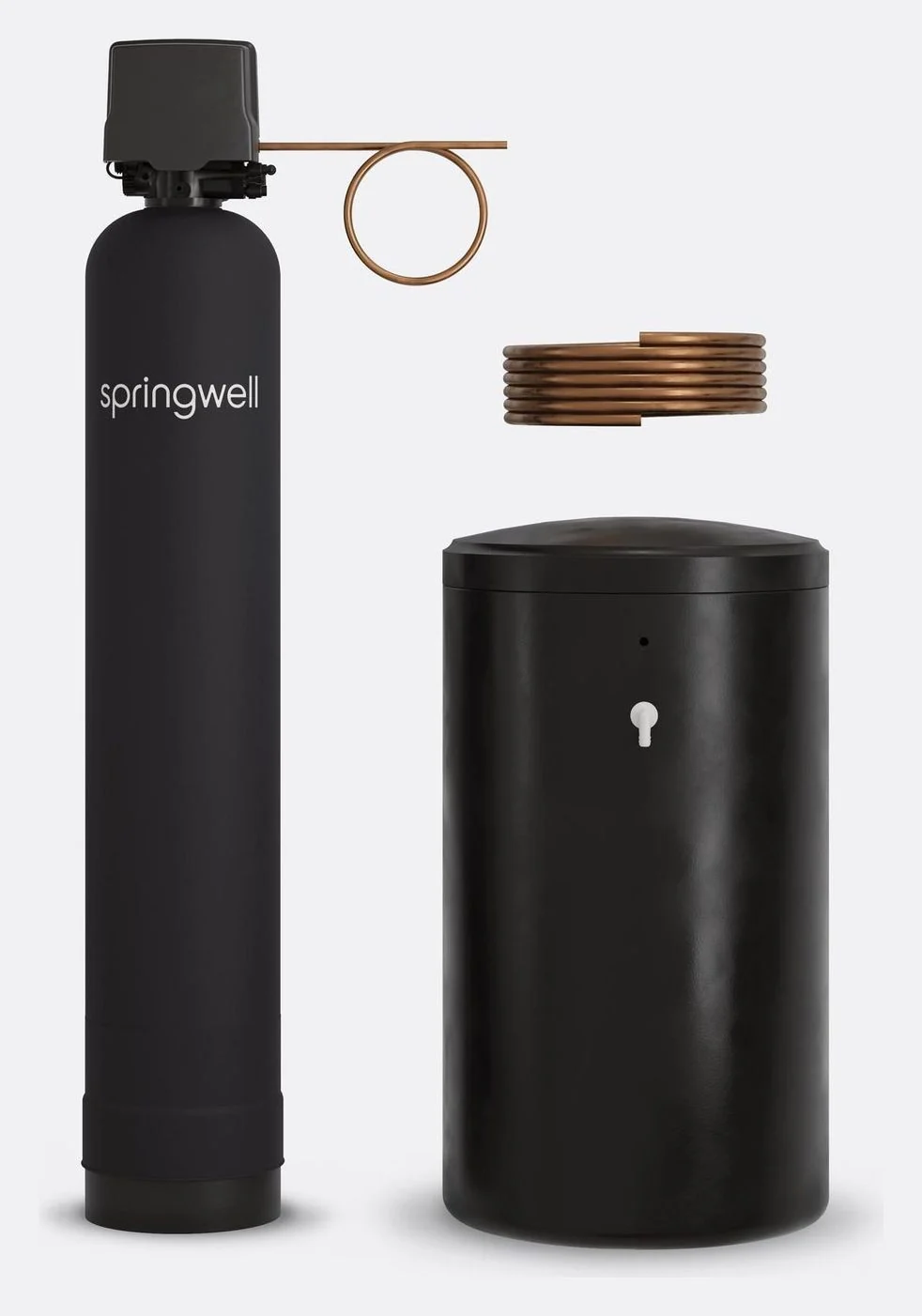
SpringWell
SpringWell SS1 Salt Based Water Softener
Best for: Homes with 1 to 3 bathrooms on hard city water that want true ion-exchange softening at a factory-direct price
- Grain capacity
- 32,000
- Service flow
- 11 GPM
- Bathrooms
- 1 to 3
- Tank
- 9" × 48" (57" with head)
- Connection
- 1"
- Brine tank
- 18" × 33" round (~200 lb salt)
The SS1 was $1,606.50 as of Sep 12, 2026, and it is the size most households in the chart above land on. The honest caveats before you click anything: that figure moved 6% in ten days and the SS line runs to $2,677.50 at the largest size, the electronic head is warrantied 5 years despite the lifetime marketing on the tank, and the price per grain is unfavorable against 48,000 grain competitors near $2,000. The full teardown is in our SpringWell softener review.
On a tighter budget the same capacities exist in the big-box aisle with 1 year warranties instead of lifetime tank coverage. The 32,000 grain Rheem RHS32 was $489 at Home Depot as of Aug 28, 2026, with a 7.9 GPM flow rate that is the real constraint on larger homes, examined in our Rheem RHS32 review. For the 48,000 grain row of the chart, the Whirlpool WHES44 brings 44,000 grains, 9 GPM and a 140 gpg hardness rating at $619 at Lowe's on the same date, with the warranty small print unpacked in our Whirlpool softener review.
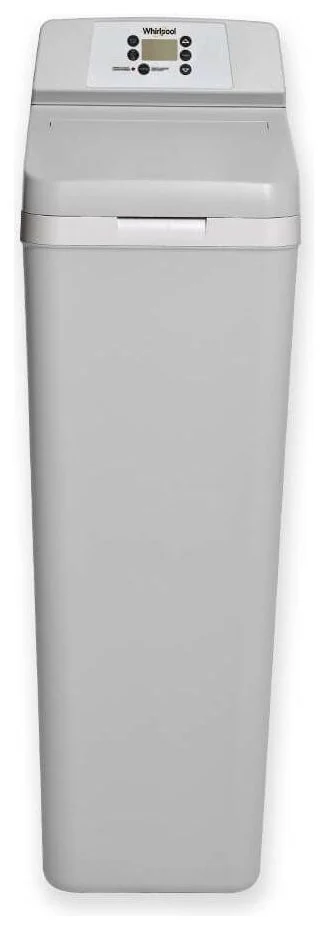
Whirlpool
Whirlpool WHES44 Water Softener (44,000 Grain)
Best for: Big families on a budget: the highest grain, hardness and iron ratings in the big-box aisle
- Grain capacity
- 44,000
- Flow rate
- 9 GPM
- Max hardness
- 140 GPG
- Iron reduction
- 12 PPM
- Retail
- Sold at Lowe's (machine not sold on Amazon, parts only)
What Goes Wrong When You Size It Wrong?#
Both mistakes cost money, in opposite ways, and only one of them announces itself.
Undersized
- Regenerates every night or every other night instead of weekly
- Salt and water spent on every extra cycle
- Hard water at the tap during each regeneration on a single-tank unit
- More valve wear, so the machine ages faster too
Oversized
- Bed sits loaded for two or three weeks between cycles
- Salt spent per grain removed gets worse, not better
- Risk of channeling: water carves paths through the resin instead of contacting all of it
- You paid for capacity that never does any work
Bottom line
Undersizing is the common mistake and the loud one. Oversizing is the expensive one nobody notices, because nothing about it looks broken.
Our salt guide covers what those extra cycles actually cost you per year, and the monthly check that catches an unhealthy regeneration rhythm is in the maintenance checklist.
There are two legitimate reasons to take the next size up: your hardness is at the top of a band and likely to be measured higher on another day, or your household is about to grow. "To be safe" is not one of them.
How Do You Get Your Hardness Number?#
Three routes, cheapest first. On city water it is free, on a well it is the only responsible option.
- City water, free: your utility's annual Consumer Confidence Report lists hardness, and a state page is the fastest way to a starting figure. Arizona, for instance, sits in the very hard band statewide.
- Any water, a few dollars: hardness test strips give a usable gpg reading in about a minute.
- Well water, thorough: a state-certified lab test, which also returns iron and manganese in ppm. On a well those two numbers change the answer more than hardness does.
USGS hardness bands
- Soft, 0 to 60 ppm0 to 3.5 gpg. No scale problem. A softener solves nothing here.
- Moderately hard, 61 to 120 ppm3.6 to 7.0 gpg. Spotting and light scale. Treatment is optional, not urgent.
- Hard, 121 to 180 ppm7.1 to 10.5 gpg. Scale in the water heater, soap that will not lather, film on the glassware.
- Very hard, over 180 ppmOver 10.5 gpg. Appliance territory: scale builds fast in anything that heats water, and it shortens the life of the thing doing the heating.
USGS classification of hardness as calcium carbonate, where 1 grain per gallon = 17.1 mg/L. A statewide or citywide figure is a wide typical range, never a reading at your address: the USGS says its national map is not built for decisions at the scale of one property. A test strip settles it in two minutes.
Before you order a capacity
5 itemsThen run your figure through the calculator linked at the top of this page: same formula, same iron rule, same 75% margin, capacity named at the end.
The size to order#
Size on arithmetic, not on bathrooms and not on a salesperson's table. People x 75 x gpg x 7 gives the weekly load; pick the smallest capacity whose 75% usable figure covers it; add 3 gpg per ppm of iron first, and switch to an iron filter past about 3 ppm. Most American households land on 32,000 or 48,000 grains, a far cheaper conclusion than a dealer quote implies.
The ranked picks are in our best water softeners guide, and the money side, capacity by capacity, is in the price guide by type and size.
Frequently asked questions
What size water softener do I need for a family of 4?
On 10 grains per gallon water, a family of four carries about 21,000 grains a week (4 people x 75 gallons x 10 gpg x 7 days), and a 32,000 grain softener covers that comfortably. Push the hardness to 15 gpg and the same family needs 31,500 grains a week, which moves you to 48,000 grains. The household size alone never answers the question: your hardness number does half the work.
How do I calculate what size water softener I need?
People in the home, times 75 gallons per person per day, times your hardness in grains per gallon, times 7 days. That is the grain load your softener has to remove between weekly regenerations. Add 3 gpg to your hardness for every 1 ppm of dissolved iron before you multiply, which is the standard industry compensation rule.
Is a 48,000 grain water softener too big for a small house?
For two people on moderately hard water, yes, and oversizing is not free. A bed that regenerates every two or three weeks instead of weekly sits idle between cycles, and the salt you spend per grain removed gets worse, not better. Size for a roughly weekly regeneration and buy the next size up only for the documented reasons in this guide.
Does iron change the size of water softener I need?
Yes. The standard industry rule adds 3 gpg of compensated hardness for every 1 ppm of dissolved iron, so 2 ppm of iron on 12 gpg water sizes like 18 gpg water. Above roughly 3 ppm, a softener is the wrong tool for the iron: put a dedicated iron filter ahead of it so the resin is not doing a job it was not built for.
What happens if my water softener is too small?
It regenerates constantly. Every regeneration costs salt, costs water, and hands you hard water for the duration of the cycle on a single-tank system, so an undersized unit is both more expensive to run and worse at its job. Undersizing is the more common mistake, and it is the one that shows up on your salt bill every month.
Why do sizing charts use 75 gallons per person per day?
It is the standard household water use figure the water treatment industry sizes on, and it is deliberately generous. Real US household use per person is often lower, so sizing on 75 builds margin into the answer before the 75% usable capacity rule adds more. It is an assumption, not a measurement of your house.
Keep reading

Not sure what you need?
Answer 5 questions, get the right system for your water.
City or well, budget, household size, our quiz matches your answers against every system we track.