Hard Water: Signs, Damage, and How to Fix It
Hard water starts at 7 gpg on the USGS scale and can cut water heater efficiency up to 48%. Every sign, the real damage costs, and the fixes from $10 up.
By Home Water Lab TeamUpdated Prices verified Oct 7, 2026
This page contains affiliate links; buying through them costs you nothing extra.
Hard water is water carrying a heavy load of dissolved calcium and magnesium, and per the U.S. Geological Survey classification it officially turns "hard" at 121 mg/L, about 7 grains per gallon. It is perfectly legal, the EPA does not regulate hardness, and it is quietly expensive: an industry-funded but independently run Battelle study found hard water can cut a gas water heater's efficiency by up to 48% over its lifetime.
The short answer
as of Aug 30, 2026What counts as hard water, and what does it cost you?
Water is officially hard above 7 grains per gallon (121 mg/L) and very hard above 10.5 gpg (180 mg/L), per the USGS classification. It is not a health risk, but it is an equipment tax: the Battelle study for the Water Quality Research Foundation measured roughly 4% water heater efficiency lost per 5 gpg, up to 48% across a gas heater's life, and tankless heaters clogging in about 1.6 years on 26 gpg water. The fix ladder runs from a $10 test strip to a salt-based softener at $1,000 to $3,000 installed.
Here is how to recognize it, what it actually costs you, and every fix from that test kit up to a whole-house system. If you already know your number and just want the equipment, jump straight to the water softener systems guide; if you do not, our hardness lookup by ZIP code is the fastest first estimate.
Key takeaways
- Hard starts at 7 gpg (121 mg/L) and very hard at 10.5 gpg (180 mg/L), per the USGS classification.
- Gas water heaters lose about 4% efficiency for every 5 gpg of hardness, up to 48% over a lifetime (Battelle for the WQRF).
- Tankless heaters on 26 gpg water clogged in roughly 1.6 years of equivalent use in the same testing.
- Only ion exchange removes hardness. Conditioners cut scale, carbon filters do nothing to it.
- A $10 test strip decides everything else: below 3.5 gpg, treatment rarely pays.
What Is Hard Water?#
Rain falls soft. Everything after that is geology: groundwater picks up calcium and magnesium from the rock it passes through, and how much it picks up decides how hard your tap water is.
As groundwater moves through limestone, chalk, and gypsum, it dissolves those minerals and carries them into wells, aquifers, and municipal supplies. The more mineral-rich the rock under your region, the harder your water. That makes hardness a geography problem: USGS surveys have found hard or very hard water across most of the United States, with the hardest belt running through the Midwest, the Great Plains, and the Southwest. Two houses in different counties can have wildly different water from the same kind of source, which is why our state-by-state pages exist: Arizona and Indiana sit in the very hard band while Maine runs soft.
What you hear
My water is fine, the city tests it every year.
What the numbers say
The EPA sets no limit on hardness and treats it as an aesthetic matter, so a utility can report fully compliant water at 20 gpg. Hardness is the one water problem your city will never fix for you.
How Is Water Hardness Measured?#
In two units that describe the same thing. Labs and city reports use mg/L (identical to ppm), the water treatment industry uses grains per gallon, and the conversion between them is fixed. Get your number in gpg, because that is the unit every piece of equipment is sized in.
USGS hardness bands
- Soft, 0 to 60 ppm0 to 3.5 gpg. No scale problem. A softener solves nothing here.
- Moderately hard, 61 to 120 ppm3.6 to 7.0 gpg. Spotting and light scale. Treatment is optional, not urgent.
- Hard, 121 to 180 ppm7.1 to 10.5 gpg. Scale in the water heater, soap that will not lather, film on the glassware.
- Very hard, over 180 ppmOver 10.5 gpg. Appliance territory: scale builds fast in anything that heats water, and it shortens the life of the thing doing the heating.
USGS classification of hardness as calcium carbonate, where 1 grain per gallon = 17.1 mg/L. A statewide or citywide figure is a wide typical range, never a reading at your address: the USGS says its national map is not built for decisions at the scale of one property. A test strip settles it in two minutes.
The U.S. Geological Survey classifies hardness like this:
| Classification | mg/L (ppm) | Grains per gallon |
|---|---|---|
| Soft | 0 to 60 | 0 to 3.5 |
| Moderately hard | 61 to 120 | 3.6 to 7.0 |
| Hard | 121 to 180 | 7.1 to 10.5 |
| Very hard | over 180 | over 10.5 |
What Are the Signs of Hard Water?#
You can usually diagnose hard water from the kitchen and bathroom without a test. Three or more of the symptoms below and hardness is the likely culprit, though only a number tells you how bad it is.
- White, chalky crust on faucets, shower heads, and around drains
- Spotted, filmy glassware straight out of the dishwasher
- Soap that refuses to lather and leaves scum rings on tubs
- Stiff, dingy laundry despite more detergent
- Dry skin and dull hair after showering, from mineral residue
- Falling water pressure at aerators and shower heads as scale narrows the openings
- A kettle or coffee maker that crusts up within weeks of descaling
Our 10 signs of hard water checklist walks through each one with what it costs you if ignored.
What Does Hard Water Do to Your Home?#
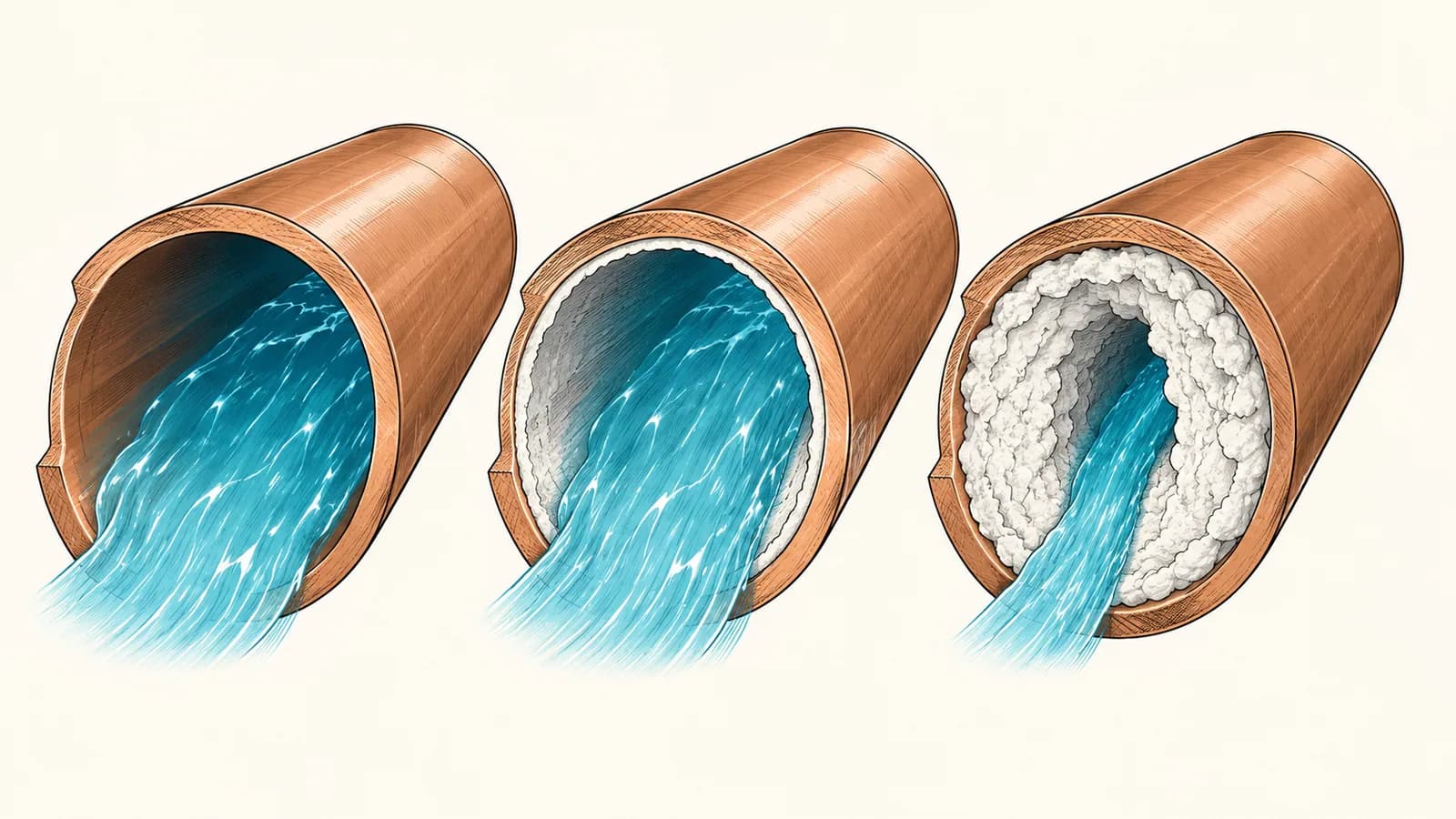
It converts dissolved minerals into scale wherever water is heated or evaporates, and scale is an insulator. That is why the measurable damage shows up first in anything that heats water, and last in the pipes you cannot see.
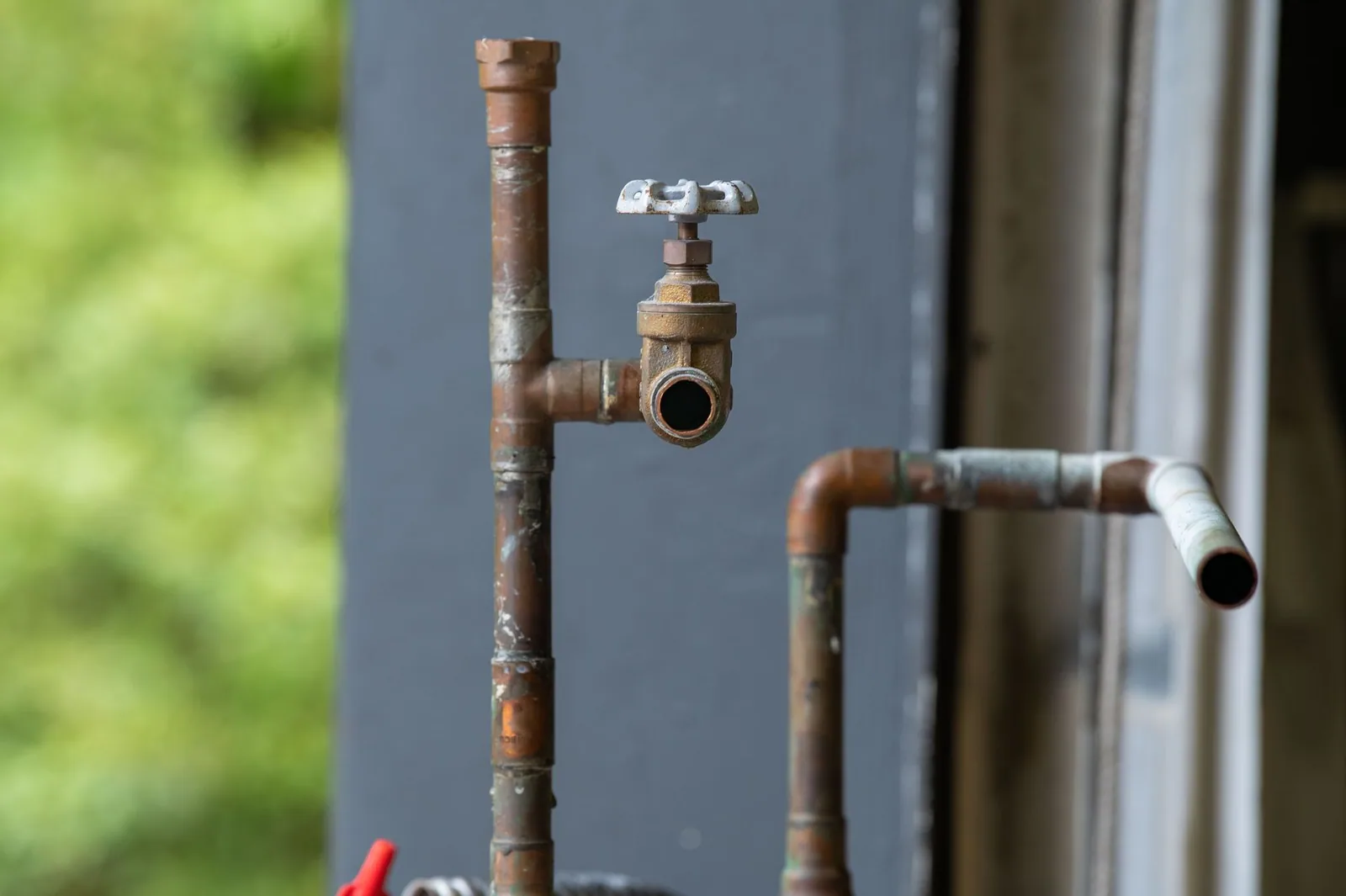
The best available numbers come from a Battelle Memorial Institute study commissioned by the Water Quality Research Foundation (2009-2010), industry-funded but independently run, and they are specific:
Up to 48%
- Gas water heaters lose roughly 4% efficiency, and 4% in operating cost, for every 5 gpg of hardness at typical usage. On softened water, heaters in the study held their original efficiency across 15 years of simulated service.
- Electric water heaters accumulate about 0.4 pounds of scale per year for every 5 gpg, shortening heating element life.
- Tankless water heaters are the extreme case: on very hard 26 gpg water, test units clogged in about 1.6 years of equivalent use.
- Pipes, fixtures, and appliances narrow and clog as scale accumulates, and everything that heats water (dishwasher, washing machine, coffee maker) ages faster.
- Soap chemistry breaks. Hardness minerals react with soap to form scum instead of lather, so you buy more detergent for worse results.
None of it is dramatic on any given day. The bill arrives over years, in energy, appliance replacements, and cleaning products.
Is Hard Water Bad for Your Health?#
No. The minerals in hard water are dissolved calcium and magnesium, the same ones in food and supplements, and the World Health Organization has not found convincing evidence that drinking hard water harms health. Skin and hair complaints are real but cosmetic: mineral residue left after showering reads as dryness or dullness for many people. Treat hard water to protect your house and your comfort, not your safety.
Does Hard Water Affect Skin and Hair?#
Cosmetically, yes. Hardness minerals bind with soap and shampoo before they can foam, leaving a film that many people read as tight, dry skin and flat hair. The chemistry is real; the products sold against it mostly are not.

The insoluble film is the same chemistry that leaves scum rings on the tub, and a trace of it stays on skin and hair after every rinse. Two honest caveats: the effect varies a lot from person to person, and no shower-mounted filter fixes it. A shower filter can reduce chlorine, but the contact time inside a filter cartridge is far too short to remove dissolved hardness minerals, so the "softening shower head" pitch does not survive the chemistry. Chelating shampoos strip mineral buildup after the fact; the only fix at the source is treating the water before it reaches the bathroom, which is the same equipment decision as the rest of this page.
How Do You Test for Hard Water?#
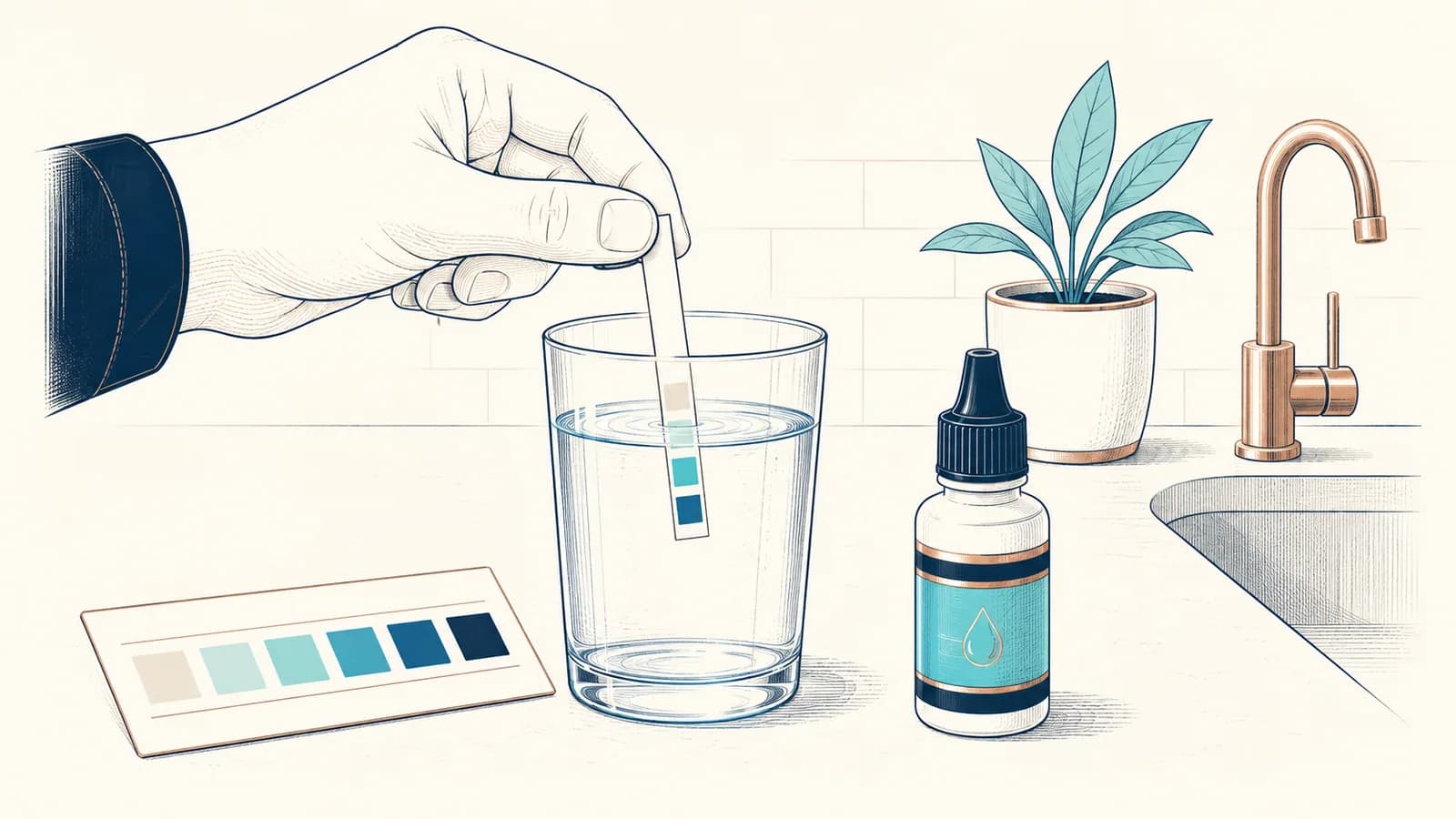
Three routes, and which one you take depends on where your water comes from. Never size equipment off a regional map: it tells you what your neighbors have, not what is in your pipes.
Getting your own number
Read your Consumer Confidence Report (city water)
Every US community water system publishes this annual quality report, and most include hardness even though the EPA does not require it. Search your utility's name plus CCR, or call and ask for hardness in gpg or mg/L.Test at the tap (any water)
Strips cost around $10 and give a usable range in seconds. Drop-count titration kits are more precise, which matters when the number sits near a capacity threshold.Order a certified lab test (well water)
Private wells are not covered by EPA rules or CCRs, so a state-certified lab test is the only real answer. It will also flag iron and manganese, which change the equipment you need entirely.
The same report answers a bigger question than hardness, and our guide to reading your water report to judge whether tap water is safe shows which lines to check for violations and lead.
Is Well Water Hard Too?#
Frequently, and it is always less documented. Hardness comes from the rock the water traveled through, and a private well pulls straight from that groundwater with no utility, no annual report, and no EPA oversight in between. On a well, nobody measures your water unless you do.
Well water also rarely stops at hardness. Iron, manganese, and hydrogen sulfide ride along in many aquifers, and they change the equipment answer completely: iron stains fixtures, fouls softener resin over time, and disqualifies most salt-free conditioners outright. The SpringWell FutureSoft spec sheet, for example, requires 0 ppm iron and 0 ppm manganese in the feed water. The standard well setup treats problems in order, an air injection iron filter first, then a softener for the hardness itself. Our well water treatment guide maps the full symptom-to-system decision, and the softener picks built for wells cover the combo systems designed for exactly this stack.
How Do You Fix Hard Water?#
There is exactly one technology that removes hardness from your whole water supply, and a ladder of partial fixes below it. Filtration is not on that ladder at all, for reasons worked through in hard water filters: what works and what doesn't. Where you get on that ladder is decided by your gpg number and by whether salt is an option in your district.
Ion exchange, step by step
- Hardness arrivesCalcium and magnesium are the two ions the industry calls hardness. They are dissolved, not suspended, so no filter screen can catch them.
- The resin bedPolymer beads whose exchange sites are pre-loaded with sodium. The resin grips calcium and magnesium far harder than it grips sodium, and that difference in affinity is the whole trick.
- The trade, one for twoEvery calcium ion that sticks releases two sodium ions, because one Ca2+ carries the charge of two Na+. Nothing is strained out: hardness is swapped, ion for ion.
- Until the beads fill upSites are used up from the inlet end toward the outlet. When that front reaches the outlet, hardness starts to break through and the control valve runs a regeneration.
The swap runs both ways, which is why a bed saturated with hardness can be recharged with nothing more concentrated than salt water. A softener does not consume its resin, it rents it out and takes it back every few days.
From cheapest to most complete:
Tier 0: confirm the problem (about $10). A test kit turns "I think it's hard" into a gpg number. Below about 3.5 gpg, per the USGS scale, treatment rarely pays.
Tier 1: spot treatments ($20 to $100). Vinegar soaks for shower heads, rinse aid in the dishwasher, chelating shampoos. These manage symptoms at single fixtures and do nothing for pipes or the water heater. A shower filter belongs here too, with the caveat above: it reduces chlorine, not hardness. For the crust already on faucets, glass and tile, our surface-by-surface method for removing hard water stains shows which cleaner each material can take.
Tier 2: salt-free conditioner ($879 to $2,094.10 equipment, as of Sep 21, 2026). TAC conditioners stop most new scale from sticking without salt, power, or a drain, but leave the minerals (and the spotting) in the water.
Tier 3: salt-based softener (the complete fix). Ion exchange removes the calcium and magnesium themselves. Hardness drops to near zero, soap works, spotting stops, and scale stops accumulating. Most homes land between $1,000 and $3,000 installed per Angi and HomeGuide 2026 data, with HomeGuide's full salt-based range at $1,200 to $3,800, and big-box DIY units starting at $489. Beware the dealer channel: Culligan, Kinetico, and RainSoft quotes documented in 2026 routinely run $5,000 to $10,000 for comparable equipment, which is what our softener cost pillar is built to benchmark.
Tier 2: salt-free conditioner
- Over 88% scale reduction in the WateReuse evaluation
- Hardness reading unchanged: 15 gpg in, 15 gpg out
- No salt, no drain, no electricity, no wastewater
- $879 to $2,094.10 equipment (as of Sep 21, 2026)
Tier 3: salt-based softener
- Removes the calcium and magnesium outright
- Soap lathers, spotting stops, the feel of the water changes
- About one 40 lb salt bag a month, $50 to $150 a year
- $1,000 to $3,000 installed (Angi and HomeGuide, 2026)
Bottom line
If spotting, laundry and the way water feels are what bother you, only ion exchange changes them. If you only need to protect a water heater and salt is off the table, the conditioner is the honest buy.
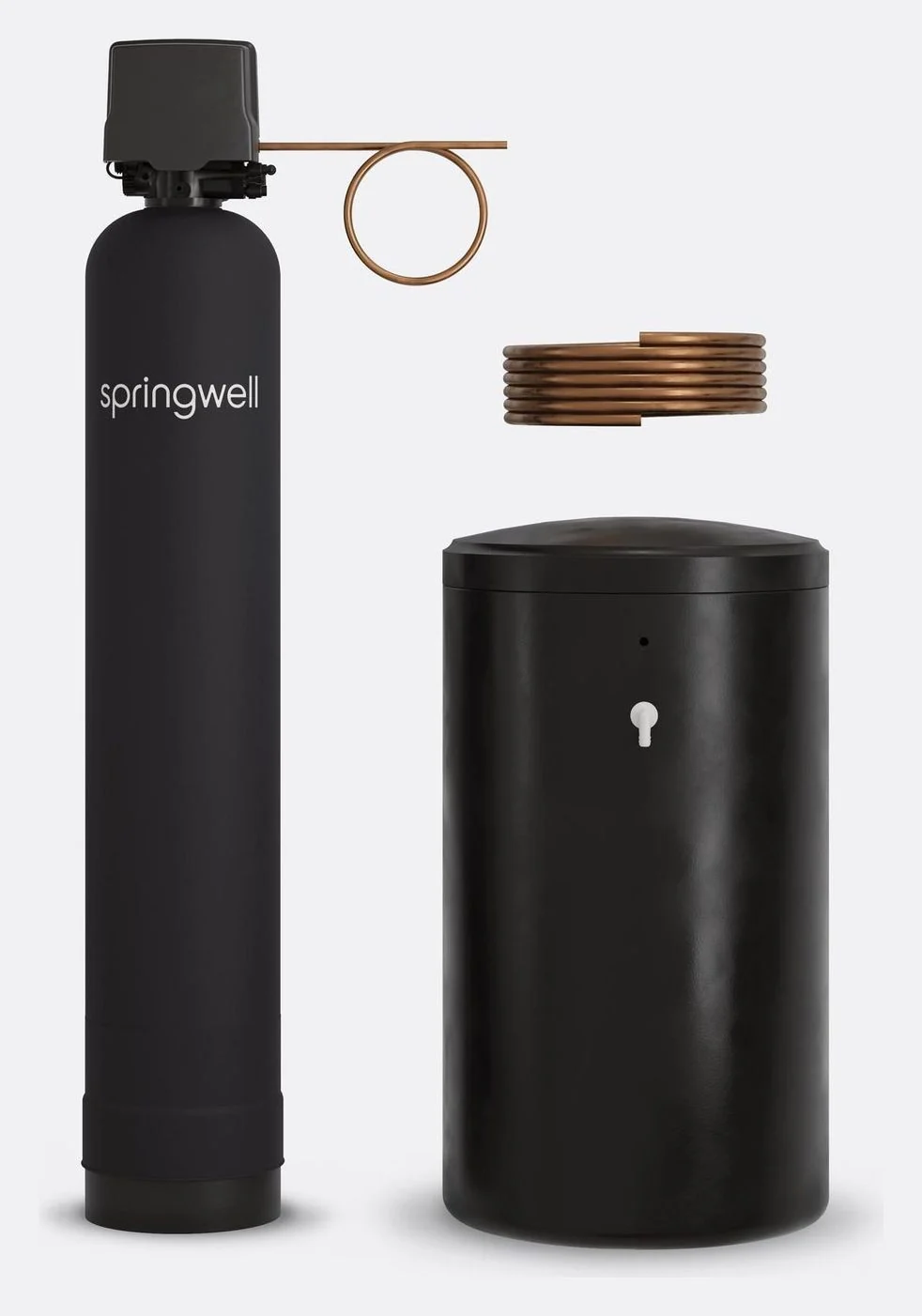
SpringWell
SpringWell SS1 Salt Based Water Softener
Best for: Homes with 1 to 3 bathrooms on hard city water that want true ion-exchange softening at a factory-direct price
- Grain capacity
- 32,000
- Service flow
- 11 GPM
- Bathrooms
- 1 to 3
- Tank
- 9" × 48" (57" with head)
- Connection
- 1"
- Brine tank
- 18" × 33" round (~200 lb salt)
The full comparison of all six approaches, with budgets and honest trade-offs for each, is in how to fix hard water, and the salt versus salt-free head-to-head settles the tier 2 against tier 3 decision. If you go the softener route, our ranking of current systems covers the field, and the grain capacity calculator converts your gpg number and household size into the capacity to buy. Two things hardness will never fix, for the record: chlorine taste at every tap, which is a job for a whole house filter, and drinking-water contaminants like arsenic or fluoride, which belong to reverse osmosis.
What If You Already Have a Softener and Still See Hard Water?#
Hard water symptoms in a softened house mean the softener is not doing its job, and the causes sort neatly from cheap to terminal. Work down this list before you spend anything.
Softener installed, water still hard
5 itemsAn empty tank, or a salt bridge holding a crust above the water so no brine forms beneath it, stops softening entirely and costs nothing to fix. A unit programmed for 10 gpg cannot fix 20 gpg water, which is why the test above comes before everything else. And resin beds wear out gradually, so an old softener can regenerate on schedule while softening less each year.
Work through our maintenance checklist in that order. The salt buying guide covers which type to use and what a healthy system should consume, normally $50 to $150 per year per HomeGuide 2026 data, and the six softener salt bags we compared on price and purity narrow it to a brand. And when maintenance stops moving the number, how long softeners last walks the repair-or-replace call.
The Verdict#
Hard water will not hurt you, but ignoring it is a slow tax on every appliance that touches water in your house. Spend $10 on a test first. Under 3.5 gpg, do nothing. In the moderately hard band, fix the symptoms that bother you. At 7 gpg and above, the Battelle efficiency numbers say real treatment pays for itself, and the higher your gpg, the faster the payback.
Frequently asked questions
What is considered hard water?
By the U.S. Geological Survey classification, water is hard above 121 mg/L of dissolved calcium carbonate (about 7 grains per gallon) and very hard above 180 mg/L (about 10.5 gpg). Between 61 and 120 mg/L counts as moderately hard, and many households in that range already notice spotting and scale.
Is hard water bad for your health?
No. Hardness is dissolved calcium and magnesium, the same minerals found in food and supplements, and the World Health Organization has not found convincing evidence that drinking hard water harms health. The EPA does not even regulate hardness. It is an appliance, plumbing, and cost problem, not a safety problem.
How do I know if I have hard water?
Look for white crust on faucets and shower heads, spotted glassware, soap that will not lather, stiff laundry, and dry skin or hair after showering. To confirm, check your utility's annual Consumer Confidence Report, or test at the tap: hardness strips cost around $10 and give a usable gpg reading in seconds.
Does hard water damage water heaters?
Yes, and it is measurable. An industry-funded but independently run Battelle study for the Water Quality Research Foundation found roughly 4 percent efficiency loss for every 5 gpg of hardness in gas water heaters, up to 48 percent over the unit's life, and tankless heaters clogging in about 1.6 years on very hard 26 gpg water.
What removes hardness from water?
Only ion exchange, the technology inside salt-based water softeners, actually removes dissolved calcium and magnesium from your whole water supply. Salt-free conditioners reduce scale but leave the minerals in place, and ordinary carbon filters do not touch hardness at all.
Published in this section
Hard Water Filters: What Works, What Doesn't (Filter vs Softener)
Read the guide
How Long Do Water Softeners Last? (And 5 Signs Yours Is Dying)
Read the guide
10 Signs of Hard Water in Your Home (and What Each One Costs You)
Read the guide
How to Fix Hard Water: 6 Solutions Compared (From $20 to $1,785)
Read the guide
Hard Water Explained: What GPG and PPM Numbers Actually Mean
Read the guide
Water Softener Salt Guide: Pellets vs Crystals vs Block (Which to Buy and How Much)
Read the guide
Water Softener Maintenance: The Complete Checklist
Read the guideKeep reading
Not sure what you need?
Answer 5 questions, get the right system for your water.
City or well, budget, household size, our quiz matches your answers against every system we track.