Well Water Filtration: The Complete Treatment Guide
Well water filtration from symptom to test to system: iron, sulfur and sediment fixed in the right order, with full stacks from $2,231.25 to $4,422 (Aug 2026).
By Home Water Lab TeamUpdated Prices verified Oct 7, 2026
This page contains affiliate links; buying through them costs you nothing extra.
There is no such thing as one well water filter, because there is no such thing as one well water problem. Private wells fail in patterns (iron, sulfur, sediment, hardness, bacteria), and the right system depends on a lab test, not a guess.
The short answer
as of Aug 28, 2026What goes into a well water filtration system, and what does it cost?
A lab test decides the stack, and the order is fixed: sediment, then an iron filter, then a softener, then UV, then an under-sink RO. Getting that first stage right is cheaper than every other decision on this page, and our whole house sediment filter guide covers the micron choice and where the screen goes relative to the pressure tank. Most homes need two or three of those stages, not all five. On the factory-direct pricing we track, a complete SpringWell stack runs $2,231.25 for the air injection iron filter alone, $3,123.75 with a salt-based softener added, and $4,422 for the full combo with UV disinfection. Professional installation is extra on all three.
This guide is the funnel we wish every well owner got handed: symptom, then test, then system, in that order. Skipping the middle step is how people buy a $1,600 softener that iron destroys, or a carbon filter aimed at a bacteria problem. City water is a different playbook entirely, covered in our whole house water filters guide.
Key takeaways
- The EPA does not regulate private wells, and the CDC recommends testing at least once a year.
- Treatment order is fixed: sediment, iron filter, softener, UV, then an under-sink RO for drinking water.
- Iron fouls softener resin, which is why an air injection filter goes upstream of the softener, never after it.
- The SpringWell WS1 is rated to 7 ppm iron, 1 ppm manganese and 8 ppm hydrogen sulfide. Above that, air injection is outgunned.
- Complete factory-direct stacks run $2,231.25 to $4,422 (as of Sep 12, 2026), installation not included.
Why Is Well Water Different?#
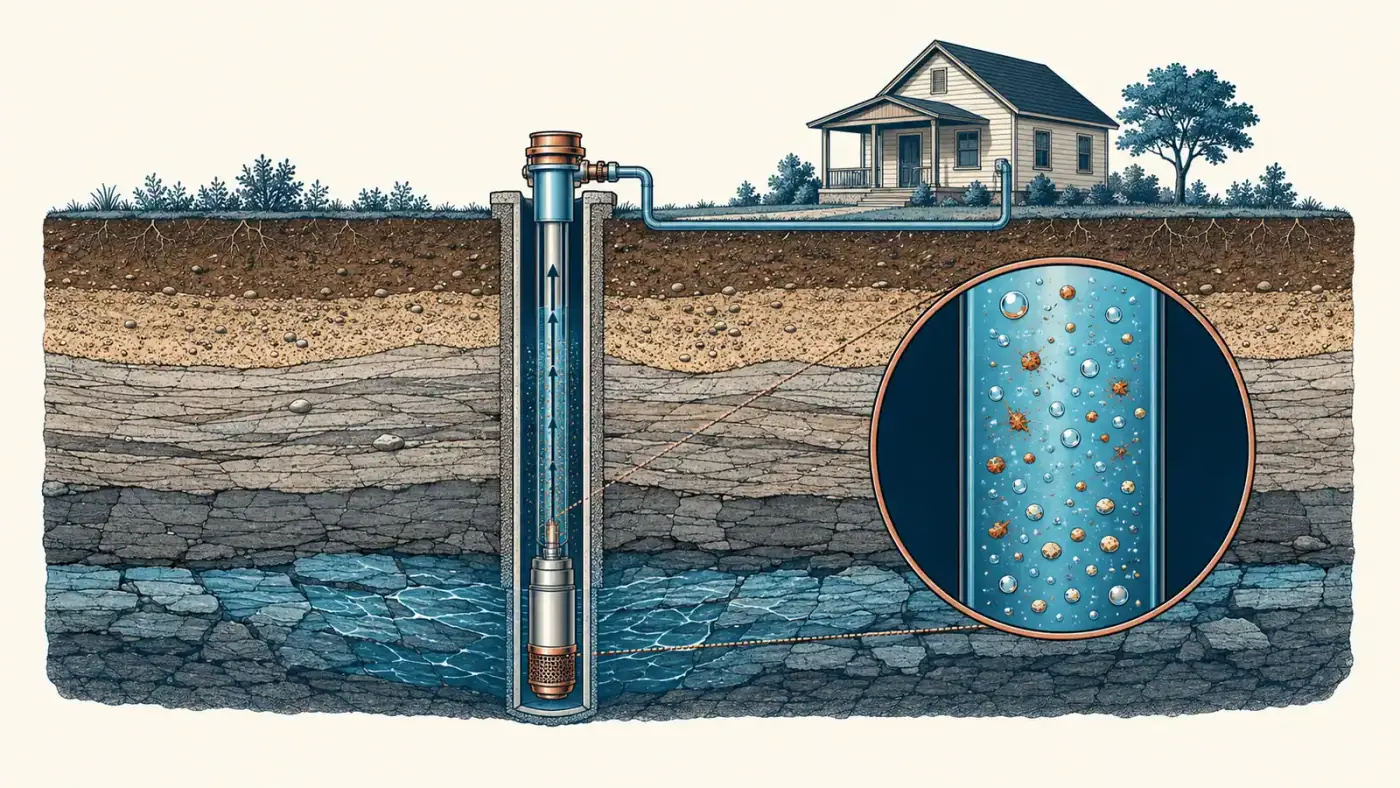
Because nobody is treating it before you. A city supply is disinfected, filtered and monitored under EPA rules, and you get an annual quality report. A private well has none of that: the EPA does not regulate private wells, and the CDC recommends owners test at least once a year. You are the water company.
That changes the equipment list. City-water systems target the chlorine the utility added. Well water systems target what the ground added: dissolved iron that stains everything orange, hydrogen sulfide that smells like rotten eggs, manganese, sand and grit, hardness, and sometimes bacteria. Carbon tanks built for city water do not solve any of those.
What you hear
Well water is natural, straight from the ground. It does not need treating.
What the numbers say
Nobody treats it before you do. The EPA does not regulate private wells and the CDC recommends testing at least once a year, and the contaminants that matter most (coliform bacteria, nitrates, arsenic) have no taste, smell or color at all.
It also changes the stakes. Well problems compound quietly: iron plugs fixtures and fouls softener resin, sediment chews through pump seals and appliances, and an untested well can carry contamination you cannot taste. The funnel below exists to keep you from paying for the wrong fix.
What Are Your Symptoms Telling You?#
Your house has been running the diagnostics for months. Each visible symptom points at one likely culprit, and every one of them is confirmed the same way: a number from a lab.
| Symptom | Likely culprit | Confirmed by |
|---|---|---|
| Orange or brown stains in tubs, toilets, laundry | Dissolved iron | Lab test, iron in ppm |
| Rotten egg smell, worse on hot water | Hydrogen sulfide gas | Lab test (sample carefully, it escapes) |
| Black stains or specks | Manganese | Lab test, manganese in ppm |
| Cloudy water, gritty faucet aerators | Sediment or sand | Sediment test, visual |
| White scale, spotted glasses, dry skin | Hardness | Hardness in gpg |
| Metallic taste | Iron or low pH | Lab test incl. pH |
Orange stains need one extra look before the lab, because water that is already orange at the tap and water that runs clear and stains later call for different filters; our rust filter picks matched to the stain you see walk through the glass test that tells them apart.
Two notes before you shop on symptoms alone. First, problems travel in packs: iron, sulfur and hardness frequently show up together, which is why combo stacks dominate this category. Second, the worst contaminants (coliform bacteria, nitrates, arsenic) have no smell, taste or color at all. That is what the test is for.
If scale is your only symptom, your problem may be simple hardness rather than a well problem: run through the signs of hard water, check what your region typically reports in the hardness lookup, and read the hard water hub before you price any well equipment. Well country and hard water overlap heavily, which is why states like Michigan sit in the very hard band with a high share of private wells.
How Should You Test Well Water?#
Order a state-certified lab test, not a strip. You are about to size equipment against exact concentrations, and the difference between 3 ppm and 8 ppm of iron changes which machine you should buy.
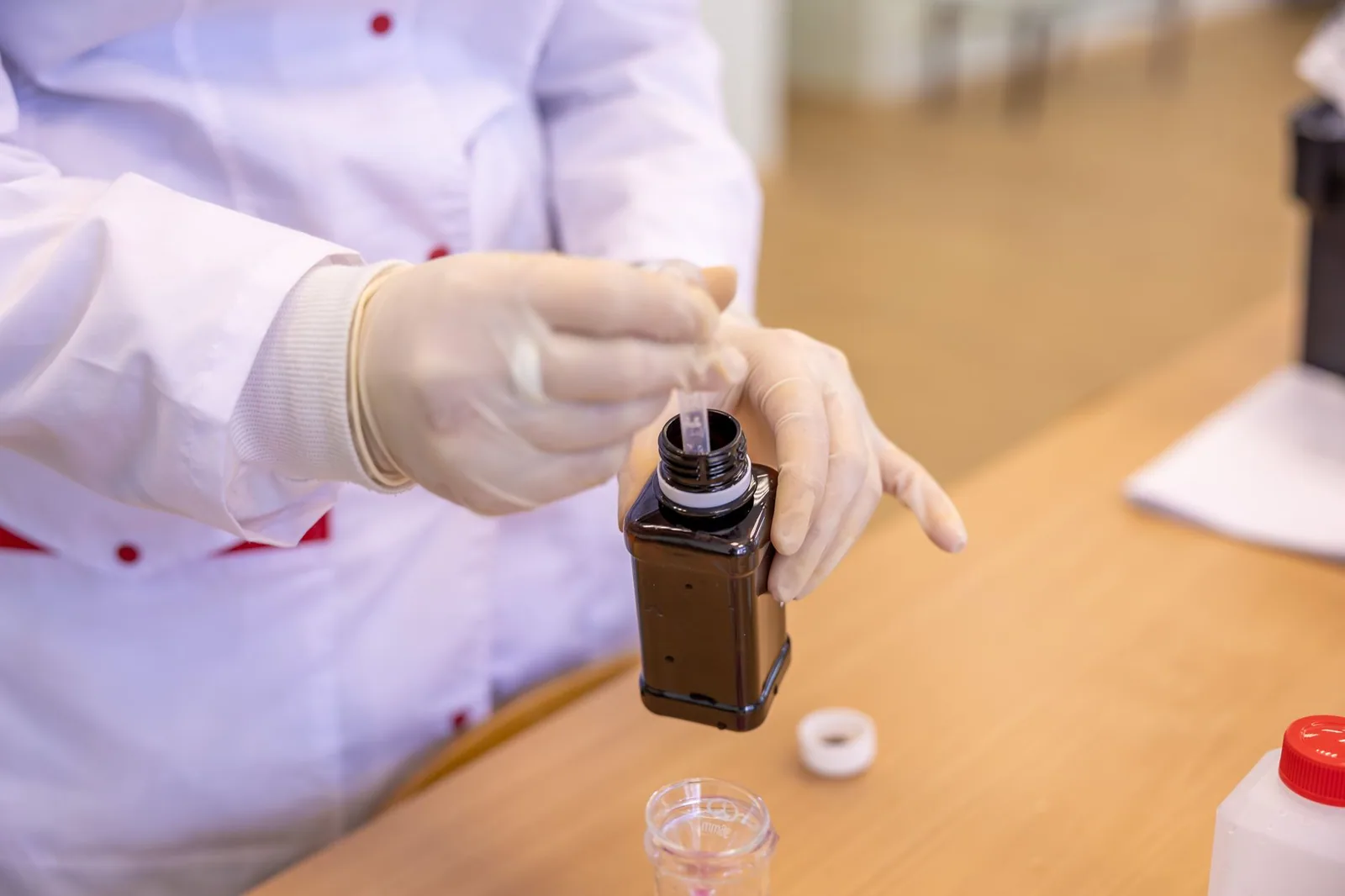
What to ask the lab to measure
6 itemsPer CDC guidance, retest yearly, and again after flooding, nearby construction, or any change in taste, smell or color. Write the numbers down: every system in the next section has published ratings in ppm and gpg, and matching your lab report against those ratings is the entire buying decision. The full schedule, the EPA's list of extra tests by symptom and the sampling steps are in our step-by-step guide to testing a private well.
Buying a property brings a different set of questions. Keystone Well Water's guide to buying a home with a well in Pennsylvania covers pre-purchase water testing, reading the results, and questions to ask about existing treatment equipment.
Which System Fixes Which Problem?#
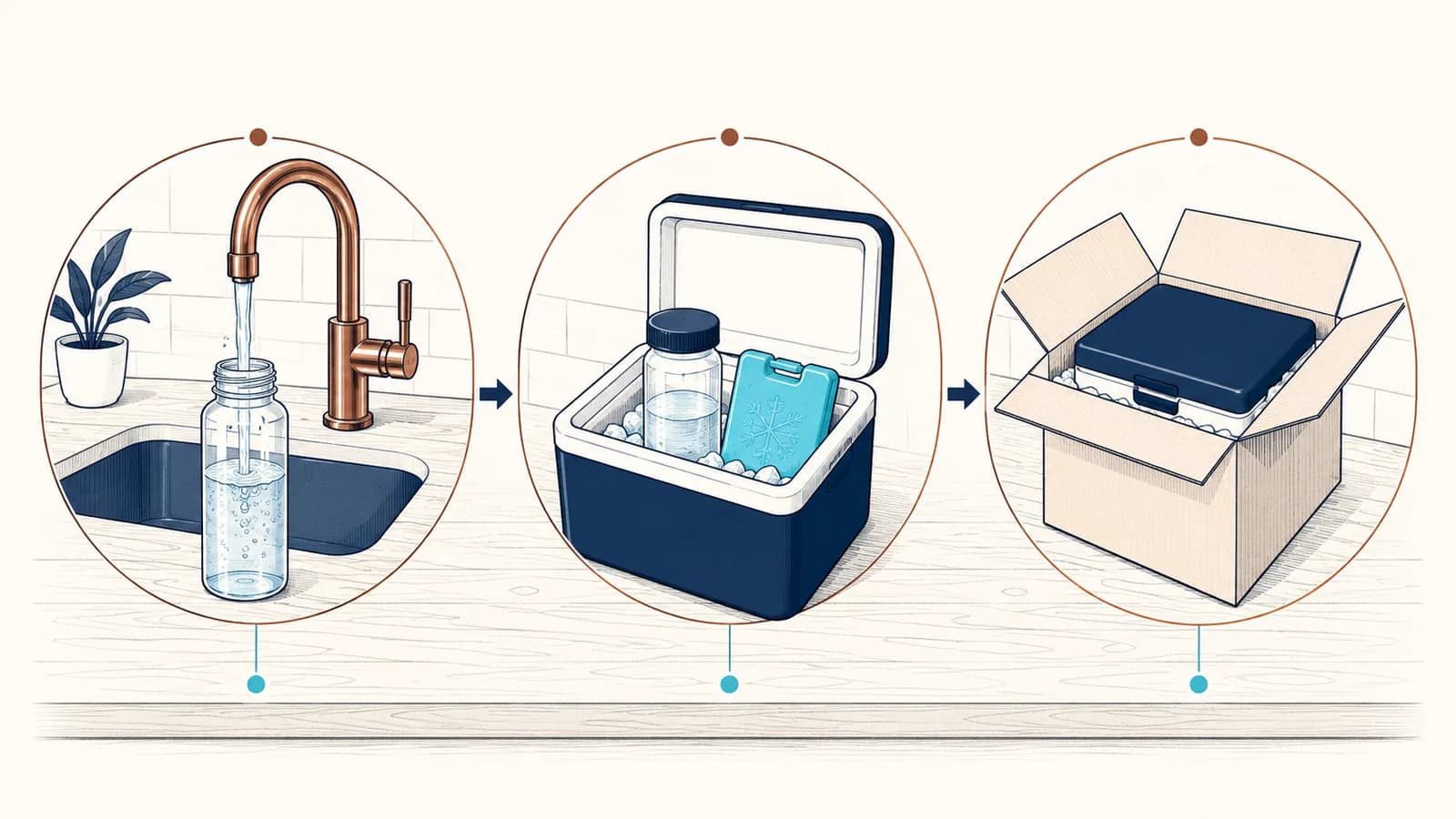
One stage per problem, and no stage does two jobs. Iron, sulfur and manganese go to air injection. Sediment gets a pre-filter. Hardness gets a softener. Bacteria get UV. Drinking water gets reverse osmosis at the sink.
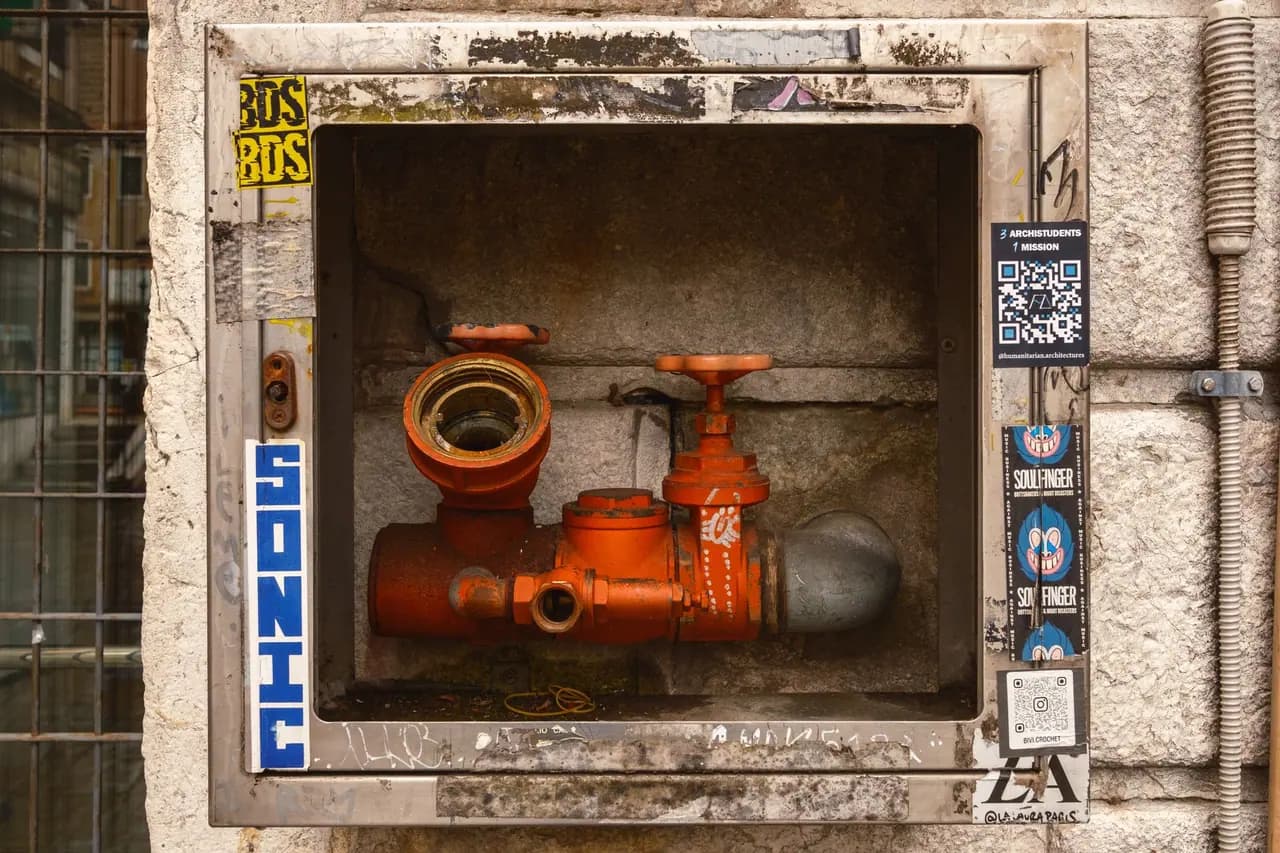
Iron, sulfur and manganese: air injection oxidation#
The workhorse of well treatment. An air pocket at the top of the tank oxidizes dissolved iron, sulfur and manganese into particles, a greensand media bed catches them, and an automatic nightly backwash flushes them to drain. No chlorine injection, no dosing pump, no consumables to refill.
The honest limits are the ratings. The SpringWell WS1 we track is rated for 7 ppm iron, 1 ppm manganese and 8 ppm hydrogen sulfide. Above those loads, air injection is outgunned. A vendor who quotes you an AIO system without asking for your iron number is guessing with your money. How those three ceilings play out against your own report is the subject of our SpringWell WS1 review, read against its ratings.
Air injection oxidation
- No chemicals, no dosing pump, nothing to refill
- Rated to 7 ppm iron, 1 ppm manganese, 8 ppm H2S on the WS1
- Automatic nightly backwash, audible near bedrooms
- $2,231.25 for the WS1 (as of Sep 12, 2026)
Chemical oxidation
- Handles iron and sulfur loads above the AIO ceiling
- Adds a dosing pump and a chemical you keep in stock
- The escalation path US Water Systems builds for heavy wells
- Configured and quoted per well, not sold off a shelf
Bottom line
Your lab number decides this, not your budget. Under the published AIO ratings, air injection is the cheaper and simpler machine. Over them, injecting a chemical is not an upsell, it is the only thing that works.
Rankings and the heavy-iron alternatives are in best iron filters for well water.
Sediment: a pre-filter stage#
Sand and grit get a dedicated sediment stage ahead of everything else. It is the cheapest component in the stack and it protects every expensive tank behind it. Choosing between a manual screen, a self-flushing one, a cartridge or a backwashing tank is the subject of our spin-down versus cartridge versus backwashing comparison for wells.
Hardness: a softener, installed second#
Ion exchange works the same on wells as on city water, with one rule: the iron filter goes first, because iron fouls softener resin.
Use the sizing guide and the grain capacity calculator with your lab numbers, see softeners built for well water for the picks, and read the water softener systems hub if ion exchange itself is new to you. One shortcut worth ruling out early: salt-free conditioners require 0 ppm iron, so most wells disqualify themselves.
Bacteria: UV disinfection#
If the lab finds coliform, a UV purification stage kills what carbon and greensand cannot. SpringWell lists its UV system from $1,036 (as of Aug 28, 2026, and the site showed different UV prices on different pages the same day, so check at checkout), with an annual bulb replacement around $130. UV needs clear water to work, which is why it sits last in the chain.
Drinking water polish: under-sink RO#
For taste and final drinking-water protection at the kitchen tap, an under-sink reverse osmosis unit completes the stack. That world is covered in the reverse osmosis buyer's guide.
What Order Should Treatment Go In?#
Sediment, iron, hardness, bacteria, drinking water. The sequence is not negotiable, and it is the most common thing dealers get away with scrambling.
The install, in order
- Main shut-offEverything downstream starts here. Find it and turn it before you buy anything: an install with no working shut-off is a plumber's job, not a Saturday.
- Untreated branchOutdoor taps and irrigation tee off before the softener. A lawn does not care about hardness, and softened water is salt you paid for. Many installs run the kitchen cold tap off this same branch and keep drinking water untreated.
- Bypass valveTakes the softener out of service without cutting water to the house. It is what turns a resin change from an outage into an errand.
- SoftenerOn the main line, ahead of anything that heats water. Everything downstream of this point is soft; everything on the untreated branch is not.
- Brine tankStands within a few feet of the valve, and needs enough clearance overhead to lift a 40 pound bag of salt over the lid.
- Drain line, with air gapBackwash has to reach a drain, and the gap above it is what code asks for. The distance to that drain is the most common reason an install ends up on a different wall.
- Water heaterDownstream, on purpose. Scale forms fastest where water is heated, so the heater is the appliance a softener is really protecting.
- Power outletThe control valve needs power within reach of its cord. The battery inside only holds the clock, it does not run a cycle.
Schematic: pipe runs, wall space and distances change with every house. The order does not. Main, then the untreated branch, then the bypass, then the softener, then the heater, plus the three things a control valve has to reach: a drain, its brine tank and an outlet.
The fixed treatment order
Sediment pre-filter
First in line, protecting everything downstream from sand and grit. The cheapest part of the stack and the one that extends the life of the rest.Air injection iron filter
Second, removing iron, sulfur and manganese before they can reach the resin. This is the stage that keeps a softener alive on well water.Water softener
Third, on iron-free water, where its resin can last a normal lifetime. Size it on your lab hardness reading, not on the house.UV disinfection
Fourth, on clear water, where the light actually reaches the microbes. Only if the lab found coliform.Under-sink reverse osmosis
Last, polishing the water you drink and cook with. It treats one tap and is not a substitute for anything above it.
Most homes need two or three of these stages, not all five. The lab report decides which.
How Much Does Well Water Filtration Cost?#
Between $2,231.25 and $4,422 for the equipment, depending on how many of those five stages your lab report calls for, plus installation. Those are factory-direct Starting at prices read Sep 12, 2026 on SpringWell's shop.
$2,231.25-$4,422
| Stack | What it treats | Price |
|---|---|---|
| WS1 iron filter alone | Iron, sulfur, manganese | $2,231.25 |
| WSSS1 (iron filter + softener) | Iron, sulfur, manganese + hardness | $3,123.75 (range $3,123.75 - $3,570 by size) |
| ULTRA combo (iron filter + softener + UV) | The above + bacteria | $4,422 |
Professional installation is extra on all three, and worth budgeting seriously: these systems tie into your main line and need a drain for backwash. For the installed totals, the add-ons and the 10-year view, see the well water system cost breakdown.
Those price points also explain why this category attracts $8,000 dealer quotes. The hardware above is the same class of equipment, priced in the open with the dates attached, and if you are holding a quote right now our line-by-line quote decoder shows you what each line is actually worth. The same benchmarking exercise on city-water softeners lives in the softener cost pillar.
Which Well Water Systems Should You Buy?#
Two configurations cover most problem wells: the WS1 alone when iron and sulfur are the whole story, and the WSSS1 when hardness rides along with them. Both are named with their defects below.
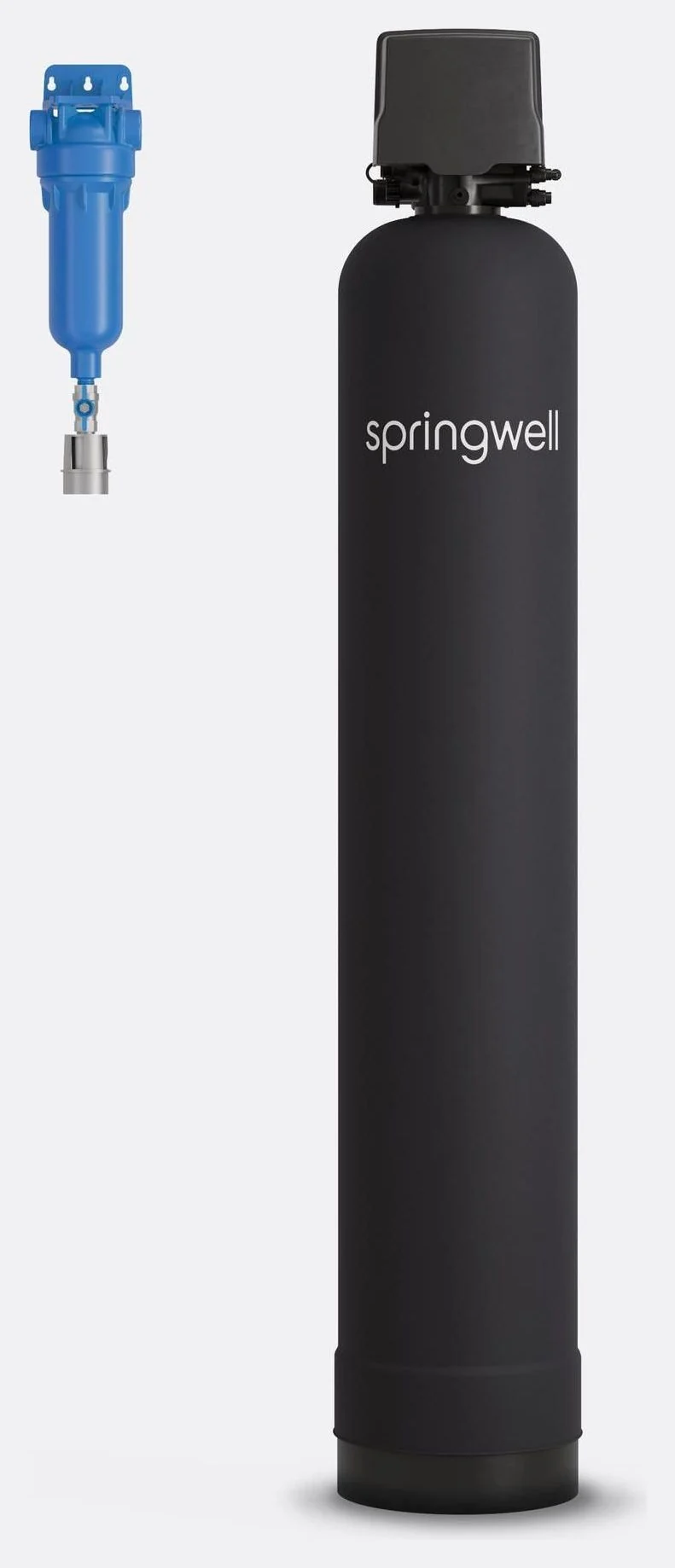
SpringWell
SpringWell WS1 Whole House Well Water Filter
Best for: Well-water homes with light-to-moderate iron, sulfur or manganese that want a chemical-free, no-consumable setup
- Technology
- Air Injection Oxidation (AIO), single tank, chemical-free
- Flow rate
- 12 GPM
- Iron rating
- 7 ppm
- Manganese rating
- 1 ppm
- Sulfur (H2S) rating
- 8 ppm
- Media
- Greensand fusion, 10+ year life
The WS1 is the chemical-free fix for the classic orange-stain, rotten-egg well: single tank, Bluetooth head, media rated for 10+ years with nothing to refill. Know the limits before buying: 7 ppm iron, 1 ppm manganese and 8 ppm hydrogen sulfide ratings mean heavily loaded wells need stronger oxidation setups instead, and the nightly backwash is audible near bedrooms.
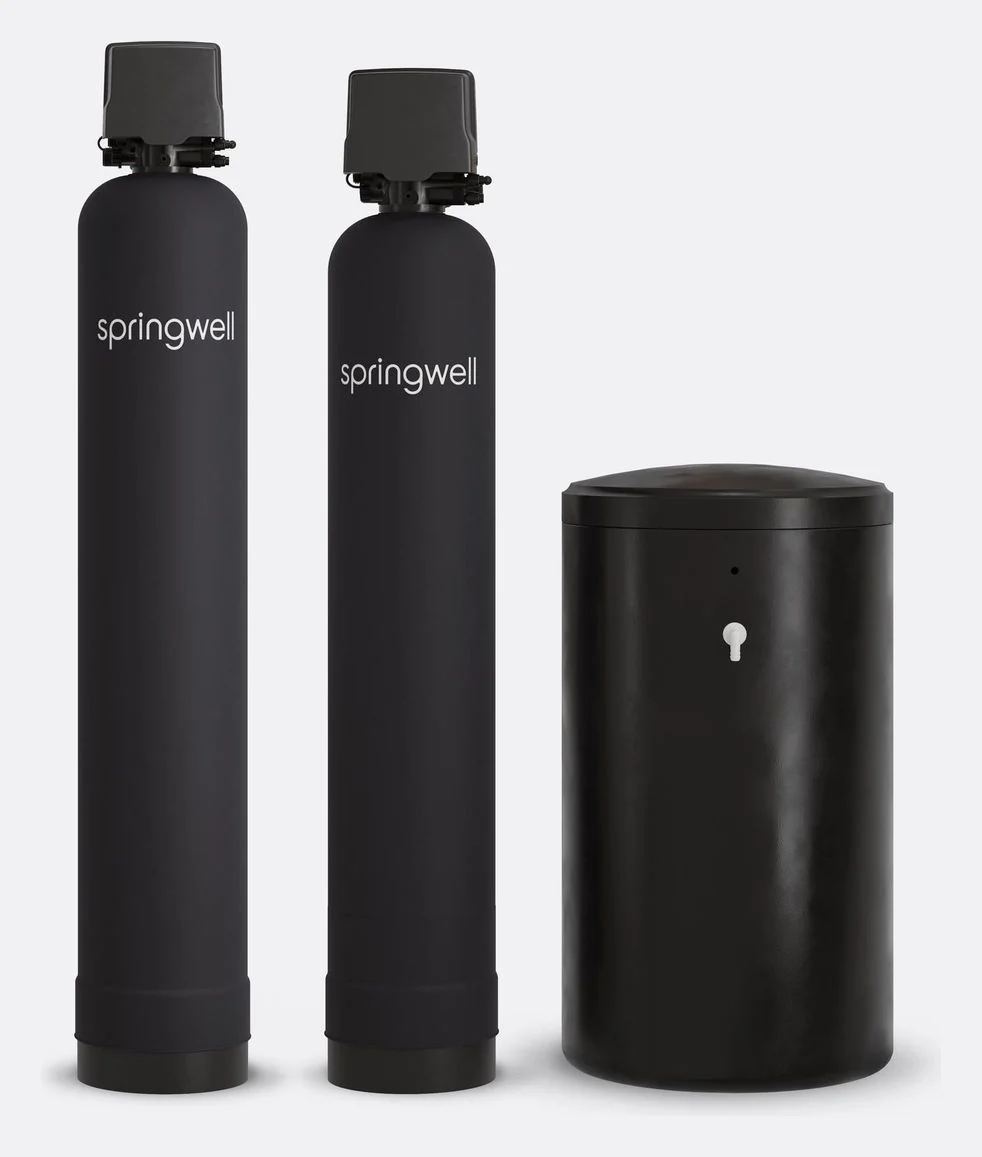
SpringWell
SpringWell WSSS1 Well Water Filter + Salt Softener Combo
Best for: Well-water homes with iron, sulfur AND hardness, the correct treatment order in one package
- Contents
- WS air-injection iron filter + SS salt-based softener
- Iron rating
- 7 ppm
- Sulfur (H2S) rating
- 8 ppm
- Manganese rating
- 1 ppm
- Price range
- $2,975, $3,400 depending on size
- Treatment order
- AIO iron filter first, then softener (protects the resin)
The WSSS1 solves the full iron-plus-hardness pattern in the correct order, with the AIO stage protecting the softener resin. It is a three-tank footprint, so measure your utility space, and the same 7 ppm iron ceiling applies. Above that, or with tannins and other complications, US Water Systems' peroxide injection line is the escalation path, backed by an actual technician hotline.
If your well only has one problem, buy one system, not a stack. And if you want to see how these compare against city-water softeners on price and warranty, the full softener ranking covers both worlds side by side. How we price, date and check all of it is documented in our methodology; once installed, the maintenance checklist applies to the softener stage exactly as it does on city water.
What to install, in what order#
Test first, with a state-certified lab, once a year per CDC guidance. Then match your numbers to published ratings: air injection up to 7 ppm iron and 8 ppm sulfur on the system we track, peroxide injection beyond, softener after the iron filter, UV only if the lab says so. Complete factory-direct stacks run $2,231.25 to $4,422 as of Sep 12, 2026, which is the honest benchmark to hold against any in-home quote.
Frequently asked questions
How often should you test well water?
At least once a year, per CDC guidance, and again after flooding, nearby construction or any change in taste, smell or color. Private wells are not regulated by the EPA, so no one tests your water unless you do. Use a state-certified lab, not just strips, when sizing treatment equipment.
Will a water softener alone fix well water?
Usually not. Most problem wells carry iron, sulfur or sediment along with hardness, and iron fouls softener resin. The proven order is a dedicated iron filter first, then the softener. Putting a softener alone on iron-heavy well water is how a $1,600 machine dies young.
What removes the rotten egg smell from well water?
That smell is hydrogen sulfide gas, and the chemical-free fix is air injection oxidation: the SpringWell WS1 we track is rated for up to 8 ppm of hydrogen sulfide, along with 7 ppm iron and 1 ppm manganese. Wells above those loads move up to stronger oxidation setups such as peroxide injection systems.
How much does a well water filtration system cost?
On the factory-direct pricing we track (SpringWell well line, as of Sep 12, 2026): $2,231.25 for the air injection iron filter alone, $3,123.75 with a salt-based softener, and $4,422 for the full combo with UV disinfection. Professional installation is extra on all three.
Published in this section
Keep reading
Not sure what you need?
Answer 5 questions, get the right system for your water.
City or well, budget, household size, our quiz matches your answers against every system we track.