Water Softener Systems: The Complete Guide for US Homeowners
What a water softener system does, which type and size fit your home, and what you really pay: $489 DIY to $3,000 installed, every figure dated and sourced.
By Home Water Lab TeamUpdated Prices verified Oct 7, 2026
This page contains affiliate links; buying through them costs you nothing extra.
A water softener system removes the calcium and magnesium that make water hard, using a resin bed and an ion-exchange reaction that has not fundamentally changed in decades. For most US homes it costs $1,000 to $3,000 installed, per Angi and HomeGuide 2026 cost data, while big-box DIY units start at $489 and the dealer quotes we have documented run $5,000 to $10,000 for comparable hardware.
The short answer
as of Aug 28, 2026What is a water softener system, and what should one cost?
A water softener system is a resin tank plus a brine tank that pulls calcium and magnesium out of your water by ion exchange, the only common residential technology that actually removes hardness rather than managing it. You size it on grains per day, not on square footage: a family of four on 10 gpg water carries about 3,000 grains a day, which a 32,000-grain unit handles while regenerating roughly once a week. Budget $1,000 to $3,000 installed for most homes per Angi and HomeGuide 2026 data. The floor is $489 for a big-box unit you install yourself (Rheem RHS32, Home Depot); the ceiling is the $5,000 to $10,000 we have documented on in-home dealer quotes for the same class of hardware.
That price spread is the reason this guide exists. The technology is mature and well understood. The market around it is not: identical resin tanks sell for triple the price depending on the logo and the sales channel. Everything below starts from one number, your hardness in grains per gallon, which you can pull from our hardness lookup by ZIP code or understand properly in the complete hard water hub.
Key takeaways
- Only ion exchange removes hardness. Salt-free conditioners cut scale by over 88% in the WateReuse evaluation but leave your gpg reading unchanged.
- Size on grains per day: people x 75 gallons x your gpg. Four people on 10 gpg water need 3,000 grains a day, which a 32,000-grain unit covers.
- Most homes pay $1,000 to $3,000 installed (Angi and HomeGuide, 2026). Equipment alone is $500 to $2,000 per Fixr's January 2025 data.
- Dealer quotes we have documented run $5,000 to $10,000 for hardware in that same class, sold through an in-home visit.
- Running cost is mostly salt: about one 40 lb bag a month, or $50 to $150 a year per HomeGuide 2026.
What Is a Water Softener System?#
It is two tanks and a valve. The tall tank holds resin beads that trade sodium for the calcium and magnesium in your water; the short tank holds the salt used to recharge those beads. Nothing else in residential water treatment removes hardness minerals from the supply.
What is actually in the box
- Bypass valveSends water straight to the house. Every service call starts here: without it, touching the softener means shutting off the whole home.
- Control valveThe head that meters water and decides when to regenerate. A metered head counts gallons, a timer head only counts days, which is why metered heads use less salt.
- Riser tube and upper distributorWater enters at the top, works down through the bed, then returns up the centre tube. Screens at both ends keep resin in the tank and out of your plumbing.
- Resin bedThe working part. Beads loaded with sodium trade it for hardness as water passes. Capacity is rated in grains, which is what 32,000 or 48,000 on the box refers to.
- Drain line, with air gapBackwash water and spent brine leave here. Plumbing code wants a physical gap above the drain so nothing can siphon back into the softener.
- Lower distributor and gravel bedCollects treated water evenly across the tank floor. Uneven collection channels the flow through part of the resin and wastes capacity.
- Brine tankHolds the salt. Its job is to make brine for the recharge, not to add salt to your water: the two only meet inside the resin tank, during regeneration.
- Brine well and safety floatThe float caps how much water can enter the tank. It is what stops a stuck valve from putting the brine tank on your floor.
- Brine lineCarries brine to the valve during the draw, and fresh water back to the tank during refill. One tube, both directions.
Schematic, not to scale. Tank sizes and valve brands change, the order of the parts does not. A control valve needs a drain, a brine line and a power outlet within reach, and that is what decides where the pair can physically stand.
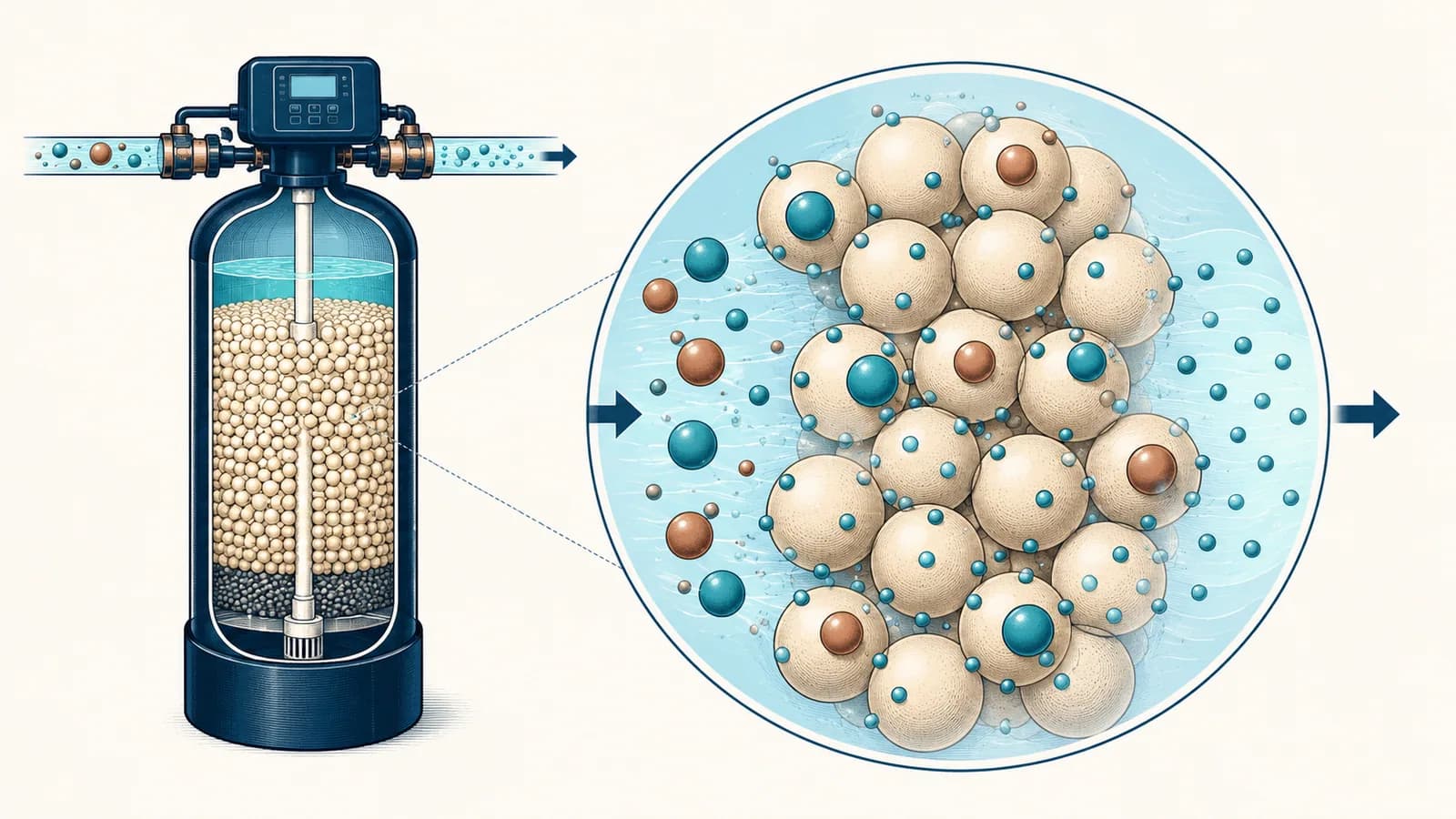
As hard water flows through, the resin grabs calcium and magnesium ions and releases sodium in exchange. That swap, called ion exchange, is what makes the water measurably soft: soap lathers, glassware stops spotting, and scale stops forming on heating elements.
The resin eventually fills up with hardness minerals. The system then flushes it with brine from the second tank, sending the captured minerals down the drain and recharging the resin. Modern metered heads track your actual water use and regenerate only when needed, which saves both salt and water compared with old timer-based units.
Hardness is measured in grains per gallon (gpg) or milligrams per liter (mg/L), and 1 gpg equals 17.1 mg/L. Per USGS classification, water above 7 gpg (121 mg/L) is hard, and above roughly 10.5 gpg (180 mg/L) it is very hard. Large parts of the Midwest, the Plains and the Southwest routinely exceed that, and our plain-English explainer on gpg and ppm unpacks the two units if the conversion keeps tripping you up.
Do You Actually Need a Water Softener?#
Below about 3.5 gpg, no. In the moderately hard band (3.6 to 7 gpg) it is a comfort call. Above 7 gpg the math on scale, appliance wear and energy starts favoring treatment, and above 10 gpg most households benefit.
The cost of doing nothing is real. An industry-funded but independently run Battelle study for the Water Quality Research Foundation found that gas water heaters lose roughly 4% efficiency for every 5 gpg of hardness, up to 48% across the unit's life, while softened water kept heaters near their original efficiency over the 15-year test horizon. The same study found tankless water heaters on very hard water (26 gpg) clogged in about 1.6 years of equivalent use.
1.6 years
Before you spend anything, get your number. Run through the 10 signs of hard water if you want to read your house before reading a test strip, and if you are weighing the whole decision, the 10-year payback math is worth ten minutes.
What Are the Main Types of Water Softener Systems?#
Five things get sold under the word "softener" and only two of them are worth most homeowners' attention. Salt-based ion exchange is the real thing. Salt-free conditioning is a legitimate but different product. The rest are edge cases or, in one case, something we will not recommend.
Salt-based ion exchange#
The default, and the only type that removes hardness minerals. One resin tank, one brine tank, a control valve on top. HomeGuide (read Aug 28, 2026) puts salt-based systems at $1,200 to $3,800 installed. This is what the rest of this guide assumes unless stated otherwise.
Dual-tank ion exchange#
Two resin tanks alternate, so one is always in service while the other regenerates. Useful for very large households or 24/7 soft water needs. HomeGuide lists $1,700 to $5,000 installed. Most homes do not need this.
Salt-free conditioners#
These do not soften anything, and any page telling you otherwise is selling something. Template assisted crystallization (TAC) converts dissolved hardness into microscopic crystals that stick to pipes far less. A federal evaluation cosponsored by the Bureau of Reclamation and run with Arizona State University found TAC the most effective salt-free technology it tested, with over 88% scale reduction. But measured hardness is unchanged: no soft feel, no lather improvement, no before-and-after test strip win.
Conditioners still make sense where salt softeners are restricted (parts of California and Texas) or where you only care about scale. The honest breakdown lives in our salt-free conditioner guide, and the head-to-head decision is settled in salt-based vs salt-free.
Portable and RV softeners#
Small ion-exchange tanks that regenerate with salt poured in by hand, and mainstream units in both common capacity classes listed under $300 in our August 2026 market survey. Real softening for RVs, boats and rentals: see the portable and RV capacity guide.
Magnetic and electronic descalers#
HomeGuide lists magnetic systems at $2,000 to $6,000 installed. The federal salt-free evaluation crowned TAC, not magnets, measuring electromagnetic and electrically induced devices at around 50% scale reduction. We have found no independent data that would justify that price, and we do not recommend them.
What you hear
It has a lifetime warranty, so it will never cost you anything again.
What the numbers say
Read which part is covered. On the SpringWell SS1 the tank, valve and fittings are lifetime, but the electronic head is warrantied 5 years, and big-box units like the Rheem RHS32 carry 1-year base coverage.
What Size Water Softener Do You Need?#
Capacity is set by your daily grain load, which is people times water use times hardness. The target is a unit that regenerates about once a week: often enough to keep the resin working, rarely enough to keep salt use sane. For most 1 to 3 bathroom homes that lands on 32,000 grains.
Sizing, by the week
- The size to buyThe smallest tank whose usable capacity still covers a full week, so the unit recharges about weekly. That is the rhythm resin is happiest at.
- More than you needIt will work, but you paid for resin that never gets used, and a bed that sits idle for a fortnight can channel and lose efficiency anyway.
- The 25 percent held in reserveThe dark tail on every bar is rated capacity left deliberately unused. Running resin down to its last grain costs far more salt per grain removed, so the industry sizes to about 75 percent.
4 people x 75 gallons a day x 10.0 gpg hardness x 7 days = 21,000 grains between regenerations, against usable capacity capped at 75 percent of nominal. Change any of those assumptions and the recommended size moves.
The market ladder mirrors that math: 32,000-grain units for 1 to 3 bathrooms, 48,000 for 4 to 6, and 80,000-grain units for large homes, which is exactly how SpringWell tiers its SS1, SS4 and SS+ line.
Run your own numbers in the grain capacity calculator, or read what size water softener do I need for the full chart by household and hardness.
How Much Does a Water Softener System Cost?#
The honest answer is a band, not a number: $1,000 to $3,000 installed covers most homes when you cross Angi's and HomeGuide's 2026 data. What moves you inside that band is not the machine, it is the sales channel that delivers it.
$1,000-$3,000
The layers behind that headline number, all read Aug 28, 2026:
| What you are paying for | Range | Source |
|---|---|---|
| Equipment only, salt-based | $500 - $2,000 | Fixr, Jan 2025 |
| Installed, salt-based | $1,200 - $3,800 | HomeGuide, 2026 |
| Installed, dual-tank | $1,700 - $5,000 | HomeGuide, 2026 |
| Installed, salt-free (TAC) | $1,500 - $4,500 | HomeGuide, 2026 |
| Angi national average, installed | $1,500 (range $200 - $6,000) | Angi, 2026 |
Running costs are dominated by salt: about one 40 lb bag a month for an average household, at $5 to $10 a bag per Angi's 2026 data, which lines up with HomeGuide's $50 to $150 a year.
Then there is the dealer channel. Culligan, Kinetico and RainSoft sell through in-home sales visits, and the quotes we have documented run $5,000 to $10,000 for systems whose factory-direct equivalents cost a fraction of that. Modernize's August 2026 Culligan data puts installed systems at $1,800 to $6,500, with twin-tank configurations able to exceed $8,000, and our Culligan price breakdown traces where that money goes. If the visit came from a free water test, our RainSoft review covering its warranty, complaints and quotes walks through how that sale is built.
Before you sign a dealer quote
6 itemsIf you have a quote on the table right now, our line-by-line quote decoder reads it item by item. For the complete picture, see the water softener cost pillar, the fast answer at how much is a water softener, and the DIY versus plumber breakdown. If you would rather work from your own numbers, the cost calculator builds the total from your household size and channel.
Which Water Softener Should You Buy?#
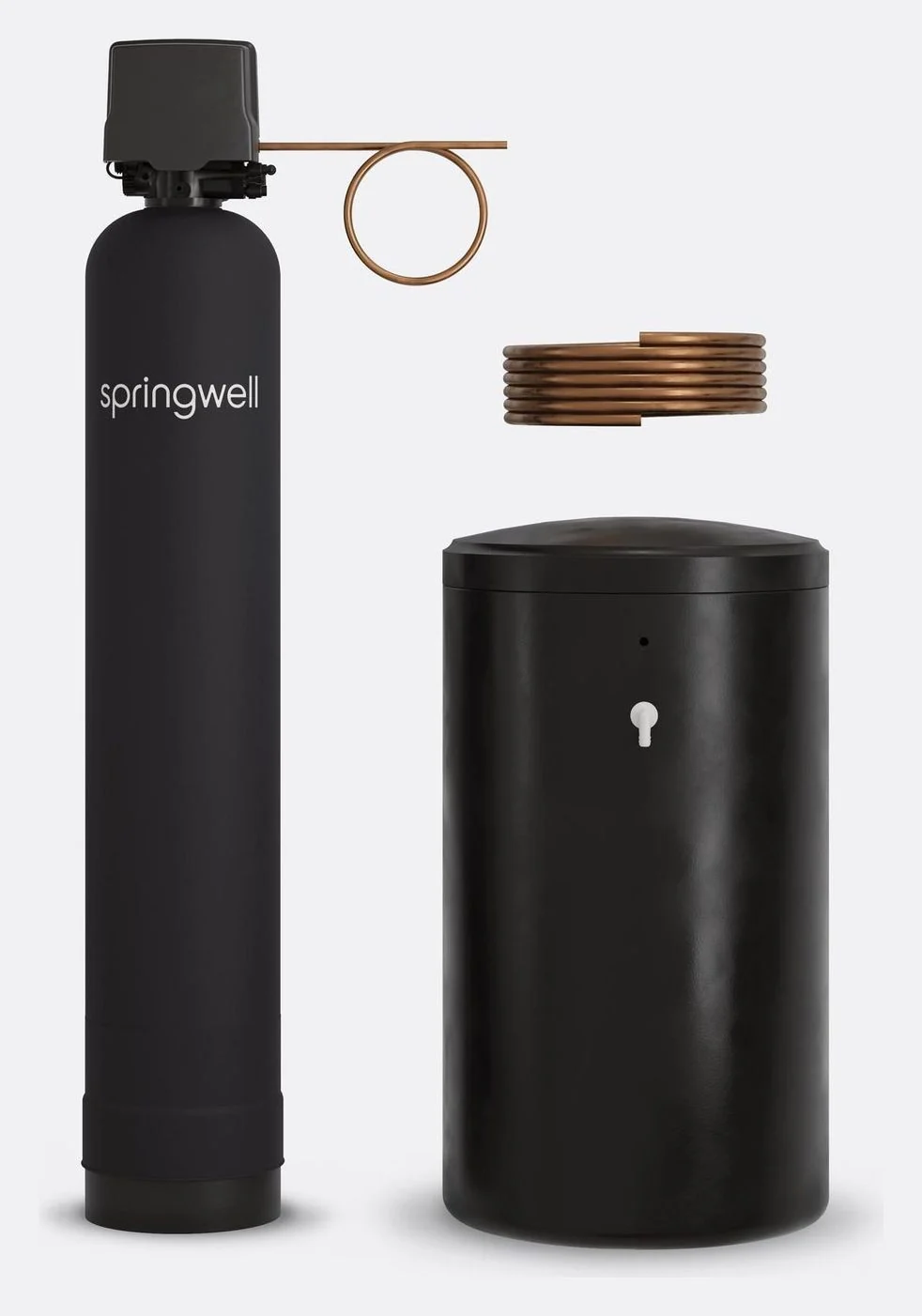
For a 1 to 3 bathroom home on hard city water, our benchmark is the SpringWell SS1. On a tight budget the Rheem RHS32 does the same core job for a third of the price, and large households are better served by the 44,000-grain Whirlpool WHES44. The full top 10 with the comparison matrix is at best water softeners.
SpringWell
SpringWell SS1 Salt Based Water Softener
Best for: Homes with 1 to 3 bathrooms on hard city water that want true ion-exchange softening at a factory-direct price
- Grain capacity
- 32,000
- Service flow
- 11 GPM
- Bathrooms
- 1 to 3
- Tank
- 9" × 48" (57" with head)
- Connection
- 1"
- Brine tank
- 18" × 33" round (~200 lb salt)
The SS1 earns the benchmark slot on true ion exchange, a Bluetooth metered head and a lifetime warranty on tank and valve. The fine print you should know before clicking anything: the electronic head is only warrantied 5 years despite the lifetime marketing, returns carry a 10% restocking fee that can reach 25%, and at roughly $1,600 for 32,000 grains the price per grain is unfavorable against 48,000-grain competitors near $2,000. Full teardown in our SpringWell SS1, SS4 and SS+ review.
On a budget, the Rheem RHS32 at $489 (as of Aug 28, 2026) is the cheapest credible unit from a national brand, sold through Home Depot, with a 7.9 GPM service flow that limits it to smaller homes and a 1-year warranty. For big families, the Whirlpool WHES44 at $619 (as of Sep 12, 2026, at Lowe's) brings 44,000 grains and the highest hardness (140 gpg) and iron (12 ppm) ratings among the big-box units we track, again with a 1-year base warranty. One warning while browsing that aisle: the GE GXSH40V, for years the default American softener, was flagged discontinued by the manufacturer as of Aug 28, 2026. Buy remaining stock only if you have checked warranty support first, and our GE softener review with clearance prices and alternatives lists the current GE models and what replaces them.
On well water, hardness is usually not the only problem, and a softener alone is often the wrong first purchase. Start with softeners built for well water.
How to buy one without getting sold one
Get your hardness in gpg
A test strip costs about $10, and many utilities publish hardness in their annual Consumer Confidence Report. Everything downstream is sized off this one number.Convert it to grains per day
People in the home x 75 gallons x your gpg. Pick the capacity that regenerates roughly once a week, not the biggest one offered.Decide whether salt is on the table
Some California districts restrict brine-discharging softeners, and septic owners often prefer not to add one. That constraint, not the price, is what sends a buyer to a conditioner.Price the same capacity in all three channels
Big-box, factory-direct and dealer sell the same class of hardware at very different prices. Get one number from each before you sign anything.Read the warranty part by part
Tank, valve and electronics are usually covered for different lengths of time. The shortest term is your real ownership horizon.
Our rating and pricing methodology explains how those figures are checked and dated.
What Does Water Softener Maintenance Involve?#
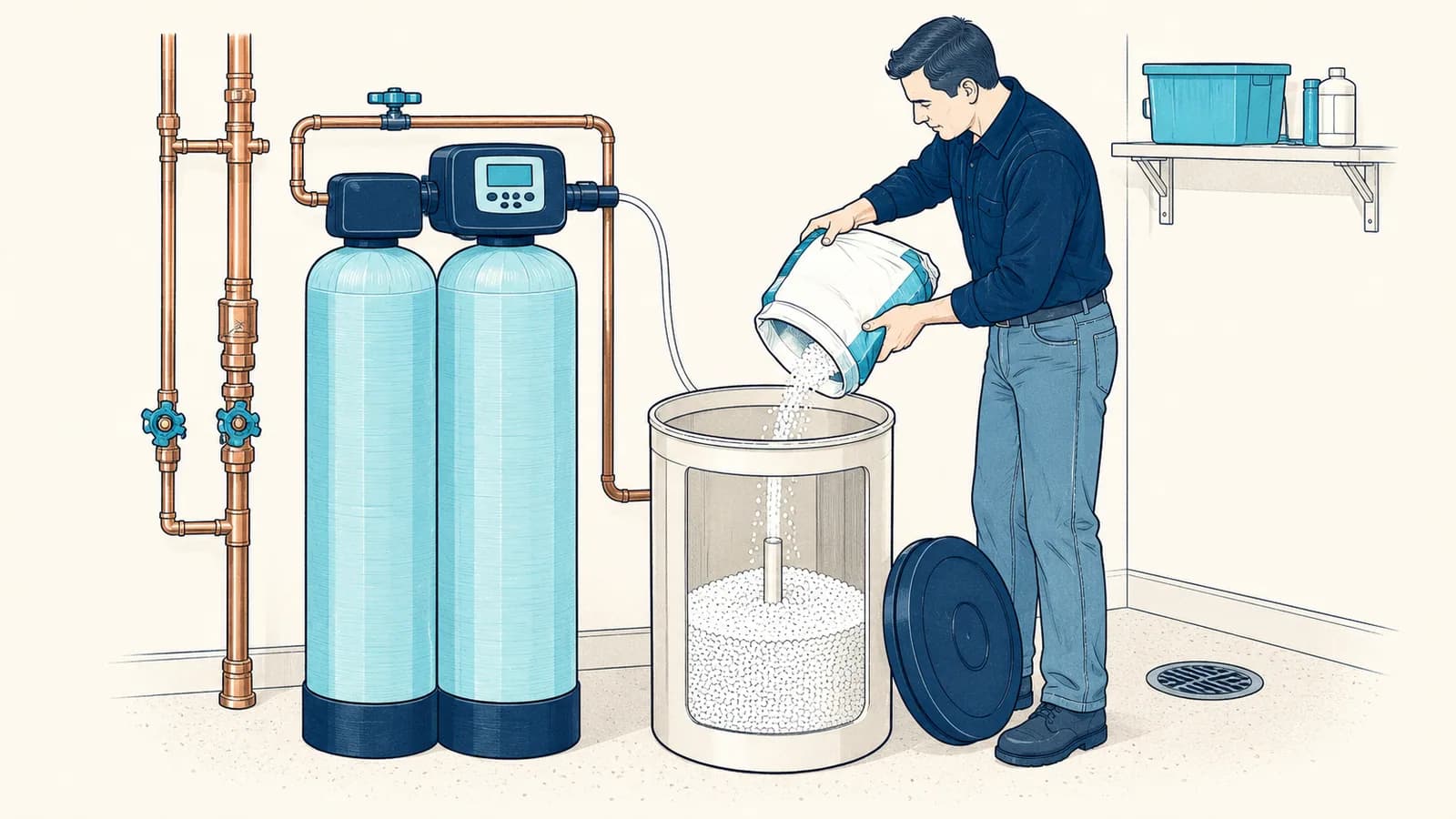
Less than dealers imply, more than zero. Budget one bag of salt a month, one look inside the brine tank, and a resin check as the unit ages past year 10. There is no annual service contract you are obliged to buy.
- Refill salt. Check the brine tank monthly; figure about one 40 lb bag a month for an average household. Pellets, crystals and blocks are not interchangeable in every unit, and our guide to choosing softener salt covers which to buy.
- Break salt bridges. A hard crust can form above the water line and stop brine from forming. The softener then quietly stops softening while looking full.
- Clean the brine tank occasionally and keep an eye on resin performance as the unit ages.
The complete schedule, task by task, is in the maintenance checklist. And if your current unit is past year 10 and the soft feel is fading, how long water softeners last walks the repair-or-replace call before you pay for either.
Do You Need a Water Softener, a Whole House Filter, or Both?#
They solve different problems, and the confusion between them is profitable for whoever is quoting you. A softener takes minerals out. A filter takes chemicals out. Neither does the other job.
Salt-based softener
- Removes calcium and magnesium by ion exchange
- Stops scale, spotting and soap scum
- Does nothing about chlorine, chloramine or PFAS
- $1,200 to $3,800 installed (HomeGuide, 2026)
Whole house filter
- Removes chlorine, chloramine, PFAS and VOCs
- Leaves your hardness reading exactly where it was
- Tank systems are rated 1,000,000 gallons or about 10 years
- $516.99 to $1,791 across the systems we track (Sep 2026)
Bottom line
On hard, chlorinated city water the honest answer is both, plumbed in series, which is why combo packages exist and usually undercut buying the two separately.
Start with the whole house filtration guide for the chemical side, and see filter and softener combos if you need the pair. On a private well, the playbook changes completely, because iron and sulfur come first: use the well water treatment guide instead.
Where to start#
Test your water first, in gpg. Below 3.5, keep your money. Above 7, a correctly sized salt-based system is the proven fix, at $1,000 to $3,000 installed per Angi and HomeGuide 2026 data, and the factory-direct brands deliver dealer-grade hardware without the $5,000 to $10,000 quote. Size it with the formula, not the salesman, and read the warranty fine print before you buy: that is where the real differences hide.
Frequently asked questions
How much does a water softener system cost?
For most homes, $1,000 to $3,000 installed, per Angi and HomeGuide 2026 cost data. Equipment alone runs $500 to $2,000 for salt-based units per Fixr, big-box DIY units start at $489, and the dealer quotes we have documented run $5,000 to $10,000 for comparable hardware.
Do salt-free water softeners actually work?
They prevent scale, but they do not soften. A federal evaluation cosponsored by the Bureau of Reclamation, run with Arizona State University, found template assisted crystallization (TAC) the most effective salt-free technology it tested, with over 88% scale reduction. Measured hardness stays the same, so water never gets that soft feel.
What size water softener do I need?
Multiply the people in your home by 75 gallons per day, then by your water hardness in grains per gallon. That daily grain load, sized so the unit regenerates about once a week, points most 1 to 3 bathroom homes at a 32,000-grain system, and larger or harder-water homes at 48,000 or 80,000 grains.
How much salt does a water softener use?
Figure about one 40 lb bag per month for an average household. Angi's 2026 data puts a 40 lb bag at $5 to $10, and HomeGuide 2026 puts annual salt spend at $50 to $150, so budget roughly $100 a year and check the shelf price before you buy.
How long does a water softener last?
Big-box units with proprietary valves typically run 8 to 12 years, while standard rebuildable valve platforms commonly reach 15 to 20, based on the service data in our research. If yours is past year 10 and softening is fading, read our guide on the signs a softener is dying.
Published in this section
Water Softener Repair: 12 Problems, What Causes Them, and What a Fix Costs (2026)
Read the guide
Water Softener Installation: The Step-by-Step Job, Start to First Soft Water
Read the guide
Water Softener Replacement: When to Replace It, and How to Swap It
Read the guide
Is a Water Softener Worth It? The 10-Year Math
Read the guide
What Size Water Softener Do I Need? Calculator, Chart and Grain Guide
Read the guide
Best Portable and RV Water Softeners 2026
Read the buyer's guide
Best Water Softeners 2026: Top 10 Systems Compared on Real Numbers
Read the buyer's guideKeep reading
Not sure what you need?
Answer 5 questions, get the right system for your water.
City or well, budget, household size, our quiz matches your answers against every system we track.