Reverse Osmosis Systems: The Complete Buyer's Guide
How a reverse osmosis system works, what it removes, tank vs tankless, and 4 vetted picks from $224.99 to $999 with real annual filter costs for each.
By Home Water Lab TeamUpdated Prices verified Oct 7, 2026
This page contains affiliate links; buying through them costs you nothing extra.
A reverse osmosis system pushes tap water through a semipermeable membrane fine enough to reject dissolved contaminants that ordinary filters cannot touch. For most homes the right buy is an under-sink unit between $224.99 and $999, and it treats the water you drink rather than the water you live in.
The short answer
as of Sep 28, 2026What is a reverse osmosis system, and which one should you buy?
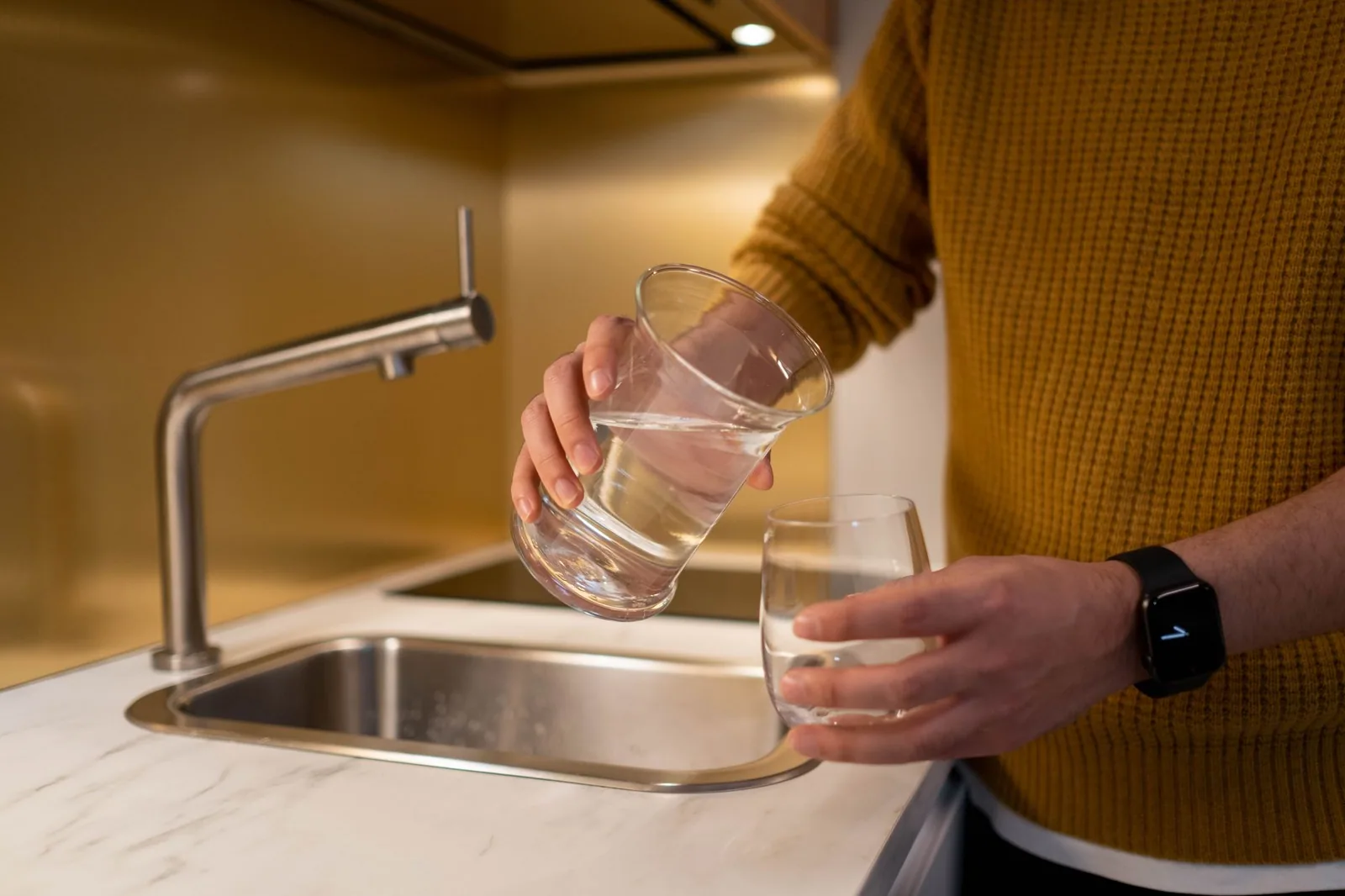
A reverse osmosis system forces tap water through a semipermeable membrane fine enough to reject dissolved contaminants that carbon cannot touch, then sends it to a dedicated faucet at your sink. It treats one tap, not the whole house. For most kitchens the buy is the Aquasana SmartFlow at $224.99, on sale against its $449.99 list price on Oct 5, 2026, which is WQA certified to NSF/ANSI 42, 53 (including the P473 PFAS protocol), 58 and 401, with a remineralizer included at no extra charge. The under-sink market we track runs $224.99 to $999.
Our short list, on dated readings: the SmartFlow has the strongest certifications per dollar on the market, the iSpring RCC7AK at $239.99 (Oct 12, 2026) is the budget tank pick, ranked #2 in Amazon's Under-Sink & Countertop Filtration category on Oct 5, 2026, the Waterdrop G3P800 at $999 (Sep 12, 2026) is the premium tankless benchmark, and the Moen RO sold by SpringWell at $363.80 (Oct 9, 2026) fits owners standardizing on one supplier. If your complaint is chlorine at every tap rather than what is in the glass, you want a whole house water filter instead.
Key takeaways
- RO treats one tap. It fixes the glass, not the shower, and it never touches house-wide hardness.
- The Aquasana SmartFlow carries the strongest certification list per dollar we track, and read $224.99 against a $449.99 list price on Oct 5, 2026.
- The iSpring RCC7AK read $239.99 on iSpring's own store on Oct 12, 2026, against a struck-through $241.99, its flat price on Sep 12.
- Tank designs send about 3 gallons to drain per pure gallon; the tankless G3P800 flips that to 3 pure per 1 drained.
- Filters are a subscription: about $100 to $110 a year on the RCC7AK, $159.97 on the G3P800.
What Is a Reverse Osmosis System?#
Point-of-use drinking water treatment, and that phrase is the whole scope. A typical under-sink system feeds your cold line through a series of filter stages and a membrane, then delivers purified water to a dedicated faucet at the sink. It treats the water you drink and cook with, not the water you shower in.
That focus is its strength: no other consumer technology reduces as broad a range of dissolved contaminants (fluoride, arsenic, lead, PFAS, nitrates, and total dissolved solids among them) at anywhere near the price.
The trade-offs are equally structural. RO is slower than a straight carbon filter, sends reject water to the drain, strips desirable minerals along with the bad, and serves one tap. Every design decision in the market, tank versus tankless, 4 stages versus 6, remineralization or not, is an attempt to soften one of those trade-offs. If chlorine and taste are your only complaints, our review of Aquasana's Claryum carbon filters covers the no-membrane route model by model.
How Does Reverse Osmosis Work?#
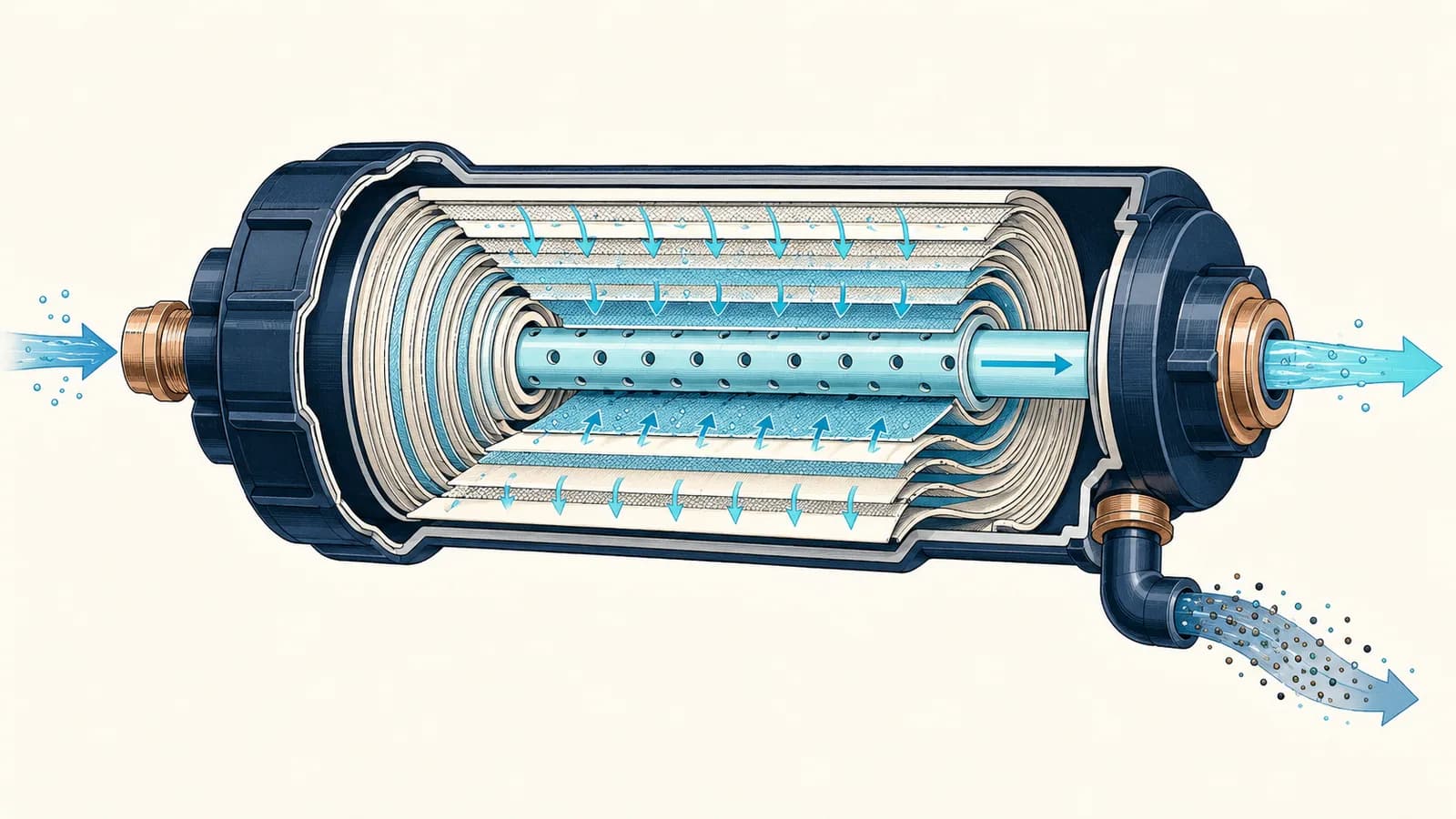
Osmosis is water's natural tendency to move across a membrane toward the saltier side. Apply enough pressure to the salty side, which is your tap water, and the flow reverses: water molecules are forced through the membrane while dissolved solids, too large for its pores, are rejected and flushed to the drain.
Household line pressure is enough to drive it in most homes; tankless systems add an electric pump to speed production.
A membrane alone would clog quickly, which is why real systems are built as a stage sequence:
- Sediment prefilter catches rust and grit that would foul everything downstream.
- Carbon prefilter removes chlorine and chloramine, which degrade the membrane itself.
- The RO membrane does the heavy lifting on dissolved contaminants.
- Carbon postfilter polishes taste after the storage tank or on the way to the faucet.
- Optional extras: alkaline remineralization to restore taste and pH, or UV sterilization on premium tankless units like the Waterdrop G3P800.
What Does Reverse Osmosis Remove?#
Model by model, and the paper trail matters more than the marketing. NSF/ANSI 58 is the certification standard written specifically for RO systems, and the strongest spec sheets in our database read like this:
- The Aquasana SmartFlow is WQA certified to NSF/ANSI 42, 53 (including the P473 PFAS protocol), 58, and 401 plus CSA B483.1, with claims of 99.99% reduction across 90 contaminants: 96% PFAS, 90% fluoride, 96% arsenic. That is the strongest certification story in its class.
- The iSpring RCC7AK carries NSF/ANSI 58 certification at a budget price.
- The Moen RO sold by SpringWell lists 86 contaminants reduced, including arsenic, fluoride, chlorine, lead, mercury, bacteria, and viruses.
- The Waterdrop G3P800 publishes strong reduction claims, but its certifications are partial and model-specific; verify the exact model in the certification databases before you rely on a specific claim.
What you hear
It says tested to NSF standards, so it is NSF certified.
What the numbers say
Those are different claims. Only a listing in the NSF or WQA product databases proves certification, and it attaches to one model number rather than to a brand. The SmartFlow is WQA certified across four standards; the G3P800 publishes strong claims with partial, model-specific coverage.
That check is the first thing we run on every pick, and our review methodology sets out the rest.
What Doesn't Reverse Osmosis Do?#
Four things, and every one of them is somebody else's machine:
- It does not fix hard water house-wide. An under-sink RO treats one faucet. Scale on your shower doors and inside your water heater is a hardness problem for the water softener guide, and diagnosing it starts at our hard water hub or with the signs of hard water if you have not tested yet. The machines that actually fix it are ranked in our softener comparison.
- It does not replace whole-house filtration. Chlorine taste and odor at every tap, shower included, is the job of a point-of-entry carbon system.
- It is not fast. Tank systems refill slowly, and even a premium tankless unit's faucet flow is a fraction of your main tap. The SmartFlow, a compact tank system, delivers 0.7 GPM at the faucet when its tank is full; filling stock pots takes patience.
- It keeps nothing it removes. Minerals that make water taste alive go to the drain with the contaminants, which is why remineralization stages exist.
Tank or Tankless: Which RO Design Is Better?#
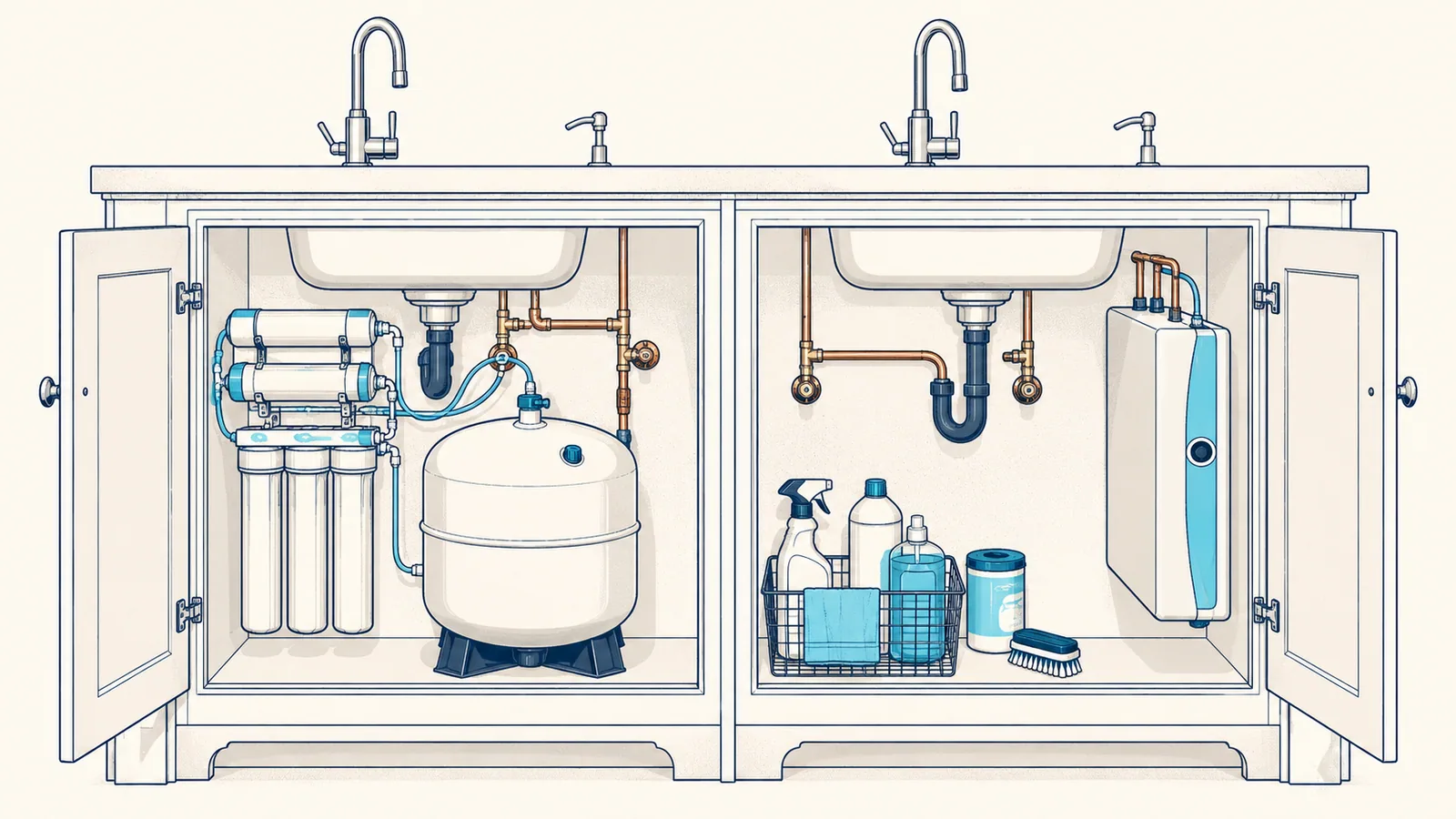
Neither wins outright, and the deciding factor is usually your cabinet. Tank systems pour instantly and need no electricity; tankless systems make water on demand, waste far less of it, and need an outlet. The tankless case is made most completely by the G3P800, which we take apart in our Waterdrop G3P800 review.
Tank system
- Pours instantly from a few stored gallons
- No electricity needed anywhere in the system
- Standard, often generic-compatible cartridges near $100 a year
- About 3 gallons to drain for every pure gallon
Tankless system
- Made on demand, up to 800 GPD on the G3P800
- 3 gallons pure per 1 gallon drained
- Frees the under-sink space but needs an outlet
- Proprietary filters: $159.97 a year on the G3P800
Bottom line
Cabinets with no outlet and buyers watching the running cost take the tank. Households that cook a lot, hate waiting and want the waste ratio flipped pay for tankless.
Real output on tankless units also drops with cold feed water or low pressure, which is the specification most product pages bury.
How Many Stages Do You Need?#
Four, covering the four jobs. Everything above that is either remineralization, which genuinely improves the taste, or a number printed on a box.
What each stage is for
- SedimentA cheap cartridge that protects everything downstream. Grit that reaches the membrane tears it.
- CarbonThe membrane's bodyguard. Chlorine destroys thin-film composite membranes, so this stage runs ahead of it, not after.
- RO membraneThe stage that makes it reverse osmosis. Everything before it exists to keep this one alive.
- PolishThe fourth core stage. A fifth or sixth stage is usually remineralization, which is what lifts flat RO water back to drinkable.
Stage order and the four core jobs as described in this guide. More stages is a spec-sheet arms race, not a quality guarantee.
What matters is which jobs are covered:
- 4 stages (Moen RO) covers the core: sediment, carbon, membrane, polish.
- 5 to 6 stages adds remineralization. The RCC7AK's sixth stage is an alkaline filter that restores minerals and lifts flat RO taste, and it is the reason we point most buyers to it over the cheaper 5-stage RCC7.
- Premium tankless stacks fold in UV sterilization and smart monitoring: the G3P800 pairs its UV stage with a faucet that displays live TDS.
If a system you are considering lacks remineralization, budget for taste: pure RO water reads noticeably flat to most palates. The SmartFlow includes its remineralizer at no extra charge, a genuine differentiator at $224.99. A live TDS readout is handy for watching the membrane, but it measures far less than it seems to, as our explainer on what TDS in water is and what a meter misses shows.
Which Reverse Osmosis System Should You Buy?#
Four systems cover the real buying situations, and each is named with its limits: the SmartFlow for most kitchens, the RCC7AK on a budget, the G3P800 for flow and efficiency, and the Moen RO for households already standardized on SpringWell. The full field, with the five-year cartridge arithmetic that decides between them, is ranked in best reverse osmosis systems; if you cannot drill a counter, the same comparison for plug-in units is in best countertop water filters.
Our top pick at a glance: Aquasana SmartFlow
as of Sep 28, 2026- Price
- $224.99 on sale ($449.99 list)
- Design
- Compact 3.2-gallon tank, remineralizer included
- Certification
- WQA to NSF/ANSI 42, 53 (P473), 58, 401
- Production
- 25.7 GPD
- Faucet flow
- 0.7 GPM
- Warranty
- 2 years + 90-day guarantee
Certifications, production and tank volume read from Aquasana's spec sheet and product page; price from its product page, Oct 5, 2026.
Aquasana
SmartFlow RO
- Contaminants reduced
- 99.99% of 90 contaminants
- PFAS / fluoride / arsenic
- 96% PFAS (P473), 90% fluoride, 96% arsenic
- Production
- 25.7 gallons/day
- Faucet flow
- 0.7 GPM
- Design
- Compact holding tank (3.2 gallons total, 1.4 to 3.2 usable), remineralizer included
- Filter schedule
- Cartridges 6 months, membrane 12 months
- Stages
- N/A
- Certification
- N/A
- Waste ratio
- N/A
- Annual filter cost
- N/A
- Extras
- N/A
- Pure-to-drain ratio
- N/A
- Bundle option
- N/A
- Replacement filters
- N/A
iSpring
iSpring RCC7AK
- Contaminants reduced
- N/A
- PFAS / fluoride / arsenic
- N/A
- Production
- N/A
- Faucet flow
- N/A
- Design
- N/A
- Filter schedule
- N/A
- Stages
- 6 (with alkaline remineralization)
- Certification
- NSF/ANSI 58
- Waste ratio
- ~1:3 (classic tank design)
- Annual filter cost
- ~$100 to 110
- Extras
- N/A
- Pure-to-drain ratio
- N/A
- Bundle option
- N/A
- Replacement filters
- N/A
Waterdrop
Waterdrop G3P800
- Contaminants reduced
- N/A
- PFAS / fluoride / arsenic
- N/A
- Production
- 800 GPD, tankless
- Faucet flow
- N/A
- Design
- N/A
- Filter schedule
- N/A
- Stages
- N/A
- Certification
- N/A
- Waste ratio
- N/A
- Annual filter cost
- $159.97
- Extras
- Smart TDS faucet; UV is claimed on some Waterdrop pages for this model and denied on others
- Pure-to-drain ratio
- 3:1
- Bundle option
- N/A
- Replacement filters
- N/A
Moen
Moen RO
- Contaminants reduced
- 86 (incl. arsenic, fluoride, chlorine, lead, mercury, bacteria, viruses)
- PFAS / fluoride / arsenic
- N/A
- Production
- N/A
- Faucet flow
- N/A
- Design
- N/A
- Filter schedule
- N/A
- Stages
- 4
- Certification
- N/A
- Waste ratio
- N/A
- Annual filter cost
- N/A
- Extras
- N/A
- Pure-to-drain ratio
- N/A
- Bundle option
- Moen RO + Sip Faucet from $520
- Replacement filters
- $55.11 (stages 1 to 2) to $132.60 (membrane)
Prices checked Oct 9, 2026.
Aquasana SmartFlow, best overall value. The certification list (NSF/ANSI 42, 53 with P473, 58, 401, CSA B483.1) embarrasses systems at twice the price, the remineralizer is included, and the compact 3.2-gallon tank saves cabinet space. Its limits are honest ones: 0.7 GPM faucet flow, 25.7 gallons per day of production, and Aquasana's brand-level service reputation (Trustpilot 1.5 out of 5 across 170 reviews as of Aug 28, 2026), the same record we document in the Aquasana Rhino review.
iSpring RCC7AK, best budget tank system. Ranked #2 in Amazon's Under-Sink & Countertop Filtration category on Oct 5, 2026, with 21,596 ratings, NSF/ANSI 58 certified, DIY-friendly top-mount bracket, and generic-compatible cartridges that keep running costs near $100 to $110 per year. It read $239.99 on iSpring's own store on Oct 12, 2026, against a struck-through $241.99, the flat price it charged on Sep 12, so the strikethrough discounts $2. The classic 1:3 waste ratio is the design tax.
Waterdrop G3P800, best premium tankless. 800 GPD on demand, UV stage, smart TDS faucet, 3:1 efficiency, 3-second filter swaps. You pay $999 up front (as of Sep 12, 2026, with the $759 promotional price no longer running), then $159.97 per year forever in proprietary filters, and it stops making water in a power outage.
Moen RO, best for SpringWell households. 86 contaminants reduced, 4 stages, and one support channel if your whole-house equipment is already SpringWell, which is worth something if you have read our SpringWell versus Aquasana comparison and landed on SpringWell. At $363.80 (as of Sep 12, 2026) it costs more than the better-certified SmartFlow, and with only 7 reviews on the SpringWell site at our reading, social proof is thin. Buy it for the ecosystem, not the spec sheet.
Before you order an under-sink RO
6 itemsWhat Does an RO System Cost to Run?#
Between roughly $100 and $160 a year, depending entirely on whether the cartridges are a standard format or proprietary. The purchase price is half the story; the membrane and filters are a subscription in disguise.
| System | Annual filter cost | Notes |
|---|---|---|
| iSpring RCC7AK | about $100 to $110 | Generic-compatible cartridges keep it cheapest |
| Aquasana SmartFlow | cartridges every 6 months, membrane every 12 | Proprietary; replacements generally non-commissionable, price varies |
| Waterdrop G3P800 | $159.97 | Proprietary twist-in filters, fixed schedule |
| Moen RO | $55.11 to $132.60 per cartridge | Four proprietary cartridges; membrane is the $132.60 item |
Readings as of Sep 12, 2026, except the iSpring price, re-read Sep 1, 2026. Two patterns are worth internalizing: tank systems with standard cartridge formats cost the least to feed, and every tankless system locks you into its own filters. Our five-year breakdown of what reverse osmosis really costs adds installation and the whole-house end to these filter figures.
Do You Need a Whole House Reverse Osmosis System?#
Almost certainly not. For the overwhelming majority of homes, the right architecture is a whole-house filter or softener for the water you live in, plus an under-sink RO for the water you drink.
Whole-house RO exists for genuine edge cases (extreme TDS, certain well contaminations) and it is specialist equipment with specialist costs: residential whole-house RO starts around $2,227 at Crystal Quest (as of Sep 12, 2026) before pretreatment, storage, and installation, and HomeGuide's 2026 range for whole-house RO installed is $4,800 to $8,000 (read Oct 12, 2026). If chlorine, taste, or scale at every tap is what you are solving, a whole house filter or a correctly sized softener does it for a fraction of the money, and the tank system we recommend most often is broken down in our SpringWell CF Series review. If the edge case is a private well, start from the well water treatment guide, where an under-sink RO is the last stage of a longer stack. And if salt is restricted where you live, a salt-free conditioner plus an RO at the sink is the usual workaround.
The Verdict#
Buy reverse osmosis for the water you drink, not the water you live in. Most kitchens are best served by the SmartFlow ($224.99 on sale, Oct 5, 2026); tight budgets and outlet-free cabinets should take the iSpring RCC7AK; big water-drinking households that want flow and efficiency should pay for the G3P800. Pair whichever you choose with the right whole-house equipment for your actual water problem: a filter and softener combo if you have both chlorine and scale, the hardness lookup if you do not yet know which, or our system matcher if you would rather answer six questions than read six pages.
Frequently asked questions
Does reverse osmosis remove PFAS?
Certified systems do. The Aquasana SmartFlow, for example, is WQA certified to NSF/ANSI 53 including the P473 PFAS protocol, with a 96 percent PFAS reduction claim. Certification is the key word: check each model against the NSF or WQA listings database, because tested to a standard is not the same as certified to it.
Does a reverse osmosis system waste water?
Some water always goes to drain carrying the rejected minerals, but the ratio varies enormously by design. A classic tank system like the iSpring RCC7AK sends roughly 3 gallons to drain per gallon of pure water, while a modern tankless unit like the Waterdrop G3P800 flips that to 3 gallons pure per 1 gallon drained.
Does reverse osmosis remove healthy minerals?
Yes. The membrane rejects dissolved minerals indiscriminately, including calcium and magnesium, which is why pure RO water can taste flat. That is what remineralization stages are for: the SmartFlow includes one at no extra charge and the 6-stage iSpring RCC7AK adds an alkaline post-filter for the same reason.
Is a reverse osmosis system hard to install?
Most under-sink systems are designed for DIY installation with a drilled faucet hole, a cold-line tee, and a drain saddle. The iSpring RCC7AK's top-mounted bracket design is one reason it became Amazon's best seller. Tankless units simplify the footprint further but need an electrical outlet under the sink.
How often do RO filters need replacing?
Plan on prefilters and postfilters roughly every 6 to 12 months and the membrane every 1 to 2 years, by model. In dollars per year based on dated readings: about $100 to $110 for the iSpring RCC7AK, $159.97 for the Waterdrop G3P800, and $55.11 to $132.60 per Moen RO cartridge, with the membrane at the top of that range.
Published in this section
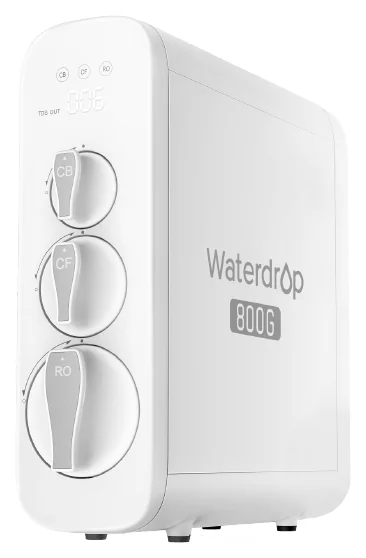
Waterdrop G3P800 Review 2026: The Tankless Benchmark, on the Numbers
Read the review
Best Countertop Water Filters 2026: Certified Picks for Renters
Read the buyer's guide
Best Under Sink Water Filters 2026: RO vs Carbon for Every Budget
Read the buyer's guide
Best Reverse Osmosis Systems 2026: Every Budget, Ranked on the Specs
Read the buyer's guide
Whole House Reverse Osmosis Systems: Do You Actually Need One?
Read the guideKeep reading
Not sure what you need?
Answer 5 questions, get the right system for your water.
City or well, budget, household size, our quiz matches your answers against every system we track.