Whole House Sediment Filters: Micron Ratings, Types and Top Picks
A sediment filter protects everything downstream of it. Which micron rating to choose, where it goes on a well, and what a reusable screen costs to run.
By Home Water Lab TeamUpdated Prices verified Oct 7, 2026
This page contains affiliate links; buying through them costs you nothing extra.
A sediment filter is the cheapest part of a water treatment system and the one that decides how long the expensive parts last. It doesn't remove anything you can taste, anything dissolved, or anything on your water report. It stops sand, rust and scale flakes from reaching a softener valve, a carbon bed or a membrane.
The short answer
as of Sep 21, 2026What does a whole house sediment filter do, and which one should you buy?
It strains out suspended particles: sand, silt, rust and loose scale. It does nothing about hardness, chlorine or anything dissolved. On a well, run two stages: a reusable spin-down screen at 50 to 100 micron, then a 5 to 20 micron cartridge. The iSpring WSP-50SL at $79.99 covers the first stage and is flushed rather than replaced, in 50 through 1,000 micron on the same body. On city water, one spin-down screen ahead of the softener or the carbon tank is usually enough.
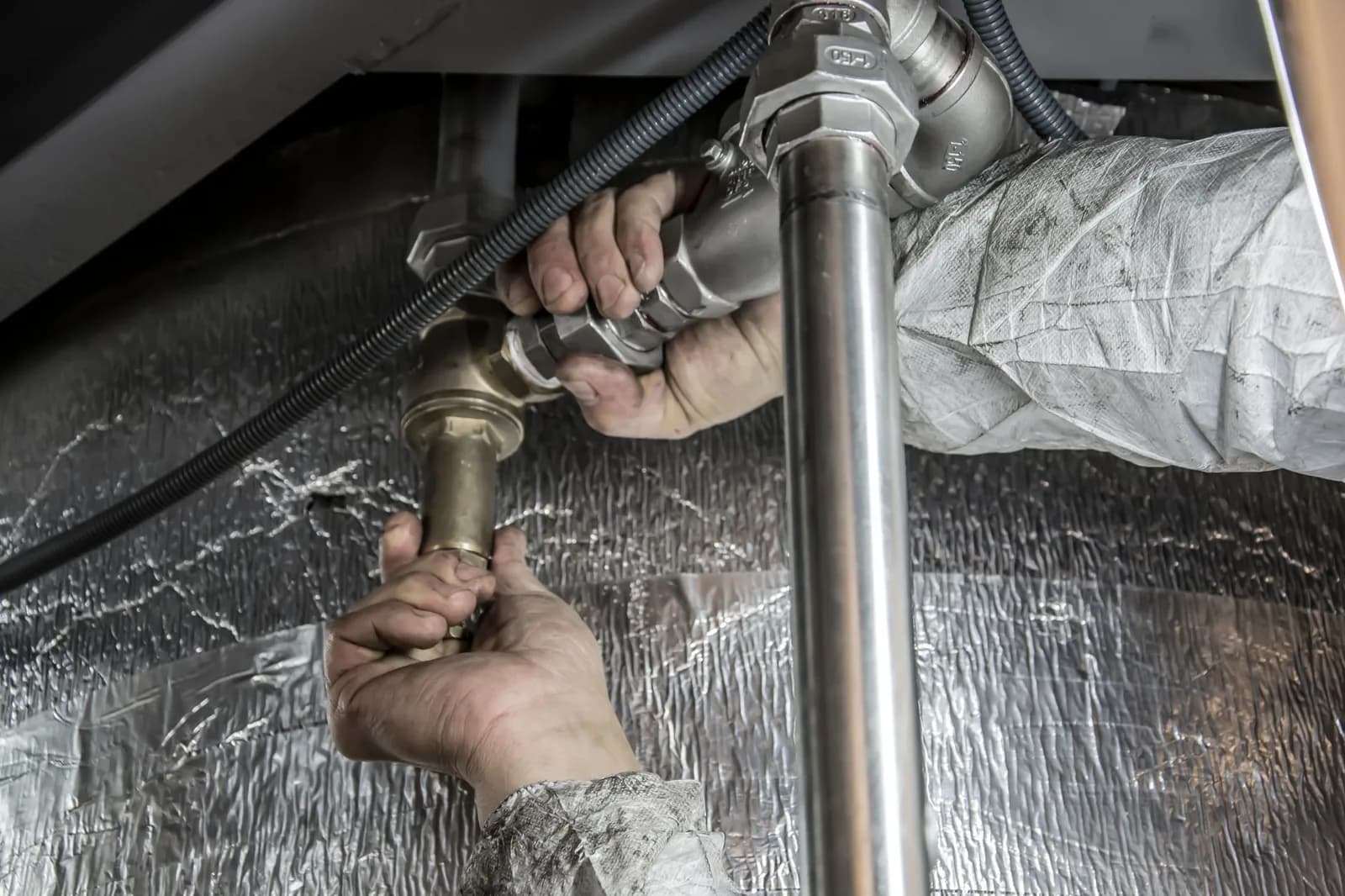
Sediment filtration is the first stage of the treatment train described in the whole house water filter hub, and on a private well it is the stage that everything else depends on, as the well water treatment sequence sets out.
Key takeaways
- A sediment filter is protection, not treatment. Nothing dissolved is affected: not hardness, not chlorine, not iron in solution.
- Two stages on a well: a 50 to 100 micron spin-down screen, then a 5 to 20 micron cartridge behind it.
- A reusable screen is flushed rather than replaced, so its running cost is effectively zero: the iSpring WSP-50SL read $79.99 on Sep 21, 2026.
- Pressure drop is the maintenance signal. A calendar date is a poor substitute for noticing the shower weaken.
- On a well it goes after the pressure tank, never between the pump and the tank.
Micron Ratings, and Why Finer Is Not Better#
A micron rating is the size of particle a filter is built to stop. Lower numbers catch more, and clog faster, and the whole skill in specifying sediment filtration is refusing to over-filter at the first stage.
Size decides what a filter can reach
- Spin-down screen50 to 1000 micronA reusable stainless mesh that stops sand, rust flakes and pipe scale. It is flushed rather than replaced, which is why it costs almost nothing to run and why it is the right first line on a well.
- Sediment cartridge1 to 50 micronThe pleated or spun cartridge in a standard housing. It takes the silt a screen lets through, and it is the part that protects the carbon and the softener resin behind it.
- Carbon block0.5 to 10 micronRated in the same range on paper, but it works by adsorption rather than straining: this is the stage that takes chlorine, taste and odour, and on certified blocks lead and PFAS.
- RO membrane0.0001 micronThree orders of magnitude below everything else on this chart, which is why reverse osmosis is the only stage here that reaches dissolved solids at all.
Particle sizes are public orders of magnitude, not a measurement of your water. A sediment stage removes nothing dissolved, which is why hardness sits off the left edge of this chart and stays in the water regardless of the rating you choose.
For reference points on that scale: fine sand sits in the hundreds of microns, a human hair is tens of microns across, and bacteria are measured in single figures. A 50 micron screen is therefore invisible to nothing you would call dirt, and entirely open to everything dissolved.
The Three Types, and What Each Is For#
Spin-down screens, the one that pays for itself#
A stainless mesh in a clear bowl with a flush valve at the bottom. Nothing is replaced: you open the valve, the accumulated grit leaves with a litre of water, and the screen goes back to work.
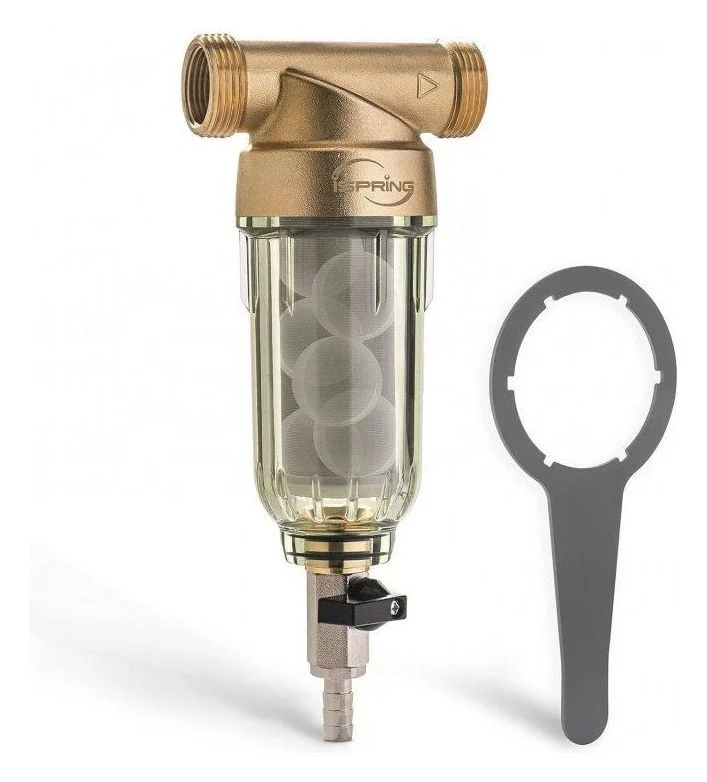
iSpring
iSpring WSP-50SL Reusable Spin-Down Sediment Prefilter
Best for: Putting a flushable, never-replaced screen in front of a softener, an iron filter or a cartridge stack
- Micron options
- 50, 100, 200, 500 and 1,000 on the same body
- Ports
- 1 in MNPT and 3/4 in FNPT, both ends
- Pressure range
- 20 to 100 PSI
- Temperature range
- 40 to 100 F
- Screen
- Reusable 316L stainless, flushed by valve
- Siliphos cartridge
- Replace every 3 to 6 months
The iSpring WSP-50SL read $79.99 on Sep 21, 2026 and the same body ships in 50, 100, 200, 500 and 1,000 micron, which is how you match it to a well rather than hoping. It takes 1 in MNPT and 3/4 in FNPT at both ends, works between 20 and 100 PSI and 40 to 100 °F, and carries a Siliphos cartridge for scale and corrosion that is the one consumable in the assembly, on a 3 to 6 month schedule.
Two honest caveats. Flushing on this model is manual, and a screen nobody flushes is a screen that blinds over, which turns your protective device into your pressure problem. And iSpring did not publish a warranty length on the product page at our reading, so we are not quoting one.
Cartridge housings, the fine stage#
A pleated or spun-polypropylene cartridge in a standard housing, typically 5 to 20 micron, replaced every 3 to 6 months. This is what catches what a screen lets through, and it is the stage most people think of as "the sediment filter".

iSpring
iSpring WGB32B 3-Stage Whole House Filter
Best for: The cartridge-filter entry into whole-house filtration, lowest upfront cost, highest recurring cost
- Type
- 3-stage Big Blue cartridge whole-house filter
- Stages
- 5-micron sediment + 2 carbon blocks, 20" x 4.5"
- Flow rate
- Up to 15 GPM (iSpring)
- Pressure
- 25 to 80 psi
- Ports
- 1" female NPT
- Cartridge cost
- $126 to $252/yr (our arithmetic on iSpring prices)
The iSpring WGB32B is worth knowing here because it bundles the sediment stage with two carbon stages in one three-housing assembly at $516.99 (read Sep 14, 2026). Its official replacement pack, the F3WGB32B, read $125.99, and at one to two sets a year the cartridge line is what decides its ten-year cost, as worked through in our whole house water filter cost guide.
Built-in prefilters, on tank systems#
Most whole-house tank systems arrive with their own sediment stage. The SpringWell CF1 carries a 5 micron pre-filter changed every 6 to 9 months at about $40 a year, which is why its running cost is the lowest of the systems we track.
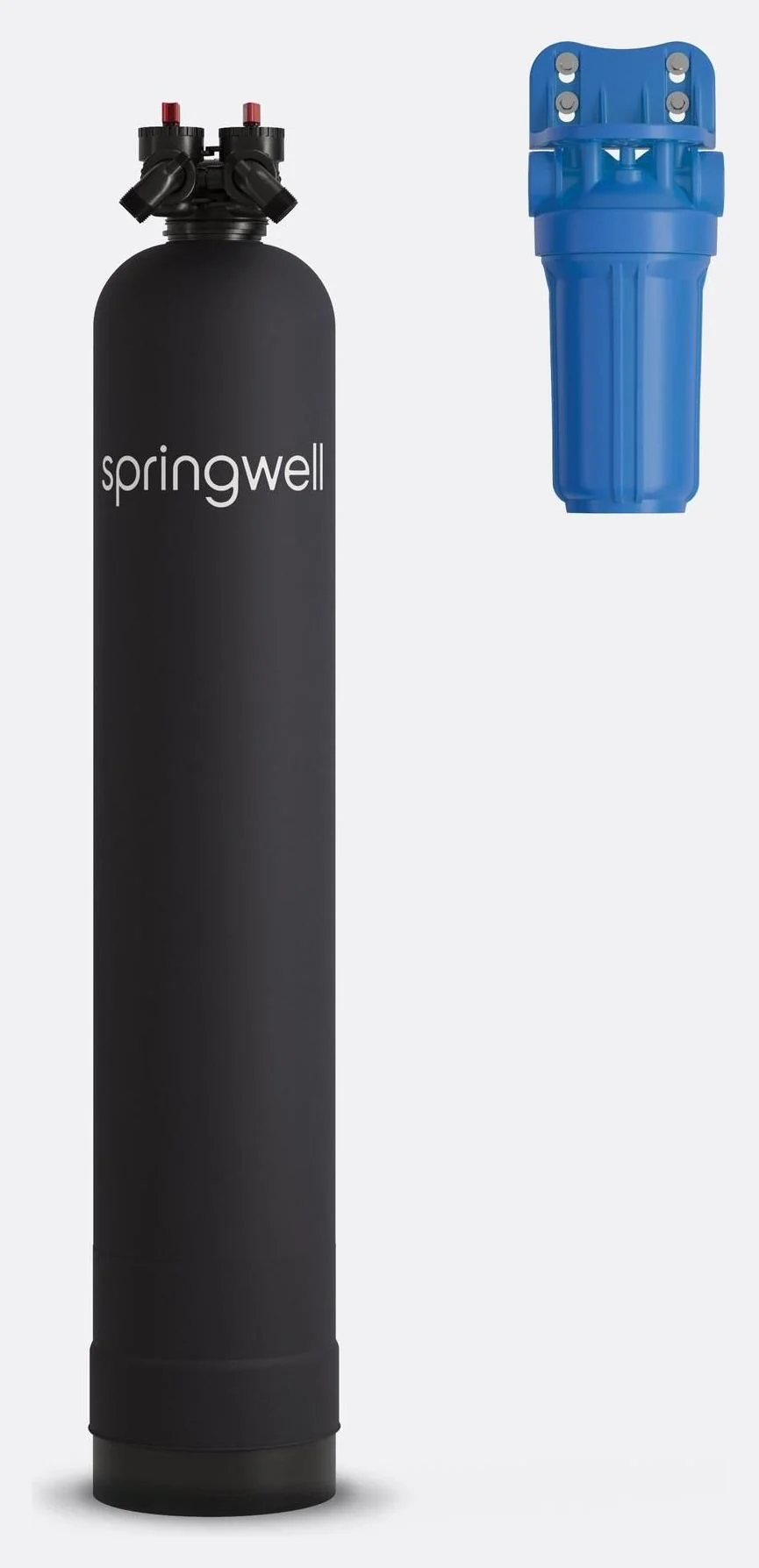
SpringWell
SpringWell CF1 Whole House Water Filter
Best for: City-water homes that want chlorine, chloramine and PFAS handled house-wide with the lowest 10-year cost of ownership
- Capacity
- 1,000,000 gallons / ~10 years
- Flow rate
- 9 GPM
- Bathrooms
- 1 to 3
- Media
- Catalytic carbon + KDF + sediment, 4 stages
- Reduces
- Chlorine, chloramine, PFAS/PFOA/PFOS, VOCs
- Sediment pre-filter
- Replace every 6 to 9 months (~$40/yr)
If you are buying a tank system anyway, you may not need a separate sediment housing at all. On a well you still want a coarse screen ahead of it.
Where It Goes in the Line#
Order matters more than brand here, and one mistake is common enough to be worth naming.
Position, on a well and on city water
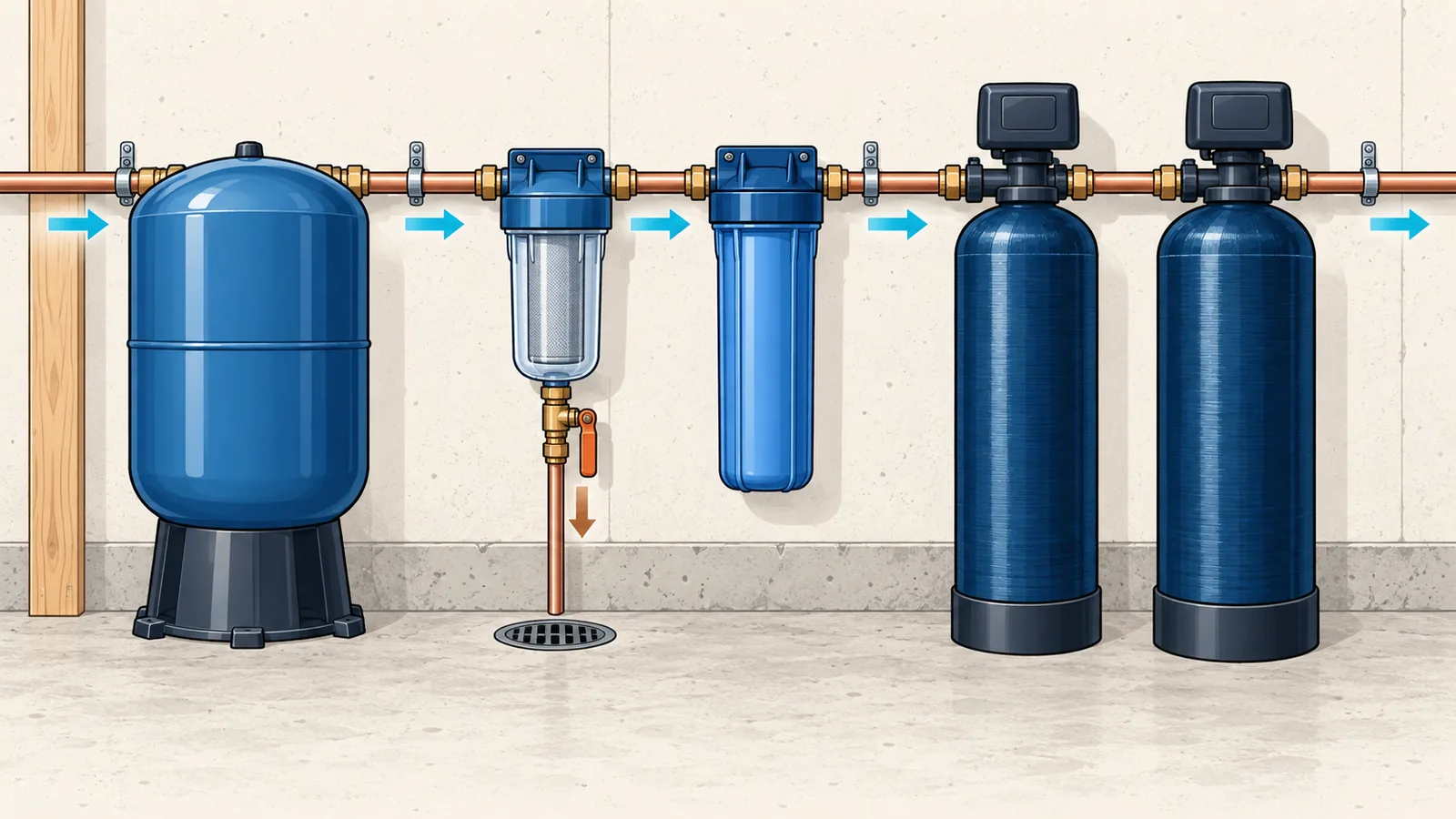
On a well: after the pressure tank
Never between the pump and the tank. A filter there adds pressure drop into the pump's control loop, which makes it short-cycle and shortens its life. After the tank, the whole house is protected.Coarse screen first
The spin-down goes in front, taking sand and grit that would blind a cartridge in days.Fine cartridge second
5 to 20 micron, catching the silt the screen passes. This is the one on a replacement schedule.Then iron, then softening
On a well, iron removal comes before the softener, because iron fouls resin, and a fouled bed is the expensive half of the water softener you are protecting.Carbon last, before the house
Chlorine and taste treatment goes at the end of the treatment train, where the water reaching it is already clear.
On a private well, the product question comes next, and our guide to which screen or cartridge to buy for a private well weighs a manual spin-down against a self-flushing one and a backwashing tank.
What you hear
A finer sediment filter gives me cleaner water.
What the numbers say
It gives you the same water and a faster pressure drop. Sediment filtration is a staging problem: a coarse screen doing the heavy lifting is what lets a fine cartridge last its rated life. Skipping the coarse stage on a well does not produce cleaner water, it produces a cartridge you replace monthly.
What It Costs to Run#
Sediment protection, five years
as of Sep 21, 2026- iSpring WSP-50SL spin-down screenBought once; the stainless screen is flushed, not replaced
- $79.99
- Siliphos cartridges, 5 yearsThe one consumable in the assembly, on a 3 to 6 month schedule at iSpring's published interval
- about $100 to $200
- Fine cartridges, if you run a second stageStandard 5 to 20 micron cartridges, price depends on housing size and how fast your water loads them
- $40 to $120 / yr
- InstallationA threaded inline fitting is a realistic DIY job; a plumber charges for cutting into the main line
- $0 to $300
Five-year range
$79.99
Equipment price is a dated manufacturer reading. Cartridge ranges are our arithmetic on published intervals and typical cartridge prices, not a quote. Your sediment load decides where in the range you land.
Set against that: a softener resin bed fouled by grit, a carbon tank blinded early, or an RO membrane torn by a particle. Put beside the cost of a water softener or the membrane systems in our best reverse osmosis ranking, the sediment stage is the cheapest insurance in the whole category, which is why it appears in every system we recommend rather than as an upsell.
When a Sediment Filter Is Not the Answer#
If the water is cloudy and a sediment filter doesn't fix it, the cloudiness probably isn't sediment.
Air. Water that clears from the bottom up in a glass over thirty seconds is aerated, not dirty, and no filter addresses it.
Dissolved iron. Water that runs clear from the tap and turns orange in the glass or the toilet is ferrous iron in solution. It passes every sediment rating and needs oxidation, which is what an iron filter does and what our best iron filter for well water ranks.
Hardness. White crust on fixtures is scale, and no sediment stage touches it. That is a water softener or a salt-free conditioner, and the distinction is drawn properly in our hard water filter guide.
Iron bacteria. A slimy orange film in the toilet cistern is biological and needs shock chlorination rather than filtration. It will blind sediment cartridges repeatedly until it is dealt with at the well.
Prices, micron ranges, port sizes and service intervals read from each manufacturer's own page on the dates shown. Where a specification is not published, such as the warranty length on the WSP-SL, we say so rather than estimating.
Sediment filter questions people actually search
What is a spin-down sediment filter?
A reusable stainless mesh in a transparent bowl, fitted inline with a flush valve underneath. Instead of replacing a cartridge you open the valve and let the accumulated grit leave with a litre of water. It is the cheapest sediment stage to own because the screen itself is permanent.
Should a sediment filter go before or after the pressure tank?
After. A filter between the pump and the tank adds restriction inside the pump's control loop, which causes short-cycling and wears the pump. After the tank, the filter sees steady pressure and protects everything downstream.
How do I clean a sediment filter?
On a spin-down, open the flush valve with the supply on and let it run until the bowl clears, then close it. On a cartridge housing there is no cleaning worth doing: pleated cartridges can be rinsed once or twice, but the fine structure does not recover and replacement is the honest answer.
What size sediment filter do I need for a whole house?
Match the flow, not the house. A standard 10-inch housing chokes a busy three-bathroom home; a big-blue 20-inch housing or a properly sized spin-down keeps the pressure drop invisible. Size on the peak flow your fixtures demand, which our [softener sizing guide](/guides/what-size-water-softener-do-i-need) works through for softeners and applies equally here.
Will a sediment filter help with well water smell?
No. Rotten-egg smell is hydrogen sulfide gas, dissolved in the water, and it passes straight through any sediment rating. That is an oxidation problem, handled by an air-injection iron and sulfur filter rather than a screen.
Frequently asked questions
What is a sediment filter?
A physical barrier that stops suspended particles: sand, silt, rust flakes and loose scale. It doesn't remove anything dissolved, so it changes neither hardness nor chlorine nor taste. Its job is to protect what sits behind it, which is usually a carbon filter, a softener resin bed or a reverse osmosis membrane, all of which cost far more than the cartridge doing the protecting.
What micron sediment filter do I need for well water?
Two stages beat one. A coarse spin-down screen at 50 to 100 micron takes sand and grit and is flushed rather than replaced, then a 5 to 20 micron cartridge catches the fine silt behind it. Going straight to 5 micron on a sandy well means a cartridge that blinds in weeks. The iSpring WSP-50SL sells the same body in 50, 100, 200, 500 and 1,000 micron, which is how you match the screen to the well.
How often should you change a whole house sediment filter?
A cartridge lasts 3 to 6 months on typical city water and considerably less on a sediment-heavy well; pressure drop is the real signal, not the calendar. A reusable spin-down screen is never replaced at all, only flushed, which is why it costs almost nothing to run: iSpring suggests flushing daily to weekly depending on the load.
Where do you put a sediment filter for well water?
After the pressure tank and before everything else. Putting it between the pump and the tank makes the pump fight the filter's pressure drop and short-cycle. After the tank, it protects the softener, the iron filter and every appliance in the house, and it is the first thing in the treatment train.
Do I need a sediment filter on city water?
Not always, and it's still usually worth the $80. Municipal water arrives filtered, but the pipes between the plant and your house are not new: main breaks, hydrant flushing and old galvanised lines release rust and scale flakes. A spin-down screen catches those before they reach a cartridge stack or a softener valve.
Does a sediment filter reduce water pressure?
A clean one barely does. A loaded one does a great deal, and that's the point at which you flush or replace it. This is why a pressure gauge either side of the filter, or simply noticing when the shower weakens, is the practical maintenance schedule rather than a date in a calendar.
Keep reading
Not sure what you need?
Answer 5 questions, get the right system for your water.
City or well, budget, household size, our quiz matches your answers against every system we track.