Hard Water Filters: What Works, What Doesn't (Filter vs Softener)
No filter removes hardness. Here is what a hard water filter actually does, which three tools do work, and how to tell which one your water needs.
By Home Water Lab TeamUpdated Prices verified Oct 7, 2026
This page contains affiliate links; buying through them costs you nothing extra.
There is no such thing as a filter that removes hardness, and almost every product sold under that name is either a sediment filter, a carbon filter or a scale conditioner wearing the wrong label. Understanding which of the three you are looking at takes about two minutes, and it saves a great deal of money.
The short answer
as of Sep 21, 2026Does a hard water filter remove hardness?
No. Hardness is dissolved calcium and magnesium: ions far smaller than the pores of any sediment or carbon cartridge, which pass straight through and arrive at your tap unchanged. Three tools do work, and only three. A salt-based softener removes the minerals by ion exchange, which is the only true fix. A salt-free conditioner leaves them dissolved but stops most scale from sticking. A reverse osmosis membrane removes them at one tap, and one tap only. Everything else marketed for hard water treats the symptoms next to it, not the hardness.
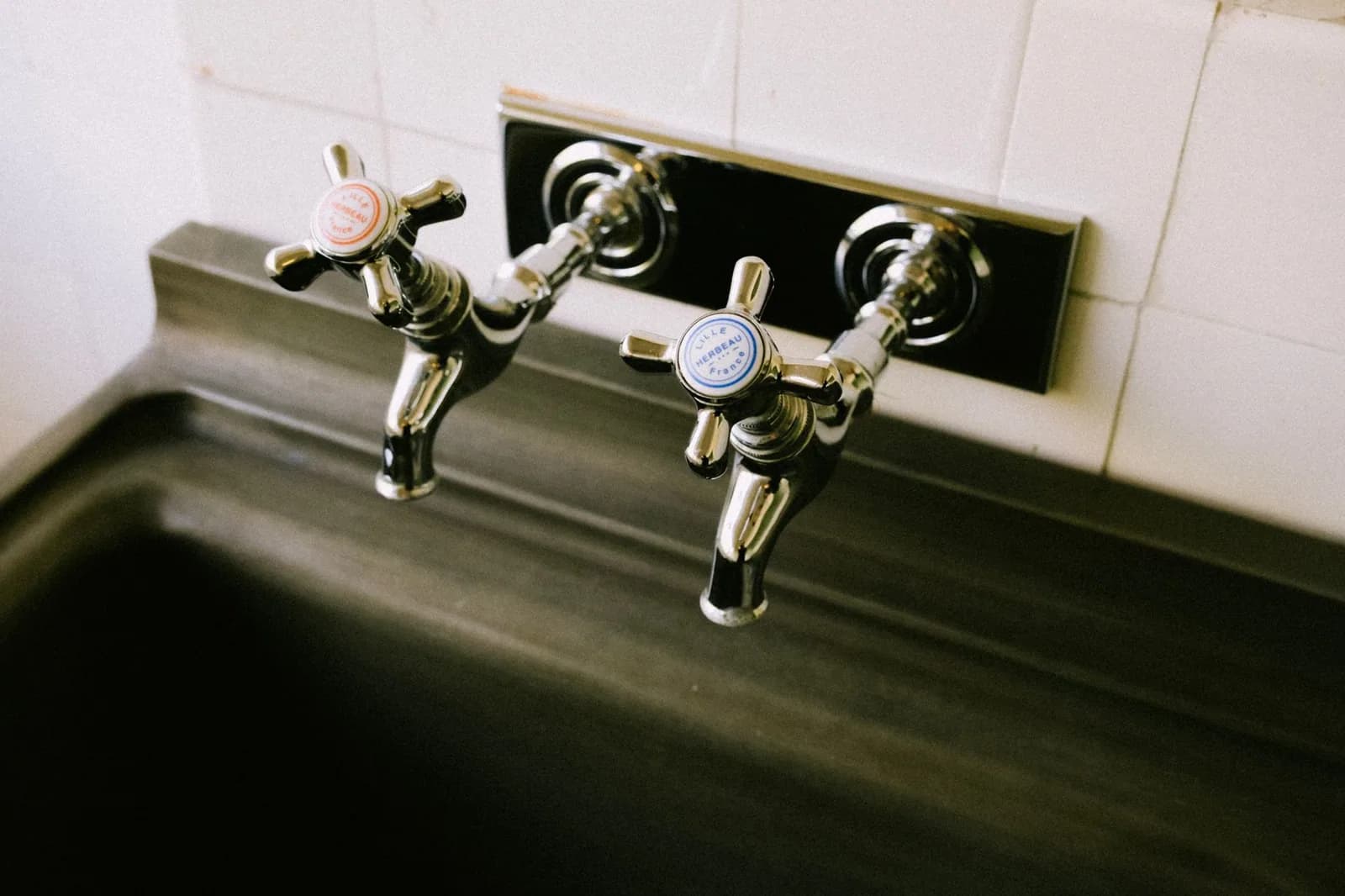
If you have landed here after searching for a filter, you are in good company: it is the most common wrong turn in the whole category, and the hard water hub exists because of it. This page explains why the wrong turn happens, what each real tool does, and how to choose between them on your own numbers.
Key takeaways
- Hardness is dissolved, not suspended. Every cartridge rating on the market is measured in microns; dissolved ions are orders of magnitude smaller.
- A salt-based softener is the only device that lowers the grains-per-gallon number in the whole house.
- A salt-free conditioner stops scale sticking without changing hardness: over 88% scale reduction in WateReuse testing, and the test strip still reads hard.
- Sediment and carbon filters are worth owning for their own reasons, none of which is hardness.
- Get your hardness figure first. The USGS calls water above about 10.5 grains per gallon very hard, and that threshold changes the recommendation.
Why No Filter Can Remove Hardness#
Filtration is a size problem. A cartridge stops what is bigger than its pores and passes what is smaller, and hardness minerals are dissolved in the water rather than floating in it. That puts them below the reach of every rating printed on a filter box.
Size decides what a filter can reach
- Spin-down screen50 to 1000 micronA reusable stainless mesh that stops sand, rust flakes and pipe scale. It is flushed rather than replaced, which is why it costs almost nothing to run and why it is the right first line on a well.
- Sediment cartridge1 to 50 micronThe pleated or spun cartridge in a standard housing. It takes the silt a screen lets through, and it is the part that protects the carbon and the softener resin behind it.
- Carbon block0.5 to 10 micronRated in the same range on paper, but it works by adsorption rather than straining: this is the stage that takes chlorine, taste and odour, and on certified blocks lead and PFAS.
- RO membrane0.0001 micronThree orders of magnitude below everything else on this chart, which is why reverse osmosis is the only stage here that reaches dissolved solids at all.
Particle sizes are public orders of magnitude, not a measurement of your water. Dissolved calcium and magnesium ions are smaller than the finest band drawn here, which is why only a reverse osmosis membrane or an ion-exchange resin reaches them at all.
Look at the spread. A spin-down screen works in the tens and hundreds of microns, a sediment cartridge in the ones and tens, a carbon block around half a micron. Reverse osmosis is three orders of magnitude finer, and that is the first stage on the chart that touches dissolved content at all.
What you hear
This whole house filter is rated for hard water, so it will soften my water.
What the numbers say
It will not. A whole-house carbon filter removes chlorine, chloramine, VOCs and PFAS, and leaves your hardness reading identical. The phrase 'for hard water' on a filter box usually means the cartridge tolerates hard water without clogging quickly, which is a durability claim about the filter, not a treatment claim about your water.
What People Are Actually Buying When They Buy a "Hard Water Filter"#
Three products, all legitimate, none of them a hardness treatment.
A sediment prefilter. A screen or cartridge that stops sand, rust and flakes of scale that have already broken loose inside old pipes. On a well it is essential; on city water it protects whatever sits downstream. The reusable spin-down type is flushed rather than replaced, so it costs almost nothing to run.
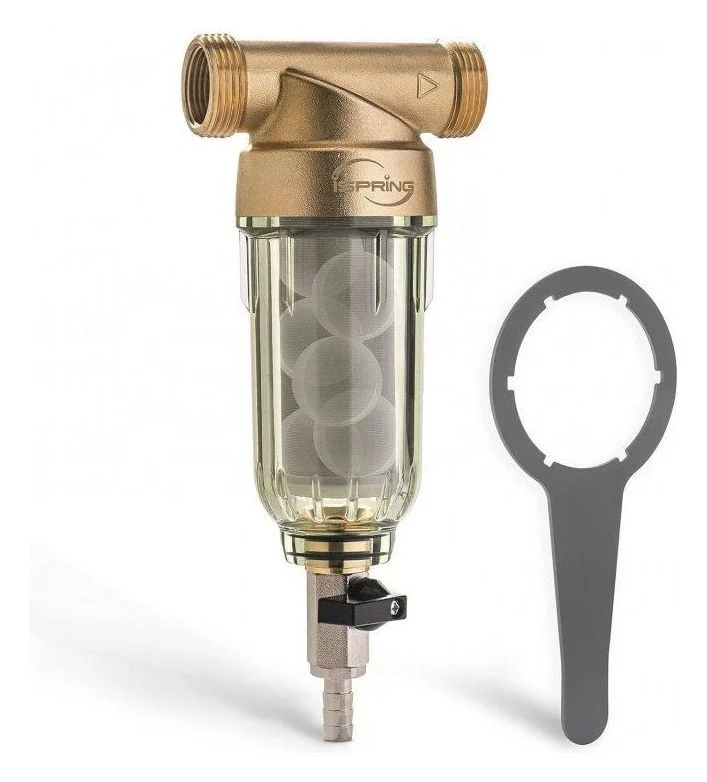
iSpring
iSpring WSP-50SL Reusable Spin-Down Sediment Prefilter
Best for: Putting a flushable, never-replaced screen in front of a softener, an iron filter or a cartridge stack
- Micron options
- 50, 100, 200, 500 and 1,000 on the same body
- Ports
- 1 in MNPT and 3/4 in FNPT, both ends
- Pressure range
- 20 to 100 PSI
- Temperature range
- 40 to 100 F
- Screen
- Reusable 316L stainless, flushed by valve
- Siliphos cartridge
- Replace every 3 to 6 months
This is a good purchase for the right reason. It is the cheapest insurance you can put in front of a softener, an iron filter or a cartridge stack, and our whole house sediment filter guide covers the sizing and micron choice. It does nothing whatsoever about hardness.
A carbon filter. Chlorine, chloramine, taste, odour, and on certified blocks lead and PFAS. Owners frequently report that water "feels better" after installing one, which is real and is about chlorine rather than hardness. The rankings live in our best whole house water filter guide.
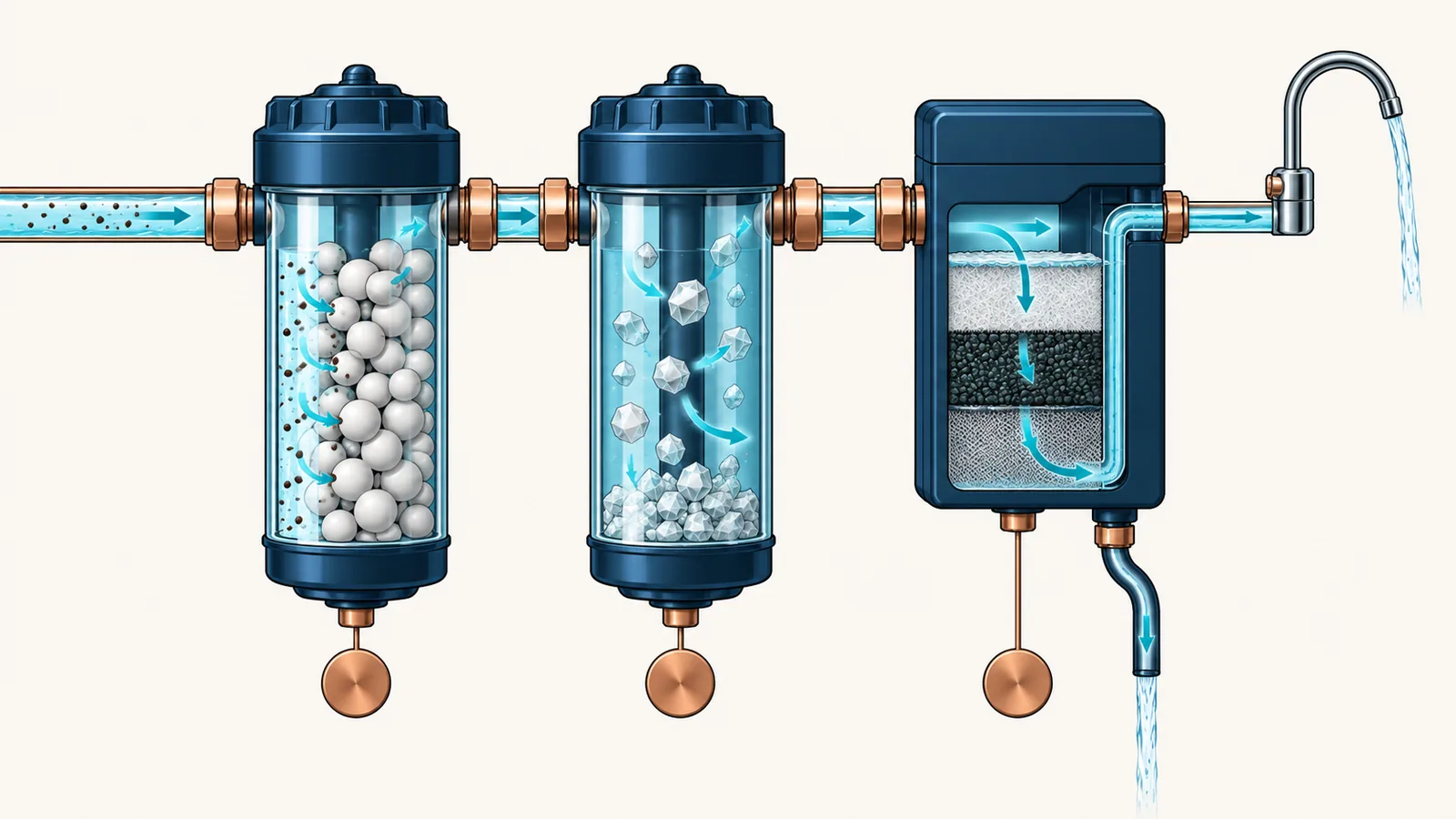
A scale conditioner in a filter-shaped tank. This is the genuine near-miss. A conditioner sits in the main line in a vessel that looks exactly like a carbon tank, and it does address scale. It simply does not remove anything.
The Three Things That Do Work#
1. A salt-based softener, the only real fix#
Ion exchange swaps calcium and magnesium for sodium on a resin bed, then flushes the captured hardness away with brine on a regeneration cycle. The water that comes out tests soft, because the minerals are genuinely gone.
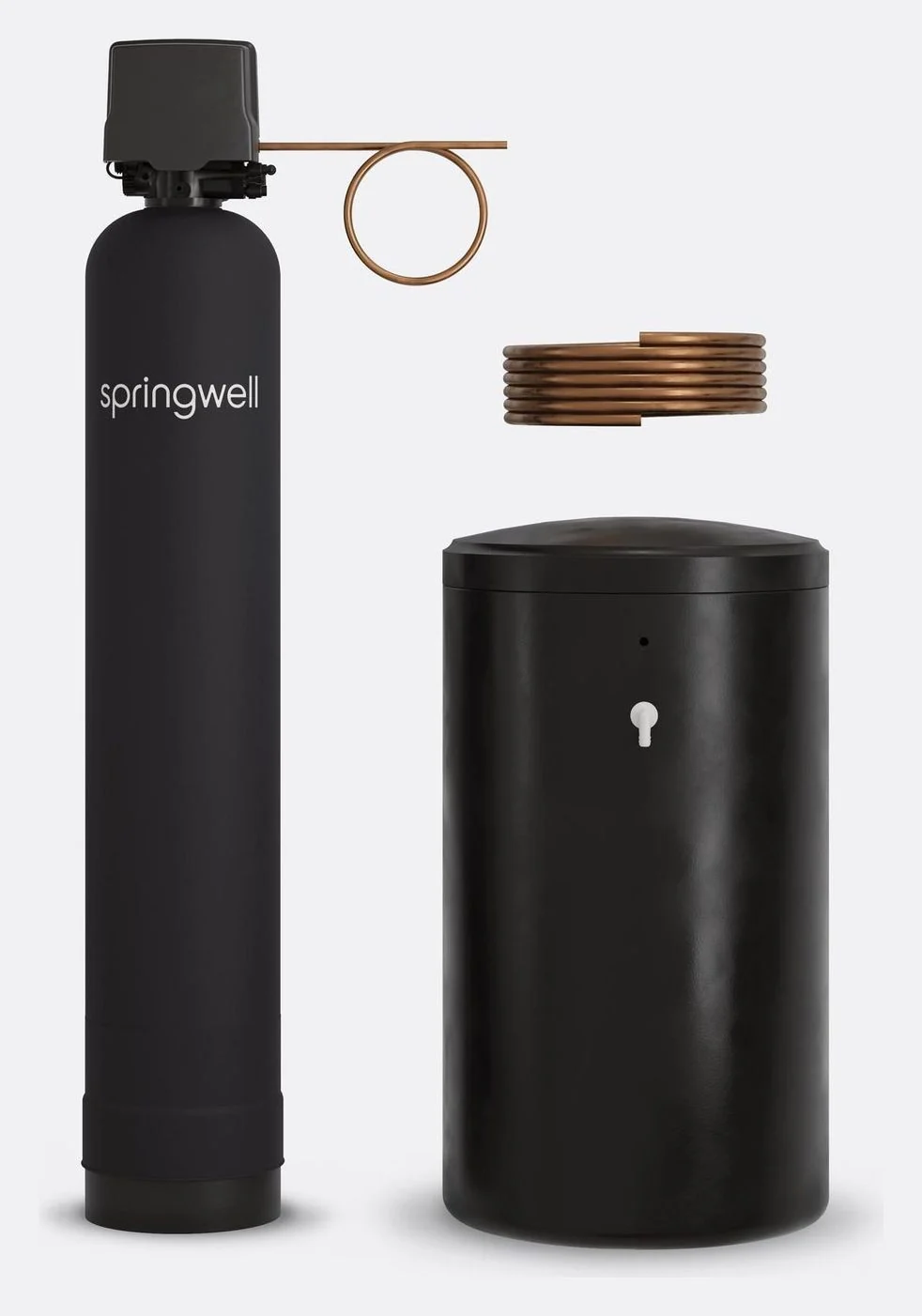
SpringWell
SpringWell SS1 Salt Based Water Softener
Best for: Homes with 1 to 3 bathrooms on hard city water that want true ion-exchange softening at a factory-direct price
- Grain capacity
- 32,000
- Service flow
- 11 GPM
- Bathrooms
- 1 to 3
- Tank
- 9" × 48" (57" with head)
- Connection
- 1"
- Brine tank
- 18" × 33" round (~200 lb salt)
That is the whole-house answer: soap lathers, spotting stops, and scale stops accumulating in the heater. The costs are honest and worth knowing before you commit: salt at roughly $50 to $150 a year per HomeGuide's 2026 figures, a drain connection, and a regeneration cycle that sends water down it. The full picture is in our water softener cost guide, and sizing is worked through in what size water softener do I need.
2. A salt-free conditioner, when brine is not an option#
Template-assisted crystallization turns dissolved hardness into microscopic crystals that stay suspended instead of bonding to hot metal. Independent WateReuse Research Foundation testing put scale reduction above 88%, and the test strip afterwards reads exactly as hard as before.
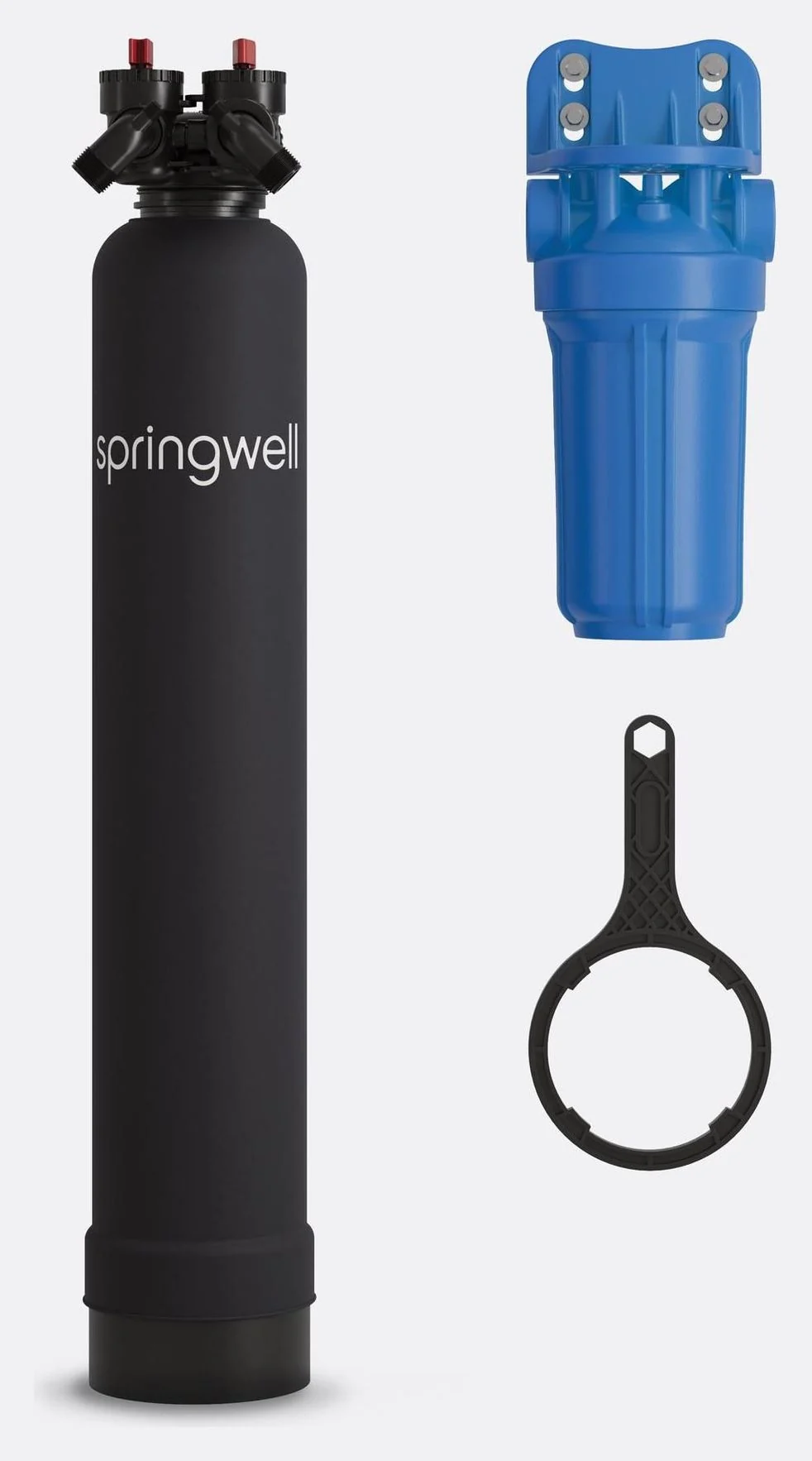
SpringWell
SpringWell FutureSoft FS1 Salt-Free Water Conditioner
Best for: City-water homes that want scale prevention without salt, a drain or electricity, not for anyone expecting soft-feeling water
- Technology
- TAC (Template Assisted Crystallization)
- Flow rate
- 12 GPM
- Bathrooms
- 1 to 3
- Tank
- 6" × 35"
- Max hardness
- 81 GPG
- Scale prevention
- Up to 95% (manufacturer claim)
The budget door into the same category is the Aquasana SimplySoft, which read $879 on Sep 21, 2026 under a half-off banner that lists it at $1,758. Choose this route when your municipality restricts brine discharge, when there is no drain where the equipment goes, or when zero maintenance matters more than a soft-water feel. Choose it knowing what it does not deliver, which is set out in salt-based vs salt-free.
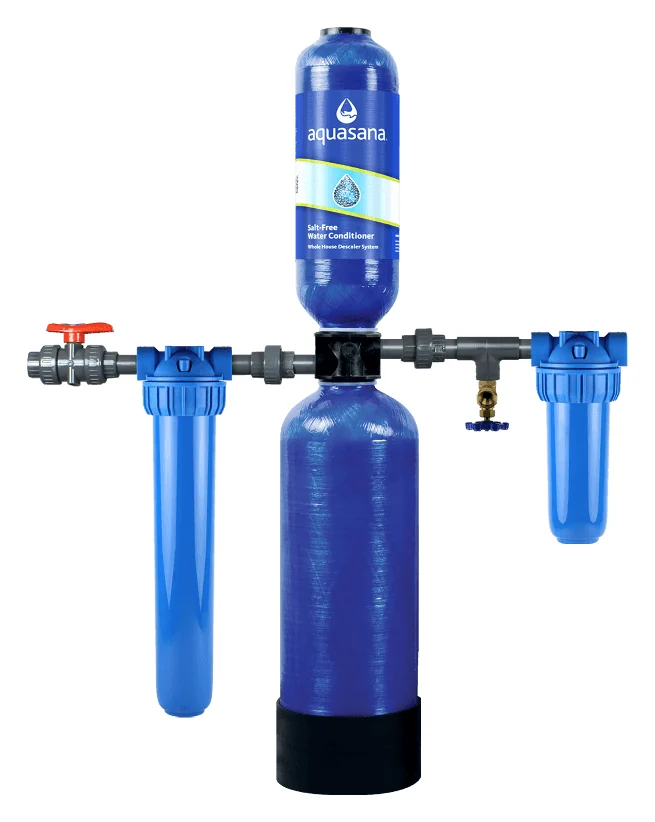
Aquasana
Aquasana SimplySoft Salt-Free Water Conditioner
Best for: City-water homes that want low-cost scale control without salt, and understand it is not a softener
- Technology
- SCM (Scale Control Media)
- Capacity
- 1,000,000 gallons / 10 years
- Flow rate
- 7.0 GPM nominal / 15.3 GPM peak
- Operation
- No salt, no electricity, no drain, no backflush
3. Reverse osmosis, for one tap#
A membrane does remove hardness, and it removes it from the water that reaches a single faucet under the sink. That is useful for drinking and cooking and irrelevant to the water heater, the shower and the dishwasher. If drinking water is the actual complaint, the best reverse osmosis systems page ranks them.
Which One Does Your Water Need?#
Four questions, in this order
What is your hardness number?
Consumer Confidence Report, supplier lookup or a test strip. Below about 3.5 grains per gallon the USGS calls water moderately hard at most and equipment is hard to justify. Above 10.5 it is very hard and the case makes itself.Is the complaint scale, or feel?
Scale on the kettle and in the heater is what a conditioner addresses. Slippery lather, spot-free glasses and less soap is what only a softener delivers, because it needs the minerals actually gone.Can you discharge brine?
A softener regenerates to a drain. Some Californian districts restrict or ban that discharge under state law, and septic owners have their own calculation. No drain or no permission means conditioner, not softener.Is chlorine part of the problem too?
If the water smells of a swimming pool as well as scaling the kettle, that is two problems and two machines, which is why filter-and-softener combination packages exist.
Softener (ion exchange)
- Hardness reading drops to near zero
- Soap works, spotting stops, heater protected
- Needs salt, a drain and regeneration water
- The only tool that genuinely removes hardness
Conditioner (TAC or SCM)
- Over 88% scale reduction in WateReuse testing
- Hardness reading unchanged: 15 gpg in, 15 gpg out
- No salt, no drain, no power, no wastewater
- Nothing to feed for years at a time
Bottom line
Softener if you want soft water. Conditioner if you want to protect the plumbing and cannot, or will not, run a brine line. Neither one is a filter, and no filter substitutes for either.
What a Filter Is Genuinely For, Alongside a Softener#
Most homes that need a softener also benefit from filtration, and the two sit in series on the same line: sediment first, carbon next, softener last. That order protects the expensive part, because resin fouled by grit or degraded by chlorine is resin you replace early.
The combination packages that bundle both are ranked in our whole house filter and softener guide, and they usually undercut buying the halves separately. If you are on a private well, the order changes again because iron comes out before hardness does, which the well water guide sets out properly.
88%+
The Cost of Getting This Wrong#
Buying a carbon filter to fix scale means paying for a machine that does a different job well, then still having the original problem. Buying a conditioner expecting soft-feeling water means being disappointed by a product that is working exactly as designed. And buying nothing because the category is confusing means the water heater keeps collecting scale, which is the expensive outcome of the three.
The symptoms worth acting on, and the ones that are cosmetic, are catalogued in signs of hard water, and the full repair menu, in order of what it costs and what it fixes, is in how to fix hard water.
Equipment prices are dated readings from each manufacturer's own page. Aquasana figures are given in both states because the brand alternates between a list price and a standing half-off banner.
Hard water filter questions people actually search
Which water filter is best for hard water?
The most useful filter to own on hard water is a sediment prefilter, because hard water carries loose scale flakes that shorten the life of everything downstream. It is not treating hardness, it is protecting the equipment that does. Pair it with a softener or a conditioner depending on whether you can run a drain line.
Do shower filters help with hard water?
They help with chlorine, which is what most people are actually reacting to in the shower, and they do not reduce hardness. If your skin and hair feel better after fitting one, that is the chlorine reduction working. The scale on the shower screen will keep forming.
Can a filter pitcher soften water?
No. A pitcher runs water through carbon, which addresses taste and chlorine. Some pitchers do reduce a little hardness through added ion-exchange resin in the cartridge, but at a jug's scale, with a short cartridge life, it is a drinking-water convenience rather than treatment.
What happens if I do nothing about hard water?
Scale accumulates where water is heated: inside the water heater, the dishwasher and the kettle. It raises energy use, shortens appliance life and eventually shows up as reduced flow in fixtures. On mildly hard water that is a slow process; above 10 grains per gallon it is measurable in years.
Do I need a filter and a softener, or just one?
Just a softener if the only complaint is scale and spotting. Both if the water also smells of chlorine or your report flags PFAS or VOCs, because a softener does nothing for any of those. They go in series on the same line, filter first.
Frequently asked questions
What type of filter is best for hard water?
None of them, in the strict sense: filtration and hardness are different problems. Hardness is dissolved calcium and magnesium, and dissolved ions pass through every cartridge rating on the market. The three tools that do work are a salt-based softener, which removes hardness by ion exchange, a salt-free conditioner, which leaves the minerals in but stops most scale sticking, and a reverse osmosis membrane, which handles one tap only.
Does a hard water filter actually work?
A product sold as a hard water filter usually does one of two real jobs: it filters sediment and chlorine while doing nothing about hardness, or it is a scale conditioner mislabelled as a filter. Both can be worth buying. Neither will change the grains-per-gallon number on your test, and any product that claims a filter cartridge lowers hardness is describing something physics does not support.
What is the best water filter for very hard water?
Above about 10.5 grains per gallon, which the USGS classifies as very hard, the answer is a salt-based softener rather than any filter. The SpringWell SS1 read $1,606.50 on Sep 21, 2026. Add a sediment prefilter ahead of it, and add a carbon filter alongside if you also want chlorine gone, because the softener does nothing about taste or smell.
Will a whole house water filter soften my water?
No, and the two products are often sold side by side in a way that suggests otherwise. A whole house carbon filter removes chlorine, chloramine, VOCs and PFAS and leaves your hardness reading exactly where it was. If you need both jobs done, you need both machines, which is why combination packages exist.
Is a salt-free conditioner a filter?
No, though it sits in a tank that looks identical to one. A conditioner converts dissolved hardness into crystals that do not stick to pipes and heaters, so scale largely stops forming while the water still tests just as hard. Independent WateReuse Research Foundation testing put template-assisted crystallization above 88% scale reduction, with measured hardness unchanged.
How do I know how hard my water is?
Two free routes and one cheap one. Your utility publishes an annual Consumer Confidence Report that usually states hardness. Many suppliers list it by zip code. Or buy a test strip kit for a few dollars and read it yourself, which is the only option on a private well. Get the number before you buy anything, because the number chooses the tool.
Keep reading

Not sure what you need?
Answer 5 questions, get the right system for your water.
City or well, budget, household size, our quiz matches your answers against every system we track.