Is a Whole House Water Filtration System Worth It? An Honest Answer
A whole house filter is worth it for chlorine, chloramine or sediment you notice at every tap. For drinking water alone, or for hard water, buy something else.
By Home Water Lab TeamUpdated Prices verified Oct 7, 2026
This page contains affiliate links; buying through them costs you nothing extra.
A whole house water filtration system is worth it when the problem follows you to every tap: chlorine you smell in the shower, chloramine your utility switched to, or sediment that ends up in toilets and appliance screens. It isn't worth it when you only care about the water you drink, and it does nothing for hard water. Most of the money people waste in this category comes from buying it for the wrong one of those reasons, which is why how a whole house filter works and what it removes is the place to start.
The short answer
as of Oct 19, 2026Is a whole house water filtration system worth it?
Yes, if the problem is at every tap: chlorine or chloramine taste and smell, or sediment. No, if it's only drinking water, where Consumer Reports says an under-sink filter is "probably all you need," and no for hard water, because carbon doesn't remove calcium or magnesium. Systems we track ran $516.99 to $1,998 before installation in October 2026, and a tank system becomes the cheaper one somewhere between year 3 and year 7.5.

Key takeaways
- Consumer Reports: for drinking and cooking water alone, an under-sink filter is 'probably all you need'.
- The EPA names brass faucets as the most common lead problem in homes without a lead service line, and a whole house filter sits upstream of them.
- No whole house carbon filter softens water: scale and spots need an ion-exchange softener.
- On official prices, a $1,160.25 SpringWell CF1 (Nov 9, 2026) overtakes a $516.99 iSpring WGB32B between year 3 and year 7.5.
- The CDC's first step is a test: with no harmful chemicals or germs in your water, you may not need a system at all.
Do I Need a Whole House Water Filter?#
Only if you can name what it's for. The CDC's advice on home treatment starts with testing your water, and says that if it has no harmful chemicals or germs, you may not need a treatment system at all. The EPA describes US public water as some of the safest in the world.
So start with paper, not hardware. Your utility's annual Consumer Confidence Report says which disinfectant it uses and what it found; a well owner gets the same picture from a lab test. Then run the three questions below, in this order, because each one can send you to a different product before you spend anything.
Before you buy
- Is the complaint scale and spots?White crust, spotted glasses and stiff laundry are calcium and magnesium. A carbon filter lets both straight through, so a whole house filter bought for scale is money spent on the wrong machine.
- Does it reach every tap?Chlorine you smell in the shower, sediment in the toilet tank and grit in appliance screens are whole house problems. A taste or a contaminant you only drink, lead above all, belongs at the kitchen tap, where a point-of-use filter costs a fraction and sits after the faucet.
- Staying more than 3 years?Cartridge systems are cheap to buy and expensive to feed; tank systems the reverse. On official prices the SpringWell CF1 overtakes the iSpring WGB32B somewhere between year 3 and year 7.5, our arithmetic.
Basis: manufacturers' own statements that carbon filters do not soften; Consumer Reports on under-sink versus whole house filters; EPA on lead from faucets; our arithmetic on SpringWell and iSpring official prices. Read Oct 19, 2026.
When Is a Whole House Filter Worth It?#
When the problem is in the water you shower, wash and cook with, not just the glass you drink. Three cases qualify, and they share one trait: you notice them away from the kitchen tap.
The first is chlorine. You smell it in a hot shower, and a carbon bed at the main line removes it before it reaches any fixture. The second is chloramine, which many utilities use because it lasts longer in the pipes; it is harder to break down, and as our whole house filter rankings explain, it takes catalytic carbon with real contact time. The third is sediment, which Consumer Reports names as what whole house filters are best at. Grit that would otherwise collect in toilet tanks and appliance screens stops at the pre-filter. A whole house sediment filter is often the cheapest fix for that one.
When Is It Not Worth It?#
In three situations, and they cover most of the people who ask.
What you hear
A whole house filter protects all your water, so it's the safest way to deal with lead.
What the numbers say
The EPA says that in homes without a lead service line, the most common lead problem is brass or chrome-plated brass faucets. A filter on the main line sits upstream of every faucet, so the lead that matters most arrives after it. Lead calls for a filter certified for lead at the tap you drink from.
First, when the worry is only drinking water. Consumer Reports' advice is that for drinking and cooking, an under-sink filter is "probably all you need," and it adds that the most basic whole house filters don't reduce the contaminants under-sink filters do. Lead, PFAS and a bad taste you only notice in a glass are kitchen jobs; our under-sink filter picks cost a fraction of a main-line system.
Second, when the problem is hard water. White crust and spotted glasses are dissolved calcium and magnesium, and no carbon bed removes them. If that's your only complaint, check the signs of hard water and shop water softeners instead.
Third, when you're leaving soon. A tank system is cheap only over a long stay, which the next section works out.
What Are the Disadvantages of a Whole House Water Filter?#
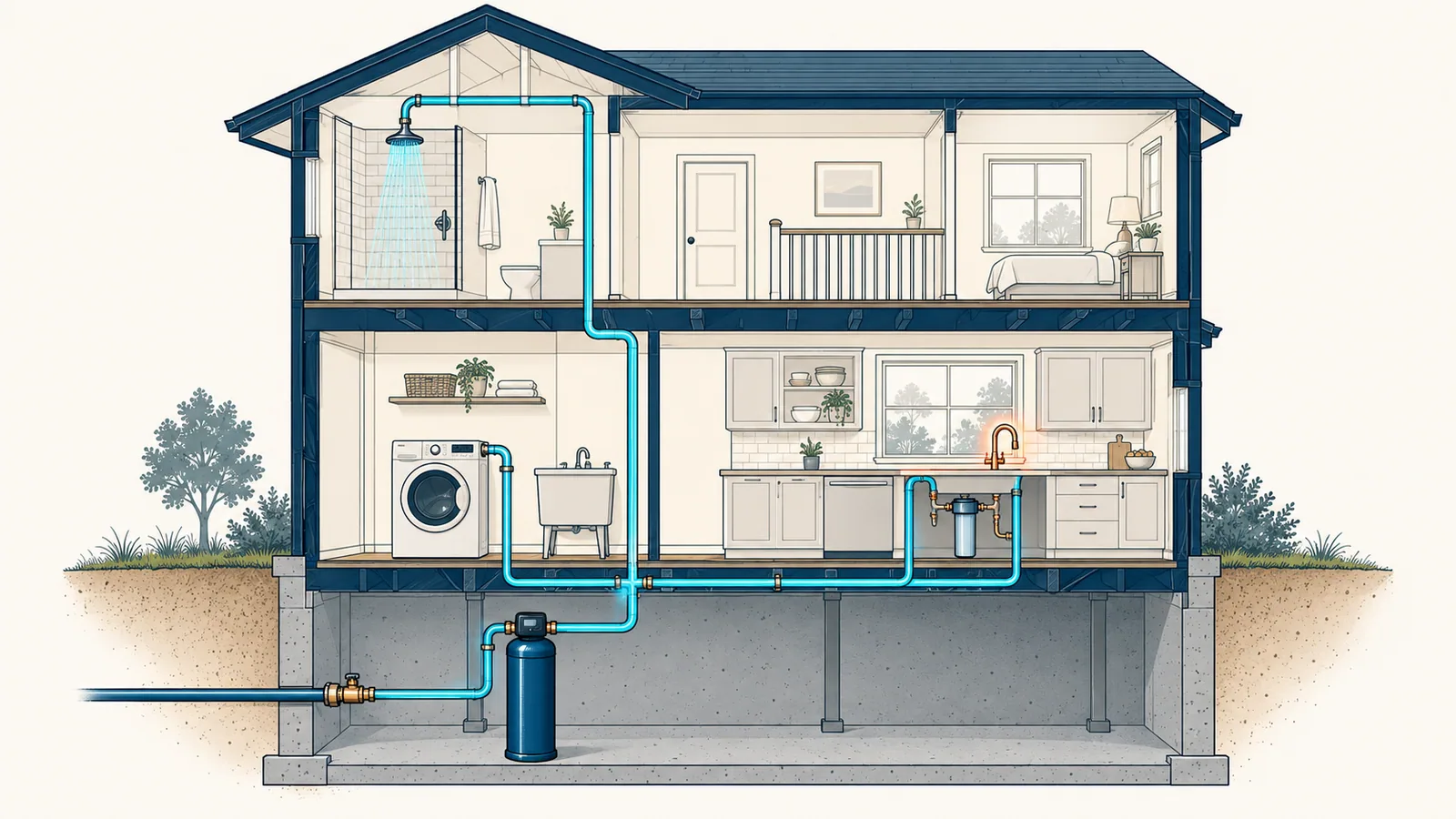
Price, plumbing and a narrower job than the marketing suggests. The equipment is the smaller half of the price once a plumber cuts into the main line, and the system then becomes one more thing on the maintenance calendar.
Flow is the one buyers notice later. A whole house filter has to keep up with every shower and appliance running at once, and ratings are measured on a clean bed: the Aquasana Rhino is rated at 7 GPM, but an installer measured it in the low 5 GPM range after a year of service, as our Aquasana Rhino review reports. Size the system to your bathrooms, not to the price tag.
The last disadvantage is the one this page keeps returning to. A carbon bed doesn't soften, doesn't catch lead added by your own faucets, and needs the right media for chloramine. None of that makes it a bad product. It makes it a specific one.
How Much Does a Whole House Water Filter Cost?#
The systems we track ran $516.99 to $1,998 for the equipment in October 2026, before $300 to $1,500 of installation, the range Angi, HomeGuide and Fixr give for a main-line job. The full breakdown, with cartridges and labor, lives on what a whole house water filter costs.
What three common systems cost to start
as of Oct 19, 2026- iSpring WGB32B, cartridge system
- $516.99 (Oct 12)
- SpringWell CF1, tank system
- $1,160.25 (Nov 9)
- Aquasana Rhino, tank system
- $1,998 at list (Oct 19)
- Installation by a plumber
- $300 to $1,500
Manufacturer prices on the dates shown. The Rhino read $999 under a 50% off banner on Sep 21, 2026. Installation range from three 2026 cost guides (Angi, HomeGuide, Fixr).
The sticker is the wrong number to compare, though. A cartridge system costs little to buy and a lot to feed; a tank system is the reverse.
Is a Tank System or a Cartridge System More Worth It?#
The tank system, if you're staying past the crossover; the cartridge system, if you're not. That's the whole decision once you know you need main-line filtration.
SpringWell
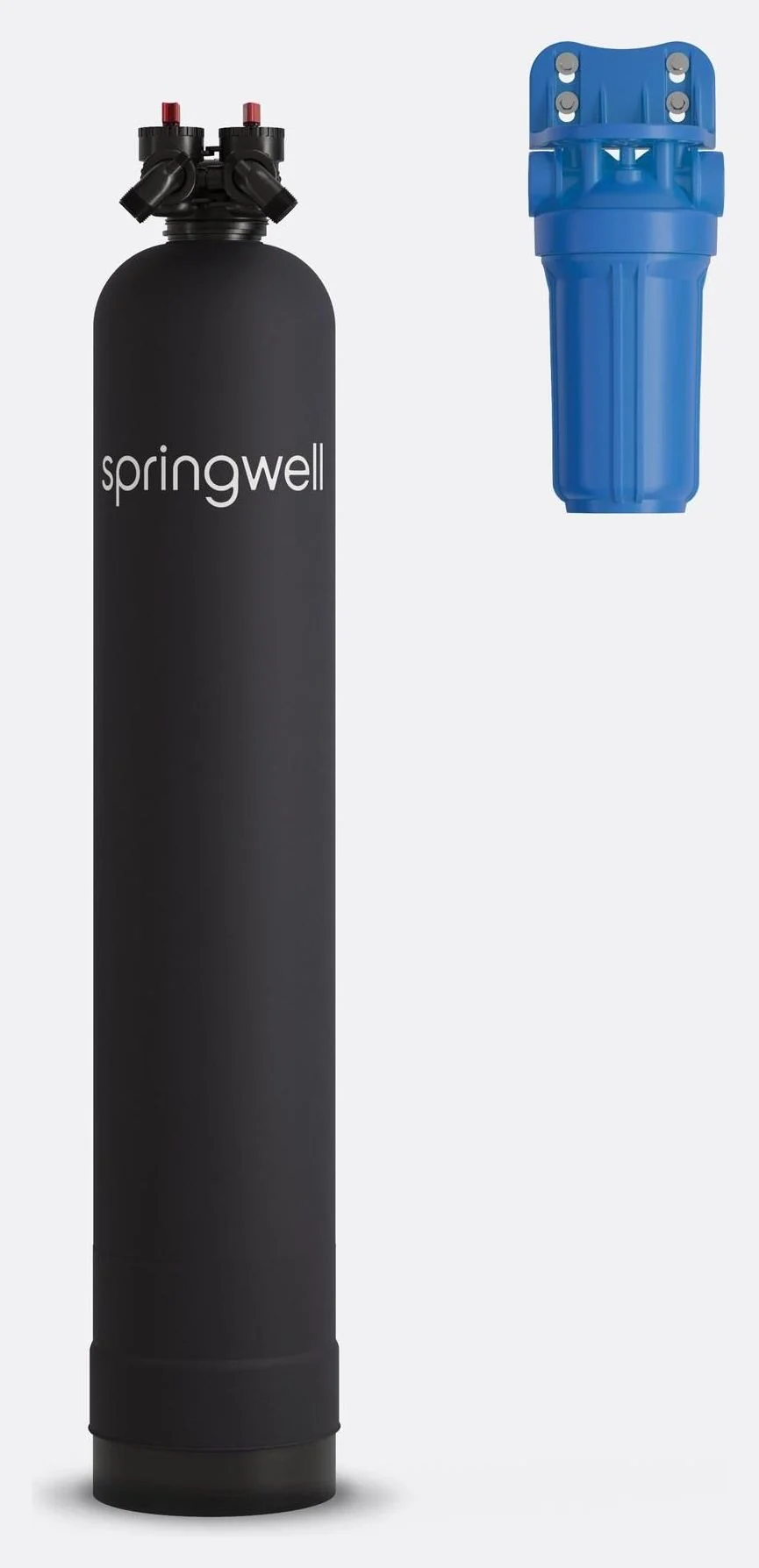
SpringWell CF1 Whole House Water Filter
Best for: City-water homes that want chlorine, chloramine and PFAS handled house-wide with the lowest 10-year cost of ownership
- Capacity
- 1,000,000 gallons / ~10 years
- Flow rate
- 9 GPM
- Bathrooms
- 1 to 3
- Media
- Catalytic carbon + KDF + sediment, 4 stages
- Reduces
- Chlorine, chloramine, PFAS/PFOA/PFOS, VOCs
- Sediment pre-filter
- Replace every 6 to 9 months (~$40/yr)
The CF1 is our pick for most city homes, and our SpringWell CF1 review covers its flow and fine print. The Aquasana Rhino is the other tank system people compare it with, and the CF1 against Rhino duel runs that head to head; our full Aquasana lineup review covers the brand's other systems too.

iSpring
iSpring WGB32B 3-Stage Whole House Filter
Best for: The cartridge-filter entry into whole-house filtration, lowest upfront cost, highest recurring cost
- Type
- 3-stage Big Blue cartridge whole-house filter
- Stages
- 5-micron sediment + 2 carbon blocks, 20" x 4.5"
- Flow rate
- Up to 15 GPM (iSpring)
- Pressure
- 25 to 80 psi
- Ports
- 1" female NPT
- Cartridge cost
- $126 to $252/yr (our arithmetic on iSpring prices)
The iSpring is the honest buy for a two- or three-year stay, and our iSpring WGB32B review works through its replacement schedule.
What If You Need Filtration and Softening?#
Then you need two treatments, and buying one won't do the other's job. A carbon filter doesn't soften, and a softener doesn't remove chlorine; a combo system puts both on the main line. Our water softener and filter combo guide explains when the pair is worth paying for and when one of them is enough.
Before you buy a whole house filter
6 itemsIf you'd rather answer a few questions than read a buyer's guide, our water treatment quiz maps your answers to a system.
Consumer Reports, What's Best: A Whole-House or Under-Sink Water Filter? (updated Oct 13, 2021); EPA, Basic Information about Lead in Drinking Water (updated Jun 18, 2026); EPA WaterSense, Point-of-Use Reverse Osmosis Systems (Aug 21, 2026); CDC, About Home Water Treatment Systems (Apr 10, 2024); SpringWell, iSpring and Aquasana product pages on the dates shown. Installation range per Angi, HomeGuide and Fixr, 2026. The crossover years are our arithmetic.
Whole house filter questions
Are whole house water filters a waste of money?
They are when they're bought for drinking water only, or for hard water. For chlorine, chloramine or sediment that reaches every tap, they're the tool built for the job. A tank system kept for a decade also costs less over time than replacing cartridges, on the prices we track.
How often do you change a whole house water filter?
On a tank system like the SpringWell CF1, only the sediment pre-filter, every 6 to 9 months; the media bed is rated for 1,000,000 gallons. On a cartridge system like the iSpring WGB32B, one or two cartridge packs a year, depending on your water and use.
Should I get a whole house filter or an under-sink filter?
Under-sink if the concern is the water you drink and cook with, which Consumer Reports says is usually all you need. Whole house if the concern also shows up in the shower or appliances, such as chlorine smell or sediment. Some homes use both: a main-line filter for chlorine and a certified filter at the kitchen tap.
Does a whole house water filter remove lead?
Not reliably where it matters. The EPA says brass faucets are the most common lead source in homes without a lead service line, and those sit downstream of a main-line filter. Use a filter certified for lead at the tap you drink from.
Frequently asked questions
Is a whole house water filtration system worth it?
It is worth it when the problem reaches every tap: chlorine or chloramine you smell in the shower, or sediment that shows up in toilets and appliance screens. It is not worth it if you only care about drinking water, where Consumer Reports says an under-sink filter is probably all you need, or if your complaint is scale and spots, which are hardness and need a softener.
What are the disadvantages of a whole house water filter?
Cost, plumbing and limits. Systems we track run from $516.99 for the iSpring WGB32B to $1,998 for the Aquasana Rhino at list, before $300 to $1,500 of installation. They don't soften water, and they can't catch lead that a brass faucet adds downstream, which the EPA names as the most common lead problem in homes without a lead service line.
Do I need a whole house water filter?
Only if you can name the problem. Read your utility's Consumer Confidence Report or test your well first: the CDC's own advice is that if your water has no harmful chemicals or germs, you may not need a treatment system. Chlorine taste and smell, chloramine and sediment are the classic whole house cases.
Will a whole house water filter remove scale?
No. Scale comes from dissolved calcium and magnesium, and carbon filters let both pass. Even the salt-free conditioners Aquasana and SpringWell sell next to their filters, by the makers' own account, don't remove hardness. To stop scale, you need an ion-exchange water softener, or a combo system that pairs one with a filter.
How long does a whole house water filter last?
It depends on the design. Tank systems such as the SpringWell CF1 and Aquasana Rhino are rated for 1,000,000 gallons, roughly a decade of city use, with only a sediment pre-filter to change. Cartridge systems such as the iSpring WGB32B need new cartridges once or twice a year, which is where most of their lifetime cost sits.
Keep reading

Not sure what you need?
Answer 5 questions, get the right system for your water.
City or well, budget, household size, our quiz matches your answers against every system we track.