Water Hardness in Maine
Water in Maine is typically soft, running about 10 to 60 mg/L as calcium carbonate, which is 0.6 to 3.5 grains per gallon. A water softener is the wrong purchase in most of Maine. If your water tests under 3.5 gpg there is nothing for the resin to remove, and you would be paying for salt and wasting water to solve a problem you do not have.
0.6 to 3.5 gpg
How Hard Is the Water in Maine?
Maine has some of the softest water in the country: granite and metamorphic bedrock give up very little calcium, and surface supplies like Sebago Lake, which serves Greater Portland, test near the bottom of the USGS scale. Private wells are the exception, and the hard ones cluster in the limestone and calcareous slate pockets of Aroostook County and the Rockland area. Most Maine homes never need a softener.
On the U.S. Geological Survey scale, soft means 0 to 60 mg/L of dissolved calcium carbonate. The range above is deliberately wide because it covers a whole state: the USGS says its own national map is meant to be read at national and regional scale and is not designed for decisions at the level of an individual property. Your utility's annual report, or a test kit on a well, is what settles your own number.
Source: USGS Water Science School, hardness of water (national map, NASQAN data). Checked Sep 1, 2026. Ranges are regional, not a reading at your address.
What Does Soft Water Do in a Maine Home?
Soft water leaves almost nothing behind, so the classic hard water symptoms, crusted aerators, spotted glassware, soap that will not lather, are rare in Maine. What soft water does do is feel slippery in the shower, because soap rinses off completely instead of reacting with minerals, and it can be mildly corrosive to older copper plumbing at low pH. If you are seeing scale in a Maine home, suspect a private well or a hot water setting above 140F before you blame the region.
The symptom checklist is the same everywhere, only the speed changes: white crust on faucets and shower heads, spots on glassware, stiff laundry, soap that will not foam, and a water heater that rumbles. Our 10 signs of hard water guide puts a cost on each one, and the hard water hub covers the full damage picture.
Which Maine Cities Does This Cover?
The range on this page spans the whole state, including its largest population centers. Hardness can differ between two of these cities by more than the width of a USGS band, because each one treats a different source: a river, a reservoir, a limestone aquifer, or a blend that changes with the season.
- Portland
- Lewiston
- Bangor
- South Portland
- Auburn
- Biddeford
- Sanford
- Saco
- Westbrook
- Augusta
To pin down your own figure, open your utility's Consumer Confidence Report and look for total hardness, usually stated in ppm or mg/L as CaCO3. Divide by 17.1 for grains per gallon. If your utility softens before delivery, the delivered number can sit far below the raw groundwater under the same city.
City Water or Well Water in Maine?
Private wells are common in Maine, and that changes the problem. Utility water is blended, treated and reported once a year in a Consumer Confidence Report, so the hardness number is knowable and fairly stable. Well water is whatever the aquifer under your property gives you, and hardness usually arrives with company: iron that stains fixtures orange, manganese that stains them black, sulfur smell, sometimes tannins. A softener sized only for hardness will foul quickly if it is being asked to strip iron as well.
If you are on a well, start at the well water treatment hub and treat in the right order: iron and sediment first, softener second. The best water softeners for well water covers the units built for that job, and the best iron filters handle the stage that protects the resin.
What Should You Install in Maine?
Before buying anything, get a number. A test strip or your utility's report will tell you in minutes whether you are actually below the line where treatment pays, and the sizing calculator shows what capacity your household would need if you are not. Many homes in soft and moderately hard areas are better served by a filter for taste and chlorine than by a softener.
- On city water, hardness only: a salt-based softener. The best water softeners ranking compares them on capacity, warranty and dated price, and the softener hub explains how ion exchange actually works.
- If salt is off the table: a template-assisted crystallization conditioner reduces scale without removing minerals. Read the salt-free explainer and salt-based vs salt-free before you spend, because the two are not interchangeable.
- Hardness plus taste, chlorine or sediment: a filter and softener combo. The combo systems comparison covers what those packages really cost, and water softener cost is the reality check on dealer quotes.
The filter we bench for Maine water
Maine's water does not need a softener. Below the hard band, ion exchange buys almost nothing: no scale to speak of, and you would pay for salt and wastewater to remove minerals that are not causing a problem. What people in soft-water states actually notice is taste, chlorine and sediment, and that is a whole-house filter's job. If your own utility report or well test comes back harder than the state range, run your number through the sizing calculator before buying anything.
Prices below are the ones we read on the manufacturer's own store, with the date we read them. Size it for your household or answer seven questions if you would rather be walked through it.
Some product links are affiliate links: buying through them costs you nothing extra and may earn us a commission.
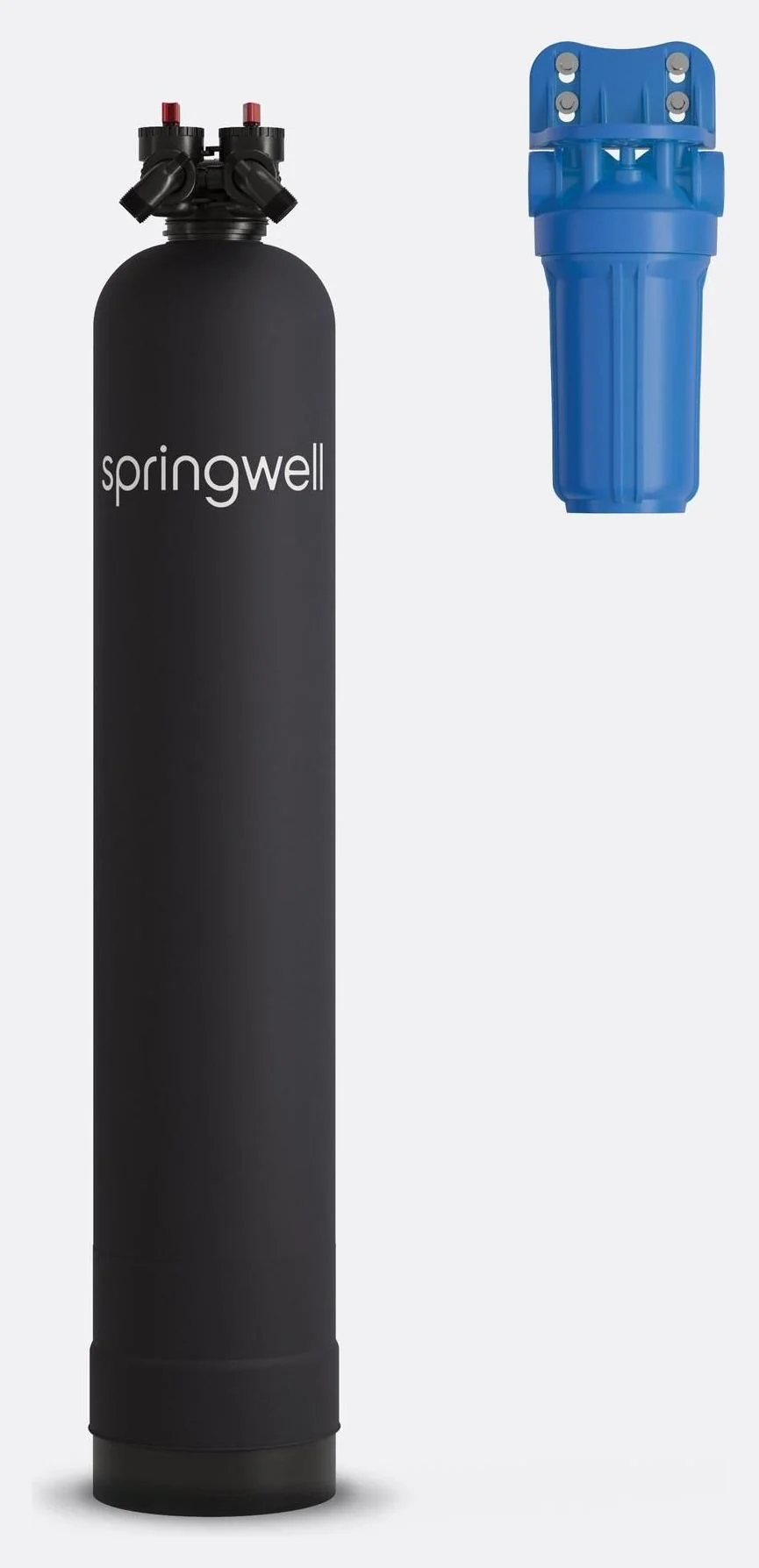
SpringWell
SpringWell CF1 Whole House Water Filter
Best for: City-water homes that want chlorine, chloramine and PFAS handled house-wide with the lowest 10-year cost of ownership
- Capacity
- 1,000,000 gallons / ~10 years
- Flow rate
- 9 GPM
- Bathrooms
- 1 to 3
- Media
- Catalytic carbon + KDF + sediment, 4 stages
- Reduces
- Chlorine, chloramine, PFAS/PFOA/PFOS, VOCs
- Sediment pre-filter
- Replace every 6 to 9 months (~$40/yr)
Water hardness in Maine: questions
Is the water hard in Maine?
Maine water is typically soft on the USGS scale, running about 10 to 60 mg/L as calcium carbonate, which is 0.6 to 3.5 grains per gallon. Soft means 0 to 60 mg/L. That is a statewide range, not a reading at your address: the number at your tap depends on your utility or your well, and it is published every year in your utility's water quality report.
How many grains per gallon is Maine water?
Roughly 0.6 to 3.5 grains per gallon across the state, from 10 to 60 ppm. To convert any figure yourself, divide ppm (mg/L as calcium carbonate) by 17.1, the conversion the USGS and water utilities both publish. Grains per gallon is the unit softener capacity is sized against, so it is the one worth writing down.
Do I need a water softener in Maine?
Probably not, on 0.6 to 3.5 gpg water. Below about 7 grains per gallon there is little scale to prevent, and a softener would add salt, cost and maintenance for a cosmetic gain. Test first, especially on a private well, because a single property can sit well above the state range.
Water hardness in nearby states
- ConnecticutSoft · 0.9 to 5.8 gpg
- MassachusettsSoft · 0.9 to 5 gpg
- New HampshireSoft · 0.6 to 4.1 gpg
- New JerseyModerately hard · 2.6 to 11.4 gpg
- New YorkModerately hard · 1.2 to 12.9 gpg
- PennsylvaniaHard · 2.3 to 12.9 gpg
See all 50 states and DC on the hardness hub, or check the USGS classification scale at the source.