Salt-Based vs Salt-Free Water Softener: Which One Should You Buy?
Salt vs salt free water softener: only ion exchange removes hardness. TAC prevents up to 88% of scale per an ASU study. The decision tree that settles it.
By Home Water Lab TeamUpdated Prices verified Sep 12, 2026
This page contains affiliate links; buying through them costs you nothing extra.
Put a hardness strip on the outlet of each machine and the argument is over in ten seconds. A salt-based softener drops the reading to near zero because it physically removes the calcium and magnesium. A salt-free conditioner reads exactly what went in, because it removes nothing. Everything else in this comparison, price, maintenance, legality, follows from that one difference.
The short answer
as of Aug 28, 2026Should you buy a salt-based softener or a salt-free conditioner?
Buy salt-based if you want soft water: lather, spot-free glass, softer laundry and a hardness reading near zero. Buy salt-free only if scale protection is the entire goal, or if your district restricts brine discharge. Independent WateReuse Research Foundation testing put template assisted crystallization above 88% scale reduction, so a conditioner is legitimate technology, but it is not softening and no measured hardness number moves. Prices are close at the flagship level: SpringWell's SS1 read $1,606.50 and its FutureSoft FS1 $1,785 on Sep 12, 2026.
The category-level verdict on conditioners, scam or legit, lives on our salt-free hub. This page is the head-to-head: the chemistry, the running costs, and a decision tree you can walk in under a minute.
Key takeaways
- Only ion exchange lowers a hardness reading; TAC changes the form of the minerals, not the amount.
- TAC measured above 88% scale reduction in WateReuse testing, against about 50% for plug-in electromagnetic descalers.
- Flagship prices sit within $180 of each other, so running cost and legality decide this, not the sticker.
- Salt-based runs $60 to $190 a year (salt, regeneration water, electricity); tank-media TAC runs essentially $0.
- On a well, salt-free is out: the FutureSoft sheet demands 0 ppm iron, manganese, copper and hydrogen sulfide.
What Is the Actual Difference in Chemistry?#
One machine takes minerals out of the water; the other rearranges them and lets them through. That is not a marketing distinction, it is the reason every other difference exists.
A salt-based softener runs ion exchange. Hard water passes through a resin bed charged with sodium ions; the resin grabs calcium and magnesium and releases sodium in trade. The hardness minerals physically leave your water, which is why measured hardness drops to near zero and why the system needs a brine tank and a drain: every few days it flushes the captured minerals away and recharges the resin with salt.
Ion exchange, step by step
- Hardness arrivesCalcium and magnesium are the two ions the industry calls hardness. They are dissolved, not suspended, so no filter screen can catch them.
- The resin bedPolymer beads whose exchange sites are pre-loaded with sodium. The resin grips calcium and magnesium far harder than it grips sodium, and that difference in affinity is the whole trick.
- The trade, one for twoEvery calcium ion that sticks releases two sodium ions, because one Ca2+ carries the charge of two Na+. Nothing is strained out: hardness is swapped, ion for ion.
- Until the beads fill upSites are used up from the inlet end toward the outlet. When that front reaches the outlet, hardness starts to break through and the control valve runs a regeneration.
The swap runs both ways, which is why a bed saturated with hardness can be recharged with nothing more concentrated than salt water. A softener does not consume its resin, it rents it out and takes it back every few days.
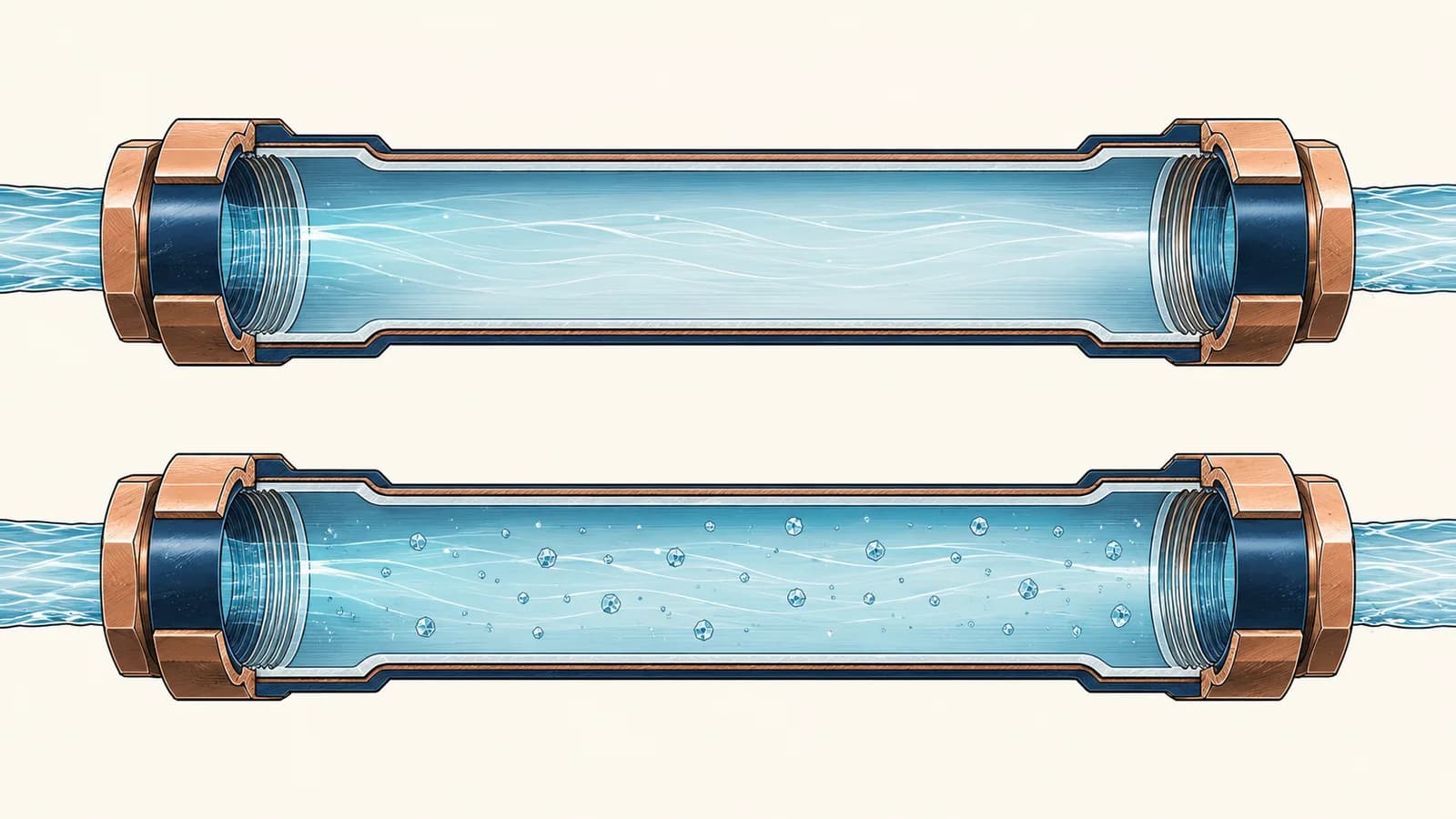
A salt-free conditioner runs template-assisted crystallization, or TAC. The media gives hardness minerals a surface to form microscopic crystals on; those crystals flow through the house instead of plating onto pipes and heating elements as scale. Nothing is removed, nothing is consumed, and there is no drain, salt or electricity.
What you hear
A salt-free softener is just a softener that skips the salt.
What the numbers say
It skips the softening. Aquasana's fine print says its salt-free system does not need to remove hard minerals, and SpringWell says the FutureSoft will not make water feel slick or stop spotting the way salt does. Water that tests 15 grains per gallon going in tests 15 gpg coming out.
What "hard" means in numbers, per the USGS classification, is covered in our hard water explainer, and you can look up the typical range where you live in our state hardness data.
Does Salt-Free Actually Work?#
Yes, at the job it is built for, and the evidence is independent rather than promotional.
88%+
The key evidence is the WateReuse Research Foundation study (project 08-06) led by Peter Fox, Ph.D., at Arizona State University: template-assisted crystallization reduced scale by more than 88 percent, while the plug-in electromagnetic and electrically induced precipitation gadgets managed around 50 percent. So TAC is not a scam; it is a legitimate anti-scale technology. The scam risk is in the label: any product marketed as a "salt-free softener" is promising a result its chemistry cannot deliver. It conditions. It does not soften.
What Do They Cost to Buy and Run?#
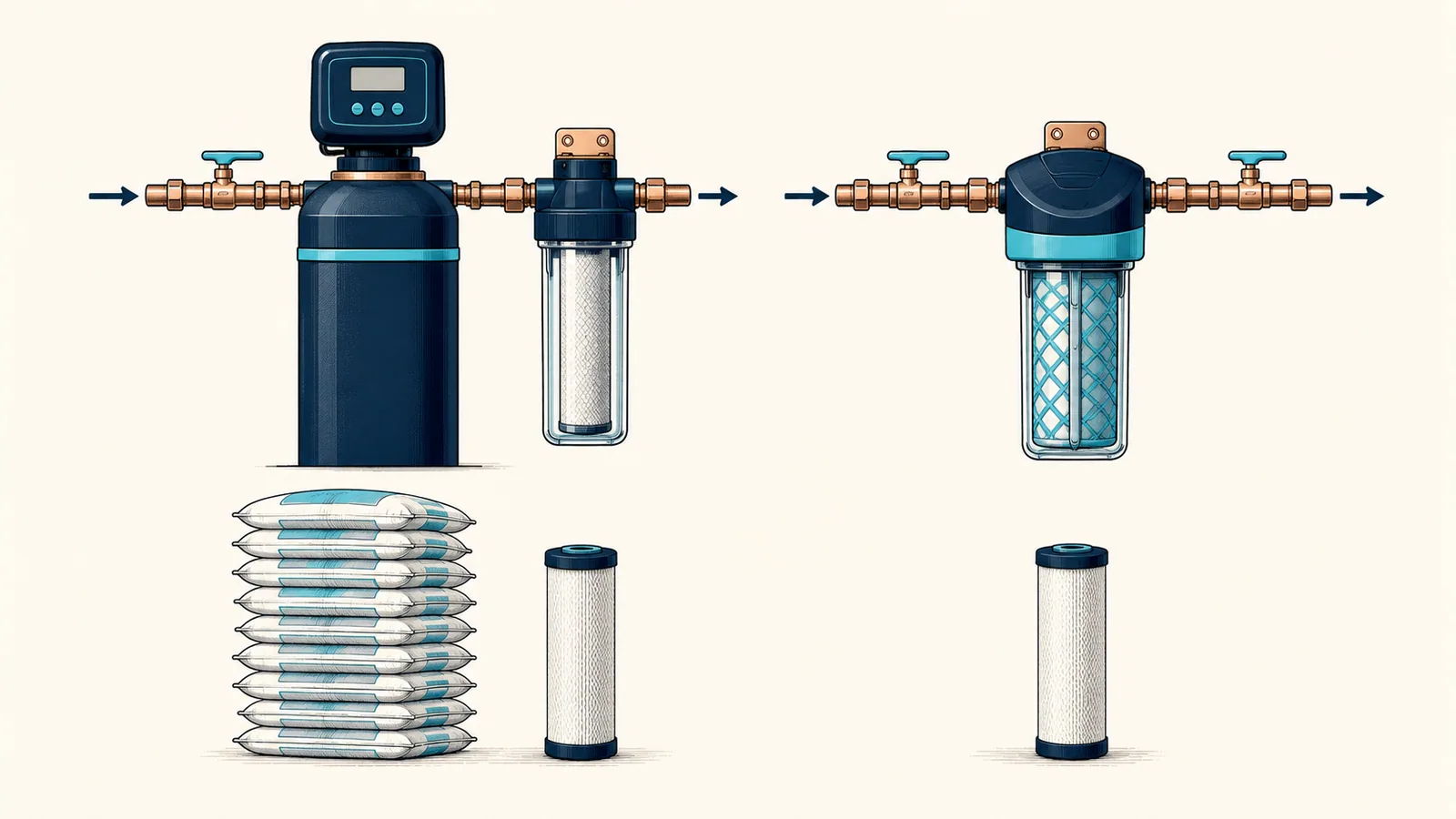
Up front, the two technologies land surprisingly close at the flagship level. SpringWell's SS1 salt softener read $1,606.50 and the FutureSoft FS1 conditioner $1,785 on Sep 12, 2026, both about 6% below their Aug 28 readings, so treat any figure older than a week as stale. The gap opens after installation.
Full 10-year breakdowns for both camps are in softener price ranges and the conditioner price breakdown; the salt line itself, and how to spend less on it, is in our softener salt guide.
Ten years of ownership
as of Aug 28, 2026- EquipmentBig-box is the middle of Angi's 2026 range for a 48,000-grain unit, $600 to $1,200. Factory-direct is SpringWell's SS1 at $1,606.50. The dealer column is a Culligan system installed, middle of $1,800 to $6,500.
- Installation$900, the middle of the $300 to $1,500 a plumber charges in the 2026 Angi, HomeGuide and Fixr guides. Doing it yourself takes this line to zero. Dealer quotes already contain it.
- Salt, ten years$100 a year, the middle of HomeGuide's 2026 range of $50 to $150, times ten. Hard water and a thirsty household push this to the top of the range.
- Regeneration water, ten years$20 a year on city water, the middle of $10 to $30, times ten. On a private well the water itself costs nothing, so this line disappears.
Midpoints of dated ranges, added up: Angi 2026 capacity table, HomeGuide and Fixr 2026 cost guides, Modernize dealer pages (Culligan page updated Aug 21, 2026) and manufacturer prices read Aug 28, 2026. No inflation, no repairs, no resin replacement. Read it as an order of magnitude, not a quote: your bill moves with hardness, water use and local labor.
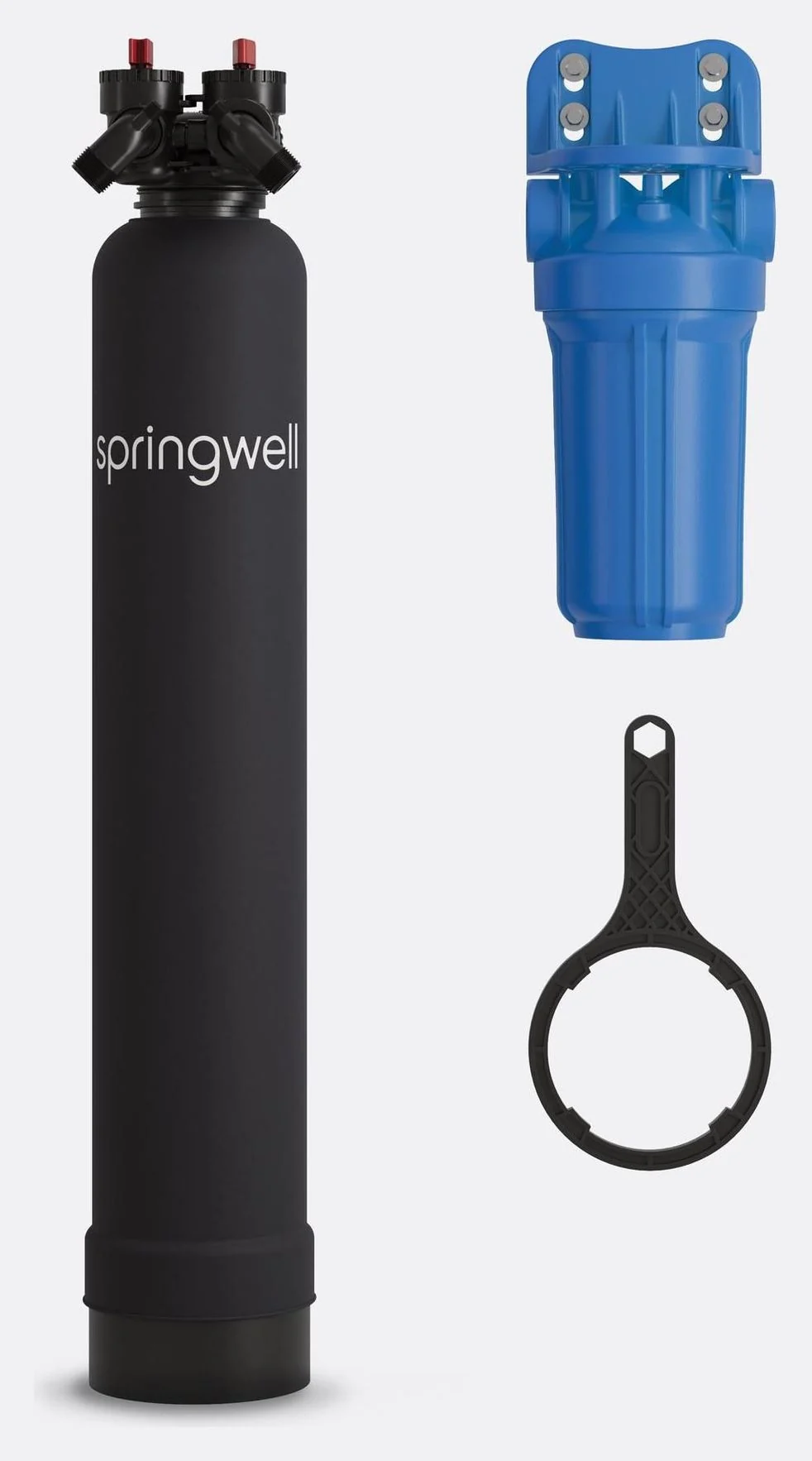
SpringWell
SpringWell SS1
- Grain capacity
- 32,000
- Technology
- N/A
- Service flow
- 11 GPM
- Flow rate
- N/A
- Max hardness
- N/A
- Operation
- N/A
- Brine tank
- 18" × 33" round (~200 lb salt)
- Media life
- N/A
SpringWell
FutureSoft FS1
- Grain capacity
- N/A
- Technology
- TAC (Template Assisted Crystallization)
- Service flow
- N/A
- Flow rate
- 12 GPM
- Max hardness
- 81 GPG
- Operation
- Upflow, no electricity, no drain, no backwash
- Brine tank
- N/A
- Media life
- 3 to 5+ years
Prices checked Sep 12, 2026.
Salt-based ion exchange
- Removes calcium and magnesium; hardness reads near zero
- Fixes lather, soap scum, stiff laundry and spotting
- Needs a drain, a brine tank and $60 to $190 a year to run
- Handles real-world well water once iron is pretreated
Salt-free TAC conditioner
- Crystallizes hardness; measured hardness and TDS are unchanged
- Over 88% scale reduction in independent testing
- No salt, no drain, no electricity, no wastewater
- Requires 0 ppm iron, manganese, copper and H2S, pH 7.0 to 9.5
Bottom line
Scale in the water heater is a job a conditioner can do. Skin, laundry and glassware are jobs only ion exchange can do.
One spec in that table deserves a flag: the FS1's feed-water limits are strict. On most private wells that makes a conditioner unusable without pretreatment, while a salt softener tolerates real-world well water far better, which is why our well water picks contain no conditioners at all.
Which One Should You Buy?#
Walk the tree in order; the first line that matches you is your answer.
- Your area restricts brine discharge: salt-free. California's AB 1366 (2009) lets districts ban self-regenerating softeners, and Santa Clarita's Measure S (2008) even required existing units removed. A conditioner is the compliant path.
- You want soft-feeling water, lather, spot-free glass, softer laundry: salt-based. No conditioner at any price delivers this.
- Your water is very hard (above roughly 10.5 gpg on the USGS scale) and you feel it daily: salt-based. Removal beats management at high hardness.
- Your only complaint is scale in the water heater and on fixtures, and your hardness is mild to moderate: salt-free is enough, and it is zero-maintenance.
- You are on a well with iron or sulfur: salt-based, or fix the well water first. TAC media tolerates none of it.
- No drain, no outlet, or no space for a brine tank: salt-free, which needs none of the three.
- You hate carrying salt bags and skipping maintenance is worth more than soft feel: salt-free, eyes open.
Salt-free is genuinely the right buy when all of these are true
5 itemsIf you ticked every line, shop the field in our best salt-free systems and read the FutureSoft FS1 review before ordering. If you missed even one, you are buying salt.
Salt or no salt: the call#
Salt-based wins whenever the goal is soft water, very hard water, or well water: the SS1 class removes the problem for $50 to $150 a year in salt, and our SS1 review covers the flagship's own fine print, while the full softener rankings put it against nine alternatives. Salt-free wins on brine bans, zero maintenance and scale-only goals. Just never pay conditioner money expecting softener results; the chemistry does not negotiate.
Still undecided after the tree? The guided system finder asks the same questions in order, and the sizing guide handles the capacity question once you have picked a side.
Frequently asked questions
Do salt-free water softeners really work?
For scale prevention, yes. The WateReuse Research Foundation study led by Peter Fox at Arizona State University (published 2014) measured over 88% scale reduction for template-assisted crystallization, the technology inside systems like the SpringWell FutureSoft. For softening, no: the calcium and magnesium stay in the water and a hardness test reads the same before and after.
Is salt-free better than salt-based?
Neither is better; they do different jobs. A salt-based softener removes hardness minerals, so you get soft-feeling water, lather, and no spotting. A salt-free conditioner leaves the minerals in and stops most scale from sticking. If your complaint is scale in the water heater, salt-free can be enough. If your complaint is dry skin, stiff laundry or spotted glass, only salt fixes it.
Which costs more, a salt or salt-free system?
Up front they are close: SpringWell's SS1 salt softener read $1,606.50 and its FutureSoft FS1 conditioner $1,785 on Sep 12, 2026. Running costs differ: HomeGuide's 2026 guide puts softener salt at $50 to $150 a year, and cross-checked industry estimates add $10 to $30 of regeneration water on city supplies plus under $10 of electricity, while a TAC conditioner consumes nothing.
Why are salt water softeners banned in parts of California?
Because of brine discharge. California's AB 1366 (2009) lets local agencies restrict self-regenerating softeners that send salty backwash to the sewer, and Santa Clarita's Measure S (2008) went further and required existing units to be removed. In those districts a salt-free conditioner is the compliant option.
Does a salt-free conditioner lower TDS or hardness numbers?
No. TAC changes the form of the minerals, not the amount. Test strips and TDS meters read the same after the unit as before, which both major manufacturers acknowledge: Aquasana states its salt-free system does not need to remove hard minerals, and SpringWell says the FutureSoft won't make water feel slick or stop spotting the way salt does.
Keep reading
Not sure what you need?
Answer 5 questions, get the right system for your water.
City or well, budget, household size, our quiz matches your answers against every system we track.