Water Hardness in Minnesota
Water in Minnesota is typically very hard, running about 100 to 400 mg/L as calcium carbonate, which is 5.8 to 23.4 grains per gallon. Treat this as equipment protection, not a luxury, in Minnesota. At these levels an untreated house replaces appliances early and runs a water heater that is quietly burning extra fuel every day.
5.8 to 23.4 gpg
How Hard Is the Water in Minnesota?
Most Minnesotans drink groundwater, and Minnesota groundwater is hard: the Prairie du Chien-Jordan and glacial aquifers run through carbonate rock across the southern half of the state. The Minnesota Department of Health advises that a softener may be worth it above 7 grains per gallon or 120 mg/L, a line most of the state clears easily. Duluth and the North Shore, drawing from Lake Superior, are the state's soft-water exception.
On the U.S. Geological Survey scale, very hard means over 180 mg/L of dissolved calcium carbonate. The range above is deliberately wide because it covers a whole state: the USGS says its own national map is meant to be read at national and regional scale and is not designed for decisions at the level of an individual property. Your utility's annual report, or a test kit on a well, is what settles your own number.
Source: Minnesota Department of Health, home water softening (softening advised above 7 gpg / 120 mg/L) cross-checked with the USGS hardness map. Checked Sep 1, 2026. Ranges are regional, not a reading at your address.
What Does Very hard Water Do in a Minnesota Home?
Over 10.5 grains per gallon, hard water stops being an annoyance and starts shortening equipment life. The same Battelle study run for the Water Quality Research Foundation (2009 to 2010) measured gas water heaters losing about 4 percent efficiency for every 5 gpg of hardness, up to 48 percent over a heater's life, and tankless units on 26 gpg water clogging completely in roughly 1.6 years without treatment. At Minnesota levels you will also go through more detergent, more descaler and more shower heads than someone two states over, and the dishwasher and washing machine will age faster than their warranties suggest.
The symptom checklist is the same everywhere, only the speed changes: white crust on faucets and shower heads, spots on glassware, stiff laundry, soap that will not foam, and a water heater that rumbles. Our 10 signs of hard water guide puts a cost on each one, and the hard water hub covers the full damage picture.
Which Minnesota Cities Does This Cover?
The range on this page spans the whole state, including its largest population centers. Hardness can differ between two of these cities by more than the width of a USGS band, because each one treats a different source: a river, a reservoir, a limestone aquifer, or a blend that changes with the season.
- Minneapolis
- Saint Paul
- Rochester
- Duluth
- Bloomington
- Brooklyn Park
- Plymouth
- Woodbury
- Maple Grove
- St. Cloud
To pin down your own figure, open your utility's Consumer Confidence Report and look for total hardness, usually stated in ppm or mg/L as CaCO3. Divide by 17.1 for grains per gallon. If your utility softens before delivery, the delivered number can sit far below the raw groundwater under the same city.
City Water or Well Water in Minnesota?
Private wells are common in Minnesota, and that changes the problem. Utility water is blended, treated and reported once a year in a Consumer Confidence Report, so the hardness number is knowable and fairly stable. Well water is whatever the aquifer under your property gives you, and hardness usually arrives with company: iron that stains fixtures orange, manganese that stains them black, sulfur smell, sometimes tannins. A softener sized only for hardness will foul quickly if it is being asked to strip iron as well.
If you are on a well, start at the well water treatment hub and treat in the right order: iron and sediment first, softener second. The best water softeners for well water covers the units built for that job, and the best iron filters handle the stage that protects the resin.
What Should You Install in Minnesota?
Size first, shop second. On the industry formula, people times 75 gallons a day times hardness in gpg times 7 days, a family of four in the middle of the Minnesota range, about 14.6 gpg, works through roughly 30,660 grains a week. That lands on a 48,000-grain softener with the regeneration margin the industry sizes for. Run your own numbers in the sizing calculator, then price ten years of ownership, salt included, in the cost calculator.
- On city water, hardness only: a salt-based softener. The best water softeners ranking compares them on capacity, warranty and dated price, and the softener hub explains how ion exchange actually works.
- If salt is off the table: a template-assisted crystallization conditioner reduces scale without removing minerals. Read the salt-free explainer and salt-based vs salt-free before you spend, because the two are not interchangeable.
- Hardness plus taste, chlorine or sediment: a filter and softener combo. The combo systems comparison covers what those packages really cost, and water softener cost is the reality check on dealer quotes.
The softener we bench for Minnesota water
At Minnesota's hardness, ion exchange is the only thing that removes the calcium and magnesium rather than just holding it in suspension. The capacity above is what the industry formula gives for a four-person household on the state's mid-range hardness; a bigger or smaller household changes it, which is what the sizing calculator is for. The system below is the one we bench against, sold in three sizes from a single product page, so match the size to your own number at checkout.
Prices below are the ones we read on the manufacturer's own store, with the date we read them. Size it for your household or answer seven questions if you would rather be walked through it.
Some product links are affiliate links: buying through them costs you nothing extra and may earn us a commission.
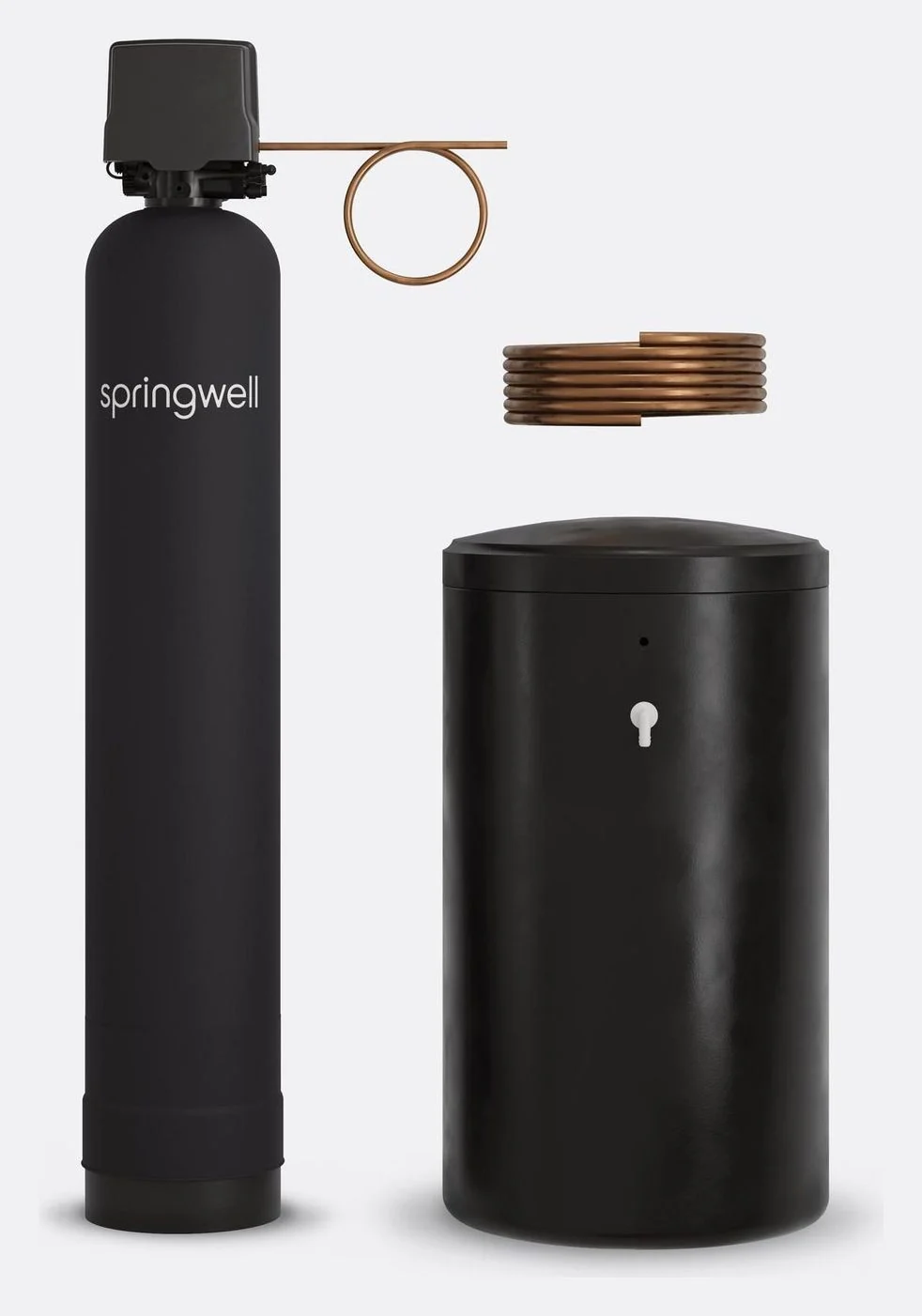
SpringWell
SpringWell SS1 Salt Based Water Softener
Best for: Homes with 1 to 3 bathrooms on hard city water that want true ion-exchange softening at a factory-direct price
- Grain capacity
- 32,000
- Service flow
- 11 GPM
- Bathrooms
- 1 to 3
- Tank
- 9" × 48" (57" with head)
- Connection
- 1"
- Brine tank
- 18" × 33" round (~200 lb salt)
Water hardness in Minnesota: questions
Is the water hard in Minnesota?
Minnesota water is typically very hard on the USGS scale, running about 100 to 400 mg/L as calcium carbonate, which is 5.8 to 23.4 grains per gallon. Very hard means over 180 mg/L. That is a statewide range, not a reading at your address: the number at your tap depends on your utility or your well, and it is published every year in your utility's water quality report.
How many grains per gallon is Minnesota water?
Roughly 5.8 to 23.4 grains per gallon across the state, from 100 to 400 ppm. To convert any figure yourself, divide ppm (mg/L as calcium carbonate) by 17.1, the conversion the USGS and water utilities both publish. Grains per gallon is the unit softener capacity is sized against, so it is the one worth writing down.
Do I need a water softener in Minnesota?
At 5.8 to 23.4 gpg, yes for most homes. Above 7 grains per gallon, scale starts costing you water heater efficiency and appliance life, and only ion exchange removes the calcium and magnesium. Size it before you shop: a family of four on 14.6 gpg water works through about 30,660 grains a week, which lands on a 48,000-grain unit with the usual regeneration margin.
Water hardness in nearby states
- IllinoisVery hard · 7 to 23.4 gpg
- IndianaVery hard · 8.8 to 23.4 gpg
- IowaVery hard · 8.8 to 26.3 gpg
- KansasVery hard · 8.8 to 29.2 gpg
- MichiganVery hard · 5.8 to 20.5 gpg
- MissouriVery hard · 4.7 to 18.7 gpg
See all 50 states and DC on the hardness hub, or check the USGS classification scale at the source.