Best Countertop Water Filters 2026: Certified Picks for Renters
The best countertop water filter is the AquaTru Classic at $475, the only one here whose certifying body is named. Three picks compared, and why Berkey is absent.
By Home Water Lab TeamUpdated Prices verified Oct 7, 2026
This page contains affiliate links; buying through them costs you nothing extra.
The best countertop water filter is the AquaTru Classic at $475, and it wins on a point most of this category avoids: its certifying body is named. IAPMO, to NSF 42, 53, 58 and 401. Everything else on a countertop unit's box is a claim until someone independent signs it.
The short answer
as of Sep 28, 2026Which countertop water filter should you buy?
The AquaTru Classic at $475: four-stage reverse osmosis, a 0.75-gallon clean tank, and certification by IAPMO to NSF 42, 53, 58 and 401, with NSF 58 covering the reverse osmosis claim itself. For one or two people in a small kitchen, the AquaTru Carafe at $375 does the same job in a smaller body, but it carries NSF 42, 53 and 401 and not NSF 58. The Bluevua ROPOT at $389 on Oct 7, 2026 adds a remineralization stage and a glass carafe, at the cost of a certification record that names no standard at all.
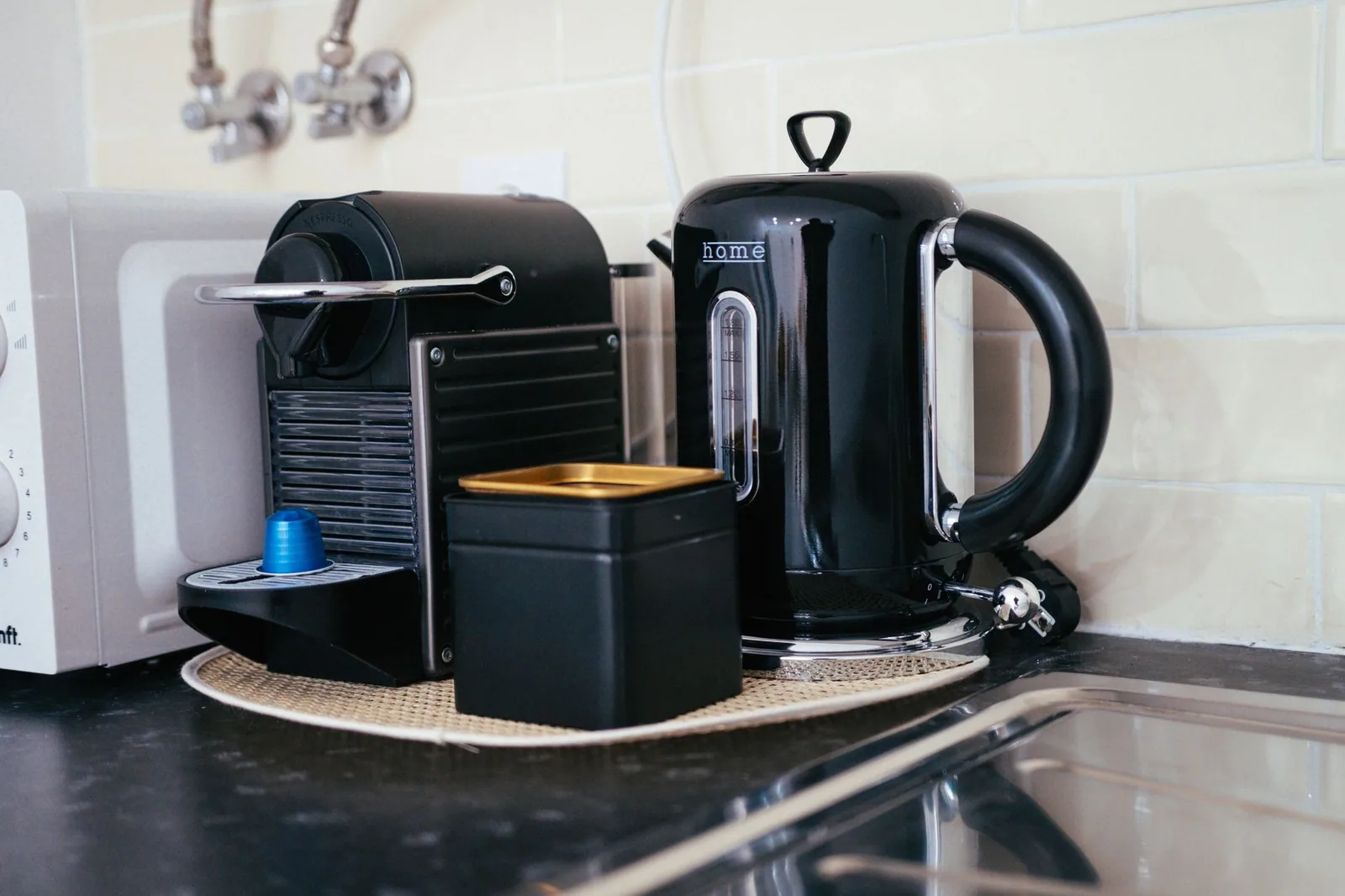
This is the rental segment of the reverse osmosis hub: same membrane technology, no drill, no drain saddle, no conversation with a landlord. The trade is counter space and capacity, and the three units below make that trade differently.
| Rank | Unit | Price (Sep 21, 2026) | Certification | Wins at |
|---|---|---|---|---|
| 1 | AquaTru Classic | $475 | IAPMO to NSF 42, 53, 58, 401 | Best overall, the full standard set |
| 2 | AquaTru Carafe | $375 | IAPMO to NSF 42, 53, 401 | Best small kitchen, glass carafe |
| 3 | Bluevua ROPOT | $389 ($434 compare-at, Oct 7, 2026) | Claimed, no standard named | Remineralization, if you accept the gap |
Key takeaways
- AquaTru names IAPMO as its certifying body. Bluevua states NSF and WQA certification without naming a standard, which is not the same thing.
- The Carafe carries NSF 42, 53 and 401 but not NSF 58, the reverse osmosis standard the Classic holds.
- Capacity is the real constraint: 0.75 gallon on the Classic, 0.5 gallon on the Carafe, 60 oz in the Bluevua carafe.
- Countertop units have no drain. The rejected water collects in a second chamber that you empty by hand.
- At $375 to $475 (Oct 7, 2026 readings) these cost more than an under-sink system that does the same work permanently. You are paying not to drill.
How a Countertop Purifier Differs From a Plumbed One#
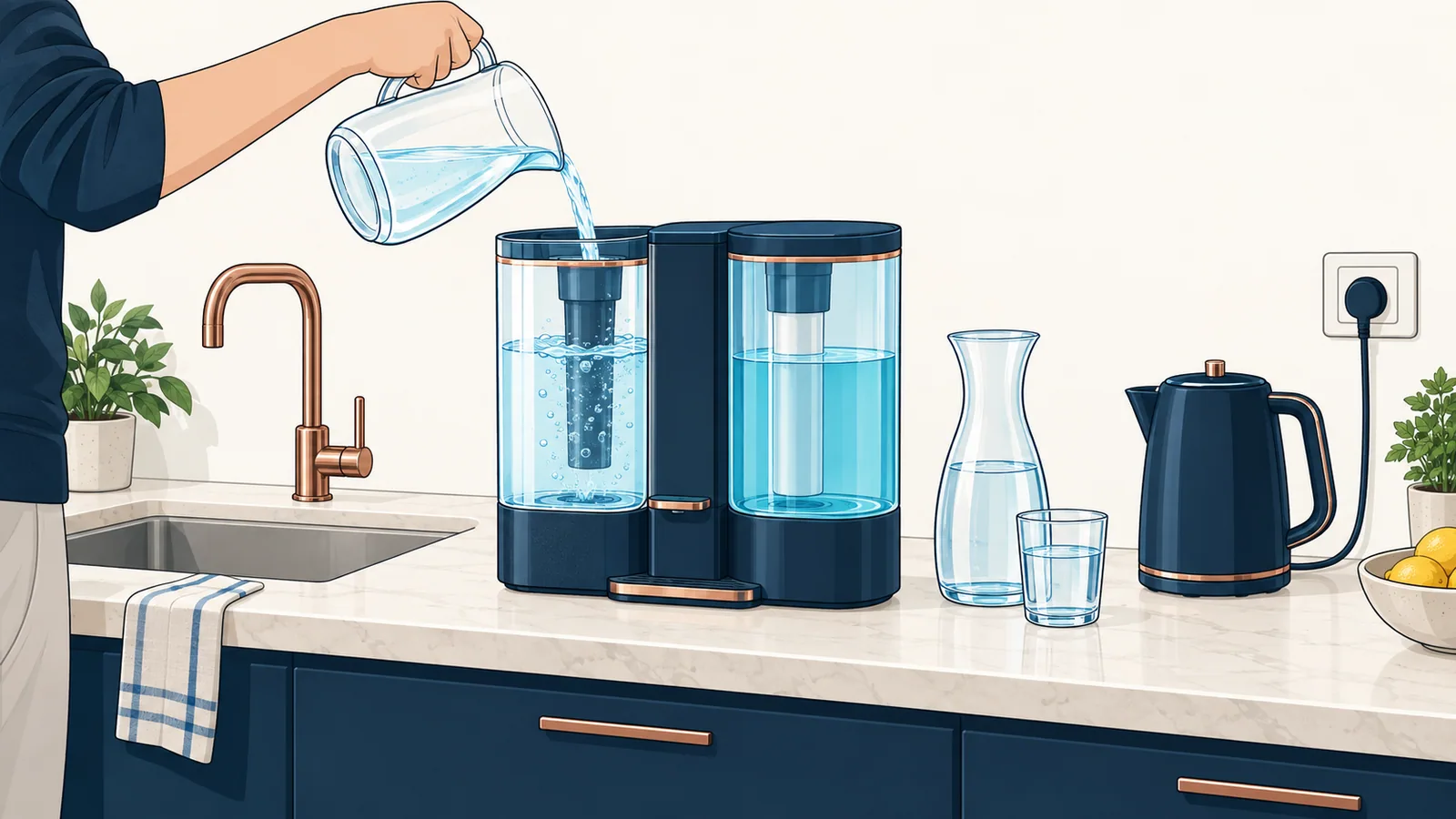
Mechanically, barely at all. The same sequence of pre-filters, membrane and post-filter runs inside a plastic body on your counter instead of a cupboard, driven by a pump rather than mains water pressure.
Where the water goes
- Pre-filters6 to 12 monthsSediment then carbon, in that order. They exist to protect the membrane: grit would tear it and chlorine would dissolve it, so the cheap cartridges spend themselves first.
- RO membrane2 to 5 yearsThe stage that does the work the others cannot. Pressure pushes water through a film whose pores stop dissolved solids, which is why RO reaches lead, fluoride, nitrate and PFAS where carbon alone does not.
- Post carbon12 monthsA taste polish on the way out, and on remineralizing systems the stage that puts calcium and magnesium back so the water does not taste flat.
- No drain linecountertopA countertop unit has nowhere to send concentrate, so it collects it in a second chamber you pour away by hand. The water is still rejected; you are simply the drain.
Structure only. Stage counts and filter intervals differ by model and are quoted from each manufacturer's own page in the sections below.
Three practical consequences, in the order owners discover them.
You are the plumbing. You fill the raw tank and you empty the reject chamber. On a household that drinks three or four litres a day, that is a daily gesture, not a weekly one.
Capacity is per batch, not per day. A 0.75-gallon clean tank is about six glasses. The unit refills continuously, but a dinner party outruns it. A plumbed system has no such ceiling, which is the argument the Waterdrop G3P800 review makes at 800 gallons a day.
It occupies the counter permanently. The AquaTru Carafe publishes 13 in high by 14 in deep by 7.5 in wide and about 9 lb. Measure the space under your upper cabinets before ordering, because 13 inches of height is where most of these don't fit.
Best Overall: AquaTru Classic#
AquaTru
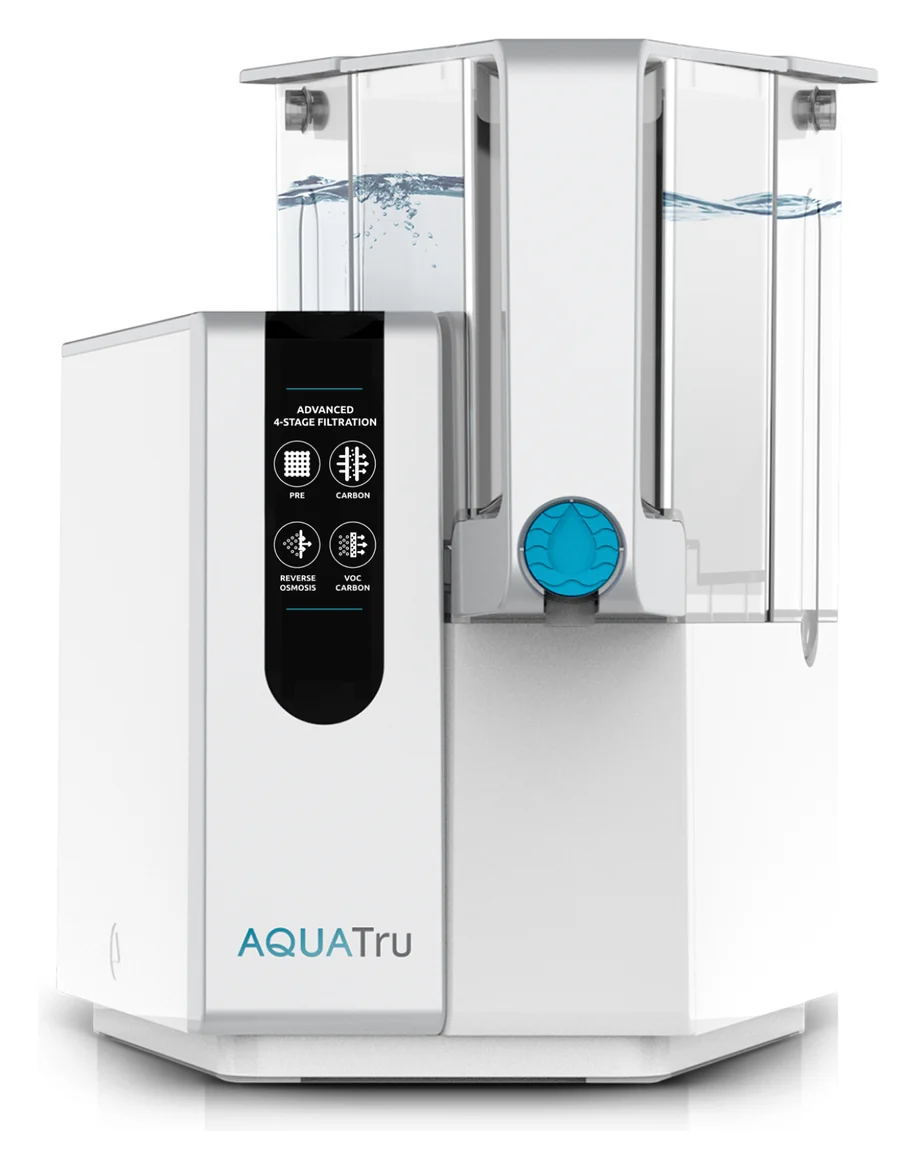
AquaTru Classic Countertop Reverse Osmosis Purifier
Best for: Renters and anyone who wants named, third-party RO certification without touching a pipe
- Install
- None, 120V plug and a countertop
- Stages
- 4 (pre/carbon, RO membrane, VOC carbon)
- Clean tank
- 0.75 gallon
- Certification
- Tested and certified by IAPMO to NSF 42, 53, 58 and 401
- Filter life
- 6 months (pre/carbon), up to 2 years (RO)
- Replacement filters
- $59.95 RO, $39.95 VOC carbon, $49.95 Mineral Boost
Four stages, a 0.75-gallon clean tank, and the certification list that decides this ranking: tested and certified by IAPMO to NSF 42, 53, 58 and 401, covering 84 contaminants. NSF 58 is the one that matters most here, because it is the standard written for reverse osmosis itself rather than for taste or health-effect claims around it.
What we like
- The only countertop here whose certifying body is named: IAPMO, to NSF 42, 53, 58 and 401
- NSF 58 covers the reverse osmosis claim itself, not just taste and chlorine
- No plumbing, no drain, no landlord conversation
- RO membrane rated up to 2 years, so the recurring cost is mostly the cheap pre-filters
What to watch
- Takes real counter space and a socket, and it is not silent
- 0.75 gallon of clean water at a time, so it suits two to four people, not a household of six
- Costs more than a plumbed-in under-sink RO that does the same job permanently
- Filters are proprietary at $39.95 to $59.95 a cartridge
The RO membrane is rated up to 2 years and the pre-carbon filters to 6 months, so the recurring bill is mostly the cheap half of the set: $59.95 for the RO cartridge, $39.95 for the VOC carbon, $49.95 for the Mineral Boost. Proprietary, all of them.
What it is not: quiet, small, or cheaper than plumbing. A under-sink system with the same certifications costs half as much and never asks you to fill a tank. The Classic exists for kitchens where that is not an option.
Best Small Kitchen: AquaTru Carafe#
AquaTru
AquaTru Carafe Countertop Reverse Osmosis Purifier
Best for: One or two people in a small kitchen who want RO water in a glass carafe rather than a plastic tank
- Install
- None, 120V plug
- Stages
- 4 (pre/carbon, RO membrane, VOC carbon)
- Clean tank
- 0.5 gallon, plus a 64 oz glass carafe
- Certification
- Tested and certified by IAPMO to NSF 42, 53 and 401
- Footprint
- 13 in H x 14 in D x 7.5 in W, about 9 lb
- Filter life
- 1,200 gallons (pre-carbon), 600 gallons (RO and VOC)
The same four-stage architecture in a body built around a 64 oz glass carafe you can lift straight into the fridge, with a 0.5-gallon clean tank behind it. For one or two people it is the more sensible purchase, and $100 cheaper.
Read the certification line carefully, because this is where the range splits: the Carafe is certified by IAPMO to NSF 42, 53 and 401. Not 58. On a product sold as reverse osmosis, the absence of the reverse osmosis standard is the single most important fact on the page, and it is not a reason to avoid the unit so much as a reason to know what you are buying. Filter life is shorter too: 1,200 gallons on the pre-carbon, 600 on the RO and VOC filters, where the Classic publishes up to two years on its membrane.
The Remineralization Pick: Bluevua ROPOT#
Bluevua
Bluevua ROPOT Countertop Reverse Osmosis System (RO100ROPOT)
Best for: Buyers who want a remineralization stage on a countertop unit and will accept a vaguer certification record
- Install
- None, 120V plug
- Stages
- 5 (PP 5 micron, carbon block, RO membrane, post carbon, remineralization)
- Carafe
- 60 oz borosilicate glass
- Filter life
- 12 to 24 months, per Bluevua
- Certification claim
- Bluevua states NSF and WQA certification without naming a standard
- Warranty
- 1 year limited
Five stages including remineralization, a borosilicate glass carafe holding 60 oz, and a filter life Bluevua puts at 12 to 24 months. The price moves with Bluevua's promotions, so read it on the day you buy: $389 on Sep 21, 2026, then $434 on the page with $325.50 at checkout under a Fall Sale from Sep 28 through Oct 5, and back to $389 on Oct 7 once that sale gave way to a buy-one-get-one offer that leaves the unit price alone. Even at its $434 compare-at it undercuts the AquaTru Classic by $41 while offering a stage the Classic charges extra for.
What we like
- Five stages including remineralization, which most countertop units charge extra for
- Borosilicate glass carafe, dishwasher and fridge safe
- Long stated filter life of 12 to 24 months
- Cheaper than the AquaTru Classic: $325.50 at checkout during a Fall Sale on Oct 5, 2026, against $475
What to watch
- The certification claim is unverifiable as published: "NSF & WQA Certified" names no NSF/ANSI standard and no certificate number
- The "up to 99.99% of contaminants" headline is a marketing figure, not a certified reduction claim
- Pure-to-drain ratio is not published on the product page, so the waste number cannot be compared
- The price moves with promotions: $389 on Sep 21, then $434 on the page with $325.50 at checkout on Sep 28 and Oct 5, 2026
Then the gap. The page says "NSF & WQA Certified" and stops there: no NSF/ANSI standard number, no certificate reference, alongside a headline claim of removing up to 99.99% of contaminants. That may well describe a properly certified product whose marketing page is simply vague. It might not. Neither we nor you can tell from the outside, and on a product whose entire value is contaminant removal, that is the difference between third place and first. The pure-to-drain ratio is not published either, so the water-loss comparison cannot be made at all.
Why Berkey Is Not on This List#
Berkey is the most-searched name in gravity filtration and it is deliberately absent, so here is the reasoning rather than a silent omission.
Gravity systems are a different technology: no membrane, no pump, no electricity, water simply falls through elements. That is genuinely useful off-grid and during outages, and it isn't what this page ranks. More decisively, the brand does not publish NSF/ANSI certification for reduction claims of the kind AquaTru names IAPMO for, and it has a documented history of regulatory friction in the United States. We aren't going to characterise that dispute, which is a matter for the parties and the regulator. We are going to apply the same rule we applied to Bluevua: a named standard, a named certifying body, a named model, or the product does not get ranked here.
What you hear
A countertop filter is a compromise for people who cannot afford a real system.
What the numbers say
It is more expensive, not less. The AquaTru Classic at $475 costs more than double the Aquasana SmartFlow, a certified under-sink membrane system that read $224.99 on sale ($449.99 list) on Oct 5, 2026. What the countertop unit buys is the absence of a drill, a drain saddle and a permanent fixture, which is worth a great deal in a rental and nothing at all in a house you own.
What These Units Do Not Do#
They treat what you pour into them. That is the whole boundary. The shower, the kettle, the washing machine and the water heater see untreated water, which means chlorine smell in the bathroom and scale wherever the water gets hot.
Hardness in particular is untouched in any useful sense: filtering a jug of water does nothing about the hard water arriving at every other outlet, and no cartridge in any of these units reaches dissolved minerals anyway, for the reasons set out in our hard water filter guide, and the fix for that is a water softener at the point the supply enters the house. For chlorine and chloramine everywhere rather than in one jug, the tool is a whole house water filter.
If you can plumb, the comparison worth running before you buy anything here is against the under-sink options, ranked in our best reverse osmosis systems and, for carbon versus membrane, in our under-sink filter guide.
Prices, certification statements, capacities and filter lives read on the dates shown, from each manufacturer's own product page. Where a certification claim names no standard, we quote the claim as published rather than interpreting it.
Countertop filter questions people actually search
What is the healthiest material for a countertop water dispenser?
Glass or stainless for anything that holds treated water for hours, which is why the AquaTru Carafe and the Bluevua ROPOT both use glass carafes. The plastic used in the tanks of these units is food-grade and the contact time is short, but a carafe that sits in the fridge overnight is the part worth having in glass.
Do countertop RO filters waste water?
Yes, exactly as much as a plumbed one. The difference is that the waste is visible: instead of running to a drain it collects in a chamber you empty. Bluevua does not publish a ratio for the ROPOT, so that particular comparison cannot be made honestly.
How long do countertop filters last before the unit itself fails?
The cartridges are the consumables; the pump and the electronics are the lifespan. AquaTru covers the Carafe with a 1-year manufacturer warranty and a 30-day money-back window, and Bluevua publishes a 1-year limited warranty on the ROPOT. Those are short warranties by the standards of plumbed equipment, where lifetime tank coverage is common.
Can I put a countertop purifier on well water?
Not without pretreatment. Sediment and iron will foul a small membrane fast, and these units have no prefilter stage designed for raw well water. Treat the water where it enters the house first, as set out in our [well water guide](/well-water), and then a countertop unit becomes a reasonable polish.
Does a countertop unit need a dedicated socket?
It needs a standard 120V outlet within reach of where it stands, which is the part people forget when they plan the space. These are pumped systems: no power, no filtered water.
Frequently asked questions
Do countertop water purifiers work?
The certified ones do, and certification is the only way to know. The AquaTru Classic is tested and certified by IAPMO to NSF 42, 53, 58 and 401, which covers taste, health effects, the reverse osmosis claim itself and emerging contaminants. A unit that advertises 99.99% of contaminants without naming a standard has made a marketing claim, not a tested one.
What is the best countertop water filter according to Consumer Reports?
We do not republish another publication's table. The evidence you can check yourself is the certification record: AquaTru names IAPMO and the four NSF standards it holds; Bluevua states NSF and WQA certification without naming a standard or a certificate number. That difference is more useful than any ranking, because you can verify it in two minutes.
What is the best countertop water filter for microplastics?
A reverse osmosis unit, because microplastic particles are orders of magnitude larger than an RO membrane's pores. All three picks here are RO systems. Look for NSF/ANSI 58, the reverse osmosis standard, rather than a microplastics claim: no residential certification exists specifically for microplastics, so the standard that covers the membrane is the closest verifiable proxy.
Is a countertop filter better than an under-sink system?
It's better at one thing: nothing gets drilled, nothing gets plumbed, and it moves house with you. It's worse at everything else. It occupies counter space, it holds half a gallon to three quarters of a gallon at a time, and it costs more than an under-sink system that does the same job permanently.
How much does a countertop reverse osmosis system cost?
$375 to $475 across the units we track, read Oct 7, 2026: the AquaTru Carafe at $375, the Bluevua ROPOT at $389 against a $434 compare-at, and the AquaTru Classic at $475. The ROPOT sat at $325.50 at checkout through a Fall Sale that ran Sep 28 to early October, so the floor moves with Bluevua promotions. Replacement filters run $39.95 to $59.95 a cartridge on the AquaTru range.
Where does the rejected water go on a countertop RO unit?
Into a second chamber you empty by hand. A plumbed system sends concentrate to a drain; a countertop unit has nowhere to send it, so you are the drain. It is the same water loss, just visible, and it is the maintenance task owners underestimate.
Keep reading
Not sure what you need?
Answer 5 questions, get the right system for your water.
City or well, budget, household size, our quiz matches your answers against every system we track.