Best Rust Filters for Well Water 2026 (What Actually Removes Rust Stains)
Rust from a well comes in four kinds and each takes a different filter. Match the stain to the fix, from a $79.99 screen to the $2,231.25 SpringWell WS1.
By Home Water Lab TeamUpdated Prices verified Oct 7, 2026
This page contains affiliate links; buying through them costs you nothing extra.
Rust stains from a well are four different problems that leave the same orange mark, and the filter that cures one does nothing for the next. Clear water that turns orange in the toilet bowl needs an oxidizing filter such as the SpringWell WS1 ($2,231.25 on Oct 12, 2026). Water that is already orange at the tap needs a $79.99 screen. Slime needs a well contractor. This page sits inside our guide to treating a private well, problem by problem, and it starts from the stain rather than the spec sheet.
The short answer
as of Oct 12, 2026What is the best rust filter for well water?
Match the filter to the stain. Orange straight from the tap is rust already in particle form: a reusable spin-down screen like the iSpring WSP-50SL ($79.99) catches it. Clear water that stains sinks and laundry later is dissolved iron: the SpringWell WS1 ($2,231.25) oxidizes and filters up to 7 ppm, and the iSpring WGB32BM ($535.99) covers light iron up to 3.0 ppm on cartridges. Slime and swampy smells are iron bacteria, which no filter fixes. Prices read Oct 12, 2026.
Key takeaways
- Staining starts above 0.3 mg/L iron, the EPA's secondary standard, which it sets for color and taste and does not enforce.
- Clear-water iron passes every sediment screen; it needs an oxidizing filter, like the SpringWell WS1 rated to 7 ppm.
- Orange-from-the-tap rust is already particles: a $79.99 spin-down screen stops it, read Oct 12, 2026.
- A softener takes some dissolved iron, with 2 to 5 mg/L the more typical limit per the Minnesota Department of Health.
- Iron bacteria call for shock chlorination close to but not above 200 ppm (MDH), and no filter can stand in for that.
What Removes Rust From Well Water?#
Whatever reaches the form of iron you actually have. The same orange stain can come from dissolved iron, from rust particles, from bacteria or from your own pipes, and each one answers to a different treatment.
The grid below is the whole page in one picture. Read your symptom down the left, then look for the solid dot.
Four kinds of rust, four fixes
- Clear-water irondissolvedFerrous iron, fully dissolved, so it slips through any screen. A softener takes some of it, with 2 to 5 mg/L the more typical limit per the Minnesota Department of Health; an oxidizing filter turns it into particles and catches them.
- Red-water ironalready particlesFerric iron has already oxidized, so a sediment screen or cartridge can stop it. It should not reach softener resin (Penn State Extension), and greensand-type oxidizing filters handle either form to about 10 to 15 mg/L (MDH).
- Iron bacteriaa well problemLiving organisms that leave rusty slime in pipes and pumps. MDH lists physical cleaning by a licensed well contractor and shock chlorination close to but not above 200 ppm; media filters downstream only clog.
- Pipe rustcorrosionFlakes shed by corroding steel casing or iron pipe, a source MDH names alongside the aquifer. A screen catches them; any tank filter catches them in passing; only replacing the corroding part ends them.
Solid dot: treats it. Half dot: up to a limit, or only in passing. Ring with a bar: does not reach it. Column heads, left to right: a sediment screen or cartridge, an ion exchange water softener, an oxidizing filter (air injection, greensand or a catalytic cartridge), and shock chlorination of the well itself. Sources: Minnesota Department of Health pages on iron and on iron bacteria in well water, and Penn State Extension, all read Oct 12, 2026.
Two of these rows are the territory of a dedicated oxidizing filter, and we rank those by technology, iron rating and running cost in our air injection and Katalox iron filter rankings. This page stays on the step before that: working out which row you are in, because that decides whether you need a $79.99 screen or a $2,231.25 tank.
Why Is My Well Water Orange? Four Kinds of Rust#
Your water is orange because iron is in it, either dissolved or already oxidized, and a two-minute glass test tells you which. The Minnesota Department of Health describes the split plainly: clear-water iron "comes out of the faucet clear, but turns red or brown after standing", while red-water iron "is red or yellow when it first comes out of the faucet."
The two-minute glass test
Run the cold tap for a minute, then fill a clear glass
Use a tap that bypasses any filter you already own. Look at the water against a white sheet of paper the moment it is poured.Orange or cloudy right away?
That is red-water iron or rust flakes, already in particle form. A sediment screen will catch it.Clear now, orange once it has stood a while?
That is clear-water iron, dissolved until the air oxidizes it. No screen stops it; this is the job of an oxidizing filter.Slime in the toilet tank, or a swampy, oily or musty smell?
MDH lists sticky rusty, yellow, brown or grey slime and those odors among the signs of iron bacteria. Test before you shop.Send a sample to a certified lab either way
You need iron and manganese in ppm, plus coliform. The number decides between a $536 cartridge rack and a $2,231 tank.
There is a fourth kind the glass will not show you. MDH also lists "corrosion of iron or steel well casing or water pipes" as a source of iron, which produces flakes rather than dissolved iron. The fix there is the corroding part, and a screen only buys you time. Our step-by-step well water testing guide covers which lab panel to order and how to read it.

Is Rusty Well Water Safe to Drink?#
At the levels that stain a sink, iron is a nuisance, not a health hazard. The EPA lists iron among its secondary standards, which it says it does not enforce, and states that these contaminants "are not considered to present a risk to human health" at that level.
0.3 mg/L
What you hear
Orange water means the well is contaminated and unsafe.
What the numbers say
Iron alone is cosmetic: MDH says iron in water 'does not usually present a health risk', and Penn State Extension says the same of iron and manganese together. The caveat is the company it keeps. MDH notes iron can matter if harmful bacteria have entered the well, so the coliform line on your lab report deserves more attention than the color.
Manganese is the exception worth knowing. Its secondary standard is 0.05 mg/L for black staining, and Penn State Extension notes a separate EPA health advisory for manganese at 0.3 mg/L. If your stains run black or brown rather than orange, the manganese number on your report matters as much as the iron.
Which Rust Filter Should You Buy?#
The one built for your row of the grid, priced at the level of iron it can actually handle. Here is the shortlist, every price read at the maker's site on Oct 12, 2026.
| Rust you have | Pick | Price | Rated for | Ongoing cost |
|---|---|---|---|---|
| Clear water, stains later, up to 7 ppm | SpringWell WS1 | $2,231.25 | 7 ppm iron, 1 ppm manganese, 8 ppm H2S | None besides backwash water, per SpringWell |
| Clear water, light iron, up to 3 ppm | iSpring WGB32BM | $535.99 | 3.0 ppm iron, 1.0 ppm manganese | $159.99 cartridge pack |
| Orange from the tap, rust flakes | iSpring WSP-50SL | $79.99 | Particles from 50 to 1,000 micron | Siliphos cartridge every 3 to 6 months |
| Iron plus hardness | SpringWell WSSS1 | $3,123.75 | 7 ppm iron, plus a salt softener behind it | Salt |
| Slime, swampy smell | No filter | Contractor quote | Shock chlorination of the well | Repeat if it returns |
How we chose: one pick per form of rust, since no single product covers all four. Within each row we kept the maker's published rating as the ceiling, preferred a product whose page states its iron limit in ppm, and set the price read on the maker's own site against what the product consumes over the years. Brands that publish no iron rating, or no price, did not make the table, however often they appear in forums.
The ratings are the makers', and none of them is a promise about your well. A lab number at the edge of a rating is a reason to size up, not to hope.
SpringWell WS1: best rust filter for clear water that stains later#
SpringWell
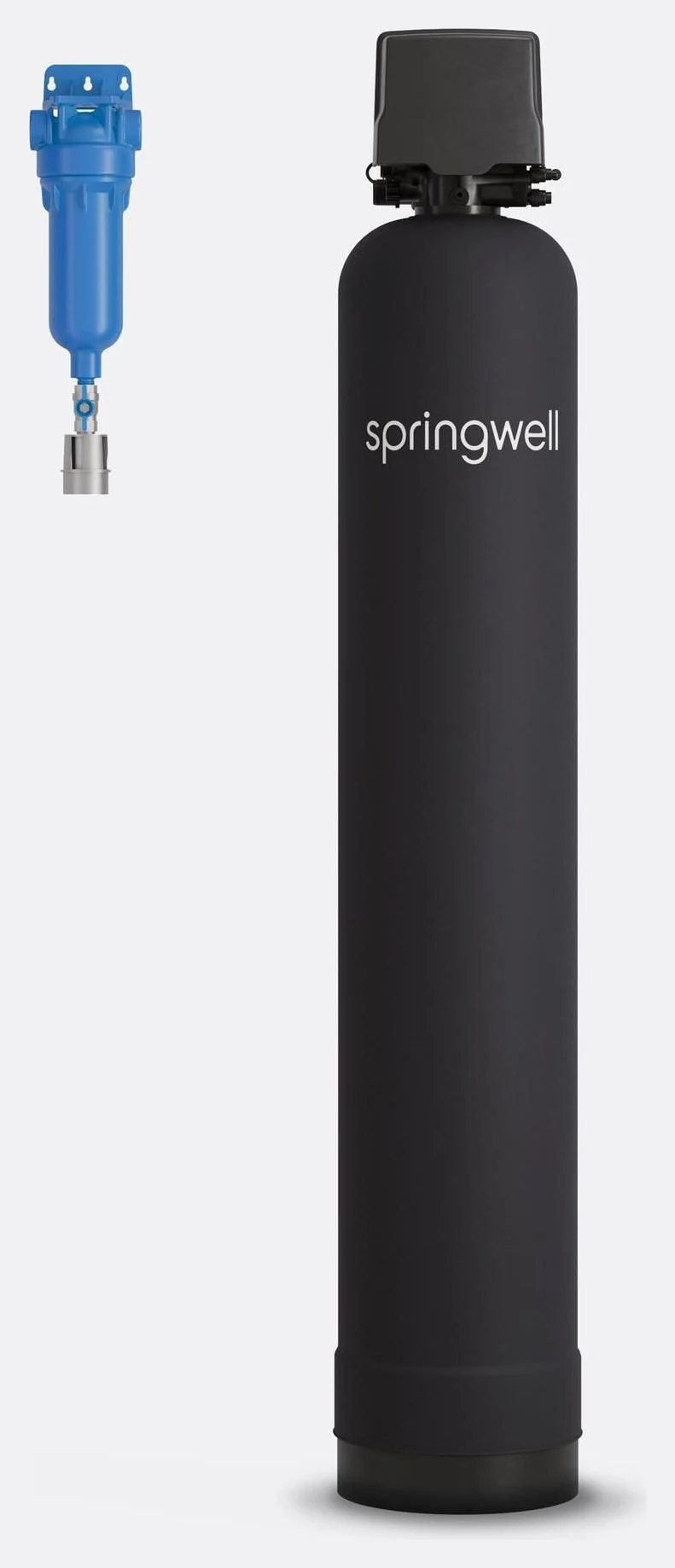
SpringWell WS1 Whole House Well Water Filter
Best for: Well-water homes with light-to-moderate iron, sulfur or manganese that want a chemical-free, no-consumable setup
- Technology
- Air Injection Oxidation (AIO), single tank, chemical-free
- Flow rate
- 12 GPM
- Iron rating
- 7 ppm
- Manganese rating
- 1 ppm
- Sulfur (H2S) rating
- 8 ppm
- Media
- Greensand fusion, 10+ year life
The WS1 is the right machine when the glass runs clear and the toilet bowl turns orange. A pocket of compressed air at the top of a single tank oxidizes dissolved iron into particles, and a greensand bed below catches them until the nightly backwash flushes them to the drain. SpringWell rates it for 7 ppm iron, 1 ppm manganese and 8 ppm hydrogen sulfide, at 12 GPM, and it was $2,231.25 on Oct 12, 2026.
Name the limits before you order. The 7 ppm ceiling is firm, and above it the bed falls behind and the stains come back. The backwash needs a drain and runs every night. SpringWell's product page also adds a well water test (Level 1 plus bacteria, $134.25) marked as required, which is the right instinct even if you test elsewhere. We go deeper on the head, the warranty split and the install in our full SpringWell WS1 review.
iSpring WGB32BM: best budget rust filter for light iron#
iSpring
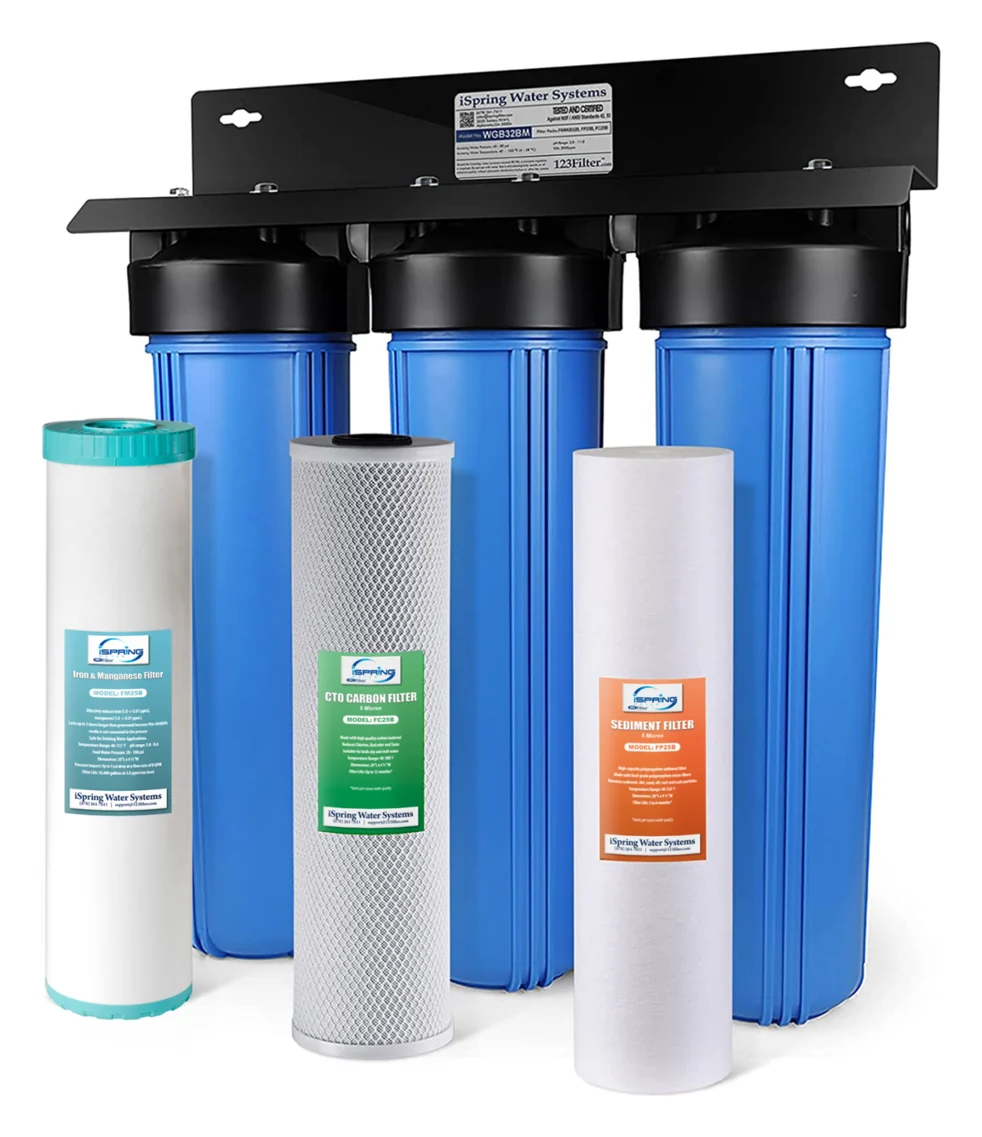
iSpring WGB32BM 3-Stage Whole House Iron and Manganese Filter
Best for: Wells with light iron, at or under 3 ppm on a lab test, where a backwashing tank is more machine than the problem needs
- Type
- 3-stage Big Blue cartridge filter, 20 x 4.5 in
- Stages
- 5 micron sediment, coconut carbon block, FM25B iron and manganese
- Iron rating
- 3.0 ppm max (FM25B cartridge)
- Manganese rating
- 1.0 ppm max
- Flow
- Up to 15 GPM system; FM25B cartridge rated 4 to 8 GPM
- Iron cartridge life
- 50,000 gallons at 3.0 ppm iron
For a well that tests at 3 ppm iron or less, a cartridge rack is a reasonable alternative to a backwashing tank. The WGB32BM puts a 5 micron sediment cartridge, a coconut carbon block and iSpring's FM25B iron and manganese cartridge on one bracket, and it was $535.99 on Oct 12, 2026. There is no drain line, no power and nothing to program.
The other trade is the warranty, one year from iSpring against SpringWell's lifetime tank. Past 3 ppm, skip it: iSpring's own WGB22BM page sends higher-iron wells to its larger systems.
iSpring WSP-50SL: best filter for orange water straight from the tap#
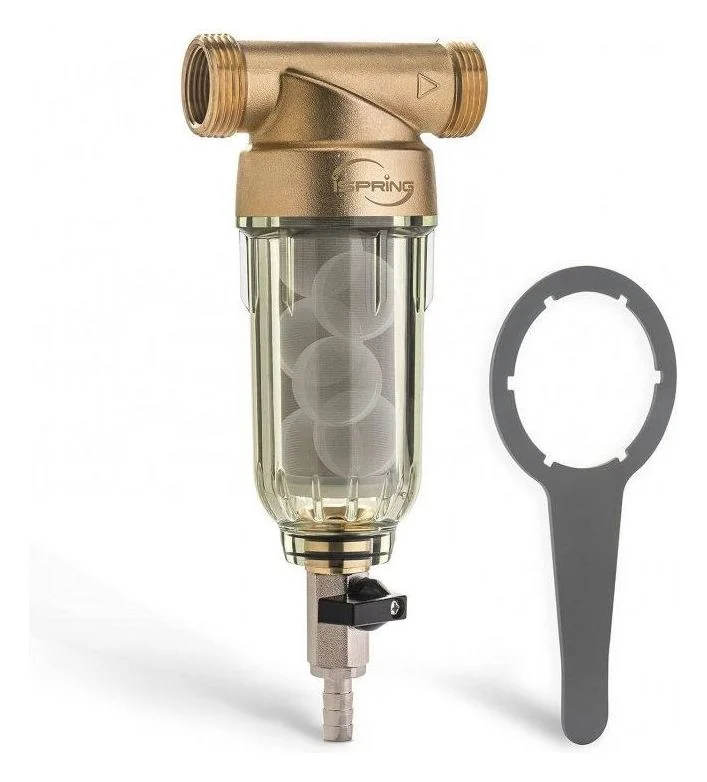
iSpring
iSpring WSP-50SL Reusable Spin-Down Sediment Prefilter
Best for: Putting a flushable, never-replaced screen in front of a softener, an iron filter or a cartridge stack
- Micron options
- 50, 100, 200, 500 and 1,000 on the same body
- Ports
- 1 in MNPT and 3/4 in FNPT, both ends
- Pressure range
- 20 to 100 PSI
- Temperature range
- 40 to 100 F
- Screen
- Reusable 316L stainless, flushed by valve
- Siliphos cartridge
- Replace every 3 to 6 months
If the water is orange the moment it leaves the tap and settles in a glass, you are looking at particles, and particles are what a screen is for. The WSP-50SL is a stainless mesh in a clear bowl, sold in 50, 100, 200, 500 and 1,000 micron on the same body, and it was $79.99 on Oct 12, 2026. You flush it through a valve rather than replace it.
It is also the cheapest mistake on this page when the iron is dissolved, because clear-water iron passes any rating straight through. Most wells benefit from one in front of whatever else they run, and our spin-down, cartridge and backwashing sediment picks for wells compare it with the self-flushing models. Micron choice, flush routine and placement are covered in our walkthrough of whole-house sediment filtration.
What If the Rust Is Iron Bacteria?#
Then no filter on this page will solve it, and a new one will clog. The same goes for the rest of the iron toolkit, as our comparison of ways to remove iron from a well shows from softeners up to chlorine. Iron bacteria live in the well, the pump and the pipes, and the Minnesota Department of Health lists the treatments as physical cleaning by a licensed well contractor, chemical treatment (chlorine most often) and pasteurization with steam or hot water.
Once the well is clean and retested, the filter decision goes back to the grid: dissolved iron that remains still needs an oxidizing filter.
Can a Water Softener Remove Rust?#
Partly, and only one kind. A softener removes some dissolved, clear-water iron by ion exchange, but the Minnesota Department of Health puts the more typical limit at 2 to 5 mg/L even though manufacturers claim up to 10, and Penn State Extension says oxidized iron should not reach the resin at all.
A softener can carry the iron
- Lab test shows dissolved iron at the low end, inside 2 to 5 mg/L
- The water is hard too, so you need the softener anyway
- The glass runs clear, with no orange particles
- You will clean the resin on the maker's schedule
Put an iron filter in front
- Iron above the softener's realistic range
- Orange from the tap, which means oxidized iron that fouls resin
- Manganese or a sulfur smell alongside the iron
- Any sign of iron bacteria
The call
Use the softener for hardness and let a dedicated filter take the iron. The resin lasts longer when it never sees rust.
When iron and hardness come together, SpringWell sells the WS1 and its 32,000-grain salt softener as the WSSS1 combo, $3,123.75 on Oct 12, 2026, with the iron filter first in line. We rank it against the other well setups in our softener picks for iron-heavy well water. Iron also raises the softener size you need, which our household grain-sizing walkthrough works through.
What Order Do Rust Filters Go In?#
Screen first, oxidizing filter second, softener last, all after the pressure tank. The order follows from the grid: particles would blind the media of the tanks behind them, and Penn State Extension says oxidized iron should not reach softener resin, so the iron filter has to sit in front of the softener.
A rust-proof treatment line, in the order the water meets it
Pressure tank
Nothing that can clog goes between the pump and the tank. Our sediment filter picks for wells explain why the pressure switch cannot see a blocked filter there.Sediment screen
Takes rust flakes and grit, and protects the valve and media bed of everything behind it.Iron filter
Air injection, greensand or a catalytic cartridge, sized to the iron and manganese on your lab report.Softener, if the water is hard
Now it sees clean, iron-free water, which is the condition the resin needs to last.
The same sequence anchors every well stack we price, from iron alone to iron, sulfur, hardness and bacteria together, which is why it repeats across the well-water pages rather than changing from one product to the next.
How Much Does a Rust Filter Cost?#
From $79.99 for a screen to $2,231.25 for an air injection tank, before installation, on prices read Oct 12, 2026. What separates them over the years is the consumable line, and the iron level you test at decides how fast the cartridge kind burns.
Rust filters, what each one costs to buy and keep
as of Oct 12, 2026- iSpring WSP-50SL spin-down screenScreen is flushed, not replaced; Siliphos cartridge every 3 to 6 months
- $79.99
- iSpring WGB32BM cartridge rackReplacement pack $159.99; FM25B iron cartridge $104.99 alone
- $535.99
- SpringWell WS1 air injectionNo cartridges; greensand bed rated 10+ years by SpringWell
- $2,231.25
- SpringWell WSSS1, iron filter plus softenerAdds salt as the running cost
- $3,123.75
- Shock chlorination for iron bacteriaMDH: licensed well contractor; no national price published
- Contractor quote
The tank route for dissolved iron up to 7 ppm
$2,231.25
Equipment prices read on ispringfilter.com and springwellwater.com on Oct 12, 2026. Installation is extra, and the WS1 also needs a drain and an outlet. Full scenarios by well problem, installed, are in our well filtration cost breakdown.
A tank looks expensive next to a cartridge rack until you count cartridges. Installed costs for every well scenario, from a single screen to a full stack, are laid out in our budget for each well water treatment stage. If you are still not sure which row of the grid you are in, our two-minute treatment finder asks the same questions in order.
EPA's page was last updated May 26, 2026; MDH's iron page Aug 1, 2025 and its iron bacteria page Jan 7, 2026; Penn State's fact sheet May 29, 2025. All were read Oct 12, 2026, as were the prices and ratings for every product named. We did not bench-test these filters; ratings are the makers' own.
Rust in well water: the questions people search
Why is my well water orange?
Iron. If it is orange the moment it leaves the tap, the iron is already oxidized into particles. If it runs clear and turns orange after standing, it is dissolved iron oxidizing in the air. The Minnesota Department of Health describes both forms, and a glass of water left to stand on the counter tells them apart.
How do you get rid of rust in well water?
Test first, then treat the form you have: a sediment screen for particles, an oxidizing filter such as air injection or greensand for dissolved iron, and shock chlorination by a well contractor for iron bacteria. Penn State Extension notes that polyphosphate products only hide dissolved iron below 2 mg/L rather than remove it.
Will a whole house sediment filter remove rust?
Only rust that is already in particle form, the kind that makes water orange straight from the tap. Dissolved iron passes through every micron rating and turns orange later in the sink or the toilet bowl.
How much iron in well water is too much?
Staining and a metallic taste start above 0.3 mg/L, the EPA's secondary standard. MDH says iron is usually below 10 mg/L in well water; where yours sits inside that range decides between a cartridge rated to 3 ppm and a tank rated to 7.
Frequently asked questions
What removes rust from well water?
It depends on which rust you have. Water that runs orange straight from the tap carries particles, and a sediment screen or cartridge catches them. Water that runs clear and stains later carries dissolved iron, which needs an oxidizing filter such as the SpringWell WS1 (rated to 7 ppm iron) or, for light iron, a catalytic cartridge like iSpring's FM25B (3.0 ppm). Slime and odd smells point at iron bacteria, which need shock chlorination of the well, not a filter.
Is there a water filter that removes rust?
Yes, several, and buying the wrong one is the common mistake. A $79.99 spin-down screen stops rust flakes but lets dissolved iron straight through. An air injection filter handles dissolved iron within its rating. A softener takes some dissolved iron, with 2 to 5 mg/L the more typical limit according to the Minnesota Department of Health, and none of the already-rusted kind.
Why is my well water suddenly rusty?
The Minnesota Department of Health names two sources besides the rock itself: corrosion of steel well casing or iron pipe, and iron bacteria, which leave rusty slime and swampy or oily smells. A change you can see from one week to the next deserves a lab test for iron, manganese, coliform and iron bacteria before you buy anything.
Is rusty well water safe to drink?
Iron itself is a nuisance rather than a health risk. The EPA's 0.3 mg/L limit for iron is a secondary standard it does not enforce, set for color, staining and taste. The Minnesota Department of Health adds one caveat: iron can matter if harmful bacteria have entered the well, so test for coliform too.
Keep reading
Not sure what you need?
Answer 5 questions, get the right system for your water.
City or well, budget, household size, our quiz matches your answers against every system we track.