Water Softener Installation Cost in 2026: DIY vs Plumber
Water softener installation cost runs $300 to $1,500 with a plumber, or a 2 to 4 hour DIY job. What moves the price, and when hiring the pro is worth it.
By Home Water Lab TeamUpdated Prices verified Sep 12, 2026
This page contains affiliate links; buying through them costs you nothing extra.
Water softener installation costs $300 to $1,500 when a plumber does it, per 2026 data from Angi, HomeGuide and Fixr. Do it yourself and the labor cost is zero: on most units it is a realistic two-to-four-hour job with basic plumbing tools.
That $1,200 spread between the floor and the ceiling is not random, and neither is the DIY decision. This page breaks down what actually moves the number, what the job involves step by step, and the specific situations where paying the plumber is the right call. It covers labor only, so pair it with the water softener systems hub for the decision itself and the price guide by type and size for the machine.
The short answer
as of Aug 29, 2026How much does water softener installation cost?
$300 to $1,500 with a plumber, per 2026 data from Angi, HomeGuide and Fixr, and $0 if you do it yourself. The floor of that range is an exposed main line next to a drain and an outlet; the ceiling is adding a softener loop or repiping through finished walls.
Location shifts the whole band. Angi's Los Angeles page, updated July 2026, puts an installed softener at a $1,704 average with a documented spread of $227 to $6,816, so high-cost metros live in the upper half of every national figure. Dealer brands remove the choice: Culligan and Kinetico install through their own networks and bundle the labor into the quote.
Key takeaways
- The published professional range is $300 to $1,500, and the $300 floor is a best case, not an average.
- DIY is realistic on most big-box and factory-direct units: 2 to 4 hours, basic tools, manufacturer instructions included.
- Labor is the single largest lever you control, worth about $900 at the midpoint of the published range.
- Four things drive the quote: distance to a drain, an air gap requirement, repiping, and the small extras that stack.
- Dealer brands take the decision away entirely, because Culligan and Kinetico install through their own certified networks.
$300 to $1,500
How Much Does Water Softener Installation Cost?#
$0 for a DIY afternoon, $300 to $1,500 for an independent plumber, and bundled into the quote if you buy from a dealer. Three ways the labor gets paid, and the choice between them moves your total more than any spec on the machine.
The install, in order
- Main shut-offEverything downstream starts here. Find it and turn it before you buy anything: an install with no working shut-off is a plumber's job, not a Saturday.
- Untreated branchOutdoor taps and irrigation tee off before the softener. A lawn does not care about hardness, and softened water is salt you paid for. Many installs run the kitchen cold tap off this same branch and keep drinking water untreated.
- Bypass valveTakes the softener out of service without cutting water to the house. It is what turns a resin change from an outage into an errand.
- SoftenerOn the main line, ahead of anything that heats water. Everything downstream of this point is soft; everything on the untreated branch is not.
- Brine tankStands within a few feet of the valve, and needs enough clearance overhead to lift a 40 pound bag of salt over the lid.
- Drain line, with air gapBackwash has to reach a drain, and the gap above it is what code asks for. The distance to that drain is the most common reason an install ends up on a different wall.
- Water heaterDownstream, on purpose. Scale forms fastest where water is heated, so the heater is the appliance a softener is really protecting.
- Power outletThe control valve needs power within reach of its cord. The battery inside only holds the clock, it does not run a cycle.
Schematic: pipe runs, wall space and distances change with every house. The order does not. Main, then the untreated branch, then the bypass, then the softener, then the heater, plus the three things a control valve has to reach: a drain, its brine tank and an outlet.
| Path | Labor cost | What you get |
|---|---|---|
| DIY | $0 plus fittings | 2 to 4 hours of your weekend, basic tools |
| Independent plumber | $300 to $1,500 | Your unit, their labor, code compliance |
| Dealer install | Bundled in the quote | Required by Culligan and Kinetico, never itemized |
Two calibration points keep those numbers honest. First, treat the $300 floor as the best case, an exposed main line next to a drain, not the average. Second, location moves everything: Angi's Los Angeles data, updated July 2026, puts an installed softener at a $1,704 average with a documented spread of $227 to $6,816.
What Makes Installation Cost More?#
Your plumbing, not the softener brand. The quote is a function of how far the water has to travel to reach a drain and how much wall has to come off to get there. Four drivers, in rough order of impact:
- Distance from the main line to a drain. Regeneration water must go somewhere. A floor drain or standpipe within a few feet keeps you at the bottom of the range; running a new drain line does not.
- An air gap requirement. Some states require an air gap fitting on the drain line by law. It is a cheap part, but it constrains where the softener can sit and adds work.
- Repiping. If your home has no softener loop and the main line hides behind finished walls, the plumber is cutting, rerouting and patching. This is the single biggest jump toward $1,500.
- The extras. A bypass valve, new shutoffs, a power outlet where none exists: each is minor alone, and they stack.
If your main line is exposed, near a drain and near an outlet, you are a bottom-of-range install, and a strong DIY candidate. Buried behind drywall in a finished basement, budget the top.
Can You Install a Water Softener Yourself?#
On most big-box and factory-direct units, yes, and it is the single biggest lever on your total cost. The honest prerequisites are an accessible main line, a drain within reach, and enough comfort with pipe to cut and join it without improvising.
Is your house a DIY install?
7 itemsTick all seven and the plumber is optional. Miss the first or the last and the money is well spent.
What Does the Job Actually Involve?#
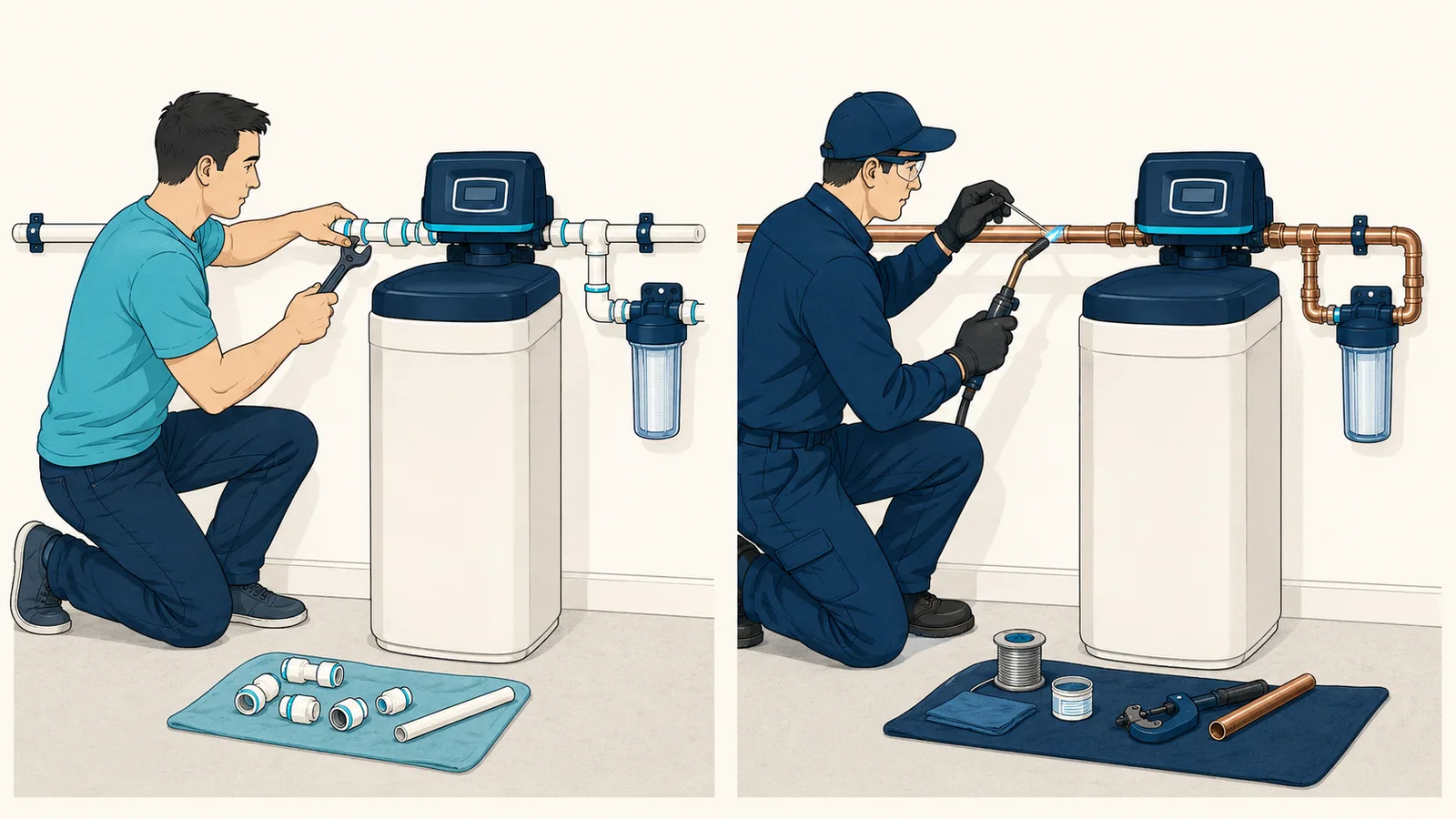
Six steps, in this order, on a standard main-line installation. Nothing here is exotic, which is why manufacturers publish their own guides for the same sequence.
A standard installation, in order
Shut off and drain the main line
Close the main, open the lowest tap in the house and let the line empty. Everything after this is dry work.Cut in the bypass valve
The bypass is what lets you take the softener out of service later without shutting off the house. Skipping it is the most common regret on a first install.Connect the inlet and outlet
Softened water goes to the house, not to outside spigots or an irrigation line. Getting the direction right matters more than the fitting type.Run the drain line with its air gap
Regeneration water needs a path to a floor drain or standpipe, and some states require an air gap fitting by law. This is the step that decides where the tank can stand.Set up the brine tank
Position it within reach of the brine line, add the first bag of salt, and leave clearance to lift a 40 lb bag over the rim.Program the hardness and flush
Enter your grains per gallon, run a manual regeneration, and flush the resin before the water reaches a tap.
Two to four hours with basic plumbing tools is realistic for that sequence. The honest self-assessment is about pipe joining: push-to-connect fittings have made this genuinely accessible, and if your install needs soldered copper in a tight space instead, the plumber earns the money.
Rheem
Rheem Preferred RHS32 Water Softener (32,000 Grain)
Best for: The budget tier-1 pick for tight budgets and handy owners, now that the GE GXSH40V is discontinued
- Grain capacity
- 32,000
- Flow rate
- 7.9 GPM
- Reduces
- Hardness and iron
- Retail
- Buy Exclusively At The Home Depot, not sold on Amazon
At $489 as of Aug 28, 2026, plus a weekend afternoon, the Rheem RHS32 is the cheapest complete path to soft water in America, and our full review covers the warranty trade that comes with it. Add $300 to $1,500 if you hand it to a plumber, and it still undercuts every dealer quote we have documented.
When Should You Hire a Plumber?#
Five situations where the pro is the right answer, not the expensive one. In four of them you are buying compliance or protecting the machine; in the fifth the decision was made for you at purchase.
- No loop, no exposed main. Repiping through finished walls is not a first DIY project.
- Code and permits. Air gap rules and local permit requirements for plumbing work vary; a licensed plumber owns that compliance so you do not have to research it.
- Well water with existing treatment. Softeners install downstream of iron filters in a specific order, and getting it wrong fouls the resin. The whole stack, in order, is priced in our well water filtration system cost page, and the hardware options are ranked in best water softeners for well water.
- You bought a dealer brand. Culligan requires installation through its dealer network per Modernize's 2026 reporting, and Kinetico uses certified dealer technicians. The decision was made for you and priced into the quote; see our Culligan cost decode and the Kinetico decode for what that bundle looks like.
- You want a serviceable install, not just a working one. A pro leaves you unions, a proper bypass and clearances that make the next repair cheaper, and cheap repairs are most of what keeps a softener alive to year fifteen.
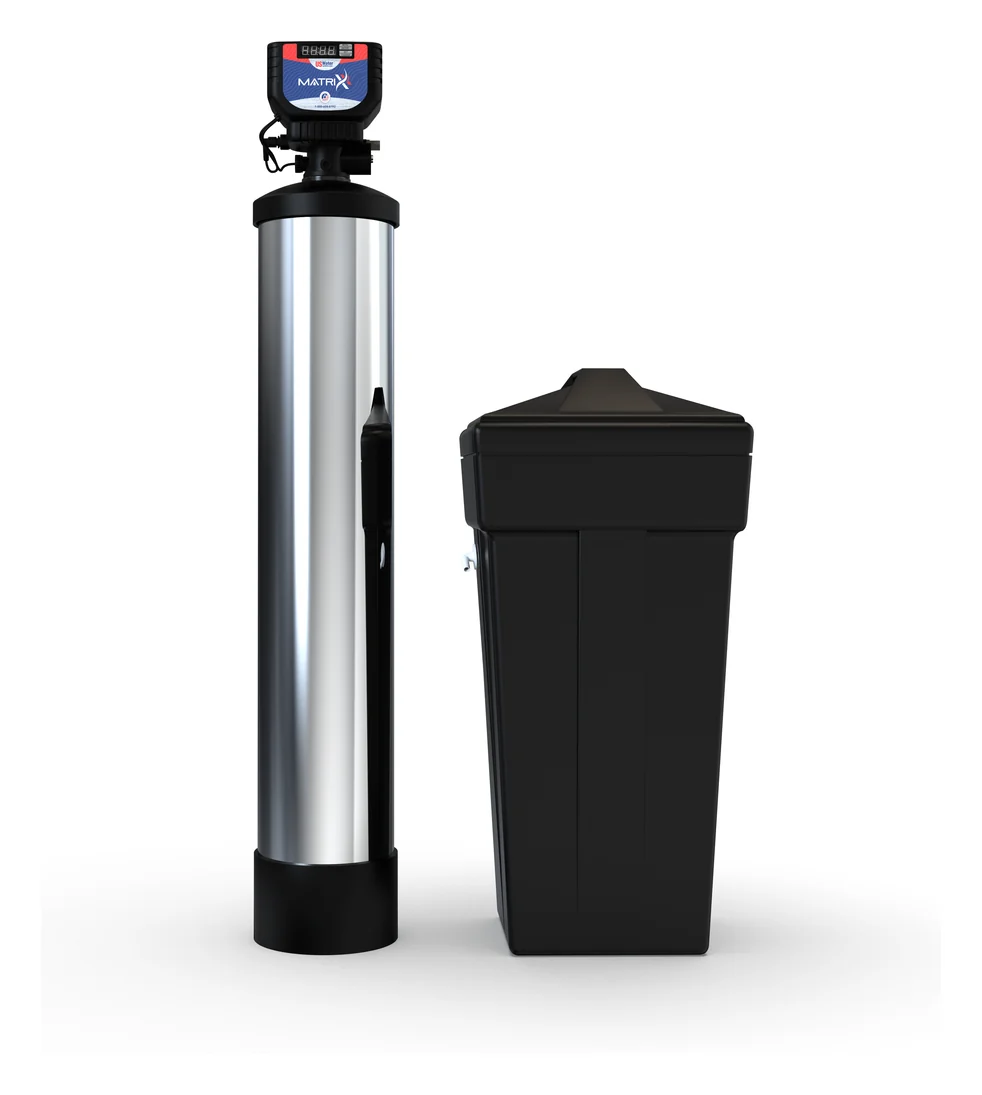
If long-term serviceability is the goal, the machine choice matters as much as the install: the US Water Systems Matrixx, $1,466.95 as of Sep 12, 2026, runs an open-standard valve that any local plumber can rebuild for the life of the system, no brand network required.
US Water Systems
US Water Systems Matrixx Smart Metered Water Softener
Best for: Buyers who want a serviceable, open-valve softener backed by real technical support, the softener plumbers buy for themselves
- Valve
- Smart metered electronic valve with Bluetooth
- Valve platform
- Open standard, rebuildable, not proprietary
- Support
- 7-day hotline staffed by water technicians
What Does Each Path Cost All-In?#
$400 to $1,000 for a big-box unit you install yourself, $700 to $2,500 with a plumber, $1,500 to $3,800 for a factory-direct system professionally installed, and $1,800 to $6,500 bundled through a dealer. Those totals are our arithmetic on the published 2026 ranges, not quotes.
DIY install
- $0 labor, plus fittings and a free Saturday
- 2 to 4 hours on an accessible main line
- You own every future service decision
- Ten-year total on a big-box unit: about $1,900
Licensed plumber
- $300 to $1,500, $900 at the midpoint
- Code compliance and permits are their problem
- Unions, bypass and clearances done properly
- Ten-year total on the same unit: about $2,800
Bottom line
If your main line is exposed and near a drain, DIY is the highest-value hour of work in this whole category. If it is behind drywall, on a well, or subject to a permit, the $900 buys something real.
Ten years of ownership
as of Aug 28, 2026- EquipmentBig-box is the middle of Angi's 2026 range for a 48,000-grain unit, $600 to $1,200. Factory-direct is SpringWell's SS1 at $1,606.50. The dealer column is a Culligan system installed, middle of $1,800 to $6,500.
- Installation$900, the middle of the $300 to $1,500 a plumber charges in the 2026 Angi, HomeGuide and Fixr guides. Doing it yourself takes this line to zero. Dealer quotes already contain it.
- Salt, ten years$100 a year, the middle of HomeGuide's 2026 range of $50 to $150, times ten. Hard water and a thirsty household push this to the top of the range.
- Regeneration water, ten years$20 a year on city water, the middle of $10 to $30, times ten. On a private well the water itself costs nothing, so this line disappears.
Equipment is $700, the middle of Angi's 2026 range of $400 to $1,000 for a standard 32,000 grain unit, and $1,766 for the factory-direct tier, the middle of the $1,232 to $2,300 dated readings above. Installation is $900, the middle of the $300 to $1,500 professional range in the Angi, HomeGuide and Fixr 2026 guides. Salt is $100 a year and regeneration water $20 a year, the middles of HomeGuide's 2026 ranges, times ten. No inflation, no repairs, no resin replacement.
Putting labor and hardware together, using Angi's 2026 unit pricing for a standard 32,000 grain softener at $400 to $1,000:
| Scenario | Hardware | Labor | All-in |
|---|---|---|---|
| Big box, DIY | $400 to $1,000 | $0 | $400 to $1,000 |
| Big box, plumber | $400 to $1,000 | $300 to $1,500 | $700 to $2,500 |
| Factory-direct, plumber | $1,232 to $2,300 | $300 to $1,500 | $1,500 to $3,800 |
| Dealer, bundled | Not itemized | Not itemized | $1,800 to $6,500 and up |
Read the last two rows together and the market becomes legible: a factory-direct system professionally installed tops out where dealer quotes get started. Whether that gap buys you something worth paying for is the question our water softener cost breakdown exists to answer, and you can run your own version of the decade in the cost calculator.
Once the unit is in, the upkeep is genuinely small: our maintenance checklist covers the whole year in one page. And when you are ready to pick the machine itself, the ranked list is in our best water softeners guide.
Frequently asked questions
How much does a plumber charge to install a water softener?
$300 to $1,500, per 2026 data from Angi, HomeGuide and Fixr. The bottom of the range is an exposed main line next to a drain and an outlet; the top is cutting into finished walls, adding a loop, or rerouting pipe. Treat the $300 floor as the best case, not the average.
Can I install a water softener myself?
On most big-box and factory-direct units, yes: two to four hours with basic plumbing tools, and manufacturers publish step-by-step guides. The honest prerequisites are an existing loop or accessible main line, a nearby drain, and comfort cutting and joining pipe. Dealer brands like Culligan and Kinetico are the exception, since they require installation through their own networks.
How long does it take to install a water softener?
Two to four hours is realistic for a DIY installation on a home with an accessible main line and a nearby drain. A professional doing a straightforward swap of an existing unit is typically faster, while a first-time install that needs new pipe runs or a drain line can take longer.
What is a water softener loop?
A softener loop is a section of plumbing that routes the incoming main line through one spot, usually in the garage or utility room, so a softener can be connected without rerouting pipe. Homes built with a loop sit at the bottom of the $300 to $1,500 install range; adding one where none exists is what pushes installs toward the top.
Is water softener installation included in dealer quotes?
Yes. Culligan requires professional installation through its dealer network per Modernize's 2026 reporting, and Kinetico installs through certified dealer technicians. That is part of why dealer quotes run $1,800 to $6,500 and up while a big-box unit plus a plumber can land under $2,000.
Keep reading
Not sure what you need?
Answer 5 questions, get the right system for your water.
City or well, budget, household size, our quiz matches your answers against every system we track.