Water Softener Maintenance: The Complete Checklist
The complete water softener maintenance checklist: salt refills, salt bridges, brine tank cleaning, resin cleaner, and the 15 minutes a month that buy 15 years.
By Home Water Lab TeamUpdated Prices verified Oct 7, 2026
This page contains affiliate links; buying through them costs you nothing extra.
Fifteen minutes a month and one honest hour a year. That is the entire maintenance burden of a salt-based water softener, and it is the difference between a machine that reaches its 10 to 15 year design life and one that quietly stops softening in year four while still looking perfectly healthy in the garage.
This is the complete checklist we use, task by task, with what each one costs, how long it takes, and the warning signs that mean you should stop DIY-ing and call a pro. If you are still choosing a system, start with our water softener hub instead; this page assumes the tank is already in your garage.
The short answer
as of Aug 29, 2026What maintenance does a water softener need?
Four recurring jobs: check the salt level monthly, break up any salt bridge you find, replace the sediment pre-filter every 3 to 6 months, and clean the brine tank once a year. Add a quarterly hardness strip test and an annual settings review. Total time is about 15 minutes a month plus one hour a year, on roughly $50 to $150 a year in salt per HomeGuide's 2026 cost data.
Key takeaways
- The whole routine is 15 minutes a month plus a one-hour brine tank clean each year.
- A salt bridge is the classic silent failure: the tank looks full and no brine is being made.
- Running costs are $60 to $190 a year: salt, regeneration water and electricity combined.
- A repair visit is $150 to $600 with a $430 national average, so the monthly check is the cheap option.
- Correct maintenance is what gets a softener to the 10 to 15 year lifespan its makers cite.
How Often Does a Water Softener Need Maintenance?#
Here is the whole schedule in one table. Everything below expands on it.
| Task | How often | Time |
|---|---|---|
| Check the salt level | Monthly | 2 min |
| Break up a salt bridge | Whenever you find one | 10 min |
| Test water hardness at a tap | Quarterly | 5 min |
| Replace the sediment pre-filter | Every 3 to 6 months | 15 min |
| Run resin cleaner (iron-prone water) | Per the product label, often quarterly | 10 min |
| Exercise the bypass valve | Twice a year | 1 min |
| Clean the brine tank | Yearly | 1 hour |
| Review regeneration settings | Yearly, or after any change in water or household | 15 min |
None of this requires tools beyond a broom handle, a bucket and mild dish soap. The stakes are real, though: an industry-funded but independently run Battelle study for the Water Quality Research Foundation found gas water heaters lose about 4 percent efficiency for every 5 grains per gallon of hardness, and up to 48 percent over their lifetime on hard water. A softener that quietly stopped regenerating protects nothing, which is the whole argument of our hard water hub turned back on the equipment meant to solve it.
How Do You Check and Refill the Salt?#
Open the lid of the brine tank (the shorter tank with the big lid) and look. Two rules cover it:
- Keep the tank at least one-quarter to one-half full, and always keep the salt level above the water line you can see in the tank.
- Do not pack it to the brim. A tank stuffed full encourages bridging, the failure mode covered in the next section. Full-size brine tanks hold a lot more than you need at once; SpringWell's standard 18 by 33 inch tank, for example, is rated for around 200 pounds.
Budget-wise, salt is the cheapest part of owning a softener: $5 to $10 per 40 pound bag per Angi's 2026 figures, and $50 to $150 a year in total per HomeGuide. Which type to buy, and how fast you will burn through it, gets its own page in our water softener salt guide. The specific bags, plain and iron-fighting pellets side by side, are priced in our shortlist of the best softener salt by bag.
What you hear
You have to use the manufacturer's own brand of salt, and more salt in the tank means softer water.
What the numbers say
No residential softener requires proprietary salt: any standard sodium chloride or potassium chloride works, and what matters is form and purity rather than the logo. Filling the tank to the lid does not soften anything further either. It makes bridging more likely, which stops softening altogether.
What Is a Salt Bridge and How Do You Break It?#
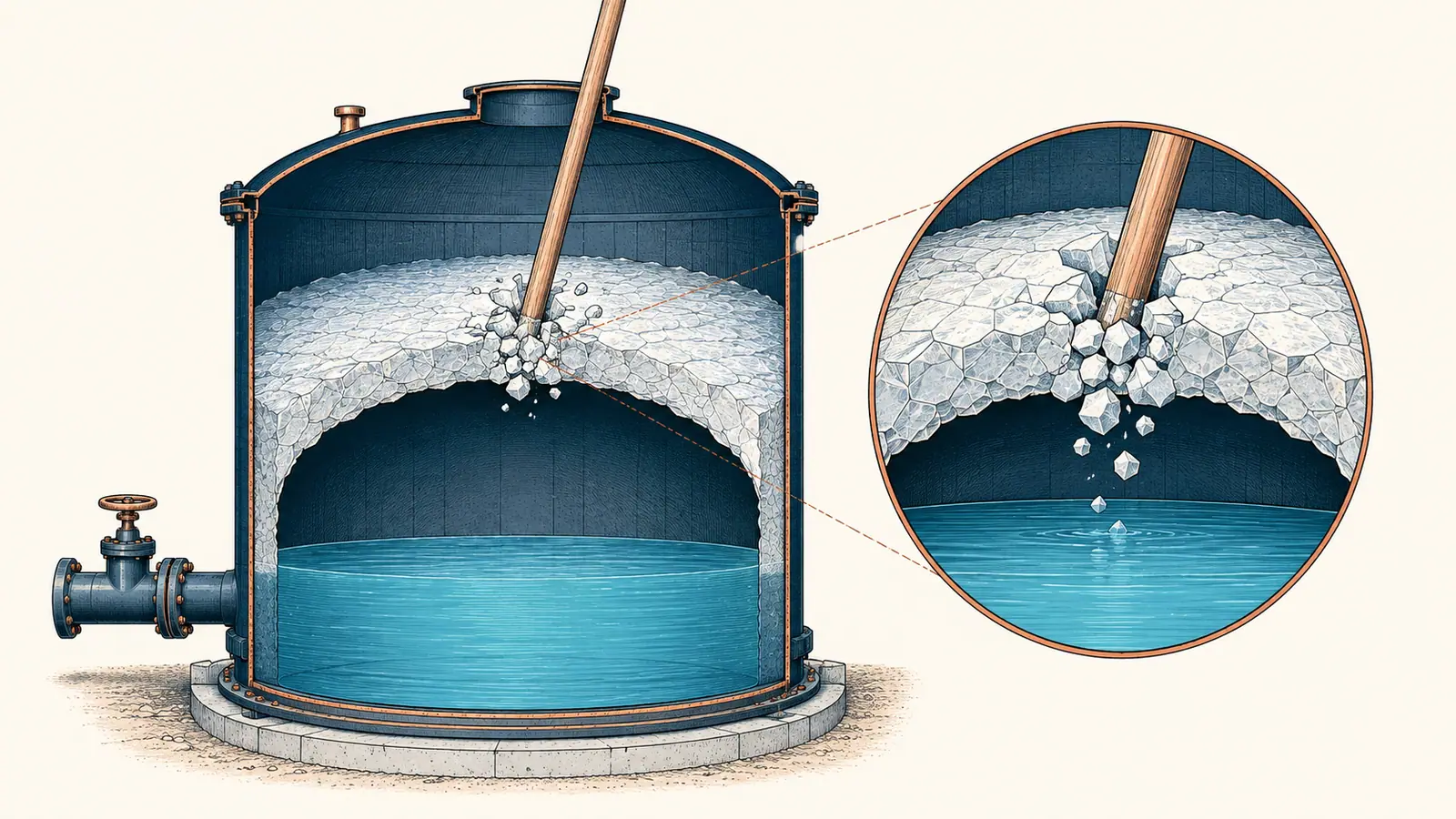
A salt bridge is a hard crust of salt that forms a dome inside the brine tank, with an air gap underneath. From the top the tank looks full, but the salt is no longer touching the water below, so no brine is made and the softener stops softening while looking perfectly normal. Most bridges are built on day one, by pouring salt into a dry tank, which is why our installation guide puts three gallons of water in first.
The fix is deliberately low-tech.
Breaking a salt bridge
Take a broom handle or a similar blunt stick
Nothing sharp, and nothing that will splinter into the tank. A wooden broom handle is the traditional tool for a reason.Push straight down into the salt in several spots
If it hits a crust that then collapses with a crunch, that was your bridge. Work around the tank rather than repeatedly through the same hole.Break up the chunks and run a regeneration
Remove any loose dome pieces, leave the clean salt in place, and let the system run its next cycle. Confirm with a hardness strip at an inside tap a day later.
While you are in there, check for salt mushing: dissolved salt that has recrystallized into a sludge at the bottom of the tank. Mush blocks the brine draw the same way a bridge does, but poking will not fix it; that calls for a tank cleaning. High humidity, cheap high-residue salt and overfilling are the usual causes of both problems.
How Do You Clean the Brine Tank?#
Once a year is the safe habit, and it is easiest when the salt is nearly used up.
The annual brine tank clean
Bypass the softener and cut the power
Turn the bypass valve so the house keeps running on untreated water, then unplug the control head if it has a cord.Scoop out the salt and the sludge
Discard mushed or bridged chunks. Clean loose salt can go back in later, so keep it in a bucket rather than throwing away a usable bag.Dump the residual water and wash the tank
Warm water, a little dish soap and a long brush on the inside walls. Rinse thoroughly: any soap left behind rides into the resin bed on the next regeneration.Rinse the brine well and float assembly
The small tube inside the tank crusts with salt and is the part most people skip. It is also the part that controls how much water the tank takes on.Refill, return to service, regenerate manually
Fresh salt, valve back out of bypass, then trigger one manual regeneration so you know the whole cycle completed before you close the lid.
That hour a year removes the impurity sludge that even good salt leaves behind, and it is the definitive cure for recurring bridges and mushing.
When Do You Need Resin Cleaner?#
The resin bed is where softening actually happens, and its enemy is iron. Even the trace iron common in city water slowly coats resin beads; well water can foul a bed in months. Fouled resin shows up as fading soft-water feel, orange staining that comes back, and salt use that no longer matches results.
The fix is a resin cleaner: iron-removal formulas sold under names like Rust Out and Iron Out at any hardware store or on Amazon for a few dollars a bottle. Follow the label; the usual pattern is adding it to the brine well and running a regeneration, quarterly on iron-prone water. It is cheap insurance on a resin bed that costs hundreds to replace. Manufacturers take it seriously too: Whirlpool extends its softener warranty from 1 to 2 years with the purchase of its own maintenance cleaner, one of the details we unpack in our Whirlpool softener review.
If your well water carries real iron (orange stains within days, metallic taste), a cleaner is a bandage, not a cure. The durable answer is dedicated iron treatment ahead of the softener; see our guide to the best iron filters for well water. Iron also has to be added to your capacity calculation at 3 gpg per ppm before it is filtered out, which is the trap our sizing guide is built around.
What is actually in the box
- Bypass valveSends water straight to the house. Every service call starts here: without it, touching the softener means shutting off the whole home.
- Control valveThe head that meters water and decides when to regenerate. A metered head counts gallons, a timer head only counts days, which is why metered heads use less salt.
- Riser tube and upper distributorWater enters at the top, works down through the bed, then returns up the centre tube. Screens at both ends keep resin in the tank and out of your plumbing.
- Resin bedThe working part. Beads loaded with sodium trade it for hardness as water passes. Capacity is rated in grains, which is what 32,000 or 48,000 on the box refers to.
- Drain line, with air gapBackwash water and spent brine leave here. Plumbing code wants a physical gap above the drain so nothing can siphon back into the softener.
- Lower distributor and gravel bedCollects treated water evenly across the tank floor. Uneven collection channels the flow through part of the resin and wastes capacity.
- Brine tankHolds the salt. Its job is to make brine for the recharge, not to add salt to your water: the two only meet inside the resin tank, during regeneration.
- Brine well and safety floatThe float caps how much water can enter the tank. It is what stops a stuck valve from putting the brine tank on your floor.
- Brine lineCarries brine to the valve during the draw, and fresh water back to the tank during refill. One tube, both directions.
Schematic, not to scale. Tank sizes and valve brands change, the order of the parts does not. A control valve needs a drain, a brine line and a power outlet within reach, and that is what decides where the pair can physically stand.
What Does the Bypass Valve Do (and Why Exercise It)?#
The bypass valve, usually a lever or knob where the softener meets your plumbing, routes water around the softener so you can service the unit without shutting off the house. You will need it for tank cleaning, repairs, and any time you want untreated water (some owners bypass for heavy outdoor watering, since softened water spends salt on plants that do not care).
Should You Change the Regeneration Settings?#
Once a year, or whenever the household changes, sanity-check two numbers in the control head.
- Hardness setting. The head should be programmed with your actual water hardness in grains per gallon. Test it rather than guessing: strips are cheap, and city numbers move. Start with our water hardness lookup and confirm with a strip at the tap. A head set to 25 gpg on 12 gpg water burns salt for nothing; set too low, it lets hardness through.
- Regeneration trigger. Metered (demand) heads regenerate based on actual water used; that is the efficient default on anything modern, including the Bluetooth-app heads examined in our SpringWell softener review. If you have an older timer unit regenerating every single night for two people, it is overspending salt and water: regeneration water itself runs $10 to $30 a year on city water when sized sensibly, and electricity stays under $10.
New baby, new roommate, a teenager discovering long showers: household size moves salt consumption more than any hardware choice, so revisit the settings when life changes.
Regeneration, one full cycle
- Backwashto drainFlow reverses and runs up through the bed, lifting the resin, flushing out grit and iron, and unpacking a bed that has compacted under months of downward flow.
- Brine draw and slow rinseto drainThe valve pulls brine out of the salt tank and moves it slowly through the resin. Sodium floods the exchange sites, the captured calcium and magnesium are pushed off and leave with the waste water.
- Rapid rinseto drainA fast downflow clears the last of the brine and settles the bed back into place, so the first glass after a cycle does not taste of salt.
- Refillto brine tankFresh water flows back into the brine tank and starts dissolving salt for the next cycle. The softener returns to service, recharged.
Most control valves run the cycle in the early hours, when nobody is drawing water. A single tank cannot soften and recharge at the same time, so water drawn mid-cycle comes through untreated. That, and nothing else, is the argument for twin-tank systems.
What About the Sediment Pre-Filter?#
If your softener has a sediment pre-filter ahead of it (most online-direct systems ship one), it is the most frequently replaced part of the whole setup: every 3 to 6 months, at $30 to $200 per cartridge cycle depending on the system, per HomeGuide's 2026 maintenance data. A clogged pre-filter shows up as a house-wide pressure drop, and a bypassed or forgotten one sends grit into the valve, which is a much more expensive conversation.
Put it on the same calendar reminder as the salt check. Two minutes of looking, four times a year.
How Much Does Water Softener Maintenance Cost Per Year?#
$60 to $190
The line items behind that figure, all from 2026 HomeGuide and Angi cost data:
| Line item | Typical annual cost |
|---|---|
| Salt (or potassium chloride) | $50 to $150 |
| Regeneration water (city supply) | $10 to $30 |
| Electricity | Under $10 |
| Sediment pre-filter cartridges | Varies by system, $30 to $200 per replacement cycle |
| Optional full-service contract | $100 to $250 |
Ranges as published in their water softener cost and repair pages; your hardness, household size and salt choice set where you land inside them.
A service contract is worth considering only if you would otherwise skip maintenance entirely; every task on this page is designed to be done by the person who owns the house. For the full ownership math, equipment and installation included, see our water softener cost breakdown and the installation cost guide. If you are questioning whether the machine earns its keep at all, is a water softener worth it runs that argument honestly.
Salt-free systems change this page almost entirely: no brine tank, no salt, no drain, and media rated for years rather than months on tank-style units like the one in our SpringWell FutureSoft review. The trade is that they condition rather than soften, which is the subject of the salt-free hub.
When Is It Time to Repair or Replace?#
Call a pro when you see any of these, because they point past DIY: water running to the drain nonstop, regeneration that never completes, resin beads appearing in faucet aerators (a cracked distributor), or persistent hardness after you have ruled out bridges, mush and settings.
Per HomeGuide's 2026 repair data, a repair visit runs $150 to $600 with a national average around $430, and diagnostic call-out fees of $40 to $100. That math matters on an old unit: two $400 repairs on a 12-year-old softener is most of the way to a new system. SpringWell's guidance puts both softener lifespan and resin life at 10 to 15 years, so if your unit is in that window and misbehaving, price a replacement before you sink money into the old tank. Our guide to how long water softeners last covers the five signs of a dying unit, and our best water softeners ranking is the shortlist we would replace it with.
SpringWell
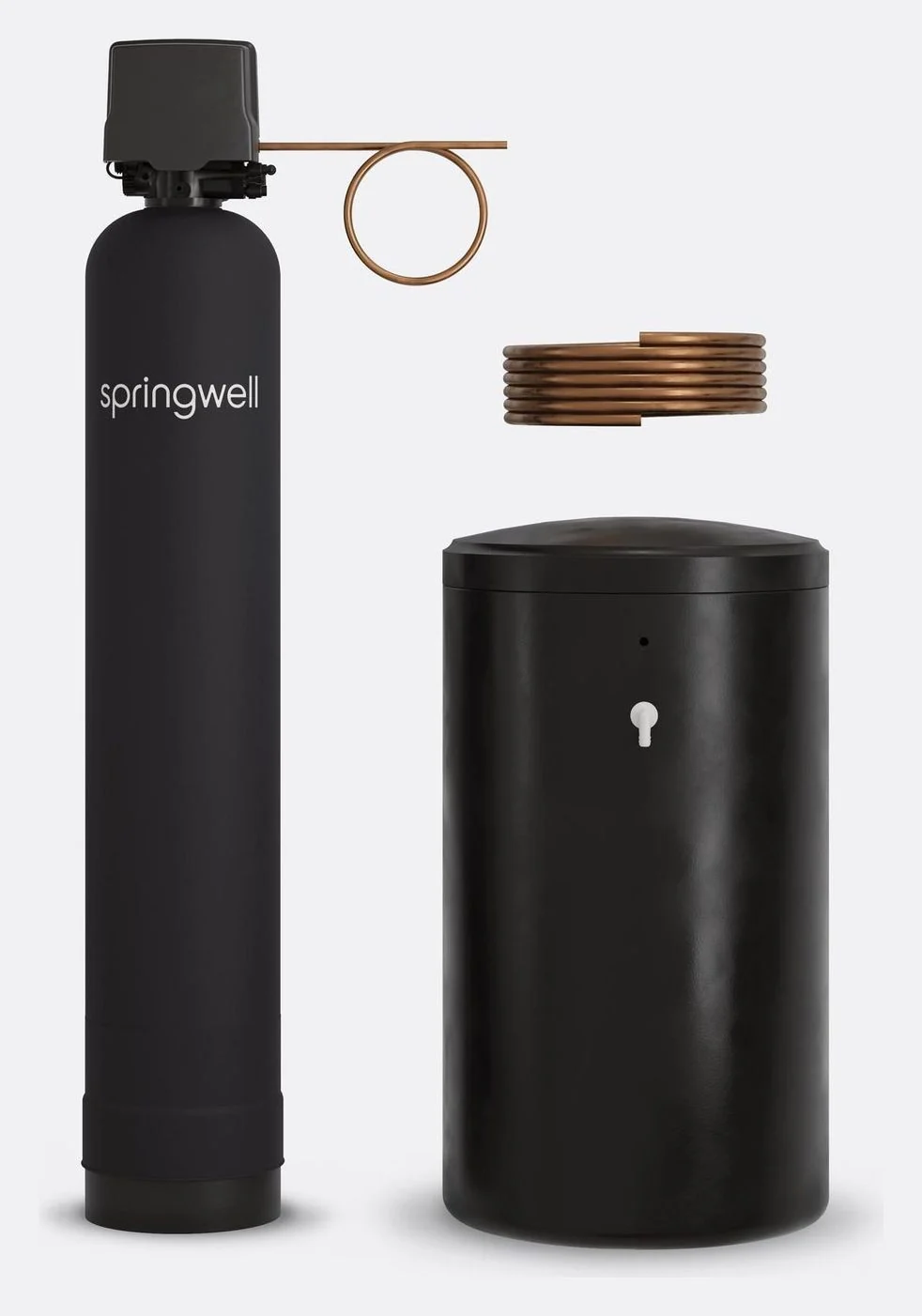
SpringWell SS1 Salt Based Water Softener
Best for: Homes with 1 to 3 bathrooms on hard city water that want true ion-exchange softening at a factory-direct price
- Grain capacity
- 32,000
- Service flow
- 11 GPM
- Bathrooms
- 1 to 3
- Tank
- 9" × 48" (57" with head)
- Connection
- 1"
- Brine tank
- 18" × 33" round (~200 lb salt)
The Complete Checklist#
Print this, stick it on the tank.
The maintenance year
9 itemsFrequently asked questions
How often should a water softener regenerate?
It depends on your hardness, household size and capacity. Demand-initiated (metered) softeners regenerate when the resin is actually exhausted, typically every few days in an average home. Old timer models regenerate on a clock whether needed or not, which wastes salt and water. If yours runs every night for a small household, the settings need a review.
Can I use any brand of salt in my water softener?
Yes. Softeners run on standard sodium chloride or potassium chloride, and no residential brand requires proprietary salt. What matters is the form and purity, not the logo: evaporated pellets are the low-residue default for most systems. See our full water softener salt guide for types and quantities.
How do I know if my water softener is working?
Test the water. A hardness test strip costs a few dollars and takes seconds: soft water should read near 0 grains per gallon at an inside tap. Everyday tells are soap that lathers easily and no new spotting on glassware. If hardness is creeping back while the salt level still drops on schedule, suspect a salt bridge, fouled resin or a stuck valve.
Do salt-free water conditioners need maintenance too?
Far less, which is their main selling point. Tank-style TAC conditioners such as the SpringWell FutureSoft have media rated for 3 to 5+ years with no salt, power or drain, though cartridge-based systems still need yearly cartridge swaps. Remember they condition rather than soften: measured hardness stays the same.
What happens if I never maintain my water softener?
The usual failure chain is a salt bridge or mushed salt stopping regeneration, hardness quietly returning, then scale doing exactly the damage you bought the softener to prevent. Neglect also shortens resin life, and a repair visit runs $150 to $600 per HomeGuide's 2026 figures, so the 15-minute monthly check is the cheap option.
How long does it take to clean a brine tank?
About an hour once a year, and it is easiest when the salt is nearly used up. Scoop out the remaining salt and sludge, dump the residual water, wash the tank with warm water and mild dish soap, rinse the brine well and float assembly, then refill and run a manual regeneration.
Keep reading


Not sure what you need?
Answer 5 questions, get the right system for your water.
City or well, budget, household size, our quiz matches your answers against every system we track.