Best Tankless Reverse Osmosis Systems 2026 (Waterdrop, iSpring, Frizzlife)
Best tankless reverse osmosis system for most kitchens: the Waterdrop G3P600, $539 on Oct 5, 2026, with 600 GPD and a 2:1 drain ratio. Four systems compared.
By Home Water Lab TeamUpdated Prices verified Oct 7, 2026
This page contains affiliate links; buying through them costs you nothing extra.
The best tankless reverse osmosis system for most kitchens is the Waterdrop G3P600 at $539 (store price, Oct 5, 2026), with 600 gallons a day on demand, a 2:1 pure-to-drain ratio and NSF/ANSI 58 certification that names its certifying body. The G3P800 adds a 3:1 ratio for $460 more, and the iSpring RO500 is the pick if you'd rather check the certificate yourself. Every system here is under-sink reverse osmosis with the storage tank swapped for a pump, and that one swap decides everything below.
The short answer
as of Oct 5, 2026What is the best tankless reverse osmosis system?
The Waterdrop G3P600 ($539 on Oct 5, 2026, or $439 with a checkout code shown on the page that day) is the best value: 600 GPD, a 2:1 drain ratio, and NSF/ANSI 58 and 372 certification credited to IAPMO R&T. The Waterdrop G3P800 ($999 the same day) leads on efficiency at 3:1. The iSpring RO500 ($659.99, Oct 5, 2026) is the one we found in NSF International's own public listing, and the Frizzlife PD600-N ($469.99, Oct 5, 2026) is the cheapest to run at about $107 a year in cartridges, though only its lead-content standard is described as certified.
Key takeaways
- A tankless GPD rating is a faucet speed: 600 GPD works out to about 0.42 gallon a minute.
- Waterdrop measures its G3P600 and G3P800 output at 30 psi and 77°F; iSpring's manual says output falls below 55°F and below 25 psi.
- At 3 gallons a day, a 2:1 system drains about 548 gallons a year and a classic 1:3 tank system about 3,285.
- The pump costs under $1 a year to run on Frizzlife's 70 W rating; the real cost of the plug is a dry faucet in a power cut.
- At Oct 5, 2026 prices, five years of ownership runs from about $1,005 (Frizzlife PD600-N) to about $1,799 (Waterdrop G3P800), against about $765 for the tank-based iSpring RCC7AK at its Oct 12 price.
| Rank | System | Store price (Oct 5, 2026) | Ratio | Wins at |
|---|---|---|---|---|
| 1 | Waterdrop G3P600 | $539 | 2:1 | Best overall value |
| 2 | Waterdrop G3P800 | $999 | 3:1 | Best efficiency |
| 3 | iSpring RO500 | $659.99 | Up to 2:1 | Most verifiable certification |
| 4 | Frizzlife PD600-N | $469.99 | 2:1 | Cheapest to run, remineralizer included |
How Does a Tankless RO System Work?#
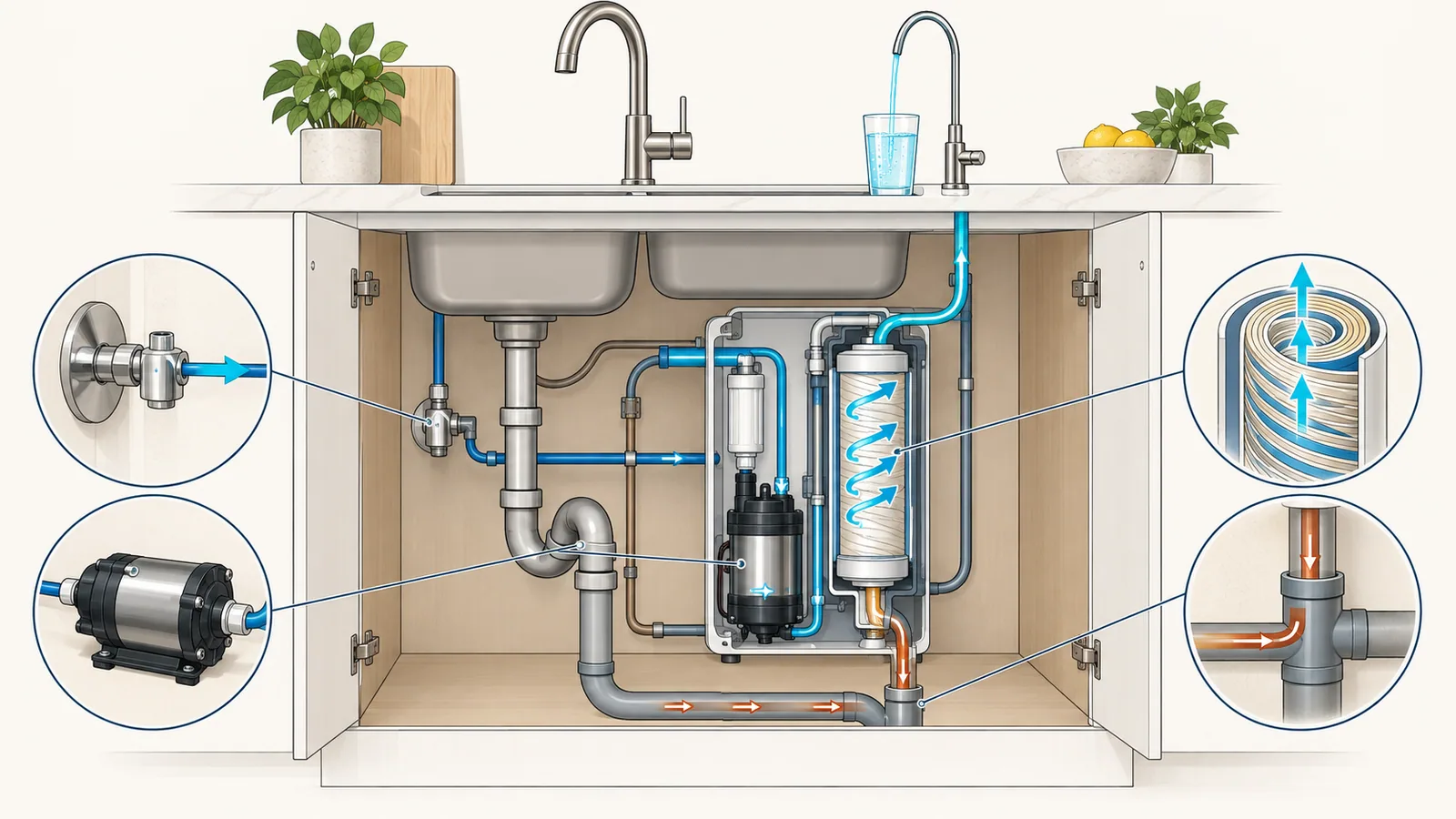
It puts an electric booster pump in front of the membrane and removes the storage tank that would sit after it. The pump raises the pressure enough for the membrane to produce at faucet speed, so water is made when you open the tap and nothing waits in a bladder. The pre-filters, the membrane and the drain line are the same parts any RO system uses.
Same membrane, two plumbing plans
- Pre-filtersboth designsSediment and carbon ahead of the membrane, in both rows. They protect the film from grit and chlorine, and they are the cartridges you change most often.
- RO membraneboth designsThe stage that does the real work, and the same job in both rows. What changes between them is the pressure pushing water through it, and therefore how fast it produces.
- Storage tanktank systemsFills slowly between uses and empties quickly at the faucet. It needs no electricity, so a power cut still leaves you a tankful; the price is the cabinet space it takes and the wait while it refills.
- Booster pumptanklessRaises the pressure on the membrane so it can produce at faucet speed, on demand, with nothing stored. It is the reason a tankless system needs a socket under the sink, and the reason it stops when the power does.
- The drain lineconcentrateEvery membrane rejects part of its feed to carry the dissolved solids away. The ratio chips show the pure-to-drain figures cited in the article, which are manufacturers' ratings at their own test conditions.
Schematic, not to scale. The 1:3 tank ratio is the figure we carry for the iSpring RCC7AK, a classic tank design; 2:1 is the rating Waterdrop, iSpring and Frizzlife each publish for the G3P600, the RO500 and the PD600-N, read Oct 5, 2026. Some tank systems add a booster pump and need a socket too, and Frizzlife sells one tankless model that runs on line pressure alone.
Two quirks come with the design. The first cup after a long pause can read a little higher on the faucet's TDS display, and Frizzlife's manual explains why: with the pump off, a few ions drift across the membrane, and they flush out within about a minute. The second quirk is a self-rinse: iSpring's RO500 flushes its membrane for 20 seconds after 24 hours without use, and Frizzlife's PD600-N flushes for 30 seconds each time it is powered on.
Tank vs Tankless RO: Which Should You Buy?#
Buy tankless if the cabinet is full, the drain line bothers you, or your household fills pots rather than glasses. Buy a tank system if the power fails often or the budget is the constraint, because a tank keeps pouring through an outage and costs less to buy and to run.
Tank system (iSpring RCC7AK)
- Pours from stored water during a power cut
- About 1 gallon pure for 3 drained
- $239.99 on Oct 12, 2026, with generic-compatible cartridges near $105 a year
- Needs time to refill after a big draw
Tankless (the four picks below)
- Makes water on demand, rated 500 to 800 GPD
- 2:1 to 3:1 in your favor
- $469.99 to $999 on Oct 5, 2026, with proprietary cartridges
- No power, no filtered water
The call
Tankless for space, speed and a smaller drain bill; tank for outages and the lowest five-year cost. The membrane removes the same things either way.
The tank route is a sound purchase, and our iSpring RCC7AK review covers the budget benchmark in detail. One popular model needs ruling out by name. The Aquasana SmartFlow isn't tankless: Aquasana's own product FAQ (read Sep 28, 2026) gives its holding tank a total volume of 3.2 gallons, which is why it sits in our main reverse osmosis rankings and not on this page.
Best Overall: Waterdrop G3P600#
Waterdrop
Waterdrop G3P600 Tankless Reverse Osmosis System
Best for: Most kitchens that want tankless RO on demand without paying for the G3P800's extra 200 GPD
- Production
- 600 GPD, tankless
- Pure-to-drain ratio
- 2:1
- Annual filter cost
- $144.97 (Waterdrop figure, Oct 5, 2026)
- Certification
- NSF/ANSI 58 and 372, credited to IAPMO R&T by Waterdrop
- Feed pressure
- 14.5 to 87 psi
- Power
- Plug-in pump, needs an outlet under the sink
$539 is the price Waterdrop's store records for the G3P600 on Oct 5, 2026. The product page the same morning showed $439 with a $100 checkout code, and as with every brand that runs standing codes, the real price is whatever the cart says on the day you buy.
The money buys 600 GPD on demand, a 2:1 ratio, an 8-stage stack in three cartridges, and a faucet with a TDS readout and filter-life lights. Waterdrop says an 8 oz cup fills in about 8 seconds. The page's certification block reads "tested and certified by IAPMO R&T against NSF/ANSI 58", plus NSF/ANSI 372 for lead content. NSF/ANSI 42 appears in the summary bullets with no body attached, so we treat 58 and 372 as the established pair.
Running cost is Waterdrop's own figure, $144.97 a year: a $29.99 CF cartridge every 6 months, a $29.99 carbon block every 12 months and a $109.99 membrane every 24 months, at Waterdrop's prices on Oct 5, 2026. The cartridges are proprietary, the warranty is one year, and the pump needs a socket within reach of the cabinet.
Best Efficiency: Waterdrop G3P800#
Waterdrop
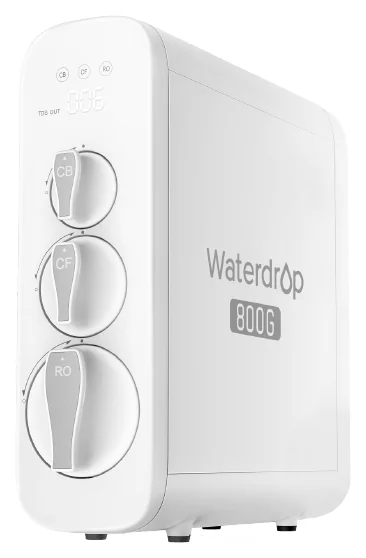
Waterdrop G3P800 Tankless Reverse Osmosis System
Best for: The premium tankless RO reference: high flow, UV, and a 3:1 efficiency ratio that flips the classic RO waste math
- Production
- 800 GPD, tankless
- Extras
- Smart TDS faucet; UV is claimed on some Waterdrop pages for this model and denied on others
- Pure-to-drain ratio
- 3:1
- Annual filter cost
- $159.97
The G3P800 is the only system here rated at 3:1, and that ratio is the reason to pay $999 (store price, Oct 5, 2026; a $150 code showed $849 on the page that day). At 3 gallons a day it drains about 365 gallons a year, against about 548 on a 2:1 model. That's roughly 180 gallons a year for $460, which makes sense on a water meter or on principle and is hard to justify on arithmetic alone.
Its paper trail is the weak point. On Sep 21, 2026 we found three different certification lists for this one model across Waterdrop's pages, and on Oct 5 the product page credited IAPMO R&T with NSF/ANSI 42, 53 and 58 plus 372. We still treat 58 and 372 as the established pair; the long version is in our Waterdrop G3P800 review. Cartridges run $159.97 a year, with the membrane alone at $139.99 every 24 months (Oct 5, 2026).
Most Verifiable Certification: iSpring RO500#
iSpring
iSpring RO500-BN Tankless Reverse Osmosis System
Best for: Buyers who want a tankless RO whose certification they can look up in NSF International's public listing
- Production
- 500 GPD, tankless (up to 0.4 GPM)
- Pure-to-drain ratio
- Up to 2:1
- Annual filter cost
- About $147.50 (2-year pack at $294.99, Oct 5, 2026)
- Certification
- NSF/ANSI 58, TDS reduction (NSF International listing)
- Feed pressure
- 15 to 70 psi
- Cartridges
- 3: sediment and carbon, RO membrane, carbon block
This is the one system on the page that we found in NSF International's public certification listing, checked on Oct 5, 2026. The listing covers the RO500-BN, the RO500-ORB and the two alkaline AK versions under NSF/ANSI 58, with a daily production rate of 500 gpd and a single claim, TDS reduction. That last part matters. The lead, fluoride and PFAS claims on iSpring's product page are iSpring's own, and the certificate doesn't cover them.
The rest is a plain, well-documented machine. Three cartridges, faucet flow of up to 0.4 GPM (an 8 oz cup in about 10 seconds, per iSpring), a ratio of up to 2:1 and an automatic membrane rinse. Cartridges come to about $147.50 a year on the $294.99 two-year pack (Oct 5, 2026). At $659.99 on Oct 5, 2026 it costs $121 more than the G3P600, and that difference buys a certificate anyone can look up.
What we like
- Listed by NSF International under NSF/ANSI 58, checked Oct 5, 2026
- Up to 0.4 GPM at the faucet, per iSpring
- Up to 2:1 pure-to-drain ratio, and a 20-second automatic membrane rinse after 24 hours idle
- Lifetime customer service and tech support from iSpring in Atlanta, GA
What to watch
- The certified claim is TDS reduction only; the lead, fluoride and PFAS claims on the product page are iSpring's own
- $659.99 on Oct 5, 2026, $121 more than the Waterdrop G3P600 for 100 GPD less rated output
- Needs an outlet within reach of its 3 ft power cable, and no power means no filtered water
- Flow drops below 55 F, below 25 psi or above 500 ppm TDS, per iSpring's manual
iSpring's cheaper tankless model, the RO5004F, read $329.99 the same day with a UV lamp and a boost pump. Its page claims no system certification, so it stays off this ranking.
Cheapest to Run: Frizzlife PD600-N#
Frizzlife
Frizzlife PD600-N Tankless Reverse Osmosis System with Alkaline Remineralization
Best for: The lowest cartridge bill among tankless picks, remineralization included, for a buyer who accepts lab-tested rather than certified performance
- Production
- 600 GPD, tankless (0.41 GPM)
- Pure-to-drain ratio
- 2:1
- Annual filter cost
- About $107 (Frizzlife prices, Oct 5, 2026)
- Certification
- NSF/ANSI 372 certified; tested by SGS to NSF/ANSI 58, 42 and 53
- Feed pressure
- 20 to 80 psi
- Power
- 70 W rated pump, needs an outlet
The PD600-N has the lowest cartridge bill here, about $107 a year at the prices and lifespans on its own page: a $33.99 pre-filter and a $29.99 remineralization refill each year, plus an $85.99 membrane every 24 months (prices read Oct 5, 2026). It ships with the alkaline remineralization stage the others sell as an extra. Its manual adds a TDS removal rate of about 94 to 95% and a rated power of 70 W, the only wattage any of the three brands publishes.
Read the certification wording before buying. The listing title advertises four NSF/ANSI standards, but the description says the system is certified to NSF/ANSI 372 for lead-free materials and tested by a third-party lab, SGS, to 58, 42 and 53. The spec table adds a line reading "SGS Certified" without saying to what. A lab test against a standard isn't the same as certification to it by an accredited body, and on this model that difference is the whole story. At $469.99 (store price, Oct 5, 2026; $399.99 with a code on the day) it's good value for a buyer who accepts that.
Is the GPD Rating Real?#
It is real at the manufacturer's test conditions, and those are warmer and steadier than many kitchens in January. Waterdrop's manuals for the G3P600 and the G3P800 state that daily production is measured at 30 psi of dynamic feed pressure and 77°F water. Colder or weaker feed water makes less.
| System | Rated output | Conditions the manufacturer publishes |
|---|---|---|
| Waterdrop G3P800 | 800 GPD | Measured at 30 psi and 77°F; accepts 14.5 to 87 psi and 41 to 100°F |
| Waterdrop G3P600 | 600 GPD | Same test note, same ranges |
| iSpring RO500 | 500 GPD, up to 0.4 GPM | Works at 15 to 70 psi and 41 to 100°F; flow drops below 55°F, below 25 psi or above 500 ppm TDS |
| Frizzlife PD600-N | 600 GPD, 0.41 GPM | Works at 20 to 80 psi and 39 to 100°F |
Low pressure is where the pump earns its place. Waterdrop accepts feed water from 14.5 psi, while a pumpless tank system like the APEC ROES-50 is rated at 50 GPD at 60 psi and produces less below that, per APEC's specification (read Sep 6, 2026). Cold is the condition no pump fixes. If your mains water runs cold in winter, expect the faucet to run slower than the box says, and iSpring is the only one of the four to name a threshold, 55°F.
How Much Water Does a Tankless RO System Waste?#
About one gallon for every two it delivers on the 2:1 models, and one for every three on the G3P800. That is a different league from most tank systems. EPA's WaterSense program says a typical point-of-use RO system sends five gallons or more to the drain per gallon treated, and the WaterSense label, specified in November 2024, caps it at 2.3.
Where the water goes
- Pre-filters6 to 12 monthsSediment then carbon, in that order. They exist to protect the membrane: grit would tear it and chlorine would dissolve it, so the cheap cartridges spend themselves first.
- RO membrane2 to 5 yearsThe stage that does the work the others cannot. Pressure pushes water through a film whose pores stop dissolved solids, which is why RO reaches lead, fluoride, nitrate and PFAS where carbon alone does not.
- Post carbon12 monthsA taste polish on the way out, and on remineralizing systems the stage that puts calcium and magnesium back so the water does not taste flat.
- The drain lineconcentrateEverything the membrane refuses leaves here. This pipe is why an RO system has a water bill attached to it, and why the pure-to-drain ratio belongs in any honest comparison.
Ratio as published by Waterdrop, iSpring and Frizzlife for those three models, read Oct 5, 2026, at each manufacturer's own test conditions. Stage names here are generic; the tankless pump sits ahead of the membrane and is not drawn.
| Design | Drain per gallon made | Drained per year at 3 gallons a day |
|---|---|---|
| Waterdrop G3P800 (3:1) | 0.33 gallon | about 365 gallons |
| G3P600, RO500, PD600-N (2:1) | 0.5 gallon | about 548 gallons |
| WaterSense label ceiling | 2.3 gallons | about 2,519 gallons |
| Classic tank, iSpring RCC7AK (about 1:3) | 3 gallons | about 3,285 gallons |
| Typical system, per EPA | 5 gallons or more | 5,475 gallons or more |
Three gallons a day is our illustration, not a measured average, so scale it to your own kitchen. None of the four product pages we read on Oct 5 claims the WaterSense label, which means the ratios above are manufacturer ratings rather than certified efficiency.
Does a Tankless RO System Use Much Electricity?#
Very little, and the power bill is the wrong thing to worry about. The pump runs only while water is being made. Frizzlife is the only one of the three brands to publish a wattage, 70 W rated for the PD600-N; Waterdrop and iSpring list power-adapter ratings but no wattage.
At 0.41 GPM a gallon takes about 2.4 minutes, or roughly 2.9 watt-hours at the full 70 W. Three gallons a day comes to about 3.1 kWh a year, which at the July 2026 US residential average of 18.31 cents per kWh (EIA) is about 57 cents a year. That's a ceiling, since 70 W is the rated figure, though it leaves out the standby draw of the display and adapter, which no brand publishes.
The real cost of the plug is dependence. A tank system keeps pouring from its stored gallons through an outage, and a pumped tankless system stops. If that rules tankless out for you, Frizzlife sells a non-electric model, the M800 ($329.99 store price, Oct 5, 2026), rated at 900 GPD with a "dynamic" 4:1 ratio, that runs on line pressure and asks for at least 50 psi. Frizzlife says it is tested and certified to NSF/ANSI 58 and 372 without naming the certifier, which is why it gets a mention rather than a card.
What Does a Tankless RO System Cost Over Five Years?#
Between about $1,005 and $1,799 for the four picks, counting each store's price on Oct 5, 2026 and five years of the manufacturer's own cartridge prices. The gap between the cheapest and the dearest grows from $529 at the checkout to about $794 after five years.
Waterdrop
Waterdrop G3P600
- Production
- 600 GPD, tankless
- Pure-to-drain ratio
- 2:1
- Annual filter cost
- $144.97 (Waterdrop figure, Oct 5, 2026)
Waterdrop
Waterdrop G3P800
- Production
- 800 GPD, tankless
- Pure-to-drain ratio
- 3:1
- Annual filter cost
- $159.97
iSpring
iSpring RO500
- Production
- 500 GPD, tankless (up to 0.4 GPM)
- Pure-to-drain ratio
- Up to 2:1
- Annual filter cost
- About $147.50 (2-year pack at $294.99, Oct 5, 2026)
Frizzlife
Frizzlife PD600-N
- Production
- 600 GPD, tankless (0.41 GPM)
- Pure-to-drain ratio
- 2:1
- Annual filter cost
- About $107 (Frizzlife prices, Oct 5, 2026)
Prices checked Oct 9, 2026.
| System | Store price (Oct 5, 2026) | Cartridges per year | Five-year total |
|---|---|---|---|
| Frizzlife PD600-N | $469.99 | about $107 | about $1,005 |
| Waterdrop G3P600 | $539 | $144.97 | about $1,264 |
| iSpring RO500 | $659.99 | about $147.50 | about $1,397 |
| Waterdrop G3P800 | $999 | $159.97 | about $1,799 |
| iSpring RCC7AK (tank, for reference) | $239.99 (Oct 12, 2026) | about $105 | about $765 |
The codes shown on the day, $70 to $150 off, would lower the price column, and installation is extra if you hire it out.
Are Tankless RO Systems Worth It?#
Yes for a household that cooks with filtered water, has no room under the sink or minds the drain line. For one that drinks a few glasses a day on a tight budget, a tank system does the same filtering for less, and the five-year gap is roughly $240 to $1,034 in the tank's favor.
Before ordering, check the cabinet for a socket. Every pumped model here plugs in under the sink, iSpring puts its power cable at about 3 feet, and Waterdrop asks for roughly an inch of clearance around the G3P600 so its vibration doesn't carry into the cabinet walls.
There are cases where none of these is the right buy. If your water comes from a well, sediment and iron have to come out first or the membrane fouls quickly; all three brands' manuals list municipal water as the intended feed, and our guide to treating well water covers the pretreatment. If drilling the counter is the obstacle, a countertop RO unit skips the plumbing entirely. And if chlorine taste is the only complaint, a carbon system from our under-sink filter rankings wastes no water at all.
Still torn between the two designs for the same cabinet? Our under-sink reverse osmosis comparison puts tank and tankless models on one table, and the system matcher narrows the field to your water and budget in a few questions.
None of this touches hardness. RO treats one tap, so scale in the water heater is a job for a water softener, and running every tap in the house through a membrane is the specialist case in our whole-house reverse osmosis explainer.
How We Chose These Four#
We did not bench-test these units. Every price, rating and operating condition here comes from the manufacturer's own store data, product page or manual, read on Oct 5, 2026, with NSF International and EPA for the certification and efficiency benchmarks. We screened first for a certification credited to a named body, which three of the four carry, then weighed ratio and output against five-year cost. That is why the G3P600 leads: the G3P800 has the better ratio, but $460 is a steep price for about 180 fewer gallons down the drain each year. The iSpring has the strongest paper trail and ranks third because it costs $121 more than the G3P600 for less rated output. The arithmetic is ours, and we've shown it.
Store prices exclude checkout codes, which are noted where they appeared. Ratios and outputs are manufacturer ratings at the manufacturer's own test conditions.
Tankless RO questions people actually search
Are tankless RO systems good?
They are good at three things and weaker at one. They save cabinet space, keep up with a household that fills pots, and drain far less water, at 2:1 or 3:1 against roughly 1:3 for a classic tank system like the iSpring RCC7AK. The weak point is the plug: no power means no filtered water, and the pump is one more part that a tank system does not have.
What is a tankless RO system?
An under-sink reverse osmosis system with an electric booster pump in place of a storage tank. The pump lets the membrane produce at faucet speed, so water is made on demand instead of being stored. Everything else, from the pre-filters to the drain line, works the same way as on a classic system.
How do tankless RO systems reject water?
Through the same drain line every RO system has. The membrane splits the feed into treated water and a concentrate that carries the dissolved solids away, and the pump's extra pressure, together with the membrane design, lets tankless models keep a larger share as treated water, which is where ratings like 2:1 and 3:1 come from. Those ratings are measured at each manufacturer's own test conditions.
Which tankless RO system is the most reliable?
We found no published failure rate for any of the four, so a reliability ranking would be guesswork. What can be compared is the backing. All four carry a one-year warranty, iSpring and Frizzlife extend it on registration, and iSpring advertises lifetime customer service and tech support from Atlanta, Georgia.
Is tank or tankless RO better for low water pressure?
Usually tankless, because the pump does the pushing. Waterdrop accepts feed water from 14.5 psi, iSpring from 15 psi and Frizzlife's PD600-N from 20 psi, while a pumpless tank system like the APEC ROES-50 is rated at 60 psi and produces less below it. The exception is Frizzlife's non-electric M800, which asks for at least 50 psi.
Frequently asked questions
What is the best tankless reverse osmosis system?
For most kitchens, the Waterdrop G3P600: $539 on Oct 5, 2026, 600 GPD on demand, a 2:1 pure-to-drain ratio, and NSF/ANSI 58 and 372 certification that Waterdrop attributes to IAPMO R&T. The G3P800 adds a 3:1 ratio and 800 GPD for $999, the iSpring RO500 ($659.99) is the one we found in NSF International's public listing, and the Frizzlife PD600-N ($469.99) is the cheapest to run, all at store prices read the same day.
Are tankless reverse osmosis systems worth it?
They are worth it when space, waiting or drain water is the real problem. At 3 gallons a day, a 2:1 tankless system drains about 548 gallons a year against about 3,285 for a classic 1:3 tank system. They are not worth it if your power is unreliable, because the pump stops with the electricity, or if the lowest five-year cost is the goal: a tank system like the iSpring RCC7AK, at its Oct 12, 2026 price, lands near $765 over five years, against roughly $1,005 to $1,799 for the tankless picks here at Oct 5, 2026 prices.
What is the typical cost of a tankless reverse osmosis system?
The four we rank read $469.99 to $999 on the manufacturers' own stores on Oct 5, 2026, before checkout codes that took $70 to $150 off that day. Cartridges add about $107 to $160 a year, so five-year totals run from roughly $1,005 to $1,799. All four are sold as do-it-yourself installs, and the step most likely to need a plumber is the one Frizzlife's spec table flags: drilling a hole in the countertop for the faucet.
What is a major problem with reverse osmosis?
Two problems, both built in. Every membrane sends part of its feed to the drain, and EPA's WaterSense program says a typical point-of-use system drains five gallons or more per gallon treated. The membrane also strips calcium and magnesium along with the contaminants, which is why remineralization stages exist. Tankless designs answer the first problem far better than the second.
Keep reading
Not sure what you need?
Answer 5 questions, get the right system for your water.
City or well, budget, household size, our quiz matches your answers against every system we track.