Best Whole House Water Softener 2026: 6 Systems Sized for Real Homes
A 1 to 3 bath home on 10 gpg water needs about 32,000 grains and 7.2 GPM. Six whole house water softeners sized by home, $489 to $3,124 (Aug to Oct 2026).
By Home Water Lab TeamUpdated Prices verified Oct 7, 2026
This page contains affiliate links; buying through them costs you nothing extra.
For most homes with 1 to 3 bathrooms, the best whole house water softener is the SpringWell SS1: 32,000 grains and an 11 GPM service flow for $1,606.50 as of Oct 5, 2026. Bigger houses should shop on flow before grains, which points homes with 4 or more bathrooms at the US Water Systems Matrixx in its 15 or 20 GPM size. The other four picks cover tight budgets and the harder cases, chlorinated city water or a well, and the chemistry behind all six sits in our guide to how a softener system works, start to finish.
The short answer
as of Oct 5, 2026What is the best whole house water softener for my home?
Size first, brand second. A 1 to 3 bathroom home with up to four people on 10 gpg water needs about 32,000 grains and a flow rating well above the 7.2 GPM two showers and a sink draw, which is the SpringWell SS1 (11 GPM) at $1,606.50 on Oct 5, 2026. A house where three showers can run at once draws 11.9 GPM with two sinks open: buy the US Water Systems Matrixx 15 GPM, $1,635 the same day, rated 48,000 grains at its maximum salt setting. On a budget, the Rheem RHS32 ($489, Aug 28, 2026) suits small homes and the Whirlpool WHES44 ($619, Sep 12, 2026) suits big families who can live with 9 GPM.
Key takeaways
- Two numbers size a whole house softener: grains between regenerations and gallons per minute at the busiest moment. Bathroom counts are a stand-in for the second.
- A family of four on 10 gpg water removes 21,000 grains a week, which a 32,000-grain unit covers with 3,000 to spare under the 75% usable rule.
- Two showers and a bathroom sink draw 7.2 GPM at EPA's standard fixture flows. Three showers and two sinks draw 11.9, more than the Rheem RHS32 (7.9) or the Whirlpool WHES44 (9.0) is rated for.
- The grain figure on the box is a full-salt number: the Matrixx 10 GPM size delivers 24,000 grains on 6 lb of salt and 32,000 on 15 lb.
- Hardware ran $489 to $4,284 on readings from Aug 28 to Oct 5, 2026, and a plumber adds $300 to $1,500 on top per Angi and HomeGuide 2026 figures.
This page is the sizing companion to our top 10 softeners ranked on price and warranty: here every system is matched to a household instead. We did not bench-test any of them, and every figure is the manufacturer's own, read on the date shown.
Which Whole House Water Softener Fits Which Home?#
Match the system to the household first, the price second. Rated capacity and service flow are the two numbers that decide whether a softener keeps up with the house it is plumbed into.
| # | System | Home profile | Rated capacity | Service flow | Price (date read) |
|---|---|---|---|---|---|
| 1 | SpringWell SS1 | 1 to 3 baths, up to 4 people | 32,000 grains | 11 GPM | $1,606.50 (Oct 5, 2026) |
| 2 | US Water Systems Matrixx, 15 GPM | 4 to 6 baths, 5 to 6 people | 48,000 grains at max salt | 15 GPM | $1,635 (Oct 5, 2026) |
| 3 | Rheem RHS32 | Condo or 1 to 2 baths, up to 4 people | 33,000 grains at 14.1 lb | 7.9 GPM | $489 (Aug 28, 2026) |
| 4 | Whirlpool WHES44 | Big family, 2 to 3 baths, tight budget | 44,000 grains at 16.7 lb | 9.0 GPM | $619 (Sep 12, 2026) |
| 5 | SpringWell CSS1 | Hard and chlorinated city water | 32,000 grains + carbon filter | 9 GPM (filter sets it) | $2,231.25 (Oct 5, 2026) |
| 6 | SpringWell WSSS1 | Well water with iron or sulfur | 32,000 grains + iron filter | 11 GPM (softener sets it) | $3,123.75 (Oct 5, 2026) |
Prices are what each seller displayed that day. SpringWell's "15% Off All Systems" banner is a standing one and the US Water Systems strikethrough is permanent, so neither is a countdown sale.
What Size Whole House Water Softener Do You Need?#
Two numbers, not one. Grain capacity decides how long the softener runs between regenerations, and service flow decides whether it keeps up when the house is busy. The bathroom counts on spec sheets are a shortcut for the second number, and SpringWell says as much on its own product page: "It's not only about bathroom count. It's about how many things run at once."
The grain side is arithmetic. People, times 75 gallons a day, times hardness in grains per gallon, times 7 days, is what the resin removes between weekly regenerations, and you buy the smallest capacity whose 75% usable figure covers it. Here is what that gives for real households, with each home's busiest moment.
| Home | People | Weekly load at 10 gpg | Weekly load at 20 gpg | Busiest realistic moment | Size to buy |
|---|---|---|---|---|---|
| Condo or 1 to 2 bath house | 2 | 10,500 grains | 21,000 grains | 1 shower + 1 sink, 4.7 GPM | 32,000 grains at either hardness |
| 2 to 3 bath family home | 4 | 21,000 | 42,000 | 2 showers + 1 sink, 7.2 GPM | 32,000 grains; 64,000 at 20 gpg |
| 3 to 4 bath, bigger family | 5 | 26,250 | 52,500 | 2 showers + 2 sinks, 9.4 GPM | 48,000 grains; 80,000 at 20 gpg |
| 4 to 6 bath house | 6 | 31,500 | 63,000 | 3 showers + 2 sinks, 11.9 GPM | 48,000 grains; twin tank at 20 gpg |
| 7 or more baths | 8 | 42,000 | 84,000 | 4 showers + 2 sinks, 14.4 GPM | 64,000 grains and 20 GPM; twin tank at 20 gpg |
Our arithmetic on the standard formula and EPA's standard fixture flows, not a manufacturer chart. The iron correction and every hardness band are in our grain worksheet for any household, and the grain calculator runs it on your own numbers.
Sizing, by the week
- The size to buyThe smallest tank whose usable capacity still covers a full week, so the unit recharges about weekly. That is the rhythm resin is happiest at.
- Too smallUsable capacity lands under your weekly load, so the valve regenerates every few days: more salt, more waste water, more wear on the head.
- More than you needIt will work, but you paid for resin that never gets used, and a bed that sits idle for a fortnight can channel and lose efficiency anyway.
- The 25 percent held in reserveThe dark tail on every bar is rated capacity left deliberately unused. Running resin down to its last grain costs far more salt per grain removed, so the industry sizes to about 75 percent.
5 people x 75 gallons a day x 12.0 gpg hardness x 7 days = 31,500 grains between regenerations, against usable capacity capped at 75 percent of nominal. Change any of those assumptions and the recommended size moves.
How Many GPM Does a Whole House Water Softener Need?#
Add up what runs at the same moment and buy a rated service flow above it. At the standard flows EPA WaterSense publishes, a showerhead draws 2.5 GPM and a bathroom sink 2.2, so two showers and a sink come to 7.2 GPM. That busiest realistic moment, not the daily average, is what a whole house softener has to meet.
Sizing, by the minute
as of Oct 5, 2026- Shower2.5 GPM eachThe standard showerhead flow EPA WaterSense quotes. A WaterSense-labeled head is capped at 2.0, so a retrofitted house draws less.
- Bathroom sink2.2 GPM eachEPA's standard bathroom faucet flow. WaterSense-labeled faucets run 1.5 or less.
- Rheem RHS327.9 GPM ratedRated at a 14.9 psi pressure drop, per Rheem's spec table.
- Whirlpool WHES449 GPM ratedRated at a 9.4 psig pressure drop, per Whirlpool's spec table.
- SpringWell SS111 GPM ratedService flow from SpringWell's spec table, which states no pressure drop.
- US Water Systems Matrixx, 15 GPM size15 GPM ratedRated at a 5 to 7 psi pressure drop, per the Matrixx spec table.
Fixture flows are the standard figures EPA WaterSense publishes (read Oct 5, 2026). Rated service flow is each manufacturer's own number, stated at the pressure drop it chooses, so two ratings compare only roughly. A dishwasher or a washing machine filling at the same moment adds to any of these bars.
Read the pressure drop printed next to each rating, because a bigger drop means a weaker shower at the same flow. The higher "intermittent" figures on the same sheets (18.7 GPM for the WHES44, 11.8 GPM at a 30 psi drop for the RHS32) are not service ratings, and Whirlpool says so itself: "Continuous operation at flow rates greater than the service flow rate may affect capacity and efficiency performance."
One adjustment runs the other way. WaterSense-labeled fixtures are capped at 2.0 GPM per showerhead and 1.5 per bathroom faucet, so two such showers and a sink draw 5.5 GPM. If you've retrofitted, size against your own fixtures.

The 6 Best Whole House Water Softeners, by Home Profile#
Each pick below is ranked for one kind of house. Read the one that matches yours, then read its flaws, because every one of them has some.
1. SpringWell SS1: Best for 1 to 3 Bathroom Homes#
SpringWell
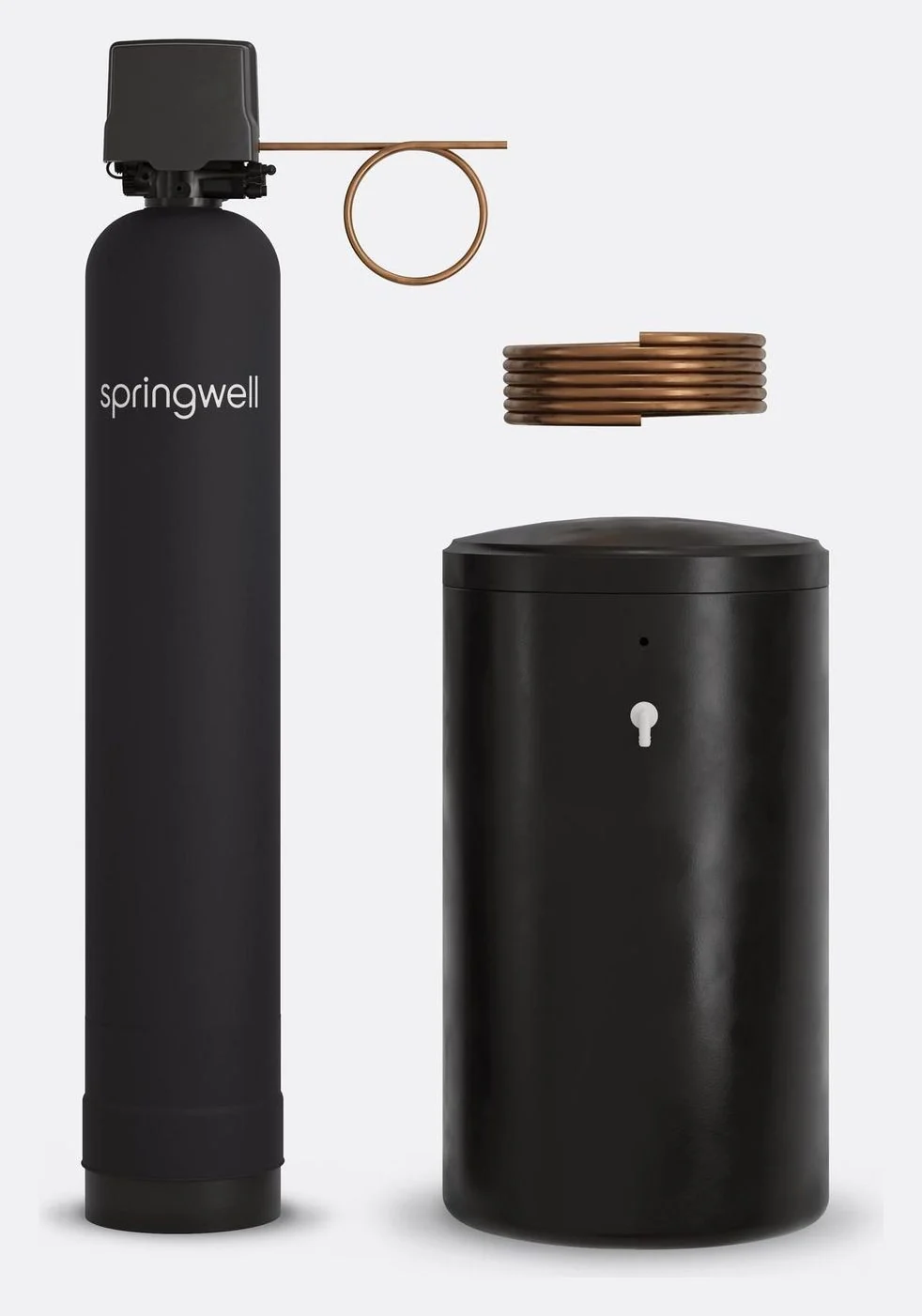
SpringWell SS1 Salt Based Water Softener
Best for: Homes with 1 to 3 bathrooms on hard city water that want true ion-exchange softening at a factory-direct price
- Grain capacity
- 32,000
- Service flow
- 11 GPM
- Bathrooms
- 1 to 3
- Tank
- 9" × 48" (57" with head)
- Connection
- 1"
- Brine tank
- 18" × 33" round (~200 lb salt)
The SS1 is sized for the household most American homes hold. 32,000 grains covers four people on 10 gpg water with 3,000 to spare at the 75% rule, and 11 GPM clears two showers and a sink with nearly 4 GPM of headroom. The 9 by 48 inch tank takes a 1-inch connection, and the Bluetooth head runs what SpringWell calls smart regeneration.
The line steps up in sizes SpringWell maps to bathrooms: the SS4 (48,000 grains, 13 GPM, 4 to 6 bathrooms) at $1,785 and the SS+ (80,000 grains, 20 GPM, 7 or more) at $2,677.50, both read on Oct 5, 2026. The flaws are the ones our SS1, SS4 and SS+ teardown documents. The electronic head carries 5 years against the lifetime tank warranty, the Chandler Systems valve has a thinner service network than Fleck or Clack, and returns are accepted uninstalled only, with a 10% restocking fee under the policy we read on Aug 30, 2026.
What we like
- Ion-exchange softening with Bluetooth smart-regeneration head (saves salt and water)
- Lifetime warranty on tank, valve and fittings + 6-month money-back guarantee
- Free US shipping and financing available
- 4.8/5 across 496 verified reviews on the SpringWell site (as of Aug 28, 2026)
What to watch
- Electronic head is only warrantied 5 years despite the "lifetime" marketing
- Chandler Systems valve platform, thinner parts/service network than Fleck or Clack
- Price per grain is unfavorable: 32,000 grains for ~$1,600 vs 48,000-grain competitors near $2,000
- Returns accepted uninstalled only, with a 10% restocking fee (up to 25%) and return shipping on the customer
2. US Water Systems Matrixx: Best for 4 or More Bathrooms#
US Water Systems
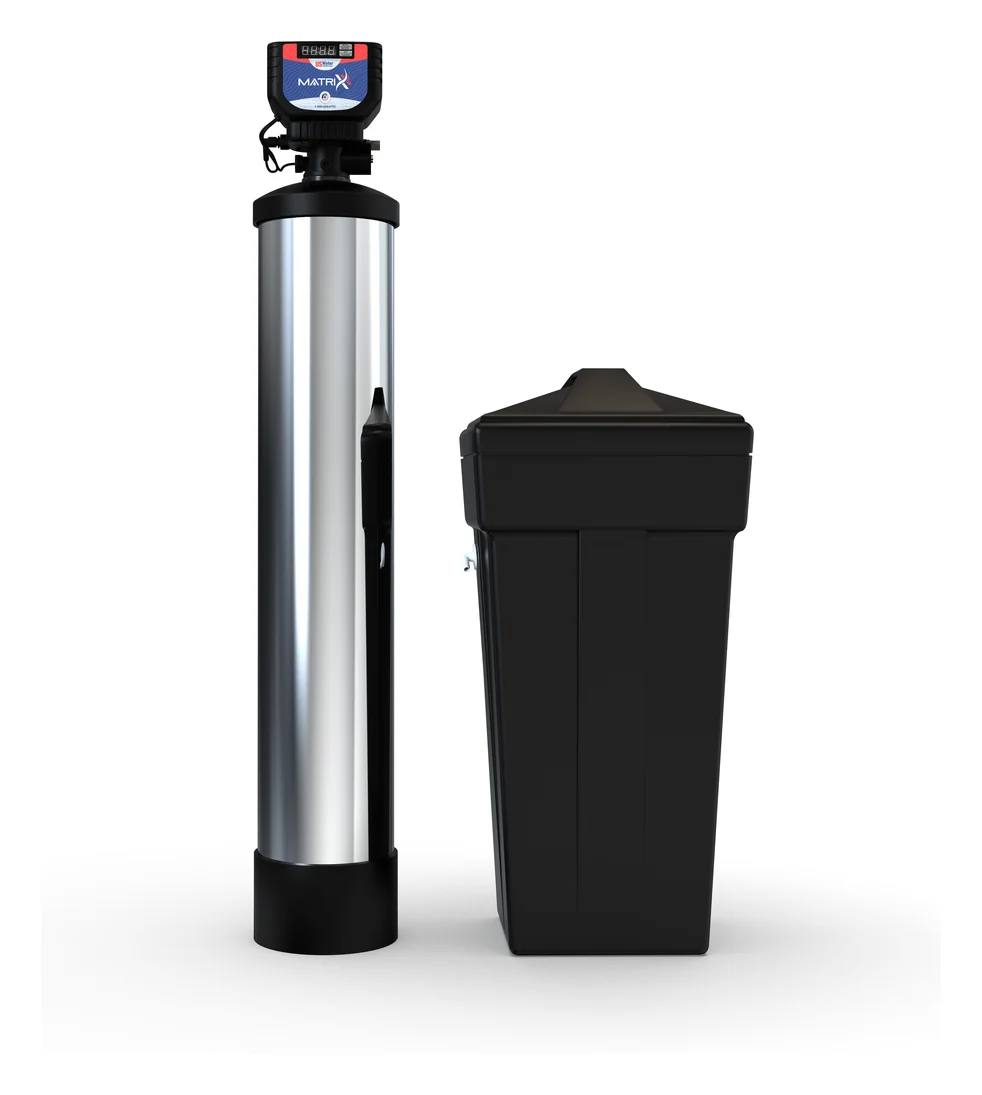
US Water Systems Matrixx Smart Metered Water Softener
Best for: Buyers who want a serviceable, open-valve softener backed by real technical support, the softener plumbers buy for themselves
- Valve
- Smart metered electronic valve with Bluetooth
- Valve platform
- Open standard, rebuildable, not proprietary
- Support
- 7-day hotline staffed by water technicians
The Matrixx is sold by flow, the honest way to size a large house: 10 GPM at $1,466.95, 15 GPM at $1,635 and 20 GPM at $1,775 on Oct 5, 2026, against strikethrough prices of $2,444.92, $2,725 and $2,958.34 that never go away. The 15 GPM size holds 1.5 cubic feet of 10% crosslinked resin rated 36,000 grains on 9 lb of salt and 48,000 on 23 lb.
That fits a house where three showers and two sinks run together, an 11.9 GPM peak. Against the SpringWell SS4 it was $150 cheaper the same day, 2 GPM faster, and covered 10 years on the valve and electronics against SpringWell's 5 on the head, with lifetime coverage on tank and resin. The 20 GPM size reaches 64,000 grains at its top setting; SpringWell's SS+ goes to 80,000.
The catches start with certification: US Water Systems advertises certified components (a WQA Gold Seal valve, NSF-certified resin) rather than a certified system. The brand is less known than SpringWell, and the strikethrough is an anchor to read past. The satisfaction guarantee runs one year; read the return terms before you order.
What we like
- Open standard valve with rebuild kits, repairable for life, unlike proprietary big-box valves
- Smart metered regeneration with Bluetooth app
- Free water test + certified technicians on the phone before you buy
- Undercuts the SpringWell SS1 at $1,606.50: by $140 at its standard price, by $310 when its countdown sale runs
What to watch
- Brand is less known than Culligan or SpringWell, expect to research more
- Perpetual "factory direct discount" strikethrough pricing to read past
- Return shipping at customer expense under the satisfaction guarantee
3. Rheem RHS32: Best Budget for Small Homes#
Rheem
Rheem Preferred RHS32 Water Softener (32,000 Grain)
Best for: The budget tier-1 pick for tight budgets and handy owners, now that the GE GXSH40V is discontinued
- Grain capacity
- 32,000
- Flow rate
- 7.9 GPM
- Reduces
- Hardness and iron
- Retail
- Buy Exclusively At The Home Depot, not sold on Amazon
Rheem builds the RHS32 for up to 4 people. 33,000 grains at 14.1 lb of salt is enough capacity; the 7.9 GPM service flow, at a 14.9 psi drop, is the limit. It clears two showers and a sink by 0.7 GPM, which is why we place it in condos and 1 to 2 bathroom houses. Its ratings run to 105 gpg and 8 ppm of clear-water iron.
It read $489 at Home Depot on Aug 28, 2026, and Home Depot has refused our reader since Sep 12, including on Oct 5, so check the cart. The warranty is 1 year on parts and labor (5 with Rheem's cleaner every four months), 3 years on electronics and 10 on tanks. The RHS42 adds 42,400 grains and 9.9 GPM at a price we could not confirm. Both are in our Rheem RHS32 and RHS42 review, and the rest of that aisle in the best softeners sold at Home Depot.
4. Whirlpool WHES44: Best Budget for Big Families#
Whirlpool
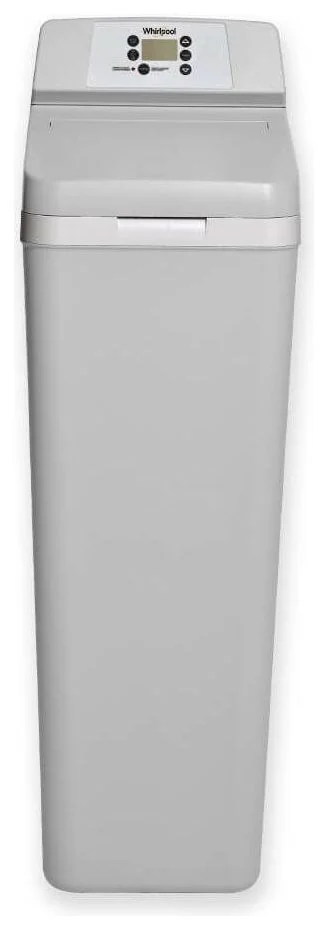
Whirlpool WHES44 Water Softener (44,000 Grain)
Best for: Big families on a budget: the highest grain, hardness and iron ratings in the big-box aisle
- Grain capacity
- 44,000
- Flow rate
- 9 GPM
- Max hardness
- 140 GPG
- Iron reduction
- 12 PPM
- Retail
- Sold at Lowe's (machine not sold on Amazon, parts only)
Whirlpool rates the WHES44 for 1 to 5 or more people, and the capacity backs that up with 44,000 grains at 16.7 lb (34,800 at 9.7 lb) from 1.23 cubic feet of resin. It tolerates 140 gpg and 12 ppm of clear-water iron, the top iron rating among the big-box units we track, with stated conformity to NSF/ANSI 44 for those claims. It sold for $619 at Lowe's on Sep 12, 2026; Lowe's refused our reader on Oct 5.
Flow is the trade. 9.0 GPM covers two showers and a sink but not two showers and two sinks at 9.4, so it belongs in a 2 to 3 bathroom house, not a large one. The warranty mirrors Rheem's structure, a 1-year parts-and-labor term that stretches to 5 with Whirlpool's cleanser, plus 3 years on electronics and 10 on the tank. Our Whirlpool model-by-model breakdown sets it against its smaller siblings, WHES30 through WHES40.
5. SpringWell CSS1: Best for Hard, Chlorinated City Water#
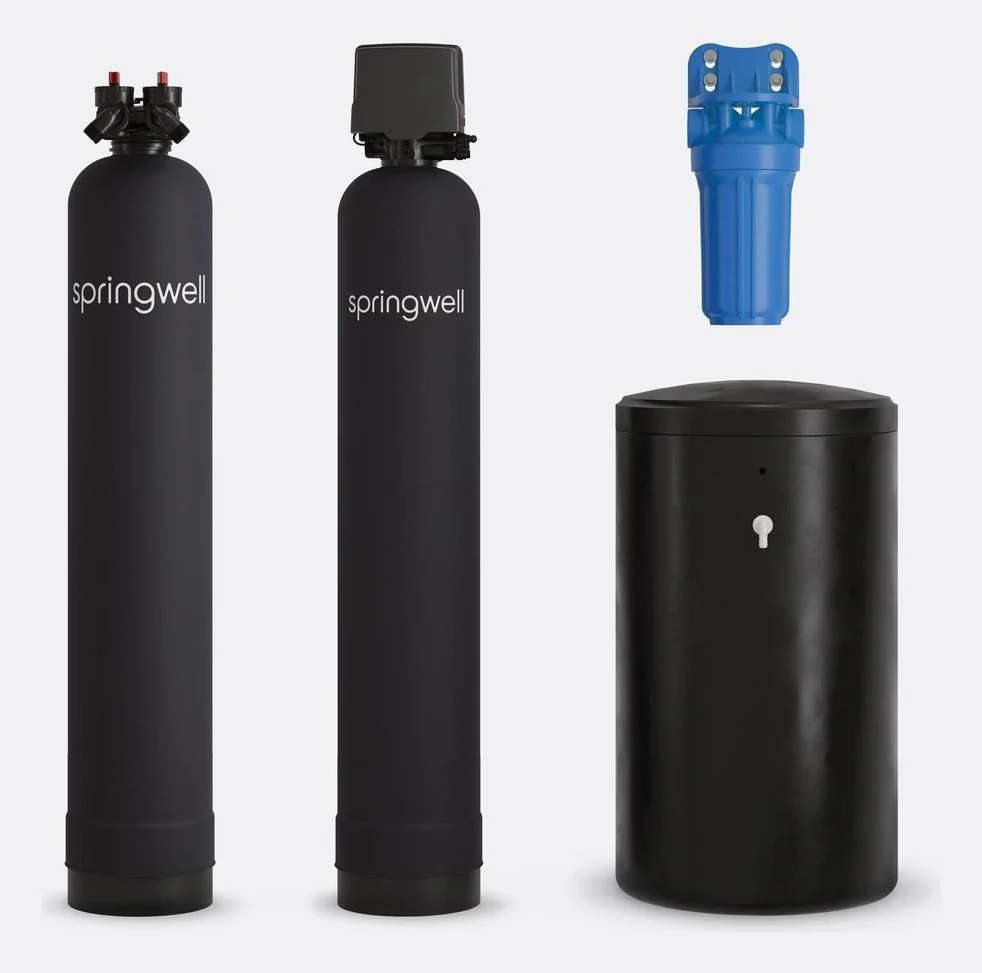
SpringWell
SpringWell CSS1 Whole House Filter + Salt Softener Combo
Best for: City-water homes fighting both chlorinated water and hardness, the direct answer to a $5,000, $10,000 dealer quote
- Contents
- CF whole house filter + SS salt-based softener
- Filter capacity
- 1,000,000 gallons / ~10 years
- Softener capacity
- 32,000 grains (SS1 size)
- Reduces
- Chlorine, chloramine, PFAS, VOCs + hardness
- Savings vs separate
- $510 (vs $2,741.25 bought separately)
If the water is hard and tastes of chlorine, the CSS1 puts SpringWell's CF carbon filter ahead of the SS softener in one order: $2,231.25, with the CSS4 at $2,499 and the CSS+ at $4,284, all on Oct 5, 2026. The filter media is rated for 1,000,000 gallons or 10 years, with a sediment prefilter changed every 6 to 9 months.
Size it on the slower tank. The two run in series, so the CSS1's flow is the CF1 filter's 9 GPM, not the softener's 11; the CSS4 pairs 12 with 13 and the CSS+ 20 with 20. A 4-bathroom house that would buy an SS4 alone should buy the CSS4 here, and SpringWell warns against using it where water is microbiologically unsafe. The together-or-separate math is in our filter and softener combos compared.
6. SpringWell WSSS1: Best for Well Water#
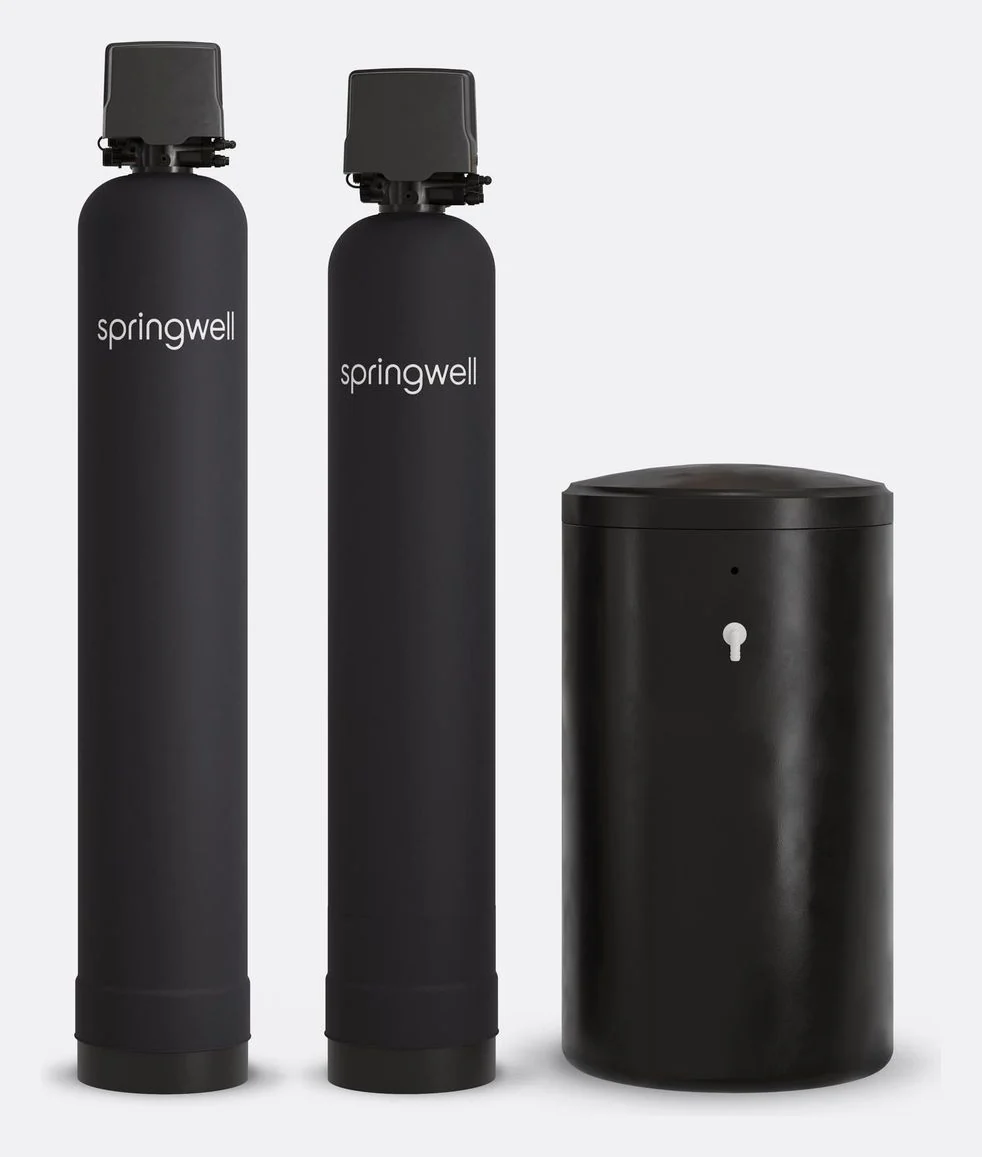
SpringWell
SpringWell WSSS1 Well Water Filter + Salt Softener Combo
Best for: Well-water homes with iron, sulfur AND hardness, the correct treatment order in one package
- Contents
- WS air-injection iron filter + SS salt-based softener
- Iron rating
- 7 ppm
- Sulfur (H2S) rating
- 8 ppm
- Manganese rating
- 1 ppm
- Price range
- $2,975, $3,400 depending on size
- Treatment order
- AIO iron filter first, then softener (protects the resin)
On a well, iron decides the order. US Water Systems, a company that sells softeners, puts it plainly on its Matrixx page: "it is not recommended to rely on a water softener specifically for iron treatment." The WSSS1 does what that sentence asks, with an air-injection iron filter rated for 7 ppm iron, 1 ppm manganese and 8 ppm hydrogen sulfide ahead of the SS softener. It read $3,123.75, or $3,570 for the WSSS4, on Oct 5, 2026.
The iron filter's 12 GPM and the softener's 11 put the WSSS1 in the same household band as the SS1. Size the softener on hardness plus any iron the filter leaves, at 3 gpg per ppm, and test before you order: SpringWell itself says a complete water test is needed to know whether the system fits. Wells past those ratings need heavier equipment, covered in our well water softener ranking.
The One to Skip: GE GXSH40V#
GE's own page said "This model is no longer being manufactured" when we read it on Oct 5, 2026, while still listing the 40,000-grain GXSH40V at $569 against $649. A proprietary valve with no production behind it is a poor base for a decade of service, and the Rheem RHS32 and Whirlpool WHES44 cover the same budget new.
Where Does a Whole House Water Softener Go?#
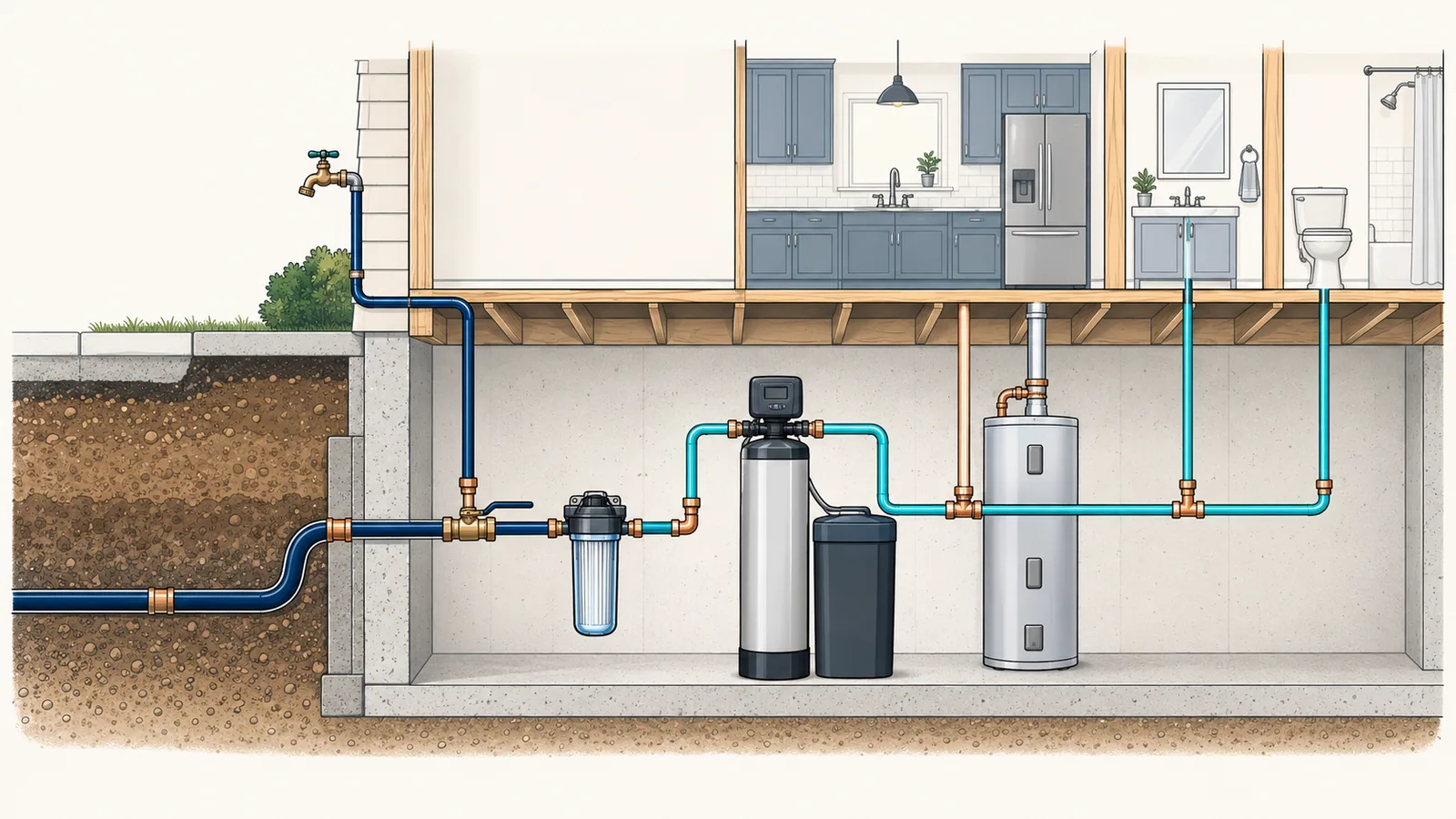
On the main line, after the branch that feeds outdoor taps and ahead of the water heater. That position is what makes it whole house: every fixture downstream gets softened water, and the lawn does not.
The install, in order
- Main shut-offEverything downstream starts here. Find it and turn it before you buy anything: an install with no working shut-off is a plumber's job, not a Saturday.
- Untreated branchOutdoor taps and irrigation tee off before the softener. A lawn does not care about hardness, and softened water is salt you paid for. Many installs run the kitchen cold tap off this same branch and keep drinking water untreated.
- Bypass valveTakes the softener out of service without cutting water to the house. It is what turns a resin change from an outage into an errand.
- SoftenerOn the main line, ahead of anything that heats water. Everything downstream of this point is soft; everything on the untreated branch is not.
- Brine tankStands within a few feet of the valve, and needs enough clearance overhead to lift a 40 pound bag of salt over the lid.
- Drain line, with air gapBackwash has to reach a drain, and the gap above it is what code asks for. The distance to that drain is the most common reason an install ends up on a different wall.
- Water heaterDownstream, on purpose. Scale forms fastest where water is heated, so the heater is the appliance a softener is really protecting.
- Power outletThe control valve needs power within reach of its cord. The battery inside only holds the clock, it does not run a cycle.
Schematic: pipe runs, wall space and distances change with every house. The order does not. Main, then the untreated branch, then the bypass, then the softener, then the heater, plus the three things a control valve has to reach: a drain, its brine tank and an outlet.
SpringWell's SS line and the Matrixx connect at 1 inch (the Matrixx also comes in 3/4 inch), and every softener here needs a drain and an outlet within reach. US Water Systems counts "just 5 simple connections" for the Matrixx, and the job runs $300 to $1,500 with a plumber per the 2026 Angi, HomeGuide and Fixr guides. Our step-by-step install walks through the job, and what a plumber charges to plumb one in breaks down the quote line by line.
How Much Does a Whole House Water Softener System Cost?#
$489 to $4,284 for the hardware on this page, read between Aug 28 and Oct 5, 2026, plus $300 to $1,500 if a plumber installs it. HomeGuide's 2026 guide puts an installed softener at $1,200 to $3,800 across all channels, with a national average of $2,500.
The spread comes from the sales channel more than the hardware. A dealer prices the house call and the service relationship as well as the tank: Modernize's Culligan cost page, updated Aug 21, 2026, puts an installed Culligan softener at $1,800 to $6,500. A six-person house on 20 gpg water, beyond single-tank sizing in the table above, lands on twin-tank systems, which HomeGuide puts at $1,700 to $5,000 installed. Salt adds $50 to $150 a year whichever you choose (HomeGuide 2026).
Is a Whole House Water Softener Worth It?#
Above about 7 grains per gallon, usually yes. The USGS classes water above 121 mg/L (roughly 7 gpg) as hard and above 180 mg/L (roughly 10.5 gpg) as very hard, and only ion exchange removes the calcium and magnesium behind those numbers. Below 3.5 gpg, the USGS soft band, there's little for a softener to do.
USGS hardness bands
- Soft, 0 to 60 ppm0 to 3.5 gpg. No scale problem. A softener solves nothing here.
- Moderately hard, 61 to 120 ppm3.6 to 7.0 gpg. Spotting and light scale. Treatment is optional, not urgent.
- Hard, 121 to 180 ppm7.1 to 10.5 gpg. Scale in the water heater, soap that will not lather, film on the glassware.
- Very hard, over 180 ppmOver 10.5 gpg. Appliance territory: scale builds fast in anything that heats water, and it shortens the life of the thing doing the heating.
USGS classification of hardness as calcium carbonate, where 1 grain per gallon = 17.1 mg/L. A statewide or citywide figure is a wide typical range, never a reading at your address: the USGS says its national map is not built for decisions at the scale of one property. A test strip settles it in two minutes.
Start from hardness by state, confirm it with a strip at the tap, and run the 10-year math on a softener before you commit.
What Are the Downsides of a Whole House Water Softener?#
Salt, a drain line, floor space and a little sodium. None of them is a reason to skip a softener on hard water, but each is a cost to plan for.
Salt is the running cost, $50 to $150 a year per HomeGuide's 2026 figures, and the bags are heavy. Every regeneration sends brine to a drain, and a single-tank unit hands the house hard water while it regenerates, which is why most are set to run at night. Sodium rises in proportion to the hardness removed, though US Water Systems says you're unlikely to taste it on city water. The same page concedes that softened water can wear a tank water heater's anode rod slightly faster. Outdoor taps stay hard by design.
Before you order a whole house softener
6 itemsIf two of those answers still point at different systems, the six-question system finder settles it.
Prices read on the dates shown: Lowe's (Whirlpool, Sep 12, 2026) and Home Depot (Rheem, Aug 28, 2026) refused our reader on Oct 5. Installed costs from the Angi, HomeGuide and Fixr 2026 guides and Modernize's Culligan page (updated Aug 21, 2026). Sizing tables are our arithmetic.
Whole house softener questions people search
Can you install a whole house water softener yourself?
If you can cut into the main line and have a drain and an outlet nearby, yes. US Water Systems counts five connections for the Matrixx, and the SpringWell SS line uses a standard 1-inch connection. Hire it out if there is no working main shut-off, no drain within reach, or an air gap your local code requires that you can't fit. A plumber charges $300 to $1,500 per Angi's and HomeGuide's 2026 guides.
Is there a salt-free whole house water softener?
Not in the strict sense. Salt-free systems are conditioners: they change how hardness behaves so less of it sticks as scale, but your water still tests hard. SpringWell's own product page says its salt-free system won't make water feel slick or stop spotting the way salt does. If you want soft water, only ion exchange delivers it.
Do you need a whole house water filter and a softener?
Only if you have both problems. A softener removes hardness and does nothing for chlorine taste; a carbon filter does the reverse. City water that is hard and chlorinated justifies a combo like the SpringWell CSS1, sized on its slower tank, which is the filter at 9 GPM on the CSS1.
What is the best whole house water softener for well water?
One with an iron filter ahead of it. The SpringWell WSSS1 pairs an air-injection filter rated for 7 ppm of iron and 8 ppm of hydrogen sulfide with a 32,000-grain softener, at $3,123.75 on Oct 5, 2026. Test the well first: past those ratings, the filter needs to be heavier than this.
Is a home water softener the same as a whole house water softener?
Usually, yes. A home or whole home softener sits on the main line where water enters the house and treats every tap downstream, which is what separates it from a shower filter or an under-sink unit. Outdoor taps are normally left on an untreated branch on purpose.
Frequently asked questions
What is the best whole house water softener?
For a home with 1 to 3 bathrooms, the SpringWell SS1: 32,000 grains, an 11 GPM service flow and a lifetime tank warranty for $1,606.50 as of Oct 5, 2026. For 4 or more bathrooms, the US Water Systems Matrixx in its 15 GPM size, $1,635 the same day, rated 48,000 grains at its maximum salt setting and covered 10 years on the valve and electronics.
What size whole house water softener do I need?
Multiply the people in the house by 75 gallons a day, by your hardness in grains per gallon, by 7 days, and buy the smallest capacity whose 75% usable figure covers the result. Four people on 10 gpg water carry 21,000 grains a week, which a 32,000-grain unit covers. Then check flow: two showers and a bathroom sink draw 7.2 GPM at EPA's standard fixture flows, so the rated service flow has to clear that.
How much does a full house water softener system cost?
The systems on this page run from $489 (Rheem RHS32 at Home Depot, Aug 28, 2026) to $4,284 (SpringWell CSS+, the largest filter and softener combo, Oct 5, 2026) for the hardware. Professional installation adds $300 to $1,500 per Angi's and HomeGuide's 2026 guides, and HomeGuide puts the installed national average at $2,500.
Is a whole house water softener worth it?
Above roughly 7 grains per gallon, where the USGS starts calling water hard, usually yes: only ion exchange removes the calcium and magnesium that scale water heaters and fixtures. Below 3.5 gpg, the USGS soft band, there is little to fix. Count the salt in the decision, $50 to $150 a year per HomeGuide's 2026 figures.
What are the downsides of having a water softener?
Salt to buy and carry, $50 to $150 a year per HomeGuide 2026; a drain line for the brine; floor space for a resin tank and a brine tank; and sodium added in proportion to the hardness removed. US Water Systems also concedes, on its own Matrixx page, that softened water can wear a tank water heater's anode rod slightly faster.
Keep reading
Not sure what you need?
Answer 5 questions, get the right system for your water.
City or well, budget, household size, our quiz matches your answers against every system we track.