Is a Water Softener Worth It? The 10-Year Math
Is a water softener worth it? Above 7 gpg usually yes, below 3.5 gpg no. The honest 10-year math: $1,000 to $8,400 of cost against one measured saving.
By Home Water Lab TeamUpdated Prices verified Sep 12, 2026
Two numbers decide this, and neither of them is on a brochure. The first is your hardness in grains per gallon. The second is what ten years of ownership costs where you plan to buy, which runs roughly $1,000 to $8,400 on our arithmetic over Angi and HomeGuide 2026 ranges. Above about 7 gpg a softener is usually worth it; below about 3.5 gpg it is not, whatever a salesperson tells you.
The honest problem with every payback calculator online is that only one side of the ledger has ever been measured in a lab. This page prices the decade, states plainly what is documented on the benefit side and what is not, and names the four situations where we would tell you to keep the money. It is the buying-decision page of our water softener hub.
The short answer
as of Aug 29, 2026Is a water softener worth it?
Above about 7 grains per gallon, usually yes, and the case is strongest with a gas or tankless water heater. Below 3.5 gpg, no. Between the two it is a comfort purchase rather than an investment. Ten years of ownership costs roughly $1,000 to $2,900 buying big-box and installing it yourself, and $2,400 to $8,400 through a dealer. On the benefit side, only water heater efficiency has been measured in a lab, so no honest payback date exists.
Key takeaways
- The threshold is 7 gpg, not house size, income or a sales visit.
- Ten years costs $1,000 to $8,400 depending entirely on the buying channel, our arithmetic on 2026 published ranges.
- One benefit is lab-measured: about 4% water heater efficiency per 5 gpg, up to 48% over a service life.
- Soap, laundry and appliance savings have a documented mechanism and no independent dollar figure, so we print none.
- Renting costs $3,000 to $12,000 over the same decade and leaves you owning nothing.
Do You Need a Water Softener at All?#
Test before you decide. Below 3.5 gpg the answer is no. From 3.6 to 7 gpg it is a comfort call. Above 7 gpg the equipment math starts working, and above 10.5 gpg most households benefit.
Those bands come from the USGS classification: hard water starts at 121 mg/L, about 7 grains per gallon, and very hard starts at 180 mg/L, about 10.5 gpg, with 1 gpg equal to 17.1 mg/L. Three ways to get your own number: your utility's annual Consumer Confidence Report on city water, a hardness test strip for a few dollars at any hardware store, or a state-certified lab test on a private well, where iron and manganese change the whole plan.
If you want to read your house before you read a strip, our 10 signs of hard water covers what each symptom costs. The unit conversions and the weight of mineral involved are in hard water explained, and the typical range for your state is on the hardness map.
USGS hardness bands
- Soft, 0 to 60 ppm0 to 3.5 gpg. No scale problem. A softener solves nothing here.
- Moderately hard, 61 to 120 ppm3.6 to 7.0 gpg. Spotting and light scale. Treatment is optional, not urgent.
- Hard, 121 to 180 ppm7.1 to 10.5 gpg. Scale in the water heater, soap that will not lather, film on the glassware.
- Very hard, over 180 ppmOver 10.5 gpg. Appliance territory: scale builds fast in anything that heats water, and it shortens the life of the thing doing the heating.
USGS classification of hardness as calcium carbonate, where 1 grain per gallon = 17.1 mg/L. A statewide or citywide figure is a wide typical range, never a reading at your address: the USGS says its national map is not built for decisions at the scale of one property. A test strip settles it in two minutes.
Write the number down. Every line below moves with it.
What Does a Water Softener Cost Over 10 Years?#
$1,000 to $2,900 if you buy at a big box and install it yourself, $2,231.25 to $5,700 factory-direct with a plumber, and $2,400 to $8,400 through a dealer. Those totals are our arithmetic on published 2026 ranges from Angi, HomeGuide and Fixr plus our own dated product readings, not quotes.
| Path | Upfront | 10-year total |
|---|---|---|
| Big box, DIY install | $400 to $1,000 | $1,000 to $2,900 |
| Factory-direct, DIY install | $1,232 to $2,300 | $1,800 to $4,200 |
| Factory-direct, plumber installed | $1,532 to $3,800 | $2,231.25 to $5,700 |
| Dealer, installed and serviced | $1,800 to $6,500 | $2,400 to $8,400 |
| Renting, owning nothing at the end | $0 | $3,000 to $12,000 |
$1,000 to $8,400
Ten years is the right window because that is roughly the machine's life: 10 to 15 years for a salt-based softener, resin included, per SpringWell's maintenance guidance read Aug 29, 2026, and the component-by-component breakdown is in how long water softeners last.
Running costs are small and predictable, all HomeGuide 2026 figures: salt at $50 to $150 a year, regeneration water at $10 to $30 a year on city supply, electricity under $10, and one repair somewhere in the decade at $150 to $600 with a national average of $430. Which salt to buy, and why the cheap bag is not the cheap option, is in our water softener salt guide.
Ten years of ownership
as of Aug 28, 2026- EquipmentBig-box is the middle of Angi's 2026 range for a 48,000-grain unit, $600 to $1,200. Factory-direct is SpringWell's SS1 at $1,606.50. The dealer column is a Culligan system installed, middle of $1,800 to $6,500.
- Installation$900, the middle of the $300 to $1,500 a plumber charges in the 2026 Angi, HomeGuide and Fixr guides. Doing it yourself takes this line to zero. Dealer quotes already contain it.
- Salt, ten years$100 a year, the middle of HomeGuide's 2026 range of $50 to $150, times ten. Hard water and a thirsty household push this to the top of the range.
- Regeneration water, ten years$20 a year on city water, the middle of $10 to $30, times ten. On a private well the water itself costs nothing, so this line disappears.
Midpoints of dated ranges, added up: Angi 2026 capacity table, HomeGuide and Fixr 2026 cost guides, Modernize dealer pages (Culligan page updated Aug 21, 2026) and manufacturer prices read Aug 28, 2026. No inflation, no repairs, no resin replacement. Read it as an order of magnitude, not a quote: your bill moves with hardness, water use and local labor.
Tier-by-tier prices live on our how much is a water softener page, the four cost layers are separated in the full cost breakdown, and you can put your own hardness, household size and buying channel through the water softener cost calculator.
Is Buying Better Than Renting?#
Renting is the one path we rule out on arithmetic alone. It is not close, and the shape of the comparison is worth seeing before a rep frames it as a monthly convenience.
Buying, installed
- $1,000 to $5,700 over ten years outside the dealer channel
- You own a machine worth something at year ten
- Repairs are yours: $150 to $600, average $430
- You choose the capacity, the valve platform and the salt
Renting
- $25 to $100 a month per Modernize, August 2026
- $3,000 to $12,000 over the same ten years
- Service usually included, nothing owned at the end
- Equipment and settings are the provider's call
Bottom line
A tenant on a two-year lease has a real case for renting. A homeowner planning to stay does not: the rental band brackets every purchase path, including the dealer one.
What Does a Water Softener Actually Save You?#
One benefit has been measured in a lab: water heater efficiency. Everything else you have read about soap, detergent, appliance life and plumbing has a documented mechanism and no dollar figure we are willing to publish.
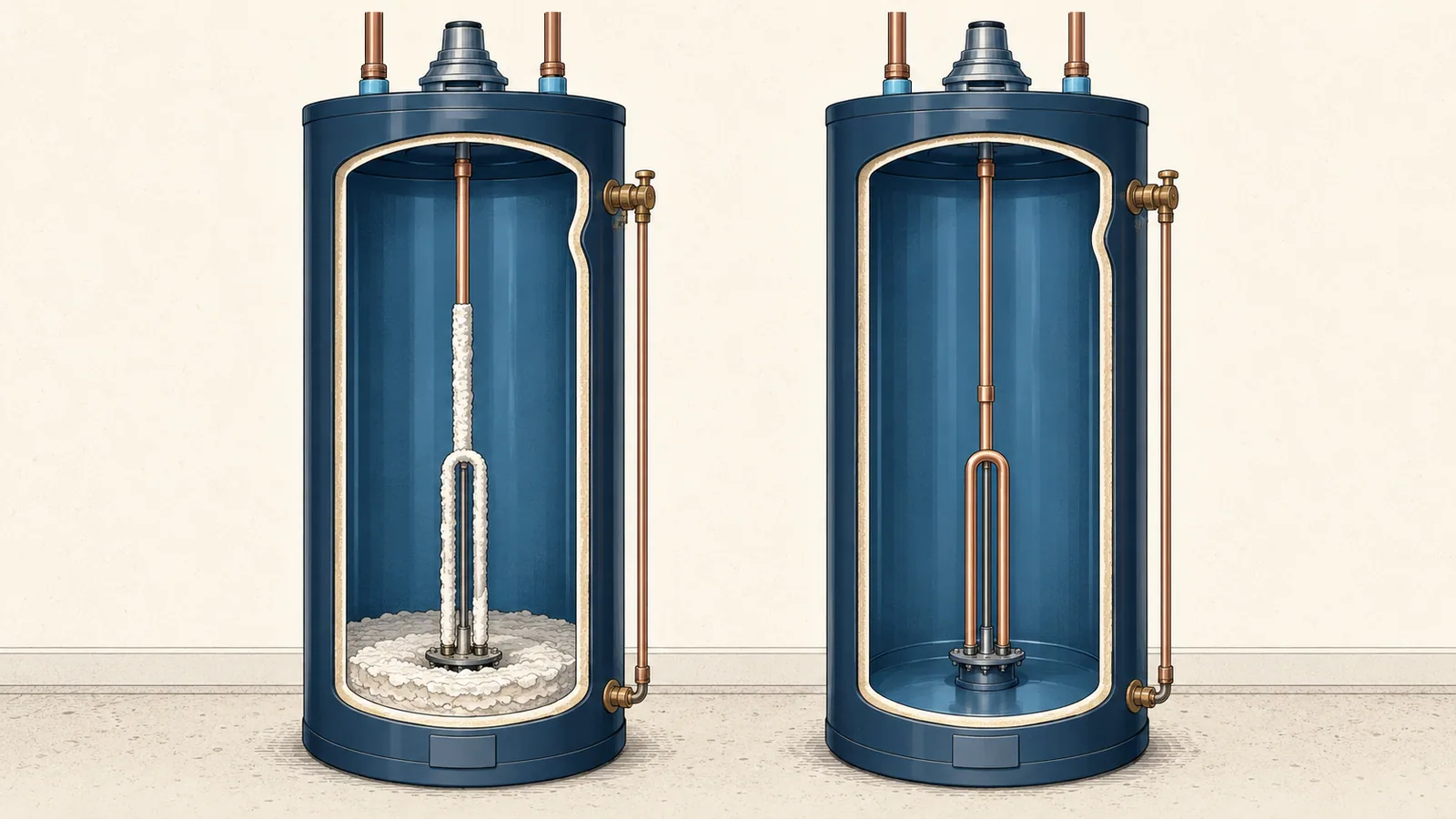
The measured part comes from the Battelle study run for the Water Quality Research Foundation, the research arm of the water treatment industry: industry funded, independently run, and we label it that way every time. Gas water heaters lost about 4% efficiency for every 5 gpg of hardness, up to 48% over their service life, while heaters on softened water held close to original efficiency across the 15-year test horizon. Electric heaters built roughly 0.4 lb of scale a year for every 5 gpg. Tankless units on 26 gpg water clogged completely in about 1.6 years of equivalent use, which is the single most expensive line in this whole discussion.
Now the part nobody measures honestly. Hardness minerals react with soap instead of lathering, so hard-water homes use more of it: that is chemistry, not a claim. Scale forms wherever water is heated, so dishwashers, washing machines and coffee makers scale exactly like the water heater does. But we have not found a current, independent dollar figure for those savings in a US household, so we do not print one.
What you hear
A water softener pays for itself in 2 to 3 years through soap, detergent and appliance savings.
What the numbers say
No independent study prices those savings for a US household. The only lab-measured benefit is water heater efficiency, roughly 4% per 5 gpg of hardness. Any calculator returning an exact annual dollar saving on detergent is generating that number, not measuring it.
Does the 10-Year Math Work Out?#
For a home above 10 gpg with a gas or tankless water heater, yes, and the tankless case is settled before the soap argument even starts. At 5 gpg with an electric tank heater and no appliance complaints, the arithmetic is thin and the real reason to buy becomes comfort. Here is the entire ledger, including the lines we cannot fill:
| Line | 10-year figure | Where it comes from |
|---|---|---|
| Equipment and installation | $400 to $6,500 upfront | Angi, HomeGuide, Fixr 2026 |
| Salt | $500 to $1,500 | HomeGuide 2026, $50 to $150 a year |
| Regeneration water, city supply | $100 to $300 | HomeGuide 2026, near zero on a well |
| Electricity | Under $100 | Valve electronics only |
| One repair | $150 to $600 | HomeGuide 2026, average $430 |
| Water heater energy and life | Measured effect, no household dollar figure | Battelle for the WQRF |
| Soap, detergent, laundry | Documented mechanism, not priced here | No independent figure we would publish |
| Appliance and plumbing life | Documented mechanism, not priced here | No independent figure we would publish |
Read that as an asymmetric bet, not a payback schedule. The costs are known within a few hundred dollars. The benefits are certain in direction, unquantified in size, and they scale with hardness: at 20 gpg the same $3,000 buys far more protection than it does at 7 gpg. Which is exactly why your grains-per-gallon number decides this and the brochure does not.
When Is a Water Softener Not Worth It?#
Four situations, and we would say no in all of them. If you can tick any one of these, keep the money.
Reasons to walk away
4 itemsThe first is arithmetic. The second is ownership: our how to fix hard water guide compares the renter options, from a $119.99 shower filter up to a portable softener. The third is triage, and hardness always loses it, because the EPA does not regulate hardness as a health contaminant. The fourth is regulatory: parts of California and Texas restrict salt-based softener discharge, and the alternative is a conditioner, which cut scale by over 88% in the WateReuse Research Foundation evaluation run with Arizona State University but leaves your water testing exactly as hard. Read the salt-free hub and the salt-based vs salt-free comparison before spending anything there.
The Verdict#
Get your gpg number, then apply it. Above 7 gpg, and especially with a gas or tankless water heater, a correctly sized salt-based system is worth it, and the decade costs $1,000 to $5,700 unless you go through a dealer. Between 3.5 and 7 gpg, buy it for the shower and the glassware if you want it, but do not let anyone sell you a return on investment. Below 3.5 gpg, keep your money.
Whatever you decide, decide the channel too: the same ion exchange happens inside a $489 big-box unit and a $6,000 dealer system. If a dealer quote is already on your table, run it through the quote decoder first, and if you are ready to shop, the ranked field is in best water softeners.
Frequently asked questions
Is a water softener worth it on city water?
It depends on hardness, not on the source. City water is chlorinated and often filtered, but utilities do not remove hardness, and plenty of municipal supplies run well above 10 grains per gallon. Check your utility's annual Consumer Confidence Report for the number, then apply the same thresholds: below 3.5 gpg no, above 7 gpg usually yes.
How long does it take a water softener to pay for itself?
Nobody can tell you honestly, and we will not pretend otherwise. The only benefit measured in a lab is water heater efficiency: the Battelle study run for the Water Quality Research Foundation, industry funded and independently run, found gas heaters lose about 4% efficiency for every 5 gpg of hardness. There is no current independent dollar figure for the soap, laundry and appliance savings, so no credible payback date exists.
Do I need a water softener at 5 grains per gallon?
That is the comfort band. At 5 gpg you will see spotting and soap that lathers poorly, but the equipment damage case is weak compared with a 12 gpg home. Buy one because you want soft water, not because a payback calculator promised you a return.
Is a water softener worth it if I rent?
No. A whole-house softener is plumbed into a loop and a drain that belong to your landlord, and you cannot take the value with you. Portable softeners, shower filters and descalers are the renter's toolkit, and they cost a fraction of an installed system.
Do you need a water softener if you already have a whole house filter?
Yes, if your water is hard. They do different jobs: a filter removes chlorine, chloramine and chemical contaminants but does nothing about hardness, and a softener removes calcium and magnesium but does nothing about taste or chlorine. Homes with both problems buy both, which is why combo packages exist.
Is renting a water softener ever worth it?
Only for a short stay. Rental runs $25 to $100 a month per Modernize's August 2026 data, which is $3,000 to $12,000 over ten years, bracketing every purchase path including the dealer channel, and you own nothing at the end. A two-year lease can justify it. A house you plan to keep cannot.
Keep reading
Not sure what you need?
Answer 5 questions, get the right system for your water.
City or well, budget, household size, our quiz matches your answers against every system we track.