Electronic Water Descalers: Scam or Legit? (What Independent Tests Found)
Electronic water descalers cut scale by about 50% in the one independent study, against 88%+ for TAC tanks, and soften nothing. Who should buy one, and who not.
By Home Water Lab TeamUpdated Prices verified Oct 7, 2026
This page contains affiliate links; buying through them costs you nothing extra.
Electronic water descalers work, about halfway. In the one independent study the whole category keeps citing, plug-in electromagnetic and electrically induced devices cut scale formation by roughly 50 percent, while tank-based template assisted crystallization (TAC) cut it by more than 88 percent. Neither removes a single grain of hardness. So the box on the pipe is legit for what it measures and oversold for everything else. This guide sits inside our guide to salt-free softeners and conditioners, which covers the whole category; here we look only at the plug-in boxes.
The short answer
as of Oct 19, 2026Do electronic water descalers work?
Partly. The WateReuse Research Foundation study led by Peter Fox at Arizona State University (project 08-06, 2014) measured about 50 percent less scale for electromagnetic and electrically induced devices, against more than 88 percent for TAC media tanks. The scale that still formed was soft enough to brush off. A descaler does not soften water: spotting, stiff laundry and weak lather stay, and a hardness strip reads the same. iSpring's ED2000 read $160.99 on Oct 19, 2026.
Key takeaways
- About 50% less scale for electromagnetic and electrically induced devices in the WateReuse 08-06 study.
- More than 88% less scale for TAC media tanks in the same study, close to double.
- Zero grains of hardness removed: iSpring itself says the ED2000 is not a water softener.
- The ED2000 read $160.99 on Oct 19, 2026, against $1,785 for SpringWell's FutureSoft TAC tank on Nov 9, 2026.
- iSpring says results may take up to 12 weeks, and iron above 0.3 ppm needs a filter first.
Do Electronic Water Descalers Really Work?#
Yes, at about half the strength of the alternative. The figure comes from a study sponsored by the Bureau of Reclamation, the California State Water Resources Control Board, the Santa Clara Valley Water District and the cities of Phoenix and Scottsdale, not by a manufacturer.
The researchers ran Colorado River surface water and a groundwater through each device under the German DVGW-W512 test protocol, then measured how much scale formed against an untreated control. Electromagnetic treatment and electrically induced precipitation, the two families most plug-in descalers belong to, each came in at approximately 50 percent. The untreated control formed hard calcite that needed an acid wash to remove; the scale after the electronic devices was a soft scale that came off with a brush.
Independent scale test, 2014
- TAC media tankGreater than 88 percent less scale than the untreated control. The technology inside the salt-free tanks sold by SpringWell, Aquasana and Kind.
- ElectromagneticApproximately 50 percent. This is the family most plug-in electronic descalers belong to. The scale that still formed was a soft scale the study says brushed off.
- Electrically inducedApproximately 50 percent, the same result as electromagnetic treatment, with the same soft, brushable scale.
- Ion exchangeThe study says ion exchange and capacitive deionization efficiently reduced scale formation, without publishing a percentage. Ion exchange is also the only technology here that lowers the hardness reading.
WateReuse Research Foundation project 08-06, "Evaluation of Alternatives to Domestic Ion Exchange Water Softeners", PI Peter Fox, Arizona State University, 2014. Colorado River surface water and a groundwater, German DVGW-W512 protocol. The percentages belong to the devices tested; no product on sale today inherits them by association.
One caution runs the other way too. Those percentages belong to the units tested in that study. No descaler on sale today inherits them by association, and a listing that quotes "88%" for a plug-in box is borrowing the TAC result.
How Does an Electronic Water Descaler Work?#
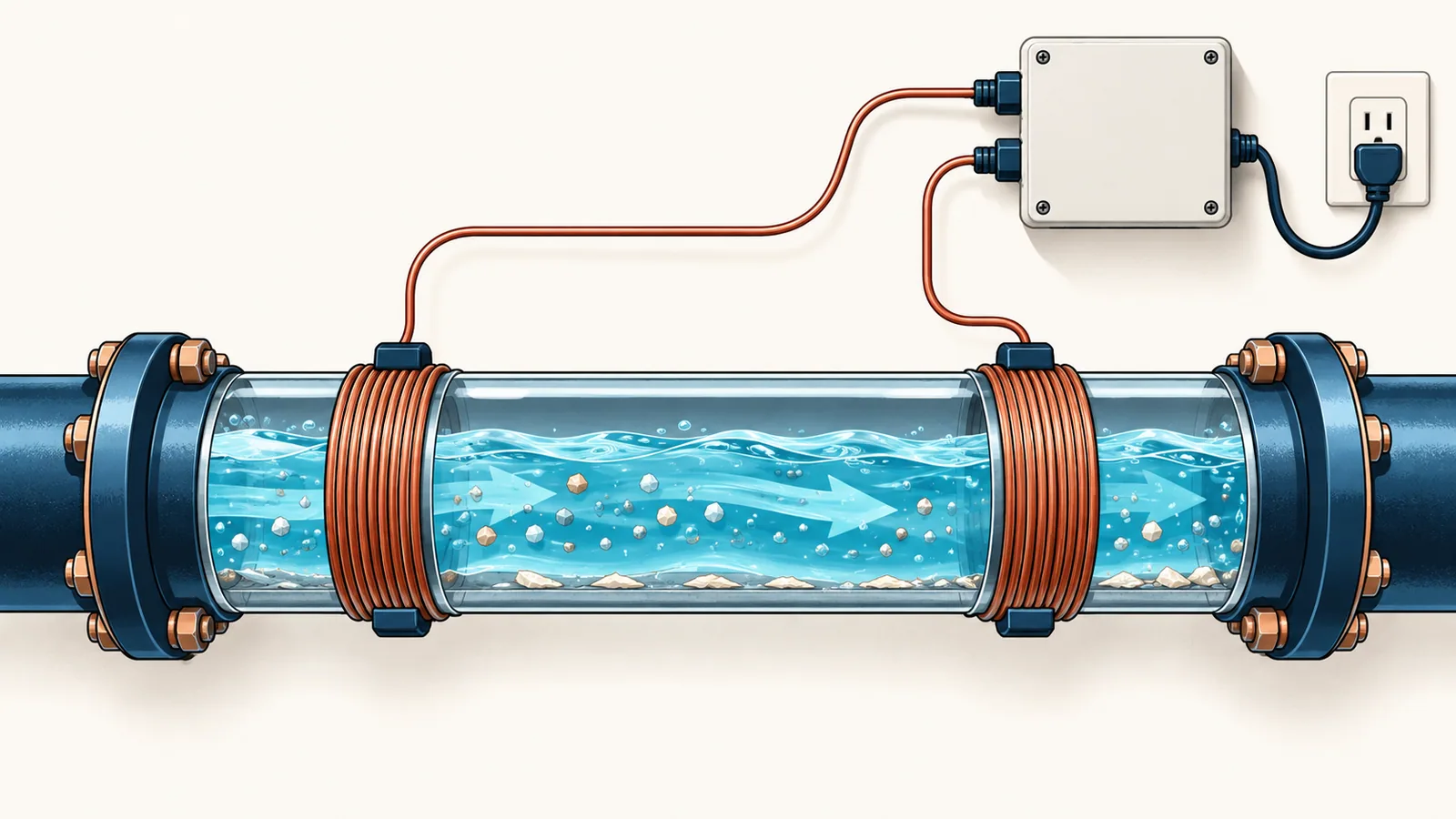
A control box sends a signal through wire coils wound around your main water pipe. The makers say the field changes how calcium crystallizes, so it forms loose particles that flow on instead of a hard crust on the heater element.
Nothing goes into the water and nothing comes out. There's no tank, no media and no drain, which is why installation takes minutes and why the device can't touch hardness. On iSpring's ED2000, the two coils wrap the pipe and the box plugs into a 110 to 120 V outlet on a 16-foot cord; iSpring puts its running cost at about 36 cents a month. If you want to see what the water was doing before you buy anything, our walkthrough on measuring your hardness before you buy gives you the number to start from.
Is an Electronic Water Softener a Real Softener?#
No, and the best-known maker says so itself. "The ED2000 is NOT a water softener and does not remove calcium or magnesium," reads iSpring's product page.
That matters because "electronic water softener" is the phrase many listings use, and it's searched more than "descaler." Softening has a definition, removing calcium and magnesium, and only ion exchange does it at home. If your complaint is white spots on glass, gray towels or shampoo that won't lather, a descaler at any price is the wrong purchase. Our comparison of what a softener fixes that a conditioner can't maps each symptom to the machine that actually fixes it.
What you hear
An electronic water softener softens water without salt.
What the numbers say
It doesn't soften anything. A hardness strip reads the same after the device as before, and iSpring's own page says the ED2000 does not remove calcium or magnesium. What it can do is reduce scale, by about half in the one independent test.
Electronic Water Descaler Pros and Cons#
The pros are all about cost and convenience; the cons are all about results. Here's how they stack up on the ED2000, the unit at the top of the shopping results.
What we like
- $160.99 on iSpring's own site (Oct 19, 2026), a tenth of a TAC tank
- No pipe cutting, no drain, no salt; iSpring says it works on PEX and PVC as well as metal
- Measured scale reduction of about 50% in independent testing
- Leftover scale is soft and brushes off, per the WateReuse findings
What to watch
- About half the scale reduction of a TAC media tank in the same study
- Removes no hardness: spotting, laundry and lather are unchanged
- iSpring says results may take up to 12 weeks to appear
- Needs an outlet near the main line and an iron filter above 0.3 ppm
iSpring
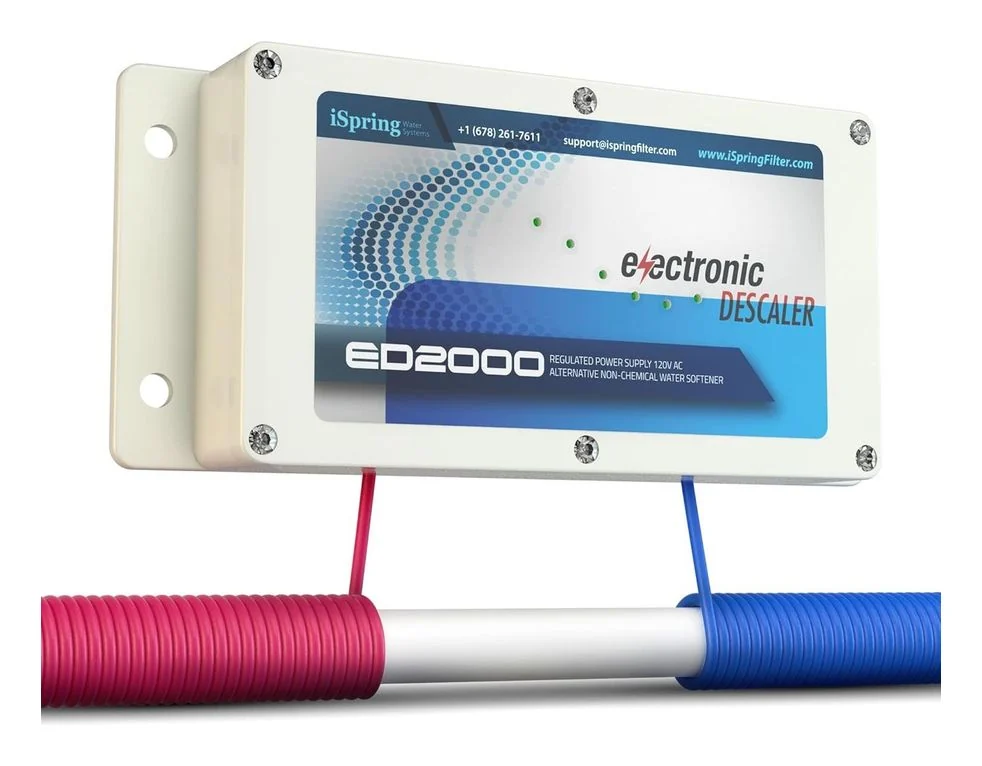
iSpring ED2000 Whole House Electronic Descaler
Best for: Renters and moderate-hardness city homes that want to try scale control for under $200 without cutting a pipe
- Type
- Electronic descaler wrapped around the main pipe
- Hardness limit
- Up to 425 ppm (25 gpg), per iSpring
- Iron
- Pre-treat above 0.3 ppm, per iSpring
- Pipe size
- Two units may be needed on mains over 1 in and under 1.5 in
- Power
- 110 to 120 V outlet near the pipe
- Time to effect
- Up to 12 weeks, per iSpring
Read iSpring's limits before you order, because they are more specific than most listings:
- Pipe size and length. One unit is rated for a 1 inch pipe and about 50 feet of pipe run; mains over 1 inch but under 1.5 inches may need two units side by side.
- Iron. "If iron levels are above 0.3 ppm (parts per million), an iron removal system should always be used."
- Hardness ceiling. The FAQ says the ED2000 handles water "as high as 425 ppm or 25 grains," while the bullet list on the same page targets "very hard water areas (10-19 grains per gallon)." We can't tell you which figure iSpring stands behind.
- Returns. The page shows a 1-year warranty, but the return window appears as one year, 30 days and 100 days in three different places. Confirm it in writing before you buy.
ScaleBlaster, the other electronic brand in the shopping results, advertised residential units "starting from $199" on its homepage on Oct 5, 2026, without a model price we could confirm.
Electronic Descaler vs Salt-Free Tank vs Water Softener#
Each one is the right answer to a different question. The descaler is the cheap way to take some scale off the water heater; the TAC tank is the serious way to do the same job; the softener is the only one that changes the water itself.
| Electronic descaler | TAC media tank | Salt softener | |
|---|---|---|---|
| Scale reduction | About 50% (WateReuse 08-06) | More than 88% (same study) | Effective, hardness removed |
| Spotting, laundry, lather | Unchanged | Unchanged | Fixed |
| Installation | Clips on, needs an outlet | Plumbed into the main line | Plumbed, plus drain and outlet |
| Example price (iSpring Oct 19, SpringWell Nov 9, 2026) | iSpring ED2000, $160.99 | SpringWell FutureSoft FS1, $1,785 | SpringWell SS1, $1,606.50 |
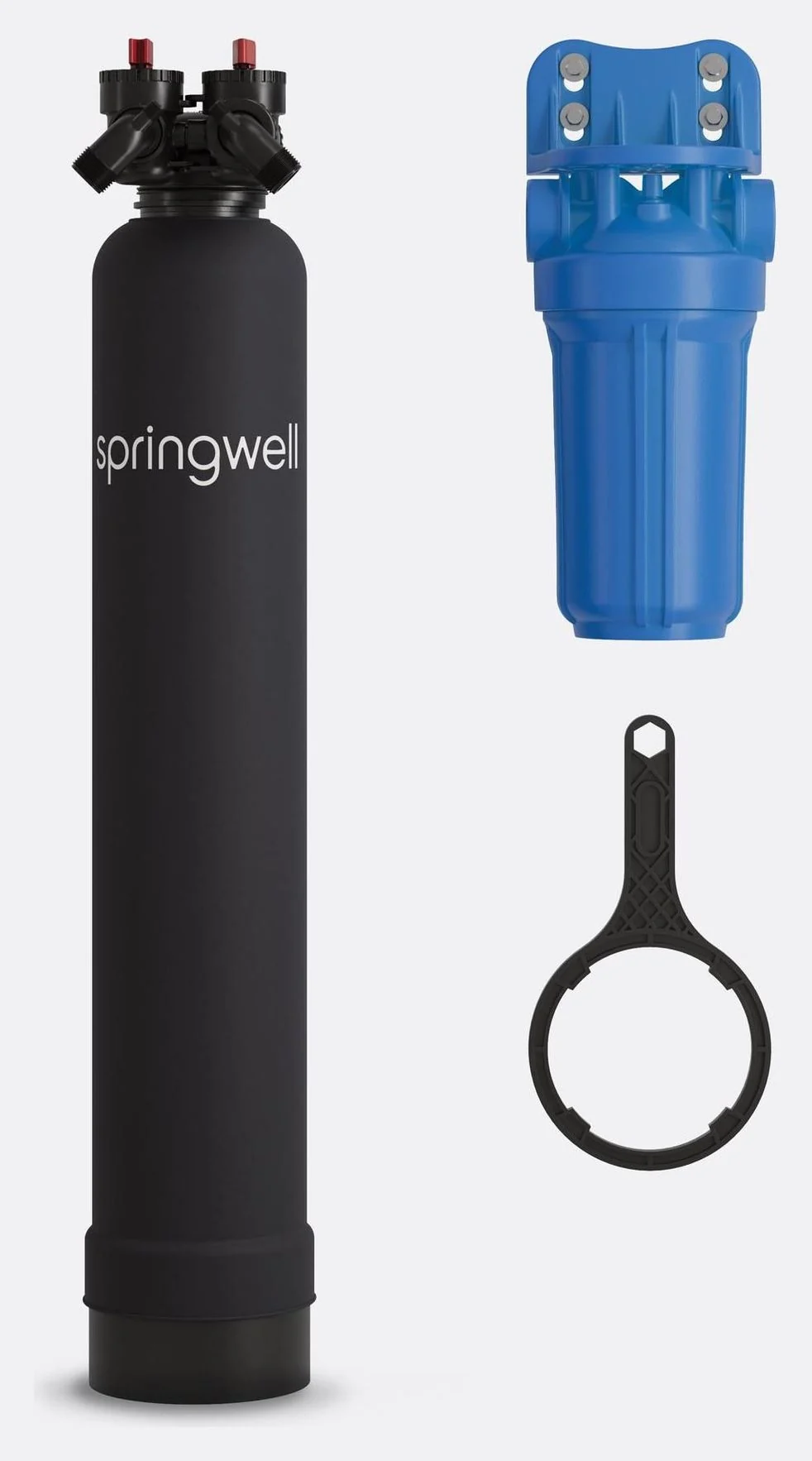
SpringWell
SpringWell FutureSoft FS1 Salt-Free Water Conditioner
Best for: City-water homes that want scale prevention without salt, a drain or electricity, not for anyone expecting soft-feeling water
- Technology
- TAC (Template Assisted Crystallization)
- Flow rate
- 12 GPM
- Bathrooms
- 1 to 3
- Tank
- 6" × 35"
- Max hardness
- 75 GPG (product page, Oct 26, 2026; 81 on the combo page)
- Scale prevention
- Up to 95% (manufacturer claim)
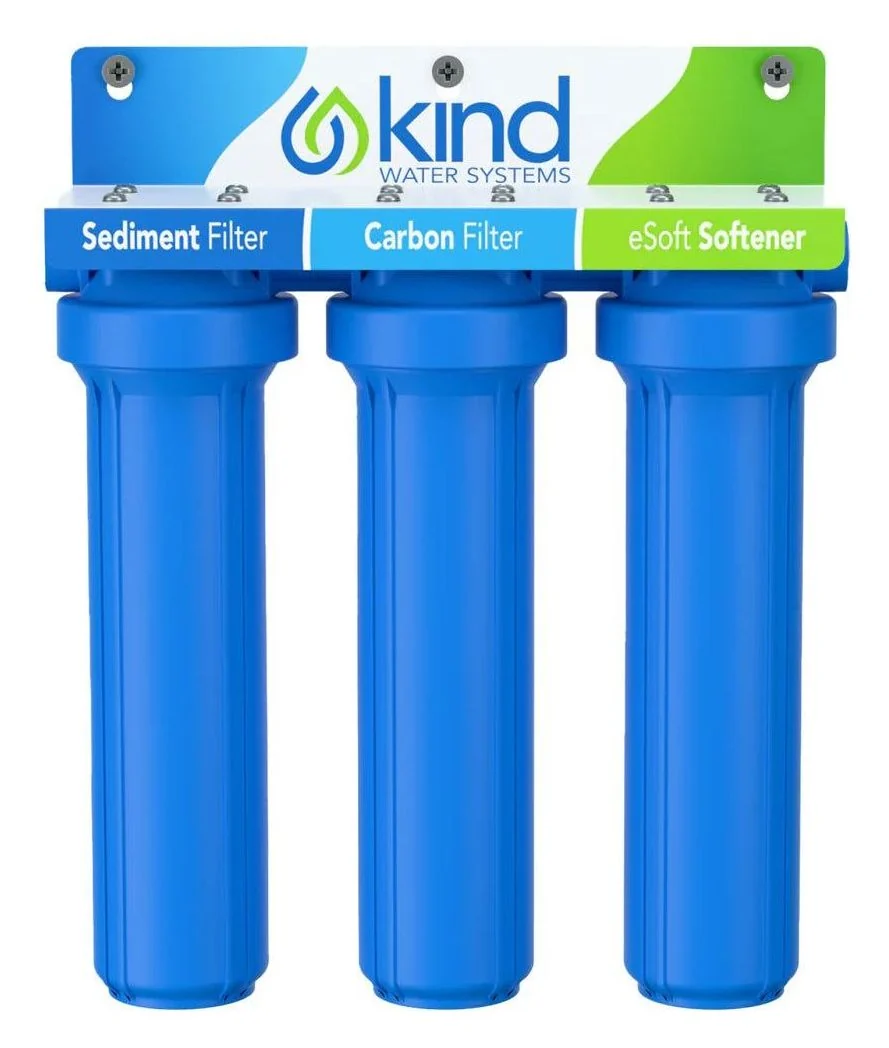
Kind Water Systems
Kind E-3000 Whole House Salt-Free Softener + Filter Combo
Best for: HOA/eco-constrained homes (salt-softener bans in CA/TX) that want filtration plus scale control in one pass
- Type
- Whole-house filter + TAC salt-free conditioner combo (best seller)
- Technology
- TAC, no electricity, no wastewater, no salt
- Maintenance
- Yearly cartridge replacement (~15 minutes)
For most homes, the salt-based against salt-free decision tree settles the choice, and the best water conditioners ranked by problem put the ED2000 next to the tank systems. If you're weighing a tank, read our review of the FutureSoft FS1 and the Kind E-3000 write-up first.
Who Should Buy an Electronic Descaler?#
Someone with moderate hardness, a water heater to protect, no drain near the main line and a budget under $200. If that's you, the ED2000 is a reasonable experiment, as long as you go in expecting about half the scale reduction of a tank and none of the softening. Whatever sits on the pipe, the heater itself still needs an annual tankless flush with vinegar or an approved descaler.
Skip the descaler if any of these is true
5 itemsThe water conditioner guide explains the four machines sold under that name, and the 10-year cost of a water conditioner prices the tank route properly. For soft water, go straight to the shortlist of salt softeners.
Electronic water descalers, answered
Do electronic water descalers really work?
Partly. In the WateReuse Research Foundation study led by Peter Fox at Arizona State University (2014), electromagnetic treatment and electrically induced precipitation each reduced scale formation by approximately 50 percent, against more than 88 percent for template assisted crystallization. The scale that still formed after the electronic devices was a soft scale the study says could be removed by brushing.
Is an electronic water softener a real water softener?
No. It doesn't remove calcium or magnesium, so a hardness test reads the same before and after. iSpring states it on its own product page: the ED2000 is not a water softener and does not remove calcium or magnesium. Only an ion exchange softener lowers the hardness reading.
What are the pros and cons of an electronic water descaler?
The pros are price and installation: iSpring's ED2000 read $160.99 on Oct 19, 2026, needs no plumbing work and runs on a standard outlet. The cons are about half the scale reduction of a TAC tank, no effect on spotting, laundry or lather, a slow start iSpring puts at up to 12 weeks, and limits on hardness, iron and pipe length.
How does an electronic water descaler work?
A control box plugs into an outlet and sends a signal through wire coils wrapped around the main water pipe. The makers say the field changes how calcium crystallizes, so it forms loose particles instead of hard scale. Nothing is added to or removed from the water, which is why the hardness reading never moves.
Do magnetic water descalers work?
There's no independent figure for them in the study the whole category cites. The WateReuse 08-06 findings cover electromagnetic and electrically induced devices, which plug in, not permanent magnets clamped on a pipe. Treat any percentage on a magnet's box as the seller's own claim.
Is an electronic descaler a scam?
Not a scam, an underpowered product. Independent testing found real scale reduction of about 50 percent. The trouble is the marketing: listings that call these boxes water softeners, or promise results a softener would deliver, are selling something the device can't do.
Frequently asked questions
Do electronic water descalers really work?
Partly. In the WateReuse Research Foundation study led by Peter Fox at Arizona State University (2014), electromagnetic treatment and electrically induced precipitation each reduced scale formation by approximately 50 percent, against more than 88 percent for template assisted crystallization. The scale that still formed after the electronic devices was a soft scale the study says could be removed by brushing.
Is an electronic water softener a real water softener?
No. It doesn't remove calcium or magnesium, so a hardness test reads the same before and after. iSpring states it on its own product page: "The ED2000 is NOT a water softener and does not remove calcium or magnesium." Only an ion exchange softener lowers the hardness reading.
What are the pros and cons of an electronic water descaler?
The pros are price and installation: iSpring's ED2000 read $160.99 on Oct 19, 2026, needs no plumbing work and runs on a standard outlet. The cons are a measured scale reduction of about half what a TAC tank achieves, no effect on spotting, laundry or lather, a slow start iSpring puts at up to 12 weeks, and limits on hardness, iron and pipe length.
How does an electronic water descaler work?
A control box plugs into an outlet and sends a signal through wire coils wrapped around the main water pipe. The makers say the field changes how calcium crystallizes, so it forms loose particles instead of hard scale. Nothing is added to or removed from the water, which is why the hardness reading never moves.
Do magnetic water descalers work?
There's no independent figure for them in the study the whole category cites. The WateReuse 08-06 findings cover electromagnetic and electrically induced devices, which plug in, not permanent magnets clamped on a pipe. Treat any percentage on a magnet's box as the seller's own claim.
Is an electronic descaler a scam?
Not a scam, an underpowered product. Independent testing found real scale reduction of about 50 percent. The trouble is the marketing: listings that call these boxes water softeners, or promise results a softener would deliver, are selling something the device can't do.
Keep reading
Water Conditioner vs Water Softener: The Difference That Costs You Money
Read the head-to-head
Culligan Salt-Free Water Conditioner (2026): Price, How It Works, and the DTC Alternative
Read the cost breakdown
Best Water Conditioner 2026: Top Whole-House Systems Compared
Read the buyer's guideNot sure what you need?
Answer 5 questions, get the right system for your water.
City or well, budget, household size, our quiz matches your answers against every system we track.