Where to Get Well Water Tested (Free and Low-Cost Options)
Where to get well water tested near you: county health departments, state labs, extension clinics, certified private labs and mail-in kits, with dated prices.
By Home Water Lab TeamUpdated Prices verified Oct 7, 2026
The fastest way to get well water tested near you is to call your county health department: the EPA says it may test a private well for free, and if it doesn't, it should hold the list of state-certified labs in your area. After that come state labs and extension clinics, which charge per test, then private certified labs and mail-in kits. What to test for and how often is covered in our well water testing guide; this page is about where to send the bottle, as part of our private well treatment guide.
The short answer
as of Oct 19, 2026Where can I get my well water tested?
Try these in order: your county or local health department, which may test for free (EPA, USGS); your state public lab or an extension clinic, such as Wisconsin's state lab at $35 for a bacteria test or Virginia Tech's clinics at $70 for 28 constituents; a state-certified private lab from your state's certification list; or a mail-in kit analyzed by a certified lab. A water treatment company's free test is a sales visit, not a certified result.
Key takeaways
- The EPA says your local health department may test a private well for free; the USGS says to ask your county first.
- Wisconsin's state lab charges $35 for bacteria and $450 for a full homeowner package (prices from Jul 1, 2026).
- Virginia Tech's clinics run in about 70 counties a year at $70 a kit for 28 constituents.
- Every state runs a drinking water lab certification program, linked from one EPA page.
- Penn State Extension advises caution with results from water treatment salespeople.
Where to Get Your Well Water Tested, in Order#
Five doors, from the one that may cost nothing to the one that should never be your only result. Start at the top and stop at the first one that tests what you need.
Try the doors in this order
as of Oct 19, 2026- County health deptThe EPA says your local health department may test a private well for free, and the USGS says to check with your county first. Where it does not test, it should hold the list of certified labs (CDC).
- State lab or clinicSome states run their own lab or an extension program. Wisconsin's state lab charges $35 for a bacteria test (prices effective Jul 1, 2026); Virginia Tech's clinics charge $70 a kit for 28 constituents.
- Certified private labEvery state runs a drinking water lab certification program, and the EPA links to each one. Use a lab certified for the tests you order, not one that is certified for something else.
- Mail-in kitFine when a certified lab does the analysis and the kit price includes the lab fee, which HomeGuide says to confirm. A strip kit with no lab behind it is a screen, not a result.
- Dealer free testFree, and usually done in your kitchen by the company that sells the fix. Penn State Extension advises caution with results from water treatment salespeople. Use it as a second opinion at most.
Sources: EPA private well and lab certification pages (updated Feb 26 and Aug 11, 2026), USGS FAQ (Mar 12, 2026), CDC (Jul 1, 2024), Wisconsin State Laboratory of Hygiene price list (effective Jul 1, 2026), Virginia Household Water Quality Program, HomeGuide (Jul 29, 2025), Penn State Extension (Jun 2, 2025). Read Oct 19, 2026. Filled check: usually true. Dash: depends on the state or the kit. Cross: not this door.
The reason to start local is the list, not just the price. The CDC says your local or state health department, environmental department or county government should have a list of the state-certified laboratories in your area, so even a county that doesn't test for you saves you the search.
Where Can I Get My Well Water Tested for Free?#
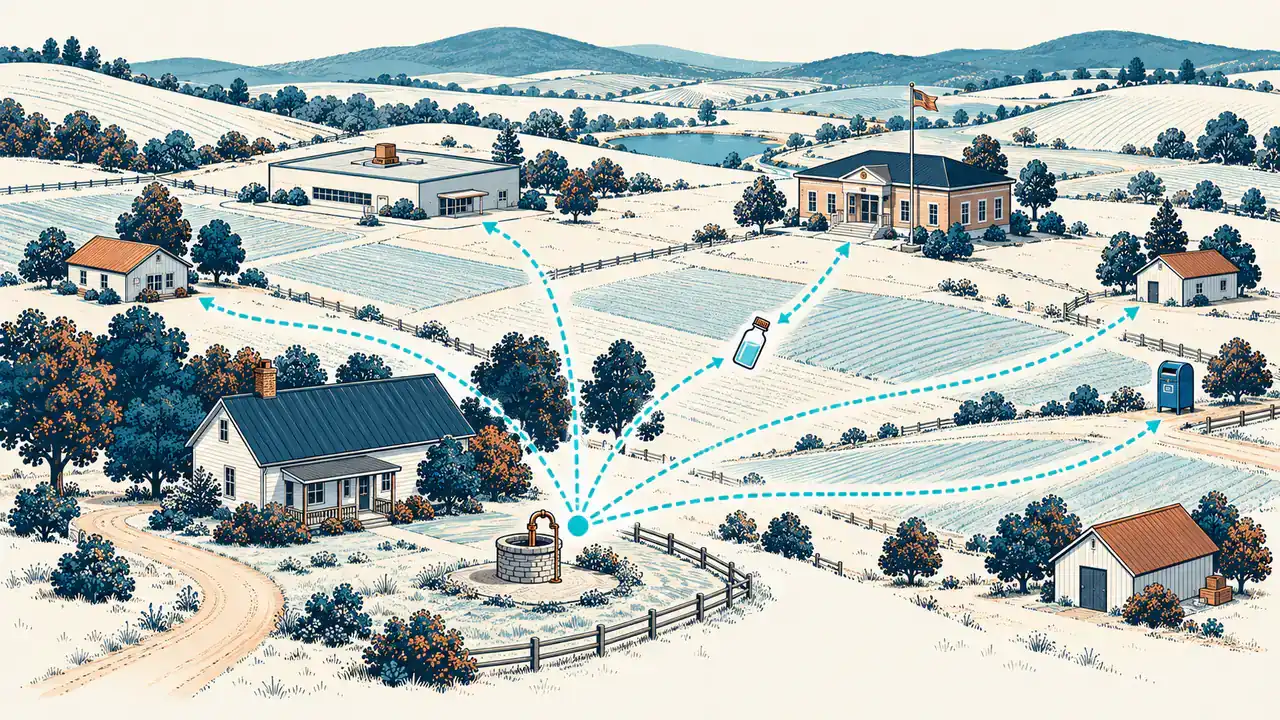
At the county or local health department, when it offers the service. The EPA's private well page says your local health department "may provide private well testing for free" (updated Feb 26, 2026), and the USGS tells well owners to check with their county first, since some offer free testing (updated Mar 12, 2026).
Free usually means a short panel. A county program is most often built around the safety basics, bacteria and nitrate, which are also the two tests most state agencies put on a yearly schedule. Ask what is included before you assume it covers iron, hardness or arsenic.
State Labs and Extension Programs#
Some states test private wells through a public lab or an extension program, and their prices are published. Two examples show what that looks like.
Wisconsin State Laboratory of Hygiene. The state lab sells kits straight to homeowners. Shipping the kit out is free, and the bill comes after the results (prices effective Jul 1, 2026). A bacteria test is $35, nitrate $35, a metals screen $97, and the full homeowner package, with bacteria, nitrate, metals, hardness, VOCs and atrazine, $450. Wisconsin's DNR tells well owners to test for bacteria and nitrate every year.
Virginia Household Water Quality Program. Virginia Tech and Virginia Cooperative Extension run drinking water clinics in around 70 Virginia counties every year. You pick up a kit locally, sample on a set day, and get results about 4 to 5 weeks later for $70 a kit, covering 28 chemical and bacteriological constituents from coliform and E. coli to lead, arsenic and iron. The program puts a comparable commercial panel at more than $300.
Other states run versions of the same idea. In Minnesota, the health department points to its search tool for accredited labs and to county environmental or public health services (updated May 20, 2025). In Pennsylvania, Penn State's Agricultural Analytical Services Laboratory is accredited by the state's Department of Environmental Protection for drinking water analysis. In Texas, the Texas Well Owner Network, run by Texas A&M AgriLife Extension, holds water screening events alongside its well owner courses; check its calendar for one near you.
How to Find a State-Certified Lab Near You#
Use your state's certification list. The EPA keeps one page linking to every state's drinking water lab certification program (updated Aug 11, 2026), and the USGS also names your State Certification Officer as a contact.
Finding and booking a certified lab
Open your state's list
From the EPA page, open your state's certification program and its list of certified drinking water labs, or ask the county for the local names.Match the certification to the test
A lab is certified for specific methods. Make sure it is certified for the contaminants you're ordering, bacteria in particular.Ask for the kit and the deadline
Request the bottles with their sampling sheet, and ask for the shipping cutoff. Bacteria samples are the tight ones, and many labs refuse Friday deliveries.Ask what the price includes
Confirm the quote covers the analysis and a written report you can read, not just the bottle. Wisconsin's state lab, for one, leaves the return postage to you.
Then order the panel your house actually needs. The EPA chart in our symptom-by-symptom testing guide pairs symptoms and nearby land uses with the tests they call for.
How Much Does Well Water Testing Cost Near You?#
From nothing at a county program to a few hundred dollars for a broad private panel. The table lines up the public prices we could date with HomeGuide's ranges for private labs.
Well water testing, by where you send it
as of Oct 19, 2026- County or local health departmentEPA, USGS; ask what the test covers
- Free in some counties
- County-provided test kitHomeGuide, updated Jul 29, 2025
- $20 to $75
- Wisconsin state lab, bacteriaPresence or absence; prices effective Jul 1, 2026
- $35
- Virginia Tech clinic kit28 constituents; about 70 counties a year
- $70
- Wisconsin state lab, HUD/FHA-VA loan packageBacteria, lead, nitrate, nitrite
- $146
- Private lab, basic panelHomeGuide; bacteria, metals, nitrate
- $130 to $200
- SpringWell Well Water Test: Level 1 + BacteriaMail-in; required with SpringWell well systems
- $134.25
- Wisconsin state lab, homeowner packageAdds metals, hardness, VOCs, atrazine
- $450
Estimated 10-year total
$835.25
Public lab prices are the labs' own lists; private lab ranges are HomeGuide's (read Oct 12, 2026). SpringWell price read on its WS1 page Oct 19, 2026. Prices vary by state: these are examples, not a national rate.
If you're buying a house, ask the lender which tests it wants first. Wisconsin's state lab sells a dedicated HUD/FHA-VA loan package at $146 for that reason, and an inspection with testing is a separate line in the cost of treating a well, stage by stage.
Are Mail-In Well Water Test Kits Worth It?#
Yes, when a certified lab does the analysis. A mail-in kit is just a bottle and a shipping label; what you're paying for is the lab behind it. HomeGuide's advice is to confirm the kit price includes the lab's testing fee (updated Jul 29, 2025).
Mail-in lab kit
- A certified lab runs the analysis
- Bacteria, nitrate, metals to a number
- Shipping deadlines to respect
- Results in days to weeks
Home strip kit
- You read a color band yourself
- No certified bacteria or nitrate result
- Cheap enough to repeat
- Useful between lab tests
Bottom line
Mail a kit to a certified lab for the yearly test. Keep strips for watching hardness or a filter between lab results.
Home strips and meters are compared in our tested breakdown of hard water test kits, and the three free ways to check hardness at home cover the cheapest screen of all.
Should You Trust a Free Water Test From a Dealer?#
Use it as a second opinion at most. Many water treatment companies advertise free in-home testing, and the person running the test is selling the fix. Penn State Extension advises caution with results from an uncertified lab or from water treatment salespeople (updated Jun 2, 2025).
What you hear
A free in-home water test from a treatment company is the same as a lab test.
What the numbers say
An in-home test reads a few numbers on the spot and is not a certified result. Penn State Extension tells well owners to be cautious with results from water treatment salespeople and to rely on a certified lab.
The same caution applies to the quote that follows. If a dealer's test leads to a system proposal, our line-by-line dealer quote decoder shows what each line usually costs on the open market.
What to Do Once the Results Come Back#
Read them against the yardsticks, then treat what's actually there. Our well water testing guide's results table lists the EPA reference levels for nitrate, arsenic, lead, iron, manganese and the rest. A positive bacteria result goes to the health department first.
Treatment follows the numbers. Iron points to five ways to remove iron from well water, by ppm, a smell to the checks in our rotten egg smell guide, and grit to the sediment filters ranked for private wells. Our channel's walkthrough goes from lab report to equipment list.
EPA pages updated Feb 26 and Aug 11, 2026; USGS FAQ updated Mar 12, 2026; CDC page dated Jul 1, 2024; Wisconsin state lab prices effective Jul 1, 2026; MDH page updated May 20, 2025; Penn State Extension updated Jun 2, 2025; HomeGuide updated Jul 29, 2025. Read Oct 19, 2026, except HomeGuide and Penn State's testing page (Oct 12, 2026). We did not send samples to any lab for this page.
More questions about getting well water tested
Does the health department test well water?
Many do, and some for free. The EPA says your local health department may provide private well testing for free; if it doesn't, the CDC says it should have the list of state-certified labs in your area.
How long do well water test results take?
It depends on the lab and the test. Wisconsin's state lab lists 2 business days for bacteria and 21 for its full homeowner package; Virginia Tech's clinics return results about 4 to 5 weeks after the sampling day.
What should I test my well water for?
At minimum, total coliform bacteria, nitrate, total dissolved solids and pH every year, per the CDC and the EPA, plus what your area and symptoms call for. Our well water testing guide has the full chart.
Can a plumber test my well water?
A plumber or well contractor can take the sample, but the analysis should come from a state-certified lab. The EPA says to use only laboratories certified for drinking water testing.
Frequently asked questions
Where can I get my well water tested for free?
Ask your county or local health department first. The EPA says your local health department may provide private well testing for free, and the USGS says some counties offer free well water testing. Where yours doesn't, it should still hold the list of state-certified labs in your area, per the CDC.
Where can I get my well water tested near me?
At a laboratory certified by your state for drinking water. Your county health or environmental office can name the local ones, and every state runs a certification program the EPA links to. Some states also run their own public lab or an extension clinic, such as Wisconsin's State Laboratory of Hygiene or the Virginia Household Water Quality Program.
How much does it cost to test well water?
From free to a few hundred dollars, depending on the county and the panel. Wisconsin's state lab charges $35 for a bacteria test and $450 for its full homeowner package (prices effective Jul 1, 2026). Virginia Tech's clinics charge $70 a kit for 28 constituents. HomeGuide puts a basic private lab panel at $130 to $200 (updated Jul 29, 2025).
Are free water tests from water treatment companies reliable?
Treat them as a sales visit, not a lab result. Penn State Extension advises caution with results from an uncertified lab or from water treatment salespeople. For anything that decides your health or a purchase, use a state-certified lab.
Do I need a certified lab to test well water?
For a result you can rely on, yes. The EPA says to use only laboratories certified to do drinking water testing, and the CDC says to use a state-certified laboratory. Check that the lab is certified for the specific tests you order.
Can I mail my well water sample to a lab?
Yes, many labs ship a kit and take the sample back by post. HomeGuide's advice is to confirm the kit price includes the lab's testing fee, and bacteria samples have tight deadlines: Wisconsin's state lab, for one, asks you not to ship on a Friday.
Keep reading
Not sure what you need?
Answer 5 questions, get the right system for your water.
City or well, budget, household size, our quiz matches your answers against every system we track.