How to Remove Iron From Well Water: 5 Methods Compared
How to remove iron from well water depends on the ppm on your test: carbon, a softener, greensand, air injection or chemical oxidation, with the limits extension services set.
By Home Water Lab TeamUpdated Prices verified Oct 7, 2026
This page contains affiliate links; buying through them costs you nothing extra.
To remove iron from well water, you oxidize the dissolved iron into particles and catch them, or you trade it out on a softener's resin while the amount is small. Which of the five methods fits comes down to one number on your lab report, iron in mg/L (the same as ppm), plus whether the water comes out clear or already rusty. This guide sits under our private well treatment guide, from symptom to system; the product rankings live in a separate list.
The short answer
as of Oct 19, 2026How do you remove iron from well water?
Match the method to the iron level. Under 1 mg/L of dissolved iron, catalytic carbon. Under 5 mg/L, a water softener can do it if the pH is above 6.7 (Penn State; MDH says 2 to 5 is more typical). From 3 to 10 mg/L, a greensand or air injection oxidizing filter. Above 10 mg/L, chemical oxidation with chlorine or peroxide, then filtration. Iron that is already rusty when it leaves the tap only needs catching, and a sediment filter does that.

Key takeaways
- Iron stains above 0.3 mg/L, the EPA's secondary standard; well iron is usually below 10 mg/L (MDH).
- A softener takes dissolved iron under 5 mg/L at pH 6.7 or higher (Penn State), 2 to 5 mg/L in typical use (MDH).
- Greensand filters cover 3 to 10 mg/L of iron and manganese combined (Penn State), about 10 to 15 per MDH.
- Above 10 mg/L, both extension services move to chlorine or peroxide oxidation ahead of a filter.
- Polyphosphate under 2 mg/L hides iron instead of removing it.
What Kind of Iron Is in Your Water?#
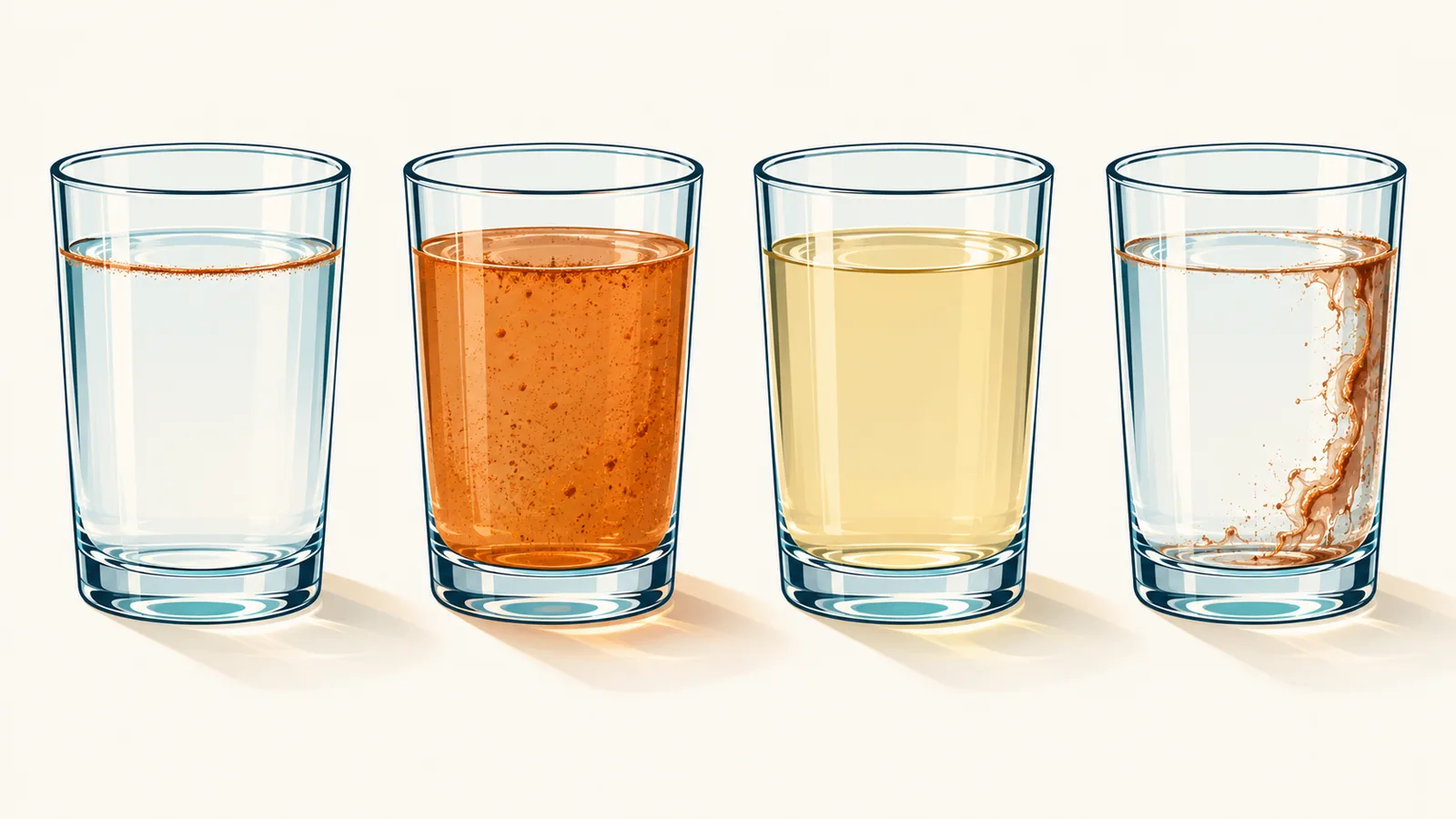
Fill a clear glass and let it stand. The Minnesota Department of Health uses what you see to sort the types, and the type decides the method before the number does (page updated Aug 1, 2025).
| What you see | Type | What it means for treatment |
|---|---|---|
| Clear from the tap, red or brown after standing | Ferrous (clear-water) iron | Dissolved: needs oxidizing, or a softener at low levels |
| Red or yellow the moment it leaves the tap | Ferric (red-water) iron | Already particles: needs catching |
| Yellow or brown, sometimes colorless, shallow well | Organic iron | Bound with tannins: softeners and iron filters may not work well |
| Red or brown slime in tanks and fixtures | Iron bacteria | A well problem first, a filter problem second |
Penn State adds the chemistry behind the glass: dissolved iron is most common in groundwater with a pH under 7.0, while oxidized iron shows up in higher-pH water or where oxygen gets in easily, such as a shallow spring (updated May 29, 2025). If the stain is the clue you have, our glass test for sorting rust stains starts from there.
How Much Iron in Well Water Is Too Much?#
Anything over 0.3 mg/L. That is the EPA's secondary standard for iron, the level where water starts to taste metallic and stain fixtures and laundry, and MDH says water above it is usually considered objectionable.
It is a nuisance limit, not a health one. Penn State says iron and manganese are not health concerns in drinking water, and MDH says well iron usually runs below 10 mg/L. Manganese rides along on most of the same tests, with a secondary standard of 0.05 mg/L and an EPA health advisory at 0.3 mg/L, per Penn State.
5 Ways to Remove Iron From Well Water, by ppm#
The chart puts each method on the same axis. Find your lab result along the bottom, then read up.
Iron on your lab report, in mg/L
as of Oct 19, 2026- Catalytic carbonUnder 1.0 mg/L of dissolved iron, with at least 4.0 mg/L of dissolved oxygen in the source water (Penn State Extension).
- PolyphosphateUnder 2 mg/L. It sequesters the iron so it stays dissolved, which stops staining but leaves the iron in the water, and does little for manganese (Penn State).
- Water softenerDissolved iron under 5 mg/L at a pH above 6.7 (Penn State). The Minnesota Department of Health calls 2 to 5 mg/L the more typical limit, whatever the box claims.
- Greensand filter3 to 10 mg/L of iron and manganese combined (Penn State); MDH puts its reach at about 10 to 15 mg/L, drawn as the lighter tail. Air injection filters use the same catch bed.
- Oxidize + filterAbove 10 mg/L, both Penn State and MDH move to a chemical oxidizer ahead of a filter. MDH warns that dosing is difficult and that improper dosing carries health risks.
Ranges from Penn State Extension, Iron and Manganese in Private Water Systems (updated May 29, 2025), and the Minnesota Department of Health, Iron in Well Water (updated Aug 1, 2025), both read Oct 19, 2026. The 0.3 mg/L line is the EPA's secondary standard for iron. 1 mg/L equals 1 ppm.
1. Sediment filter: iron that is already rust#
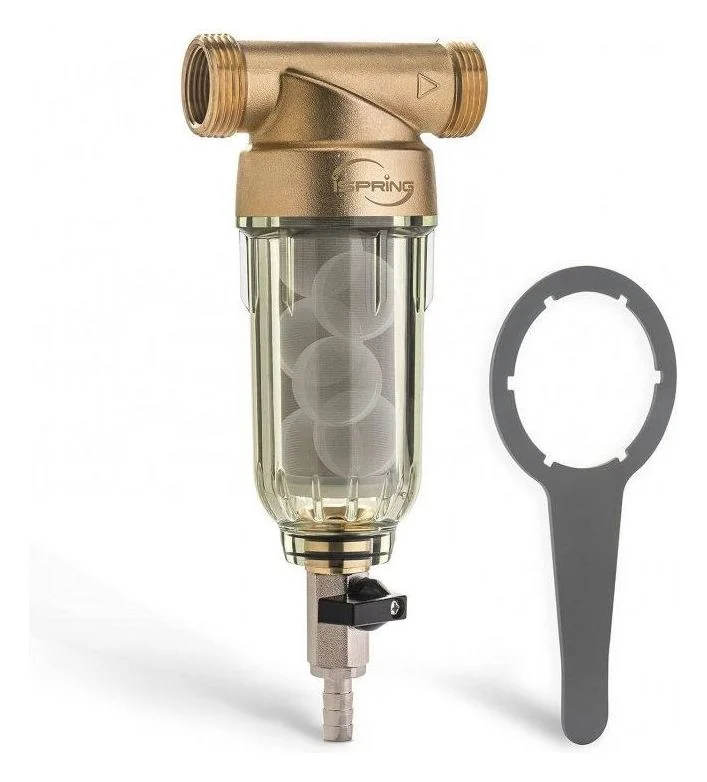
Ferric iron is already solid, so the job is catching it, not oxidizing it. MDH lists sediment and carbon filters and softeners for small amounts of it, with the warning that they clog quickly. A reusable spin-down screen ahead of everything else takes the coarse particles and can be rinsed instead of replaced.
iSpring
iSpring WSP-50SL Reusable Spin-Down Sediment Prefilter
Best for: Putting a flushable, never-replaced screen in front of a softener, an iron filter or a cartridge stack
- Micron options
- 50, 100, 200, 500 and 1,000 on the same body
- Ports
- 1 in MNPT and 3/4 in FNPT, both ends
- Pressure range
- 20 to 100 PSI
- Temperature range
- 40 to 100 F
- Screen
- Reusable 316L stainless, flushed by valve
- Siliphos cartridge
- Replace every 3 to 6 months
2. Water softener: small amounts of dissolved iron#
A softener exchanges dissolved iron the way it exchanges calcium. Penn State's conditions are strict: pH above 6.7, hardness between 3 and 20 gpg, dissolved iron under 5 mg/L, and raw water that hasn't met air or chlorine first, because oxidized iron fouls the resin. MDH notes that makers claim up to 10 mg/L, while 2 to 5 is the more typical limit.
That gap is why we treat a softener's iron rating as a tolerance, and why our iron filters ranked by ppm ceiling puts the filter ahead of the softener. The resin cleaner routine that slows the fouling is in our softener maintenance checklist.
3. Catalytic carbon: trace iron with oxygen to spare#
Catalytic carbon is the light-duty option. Penn State gives it dissolved iron under 1.0 mg/L, and only when the source water carries at least 4.0 mg/L of dissolved oxygen, which many low-oxygen wells don't.
4. Oxidizing filter: greensand, birm and air injection#
This is the method most wells end up with. The filter turns dissolved iron into particles and catches them in the same bed, then backwashes them to the drain. Penn State recommends greensand for 3 to 10 mg/L of iron and manganese combined, MDH says about 10 to 15, and birm needs a pH of at least 6.8 for iron and 7.5 for manganese.
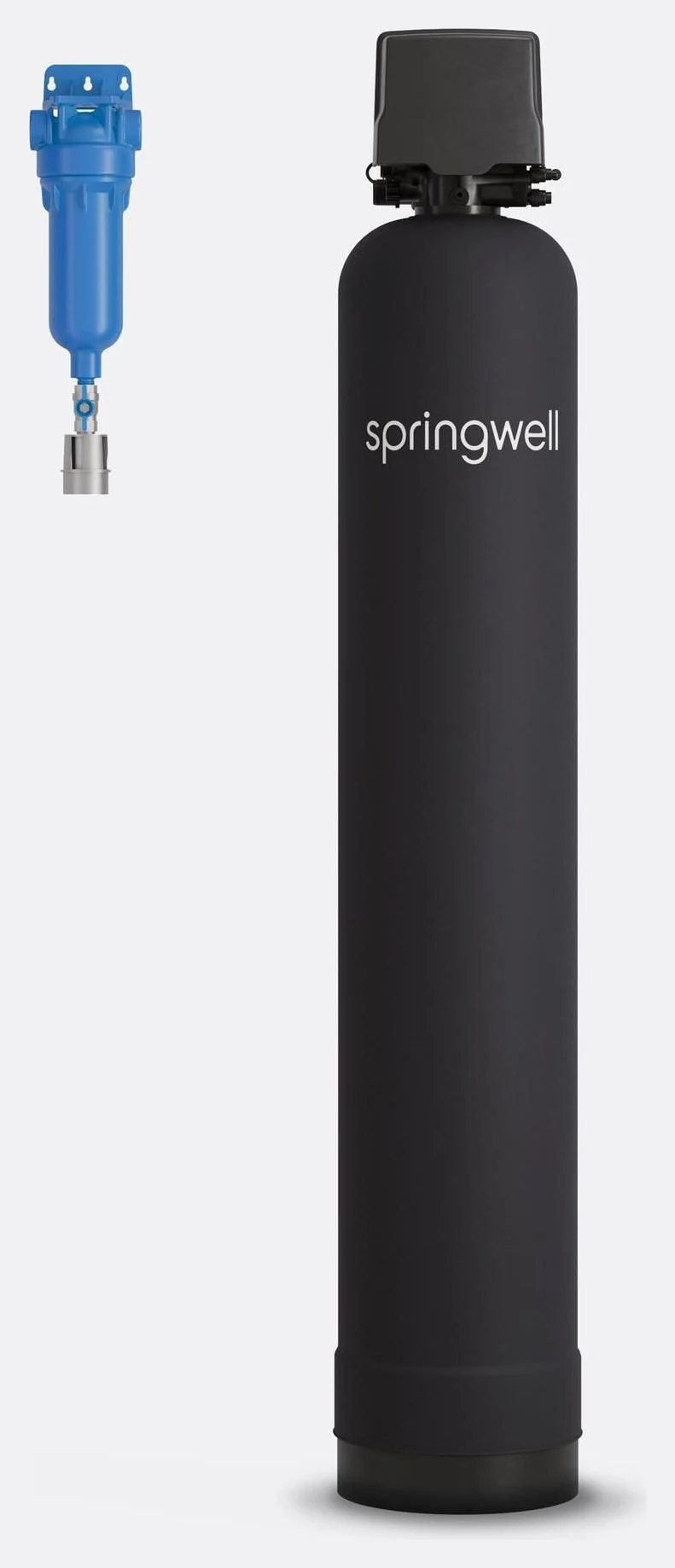
Air injection systems put a pocket of air at the top of the tank to do the oxidizing, so there is no chemical to buy. The SpringWell WS1 works this way and is rated for 7 ppm iron, 1 ppm manganese and 8 ppm hydrogen sulfide, on SpringWell's page read Oct 19, 2026. Our SpringWell WS1 review against its 7 ppm iron ceiling tests that number.
SpringWell
SpringWell WS1 Whole House Well Water Filter
Best for: Well-water homes with light-to-moderate iron, sulfur or manganese that want a chemical-free, no-consumable setup
- Technology
- Air Injection Oxidation (AIO), single tank, chemical-free
- Flow rate
- 12 GPM
- Iron rating
- 7 ppm
- Manganese rating
- 1 ppm
- Sulfur (H2S) rating
- 8 ppm
- Media
- Greensand fusion, 10+ year life
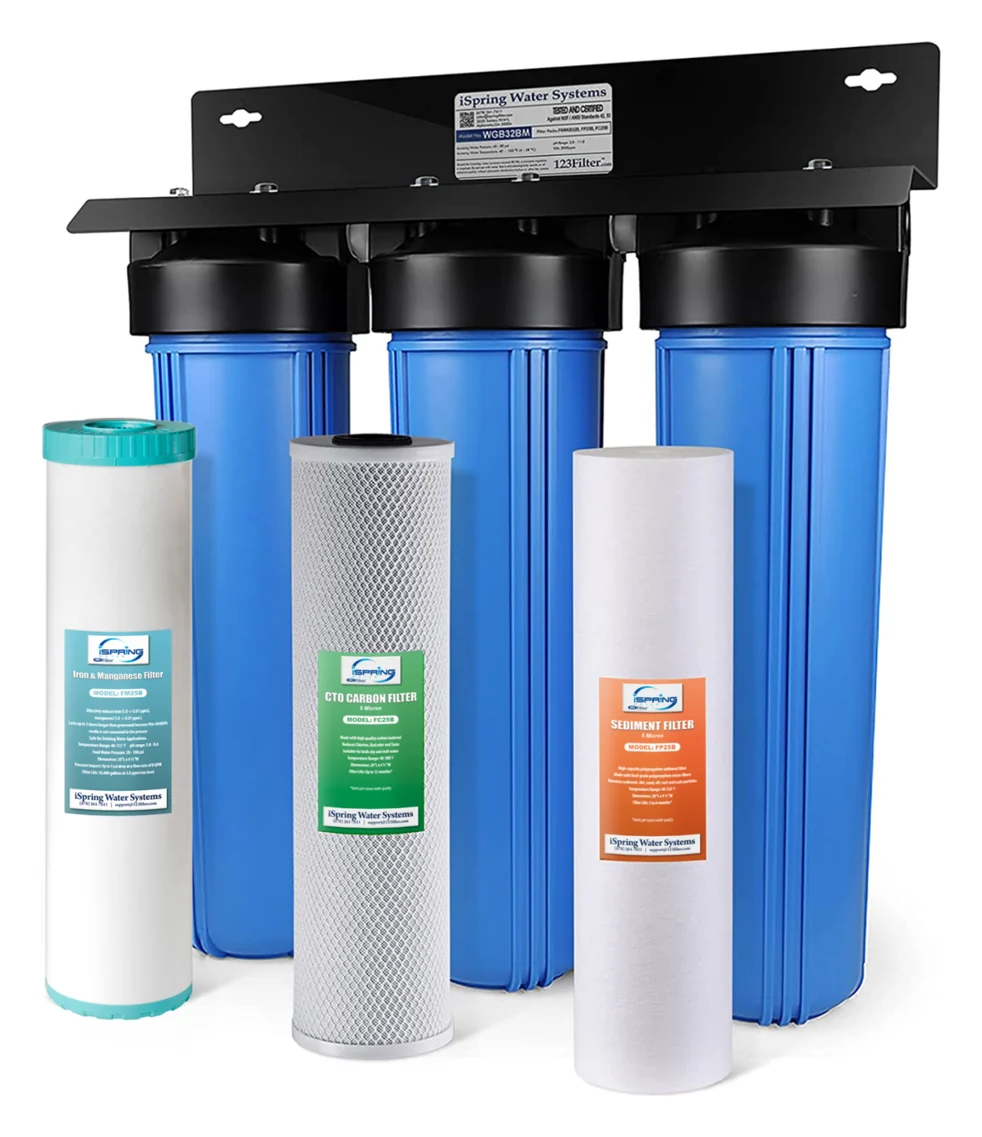
For light iron on city-style plumbing, a cartridge train is the budget route. The iSpring WGB32BM's iron stage is rated to 3.0 ppm iron and 1.0 ppm manganese, per iSpring's product page.
iSpring
iSpring WGB32BM 3-Stage Whole House Iron and Manganese Filter
Best for: Wells with light iron, at or under 3 ppm on a lab test, where a backwashing tank is more machine than the problem needs
- Type
- 3-stage Big Blue cartridge filter, 20 x 4.5 in
- Stages
- 5 micron sediment, coconut carbon block, FM25B iron and manganese
- Iron rating
- 3.0 ppm max (FM25B cartridge)
- Manganese rating
- 1.0 ppm max
- Flow
- Up to 15 GPM system; FM25B cartridge rated 4 to 8 GPM
- Iron cartridge life
- 50,000 gallons at 3.0 ppm iron
Air injection tank
- Rated 7 ppm iron on the WS1
- No cartridges, nightly backwash
- Needs a drain line and an outlet
- Handles sulfur smell on the same bed
Cartridge iron filter
- Rated 3 ppm iron on the WGB32BM
- Cartridges to replace on a schedule
- No drain, no backwash
- Cheapest entry for light iron
Bottom line
Under 3 ppm with no smell, cartridges can do it. Above 3 ppm, or with hydrogen sulfide on the report, the tank is the one that keeps up.
5. Chemical oxidation and filtration: above 10 mg/L#
Past about 10 mg/L, both extension services switch method. Penn State calls chlorine oxidation followed by filtration the most effective option above that level, sometimes with a carbon filter afterward for taste and odor; MDH lists chlorine or hydrogen peroxide. MDH's warning is that dosing is difficult and improper dosing carries health risks, which is why these systems are usually installed by a pro. The peroxide systems that take over above an air injection tank's ceiling are compared in our iron filter rankings.
Can You Remove Iron From Well Water Naturally?#
Aeration is the closest thing to it: air does the oxidizing, the same reaction that stains your sink. Penn State lists aeration without a concentration limit and says the water should also be disinfected so bacteria don't colonize the aerator. Every other method on this page uses a filter bed, a resin or a chemical.
What If the Problem Is Iron Bacteria?#
Then the fix starts at the well. MDH describes iron bacteria as a red or brown slime that is not harmful to people but makes an iron problem worse, and its treatment list is physical cleaning by a licensed well contractor, shock chlorination close to but not above 200 parts per million, or pasteurization.
Sulfur bacteria often travel with them: MDH says their slime helps iron bacteria grow. If the water also smells, run the checks in our rotten egg smell guide before choosing equipment.
What to Test Before You Buy an Iron Filter#
Iron, manganese, pH and hardness, at a certified lab. Each method above has its own pH floor or hardness window, and Penn State's own advice is to test at an accredited lab when stains or a metallic taste appear. Our guide to what a full well test should include covers the yearly panel, and where to get well water tested near you covers the labs.
The numbers each method needs
5 itemsOnce the iron is handled, the softener goes second in line, as our softeners matched to iron-bearing wells set out, and the costs of each well treatment stage price the whole train. Our channel's walkthrough matches the filter to the test.
Penn State Extension page updated May 29, 2025; MDH Iron in Well Water updated Aug 1, 2025; MDH Iron Bacteria in Well Water updated Jul 1, 2026 (read Oct 12, 2026); SpringWell WS1 page read Oct 19, 2026; iSpring prices read Oct 19, 2026 and FM25B ratings Oct 12, 2026. We did not test any well for this page.
More iron removal questions
What removes iron from well water best?
For most wells, an oxidizing filter: Penn State Extension recommends greensand for 3 to 10 mg/L of iron and manganese combined. Above 10 mg/L, chlorine or peroxide oxidation followed by filtration takes over.
Can a whole house filter remove iron?
Yes, if it has an iron stage rated for your level. A cartridge iron stage such as the iSpring FM25B is rated to 3.0 ppm iron; air injection tanks such as the SpringWell WS1 to 7 ppm. A plain sediment cartridge only catches iron that is already rust.
Does reverse osmosis remove iron?
The Minnesota Department of Health says distillation and reverse osmosis can remove any type of iron, but that with high iron levels these units clog quickly, so a whole-house system may be better.
Do I need an iron filter and a softener?
On many wells, yes, in that order. Penn State warns that oxidized iron fouls softener resin, so the iron filter goes first and protects the softener behind it.
Frequently asked questions
What is the cheapest way to remove iron from well water?
It depends on the kind of iron. For iron already visible as rusty particles, a reusable spin-down sediment screen is the cheapest catch, such as the iSpring WSP-50SL at $79.99 (Oct 19, 2026). For clear water that stains later, a softener you already own can take small amounts: Penn State Extension sets the ceiling at under 5 mg/L of dissolved iron. Above that, an oxidizing filter costs more up front but has no cartridges to buy.
Will a water softener remove iron?
Some, if it is dissolved. Penn State Extension says a softener can handle dissolved iron under 5 mg/L when the pH is above 6.7, and the Minnesota Department of Health calls 2 to 5 mg/L the more typical limit, whatever the box claims. Iron that is already oxidized fouls the resin.
Is it safe to drink well water that has iron in it?
Usually, yes. Penn State Extension says iron and manganese are not health concerns in drinking water, and the Minnesota Department of Health says iron does not usually pose a health risk. MDH adds one caution: iron can matter if harmful bacteria have entered the well, since some need iron to grow, so a coliform test belongs in the follow-up.
How does iron get into well water?
From the ground and from the pipes. The Minnesota Department of Health names soil and rock as the natural source and corrosion of iron or steel well casing or water pipes as the second. Iron bacteria can make an existing iron problem worse.
How do you remove iron bacteria from a well?
Not with a filter alone. The Minnesota Department of Health lists physical cleaning by a licensed well contractor, shock chlorination at close to but not greater than 200 parts per million, and pasteurization. A media filter downstream does not treat the colony in the well.
Keep reading


Not sure what you need?
Answer 5 questions, get the right system for your water.
City or well, budget, household size, our quiz matches your answers against every system we track.