Well Water Testing: How, Where, and What to Test For
Well water testing explained: the yearly coliform, nitrate, TDS and pH panel the CDC and EPA advise, what to add by symptom, how to sample, what labs charge.
By Home Water Lab TeamUpdated Prices verified Oct 7, 2026
Well water testing means sending a sample from your own tap to a state-certified lab at least once a year, for total coliform bacteria, nitrate, total dissolved solids and pH. The CDC and the EPA give private well owners that same list, because no one else tests a private well. This guide covers the schedule, what to add for the problems you can see, how to take the sample, and what labs charge; the treatment side is in our private well treatment guide, from symptom to system.
The short answer
as of Oct 12, 2026How do you test well water?
Order a panel from a state-certified lab and take the sample yourself, following its instructions. Test every year for total coliform bacteria, nitrate, total dissolved solids and pH (CDC and EPA), then add tests for what you see or live near: iron and manganese for stains, hydrogen sulfide for a rotten egg smell, nitrate and pesticides near farm fields. A basic panel runs $130 to $200 in HomeGuide's data, and some counties test for free.
Key takeaways
- Over 43 million people in the US rely on private wells, and federal drinking water rules don't cover them (EPA).
- The yearly baseline is total coliform, nitrate, TDS and pH, per both the CDC and the EPA.
- A basic lab panel costs $130 to $200, an extended one $700 to $750, county kits $20 to $75 (HomeGuide).
- Bacteria samples go in a sterile bottle and should reach the lab within 24 hours (Penn State Extension).
- Retest after flooding, a well repair, a change in taste or smell, a pregnancy or a new child at home (CDC).
Why Test Well Water at All?#
Because the job is yours. The EPA says private well owners "are responsible for delivering safe drinking water to their households," and that private well water is not regulated by the federal government under the Safe Drinking Water Act (page updated Aug 25, 2026).
43 million+
A city utility tests its water on a schedule and sends customers an annual report. A well owner gets neither unless they order the test, which is why the city-water question in our guide to whether tap water is safe to drink and this one have different answers.
How Often Should You Test Well Water?#
Once a year, at minimum. The CDC says to test "at least once each year" for total coliform bacteria, nitrates, total dissolved solids and pH, and to check the well every spring for mechanical problems; the EPA's private well page gives the same four tests on the same yearly rhythm.
Then come the extra tests. The CDC lists six moments that call for one outside the schedule, and the EPA adds a household rule: test more often when small children, older adults, or a pregnant or nursing person live in the home.
A private well test plan
as of Oct 12, 2026- Every yearCDC and EPATotal coliform bacteria, nitrate, total dissolved solids and pH. Both agencies give private well owners this same yearly list, and both say to use a state-certified laboratory.
- Test again whenCDCFlooding near the well, a repair or replacement of any part of the well system, a change in taste, color or smell, a pregnancy in the home, a child moving in, or a notice of well water problems in your area.
- What you see, what to addEPA chartSix pairs from the EPA's table of conditions and the tests they call for. The same table also covers radon, mining, gas drilling, landfills and salted roads.
No result and no price is drawn here: the plan says what to ask a certified lab for, not what a number means. Sources: CDC, Guidelines for Testing Well Water (dated Jul 1, 2024) and EPA, Protect Your Home's Water (updated Feb 26, 2026), both read Oct 12, 2026.
Penn State Extension runs a different rhythm for two of the four. It advises coliform and E. coli bacteria every year but pH and TDS every three years, with TDS under 500 mg/L and stable between tests (updated Jun 2, 2025). The federal agencies and the extension service disagree on that point. We follow the yearly line, since it's the one both the CDC and the EPA print, and the bacteria test is yearly in every version.
What Should You Test Well Water For?#
The four yearly tests, plus whatever your house and your neighbors point to. The EPA publishes a chart that pairs conditions near the well with the tests they call for, and it is the most useful page a new well owner can read.
| What you notice or live near | Tests the EPA chart adds |
|---|---|
| Stained fixtures or laundry | Iron, copper, manganese |
| Objectionable taste or smell | Hydrogen sulfide, corrosion, metals |
| Scaly residue, soap won't lather | Hardness |
| Intensive agriculture nearby | Nitrate, nitrite, pesticides, coliform bacteria |
| Lead in household plumbing or service lines | pH, lead, copper |
| Corroding pipes, or treatment equipment wearing out fast | pH, corrosion (and lead, for pipes) |
| Gas station, buried fuel tanks or a fuel odor | Volatile organic compounds |
| Salty taste, seawater or a heavily salted road nearby | Chloride, total dissolved solids, sodium |
| Recurring stomach illness in the household | Coliform bacteria |
| Radon in indoor air, or a radon-rich region | Radon |
The chart also covers mining, gas drilling, landfills, junkyards and dry cleaners. For risks that come from the ground itself, the EPA's advice is to ask your local health department what is common in your area's groundwater.

If you're testing to buy equipment, the panel needs more than the safety basics. An iron filter is sized on iron, manganese and hydrogen sulfide in ppm, and a softener on hardness, so ask for those numbers by name. Our ranking of iron filters for private wells shows why one ppm moves the choice, and the SpringWell WS1 review against its 7 ppm iron ceiling is a worked example of a system that ships only once the lab results are in.
What you hear
A rotten egg smell means the well is contaminated with sewage.
What the numbers say
Usually not. Minnesota's health department says the smell in most cases does not relate to the sanitary quality of the water, and that in rare cases the gas comes from sewage or other pollution. To be safe, it advises testing for coliform bacteria and nitrate.
Before you order the hydrogen sulfide test, a sniff of the hot and cold taps narrows the source, as our guide to a rotten egg smell in well water explains.
Can You Test Well Water Yourself?#
You can take the sample yourself, but the analysis belongs to a certified lab. The CDC and the EPA both say to use a laboratory certified for drinking water, and Penn State Extension advises caution with results from an uncertified lab or from water treatment salespeople.
Home kits have a place: a quick screen between lab tests, or a hardness number to set a softener. What they can't do is give you a certified bacteria or nitrate result. The matrix below was drawn for hardness kits, and the column that matters for a well is the last one.
Four tests, four questions
- Test stripa rangeReads total hardness as a color band. The WaterWorks chart steps from 120 to 180 to 250 to 425 ppm, so a strip tells you which band you are in, not where inside it.
- Drop titrationthe home standardCounts drops of titrant until the sample turns blue. Hach rates its 5-B kit at 1 drop = 1 gpg and Hanna rates the HI38033 in 1 gpg steps: a number you can program a softener with.
- TDS meternot a hardness testMeasures conductivity and converts it as if every dissolved ion were sodium chloride (HM Digital calibrates its TDS-3 on a 342 ppm NaCl solution). Calcium, magnesium and sodium all land in the same number.
- Certified labthe only full answerMeasures calcium and magnesium separately, then reports hardness in mg/L and gpg alongside iron, manganese, nitrate and bacteria, on a panel that lists them. The EPA's annual well test list is total coliform, nitrates, TDS and pH.
Solid dot: answers it. Half dot: answers it as a range only. Ring with a bar: cannot answer it. Column heads, left to right: total hardness (calcium plus magnesium), a reading precise to 1 grain per gallon, total dissolved solids, and a health panel (bacteria, nitrate, metals). Sources: Hach, Hanna Instruments, Industrial Test Systems, HM Digital and Tap Score product pages, and the EPA private well testing page, all read Oct 5, 2026.
The kit-by-kit comparison, from titration to mail-in panels, is in our tested breakdown of hard water test kits. TDS gets its own explainer in what a TDS reading does and doesn't tell you. If you would rather order a kit than wait for a county program, our ranking of well water test kits compares five on what they actually measure.
State-certified lab
- Bacteria, nitrate and metals to a certified method
- What the CDC and the EPA both name
- $130 to $200 for a basic panel (HomeGuide)
- Days, not minutes
Home strips and meters
- A few numbers, often as a color band
- No certified bacteria or nitrate result
- Cheap enough to repeat often
- Useful between lab tests
Bottom line
Use the lab for the yearly test and anything health-related. Use a home kit to watch hardness or a treatment system between lab results.
How to Take a Well Water Sample#
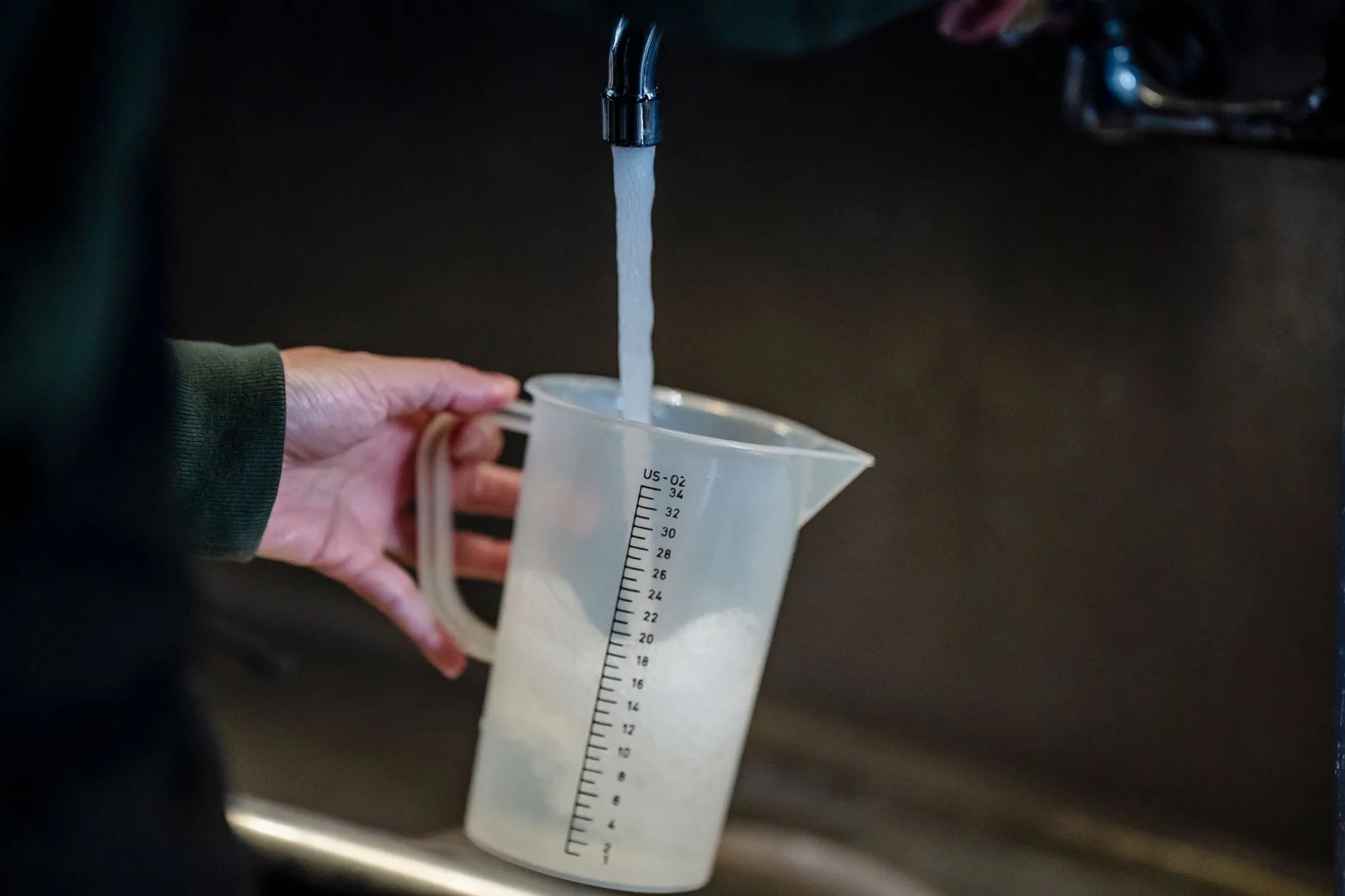
Follow your lab's own sheet first, because bottles, preservatives and deadlines vary by test. For a bacteria sample, Penn State Extension's steps are the standard ones.
Taking a bacteria sample, step by step
Use the lab's sterile bottle
Bacteria tests need a sterile container. Lab bottles carry a chemical that neutralizes chlorine, and any chlorine in the system should be cleared before you sample.Pick the right tap
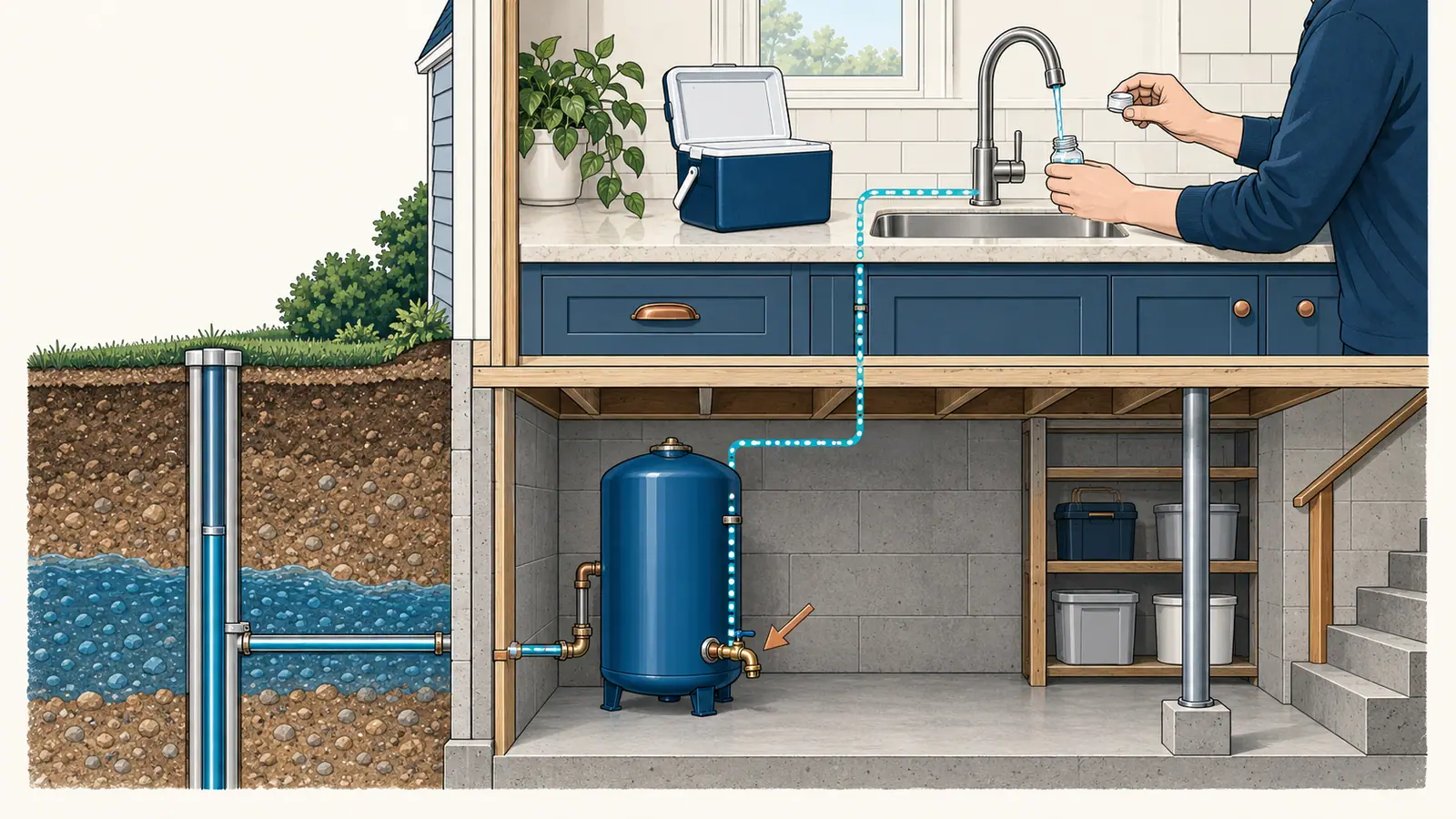
The cold kitchen tap tells you what you drink. If treatment equipment is installed, it measures treated water; for raw well water, use the spigot on the pressure tank.Prepare the faucet
Many labs recommend removing the aerator and sanitizing the end of the faucet with a flame or rubbing alcohol.Run the water, then fill
Let the water run for a few minutes. Open the bottle without setting the cap down and without touching the inside of the cap or bottle, fill it, and close it.Keep it cool and ship it fast
Deliver the sample within 24 hours. Most labs won't accept samples on a Friday or before a holiday, so sample early in the week.
Other tests can come with their own bottle and their own rules, so read the instructions for each one rather than filling them all the same way.
Where Can You Get Well Water Tested?#
Start with your county. The USGS says some counties offer free well water testing; if yours doesn't, it points to the EPA's list of state-certified labs, your county or state health department, or your State Certification Officer.
The EPA keeps a page linking to each state's drinking water laboratory certification program (updated Aug 11, 2026). Mail-in kits from private labs work too, and HomeGuide's advice is to confirm the kit price includes the lab's testing fee. Some sellers fold the test into the purchase: SpringWell, for one, holds every well system order until a $134.25 lab test comes back (Oct 12, 2026). The public options state by state, from county programs to extension clinics, are listed in our directory of free and low-cost well testing.
How Much Does Well Water Testing Cost?#
$130 to $200 for a basic lab panel, per HomeGuide, and from free to $750 overall depending on the county and the depth of the panel. HomeGuide's well inspection page was last updated Jul 29, 2025; we read it Oct 12, 2026.
Well water testing, by panel
as of Oct 12, 2026- County health department testingUSGS; check your county first
- Free in some counties
- County-provided test kitHomeGuide; bacteria, nitrate, lead and similar
- $20 to $75
- Mail-in kit, one contaminantHomeGuide; confirm the lab fee is included
- $25 to $50
- Mail-in kit, several contaminantsHomeGuide
- $100 to $380
- Basic lab panelHomeGuide; coliform, E. coli, metals, nitrate, nitrite
- $130 to $200
- Advanced lab panelHomeGuide; adds VOCs, industrial chemicals
- $220 to $450
- Extended lab panelHomeGuide; adds pesticides, radiological
- $700 to $750
- SpringWell Well Water Test: Level 1 + Bacteria53+ contaminants, mail-to-lab; read Oct 12, 2026
- $134.25
- Tap Score Essential Well Water Test54 analytes; read Oct 5, 2026
- $209
Estimated 10-year total
$343.25
HomeGuide ranges from its well inspection cost page (updated Jul 29, 2025). Brand panels are the makers' own prices on the dates shown. Penn State Extension calls exhaustive testing very expensive and unnecessary: match the panel to your list.
Set against the equipment, the test is the cheapest line in a well budget. Our budget for iron, softener and UV stages on a well prices the tanks the report might call for.
How to Read Your Well Water Test Results#
Compare each number with the EPA's limits for public water systems. They don't legally apply to a private well, but they're the published yardstick, and the secondary ones mark taste, staining and scale rather than health.
| Result on your report | EPA reference level | Type |
|---|---|---|
| Total coliform, E. coli | Present or absent; a positive needs follow-up | See the CDC steps below |
| Nitrate (as nitrogen) | 10 mg/L | Health (MCL) |
| Nitrite (as nitrogen) | 1 mg/L | Health (MCL) |
| Arsenic | 0.010 mg/L | Health (MCL) |
| Lead | 0.015 mg/L action level, 0.010 from Nov 1, 2027 | Health (treatment technique) |
| Copper | 1.3 mg/L action level | Health (treatment technique) |
| Iron | 0.3 mg/L | Secondary (staining, taste) |
| Manganese | 0.05 mg/L | Secondary (staining, taste) |
| pH | 6.5 to 8.5 | Secondary |
| Total dissolved solids | 500 mg/L | Secondary |
Hardness has no federal limit at all. It decides whether you need a softener, and our state-by-state water hardness ranges show what's typical where you live.
Once the numbers are in, treatment follows them. Orange stains from particles point to the rust filters picked for well water, sand and grit to the sediment filters ranked for private wells, and hardness with iron to the softeners matched to iron-bearing wells. Our channel's walkthrough goes from lab report to equipment list.
CDC page dated Jul 1, 2024; EPA private well pages updated Feb 26 and Aug 25, 2026; EPA drinking water standards updated May 26 and Aug 31, 2026; USGS FAQ updated Mar 12, 2026; Penn State Extension updated Jun 2, 2025; HomeGuide updated Jul 29, 2025. All read Oct 12, 2026, except the Tap Score price (Oct 5, 2026). We did not send samples to any lab for this page.
More well water testing questions
What is the best way to test my well water?
Through a state-certified laboratory, using its bottle and its sampling sheet. That is what the CDC and the EPA both recommend, and it's the only route to a certified bacteria or nitrate result.
Should I test well water before buying a house?
Yes. You inherit the well without its test history, so start with the yearly four the CDC and the EPA name, plus iron, manganese, hardness and anything the EPA chart flags for the area. HomeGuide prices a well inspection with water testing at $350 to $900 (updated Jul 29, 2025).
Where should I take the water sample from?
The cold kitchen tap tells you what you drink. If a filter or softener is installed, Penn State Extension notes the tap reading is influenced by it; for raw well water, sample at the pressure tank spigot.
How long do well water test results take?
It depends on the lab and the panel, so ask when you order. Bacteria samples have the tight deadline: Penn State Extension says to deliver them within 24 hours of collection.
Frequently asked questions
How often should you test well water?
At least once a year for total coliform bacteria, nitrate, total dissolved solids and pH, per both the CDC and the EPA. Test again after flooding near the well, after any repair to the well system, when the taste, color or smell changes, and when someone in the home becomes pregnant or a child moves in. Penn State Extension runs a looser schedule for pH and TDS, every three years, but keeps bacteria yearly.
Can I test my well water myself?
You can take the sample yourself, and most people do. The analysis is the part the CDC and the EPA both send to a state-certified laboratory, because a home strip can screen a few numbers but not certify bacteria, nitrate or metals. Many labs and county health departments mail you a sterile bottle and instructions.
How much does it cost to test well water?
HomeGuide puts a basic lab panel at $130 to $200, an advanced one with VOCs at $220 to $450 and an extended one at $700 to $750 (page updated Jul 29, 2025, read Oct 12, 2026). County-provided kits run $20 to $75 in the same data, and the USGS notes some counties test well water for free.
Can I get my well water tested for free?
Sometimes. The USGS says some counties offer free well water testing and to check with your county first, and the EPA says local health departments may offer free private well testing. Otherwise a state-certified lab charges by the panel.
How do I know if my well water is unsafe?
Only a lab result tells you. The CDC says a positive total coliform, fecal coliform or E. coli result suggests contamination from feces may be present; it advises considering bottled water or another safe source and calling your local health or environmental department, which can interpret the result and advise next steps.
Keep reading
SpringWell WS1 Review 2026: Air Injection Iron Filter Tested on Paper
Read the review
Best Sediment Filter for Well Water 2026 (Spin-Down vs Cartridge vs Backwashing)
Read the buyer's guide
Best Rust Filters for Well Water 2026 (What Actually Removes Rust Stains)
Read the buyer's guideNot sure what you need?
Answer 5 questions, get the right system for your water.
City or well, budget, household size, our quiz matches your answers against every system we track.