Best Under Sink Reverse Osmosis Systems 2026 (Tank vs Tankless)
Best under sink reverse osmosis system for most kitchens: a tank unit, Aquasana SmartFlow, $224.99 on sale ($449.99 list) Oct 5, 2026. Tankless needs a plug.
By Home Water Lab TeamUpdated Prices verified Oct 7, 2026
This page contains affiliate links; buying through them costs you nothing extra.
For most kitchens the best under sink reverse osmosis system is still a tank system, and the Aquasana SmartFlow, $224.99 on sale against a $449.99 list price on Oct 5, 2026, is the one we'd put in first. Tankless earns its premium in a narrower set of kitchens: a cabinet with no room for a tank, water pressure too low to push a membrane, or a household that fills pots rather than glasses. The membrane does the same job in both designs, as our explainer on how reverse osmosis works sets out, so this page is about everything around it.
The short answer
as of Oct 12, 2026Which under-sink reverse osmosis system should you buy, tank or tankless?
Buy a tank system if your water pressure reads at least 40 to 45 psi and there is no outlet under the sink. The Aquasana SmartFlow at $224.99 on sale ($449.99 list) carries five named certifications, and the iSpring RCC7AK at $239.99 (Oct 12, 2026) needs no electricity and has the cheapest filters we could price. Buy tankless if you want the cabinet floor back or less water down the drain, and you can plug it in. The Waterdrop G3P600 at $539 drains 1 gallon for every 2 it makes; the G3P800 at $999 drains 1 for every 3. Other prices read Oct 5, 2026.
Key takeaways
- Pressure decides first. Aquasana rates the SmartFlow for 40 to 80 psi and iSpring's manual asks 45 to 70 psi for the RCC7AK. Below that range, iSpring says to add a booster pump.
- Pumped tankless units start much lower. Waterdrop rates the G3P600 from 14.5 psi, but every pumped unit has to be plugged in.
- Tankless doesn't shrink the box. The G3P600 measures about 18 x 5.7 x 17.7 inches; what it removes is the tank, 9.06 inches across on the SmartFlow.
- The EPA puts a typical point-of-use RO system at 5 gallons or more to the drain per gallon treated. The WaterSense label caps it at 2.3.
- Installed, HomeGuide's 2026 guide (read Oct 5, 2026) puts tank systems at $300 to $700 and tankless at $450 to $950.
| Pick | System | Design | Price (Oct 5, 2026) | Choose it if |
|---|---|---|---|---|
| Best overall | Aquasana SmartFlow | Compact tank | $224.99 on sale, $449.99 list | You want the most certifications per dollar |
| Best budget | iSpring RCC7AK | Tank, no power | $239.99 (Oct 12) | You want the cheapest filters we could price |
| Best for low pressure | iSpring RCC7P-AK | Tank plus booster pump | $349.99 (Oct 12) | Your gauge reads under about 40 to 45 psi |
| Best value tankless | Waterdrop G3P600 | Tankless | $539 | You want the floor back without paying $999 |
| Best efficiency | Waterdrop G3P800 | Tankless | $999 | Drain water and refill speed matter most |
Tank vs Tankless Under the Sink: Which Should You Get?#
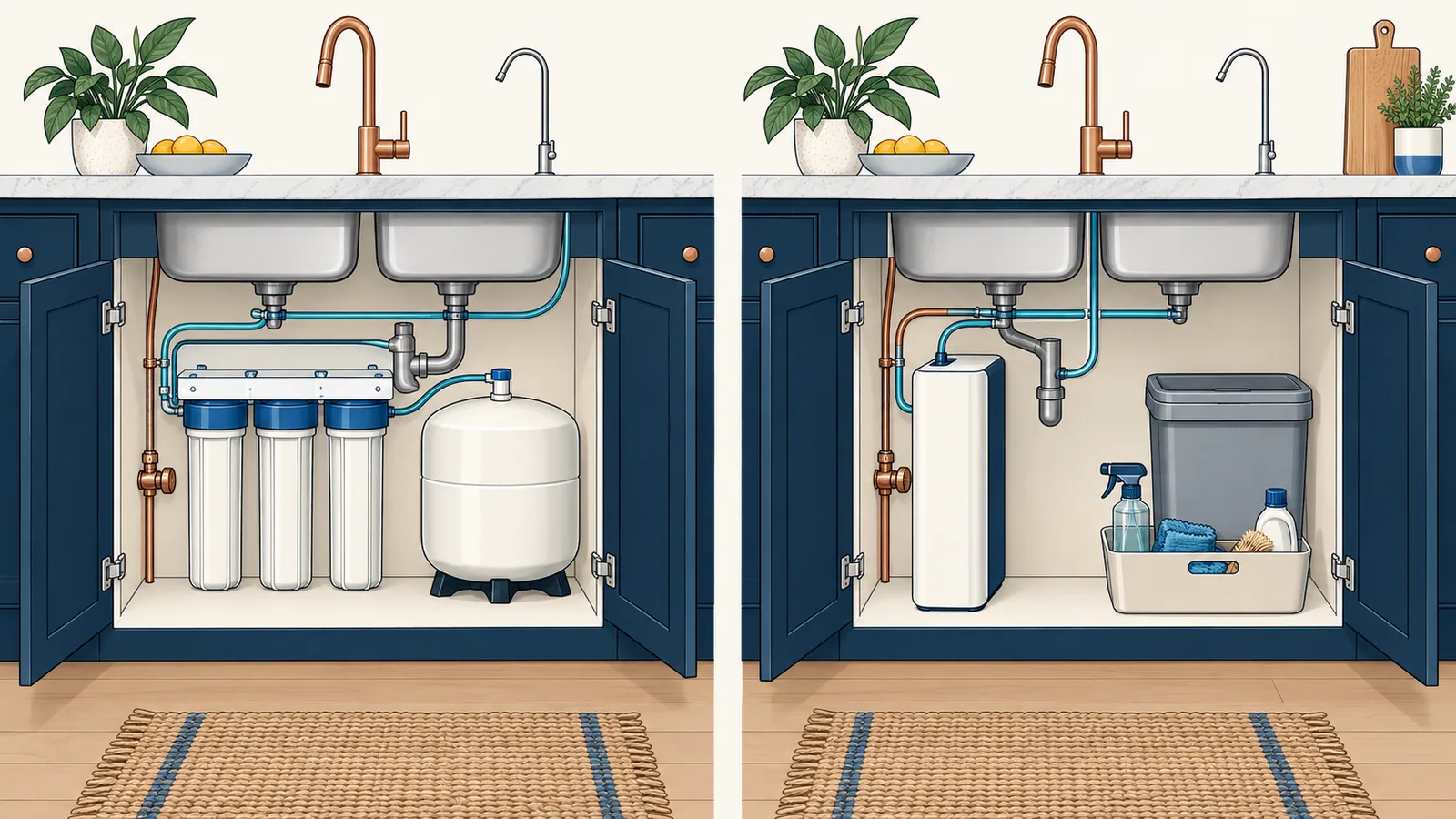
Pick on your cabinet and your water pressure, because the filtration inside is the same technology either way. A tank system stores a few gallons under air pressure and runs on line pressure alone. A tankless system makes water on demand with a pump, so it needs a plug and pays you back in floor space and drain water.
Same cabinet, two designs
- Feed tee on the cold lineboth designsEvery under-sink RO system starts with a tee on the cold supply. The kitchen faucet keeps its own line and keeps running unfiltered water.
- Drain saddle above the trapboth designsThe waste line from the membrane clamps onto the sink drain here. A pumped tankless unit usually sends less water down it; no design removes it.
- Dedicated RO faucetboth designsA second spout, through a spare sprayer hole or a new hole in the counter. This is the step that sends most people to a plumber.
- Storage tanktank onlyHolds treated water under air pressure so the faucet pours at once. It takes the cabinet floor, keeps a reserve through a power cut, and refills slowly after a big draw.
- Outlet within cord reachtankless onlyA pumped tankless unit plugs in. An outlet wired to the garbage disposal switch is often live only while the disposal runs, which makes it the wrong outlet for this job.
- Built-in pumptankless onlyRaises the pressure across the membrane, which is how a tankless unit makes water on demand and sends less of it to the drain. It is also why it stops when the power does.
Schematic, not to scale, and brand neutral. Real layouts vary: some tank systems hang their cartridges under the counter instead of on the floor, and a booster pump can be added to a tank system on a low-pressure supply, which brings an outlet back into the cabinet. Sizes, ratios and pressure ratings belong to each model and are given, dated, in the article.
Nothing about the drinking water itself decides this. Both designs put a sediment and carbon stage ahead of the membrane, both need a drain saddle, and both need their own faucet. What you're choosing is how the water gets pushed through the membrane, and where it waits once it has crossed.
Tank (SmartFlow, RCC7AK)
- Runs on line pressure, no outlet needed
- Keeps a reserve, 3.2-gallon tanks on both
- Slows down once the tank empties after a big draw
- Generic-compatible cartridges on the iSpring
Tankless (G3P600, G3P800)
- Makes water on demand, rated 600 to 800 GPD
- 2:1 and 3:1 pure to drain, per Waterdrop
- Needs an outlet, and stops in a power cut
- Proprietary filters, $144.97 to $159.97 a year (Oct 2026)
Bottom line
Tank for a cabinet with no outlet, a tight budget or regular power cuts. Tankless for a crowded cabinet, low pressure, or a kitchen that fills stock pots every night.
How Much Space Does an Under-Sink RO System Need?#
Less floor than most people fear and more height than they expect. Tankless units are not small: they swap a filter bracket and a tank for one slab about 18 inches long and 17.7 inches tall. What they free is the patch of floor where the tank used to stand.
| System | Design | Size the maker publishes | What else goes in the cabinet |
|---|---|---|---|
| Aquasana SmartFlow | Compact tank | Manifold 15 x 4.5 x 12.93 in | Tank 13.74 in tall, 9.06 in across |
| iSpring RCC7AK | Tank | 15.5 x 5.1 x 19 in | 3.2-gallon tank, size not published |
| Waterdrop G3P600 | Tankless | About 18.1 x 5.7 x 17.7 in | Nothing, but Waterdrop asks for a 1-inch gap to the cabinet wall |
| Waterdrop G3P800 | Tankless | About 18.1 x 5.7 x 17.7 in | Nothing beyond its power adapter |
| iSpring RO500 | Tankless | 17.5 x 5.12 x 16.25 in | Nothing; the power cable runs about 3 feet |
Measure the height before anything else. The RCC7AK stands 19 inches tall by iSpring's own figure, and Frizzlife asks for at least 19.7 inches of cabinet height before you order its M800. On a double sink with a garbage disposal, measure the side you will actually use, since the disposal takes most of the other one.
How Much Water Does an Under-Sink RO System Waste?#
More than most buyers assume, and the figures vary by design. The EPA says a typical point-of-use RO system sends five gallons or more to the drain for every gallon it treats, and only systems at 2.3 gallons or less earn the WaterSense label. The pumped tankless units here sit well inside that line on their makers' figures, while the iSpring RCC7AK publishes no figure at all.
2.3
| System | What the maker publishes | Drained per gallon you drink |
|---|---|---|
| Typical point-of-use RO | EPA category figure | 5 or more |
| Aquasana SmartFlow | Efficiency rating 27.4% (NSF/ANSI 58 data sheet) | About 2.6, our arithmetic |
| iSpring RCC7AK | No efficiency rating on the page or in the manual | About 3, the classic tank estimate |
| iSpring RCC7P-AK | "Up to 1.5:1" in one table, "up to 2:1" in another listing | 0.5 to 0.7 at best |
| Waterdrop G3P600 | 2:1 | 0.5 |
| Waterdrop G3P800 | 3:1 | About 0.33 |
Treat every ratio in that table as a best case. Waterdrop's own G3P600 page says the actual ratio "might be lower than the labeled, depending on many factors such as water quality, pH, pressure and temperature." The SmartFlow's data sheet is the only one we read that prints an NSF/ANSI 58 efficiency rating, and by our arithmetic on it, 27.4 gallons delivered for every 100 fed in, it lands just outside the WaterSense line. Aquasana makes no WaterSense claim for it, and neither do we.
On a metered supply the gap is real money. The EPA estimates that a WaterSense-labeled unit saves more than 3,100 gallons a year against a typical point-of-use system.
Does an Under-Sink RO System Need Electricity?#
A tank system doesn't, and a pumped tankless system always does. iSpring sells the RCC7AK as electricity-free and Aquasana lists no pump or power supply for the SmartFlow, while both Waterdrop units answer "Yes" to "Electricity Required" on their spec blocks. That makes the outlet the first thing to check rather than the last.
The other side of the plug is the outage. A tank system keeps what is in its tank, anywhere from 1.4 to 3.2 gallons on the SmartFlow depending on your pressure. A pumped tankless system stops producing until the power comes back.
What you hear
Tankless always means plugging something in.
What the numbers say
Almost always. Frizzlife sells a non-electric tankless system, the M800, at $329.99 on Oct 5, 2026, and its own page sets two conditions before you buy it: water pressure of at least 50 psi and a cabinet at least 19.7 inches tall. Without a pump, the pressure has to come from your pipes.
What Water Pressure Does a Reverse Osmosis System Need?#
Roughly 40 psi or more for a tank system without a pump, and each maker in the table below publishes its own range. Aquasana rates the SmartFlow for 40 to 80 psi, and iSpring's RCC7 manual asks for 45 to 70 psi on the RCC7AK, with a booster pump below that range and a pressure regulator above it.
| System | Rated inlet pressure | What happens below it |
|---|---|---|
| Aquasana SmartFlow | 40 to 80 psi | Less water in the tank, and the nitrate claim stops applying |
| iSpring RCC7AK | 45 to 70 psi (manual) | iSpring says add a booster pump |
| Waterdrop G3P600 | 14.5 to 87 psi | The built-in pump covers it |
| Frizzlife M800 | 50 psi minimum | No pump to fall back on |
Low pressure costs you twice on a tank system. The tank fills to less, since Aquasana says the SmartFlow holds 1.4 to 3.2 gallons "based on your inlet water pressure." And its performance data sheet certifies nitrate and nitrite reduction "only for water supplies with a pressure of 40 psi or greater." If nitrate is the reason you're buying, that line matters more than any other on the sheet.
There are two fixes. iSpring sells the same six-stage system with a pump built in, the RCC7P-AK, at $349.99 on Oct 12, 2026, which is $110 more than the RCC7AK the same day. Or you add the pump alone: iSpring's PMP5 read $124.99 on Oct 5, runs on 24 volts and ships without its transformer. Either way an outlet comes back into the cabinet, which narrows the gap with tankless more than the price tags suggest.
Measure these before you order
6 itemsWhat Is the Best Under-Sink Reverse Osmosis System?#
The Aquasana SmartFlow for most kitchens, because no other system on this page carries as many named certifications. Its price swings with Aquasana's banners, so the ranking does not rest on it. Each of the other picks answers one specific constraint, whether that's budget, low pressure, a full cabinet or drain water. If you'd rather not read the trade-offs, our short quiz picks a system from six answers.
Best Overall: Aquasana SmartFlow (Compact Tank)#
Aquasana
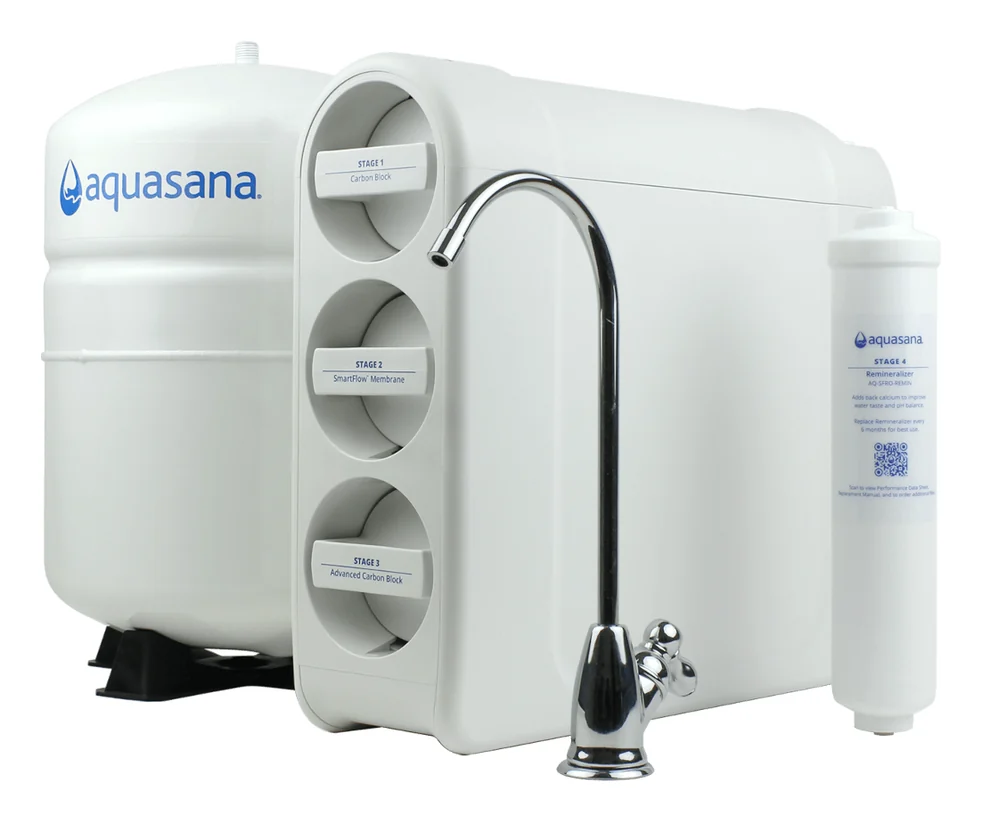
Aquasana SmartFlow Reverse Osmosis System
Best for: Drinking-water protection (PFAS, fluoride, lead) at the best certifications-per-dollar ratio on the market
- Contaminants reduced
- 99.99% of 90 contaminants
- PFAS / fluoride / arsenic
- 96% PFAS (P473), 90% fluoride, 96% arsenic
- Production
- 25.7 gallons/day
- Faucet flow
- 0.7 GPM
- Design
- Compact holding tank (3.2 gallons total, 1.4 to 3.2 usable), remineralizer included
- Filter schedule
- Cartridges 6 months, membrane 12 months
It is a tank system, however compact it looks: a 3.2-gallon tank 13.74 inches tall beside a slim 15-inch manifold, and no pump or plug anywhere. The case for it is the paper trail. The WQA certifies it to NSF/ANSI 42, 53 including the P473 PFAS protocol, 58, 401 and CSA B483.1, and it ships with a remineralizer that many rivals sell as an upgrade.
The limits are printed by Aquasana itself. Daily production is 25.7 gallons, the faucet gives 0.7 GPM only "when the tank is completely full," and the efficiency rating is 27.4%. To keep its NSF/ANSI 58 certification, the drain line needs an air gap or a certified air-gap faucet, and some local plumbing codes require one anyway. Its own product page showed a 3.2 out of 5 customer rating on Oct 5, 2026.
The price is a banner state. It read $224.99 on Oct 5, 2026 under a 50%-off banner and $449.99 when that banner came down on Sep 12. The same swing runs through Aquasana's whole range, as we documented in our review of the Rhino whole-house system.
Best Budget: iSpring RCC7AK (Tank, No Power)#
iSpring
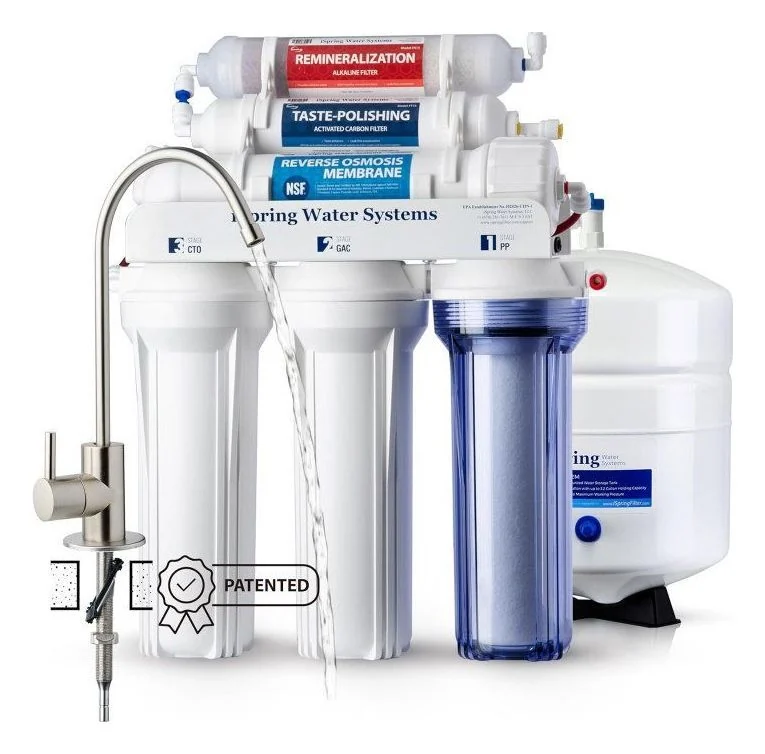
iSpring RCC7AK 6-Stage Reverse Osmosis System
Best for: A proven, cheap-to-run 6-stage under-sink RO with a very large owner base
- Stages
- 6 (with alkaline remineralization)
- Certification
- NSF/ANSI 58
- Waste ratio
- ~1:3 (classic tank design)
- Annual filter cost
- ~$100 to 110
Six stages with alkaline remineralization, 75 GPD and a 3.2-gallon tank, with an NSF/ANSI 58 certification from NSF International that lists 97.9% TDS, 97.4% fluoride and 98.9% lead reduction. It read $239.99 on iSpring's own store on Oct 12, 2026, against a struck-through $241.99, the flat price it showed on Oct 5. A 15%-off code was showing on the page on Oct 5; we publish the shelf price.
Budget here means the filters as much as the sticker. On a banner day the SmartFlow costs less up front; at its $449.99 list price, read the same day, it costs $208 more. The reason to choose the iSpring is the running cost: its one-year cartridge set read $80.99 and its MC7 membrane $42.99 the same day, with the membrane due every 2 to 3 years. The weak points are the ones iSpring answers in its own FAQ: push-in fittings that leak unless the tubing goes about half an inch home, and a one-year warranty that needs registering. Our full RCC7AK review walks through the install.
Best for Low Water Pressure: iSpring RCC7P-AK#
The same six-stage system with an electric booster pump built in, at $349.99 on Oct 12, 2026, running on the same F9K cartridge set. Buy it when your gauge reads under about 40 to 45 psi, and not otherwise, since the pump adds an outlet to the cabinet and $110 to the bill. iSpring's documents disagree on the exact threshold, 40 psi on the product page and 45 in the manual, and they print two different "up to" ratios for the pumped version. We quote both rather than pick one.
Best Value Tankless: Waterdrop G3P600#
Waterdrop
Waterdrop G3P600 Tankless Reverse Osmosis System
Best for: Most kitchens that want tankless RO on demand without paying for the G3P800's extra 200 GPD
- Production
- 600 GPD, tankless
- Pure-to-drain ratio
- 2:1
- Annual filter cost
- $144.97 (Waterdrop figure, Oct 5, 2026)
- Certification
- NSF/ANSI 58 and 372, credited to IAPMO R&T by Waterdrop
- Feed pressure
- 14.5 to 87 psi
- Power
- Plug-in pump, needs an outlet under the sink
600 GPD on demand, a 2:1 pure-to-drain ratio, and a rated inlet range of 14.5 to 87 psi, the widest pressure window on this page. Waterdrop's store data put it at $539 on Oct 5, 2026 with no strikethrough, and the page also offered a $100 checkout code that day. Filters cost $144.97 a year by Waterdrop's own figure, and the warranty is one year.
What we like
- 600 GPD on demand, with no storage tank to wait for or refill
- 2:1 pure-to-drain ratio, against roughly 1:3 on a classic tank system
- Its certification block names IAPMO R&T for NSF/ANSI 58 and NSF/ANSI 372 (read Oct 5, 2026)
- Same footprint and pre-filters as the G3P800, for $460 less (Oct 5, 2026)
What to watch
- Proprietary cartridges at $144.97 a year by Waterdrop's own figure (Oct 5, 2026)
- Needs an outlet under the sink, and no power means no filtered water
- One-year warranty
- NSF/ANSI 42 appears in its bullets with no certifying body attached; only 58 and 372 carry a named one
Read its page with the same care as the G3P800's. Waterdrop's blocks list different combinations of NSF/ANSI 42, 53, 58 and 372 for this model, and two of our readings on Oct 5, 2026 did not even agree on which block names IAPMO R&T. NSF/ANSI 58 and 372 appear in every version, so those are the two we treat as established. UV is just as muddled: one paragraph mentions UV sterilization, while Waterdrop's comparison table marks it absent on this model and sells a UV bundle separately. If tankless is where you're heading, the full field is ranked in our tankless reverse osmosis rankings.
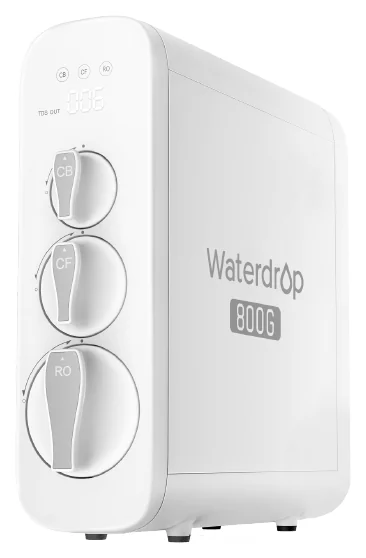
Best Efficiency: Waterdrop G3P800#
Waterdrop
Waterdrop G3P800 Tankless Reverse Osmosis System
Best for: The premium tankless RO reference: high flow, UV, and a 3:1 efficiency ratio that flips the classic RO waste math
- Production
- 800 GPD, tankless
- Extras
- Smart TDS faucet; UV is claimed on some Waterdrop pages for this model and denied on others
- Pure-to-drain ratio
- 3:1
- Annual filter cost
- $159.97
800 GPD and a 3:1 ratio, the best drain figure among our picks, with a TDS readout in the faucet. Waterdrop's store data read $999 on Oct 5, 2026, again with a checkout code on the page, $150 this time, and filters run $159.97 a year. Against the G3P600, the extra $460 buys 200 more gallons a day of rated output and half a gallon less down the drain for every three gallons made. Our G3P800 review on the numbers covers the rest, including its conflicting certification lists.
If your whole-house system is already a SpringWell, the Moen RO it sells, $363.80 on Oct 5, 2026 against a $428 list, is a four-stage system that keeps everything with one supplier. It is compared with the rest of the category in our ranking of every RO system we track.
Are Under-Sink Reverse Osmosis Systems Worth It?#
Yes when a test shows dissolved contaminants a carbon filter cannot reach, and no when the problem is taste or chlorine. The EPA's own WaterSense page says it does not intend to promote RO "for all applications," and that filtration using little or no water is sometimes enough. If that sounds like your kitchen, our comparison of carbon and RO under-sink filters is the better page to read.
Two limits apply to every system on this page. None of them touches hardness at the shower or in the water heater, which is a whole-home softener's job. And none belongs on raw well water: Waterdrop's own FAQ asks for pre-filtration on a well, which is what our sediment filter guide and private well treatment overview cover. Renting and not allowed to drill? A countertop unit does the membrane's job with no plumbing at all, compared in our countertop filter rankings.
How Much Does It Cost to Install an Under-Sink Reverse Osmosis System?#
$300 to $700 installed for a tank system and $450 to $950 for tankless, in HomeGuide's 2026 cost guide read Oct 5, 2026. Labor alone runs $150 to $350 in the same guide, and the spread is mostly the faucet hole and the drain. Whole-house systems and five years of cartridges are priced in our reverse osmosis cost guide, from countertop to whole house.
Waterdrop G3P600 in a cabinet with no outlet
as of Oct 5, 2026- EquipmentWaterdrop store price, Oct 5, 2026
- $539
- Plumber, under-sink installHomeGuide labor range for under-sink RO
- $150 to $350
- New outletHomeGuide average for adding an outlet
- $150 to $350
- New drain line, only if there is none to tapHomeGuide figure; most kitchens use the sink drain
- $300 to $800
Equipment alone, before labor and extras
$539
Equipment from Waterdrop's store data; labor, outlet and drain ranges from HomeGuide's 2026 guides, all read Oct 5, 2026. A tank system skips the outlet line entirely.
Doing it yourself is realistic with either design if you can drill the faucet hole. iSpring says the RCC7AK "is designed for do-it-yourself installation" with "a little basic plumbing knowledge," and Waterdrop says the same of its systems and recommends a 1-inch hole for the faucet, or the soap dispenser hole if your counter has one. On a stone counter we would hire out the hole and do the rest ourselves. On a tank system, recheck every push-in fitting the next morning.
Prices read on the date shown from each maker's own store; checkout codes shown on those pages are mentioned but not applied. Pressure ratings, sizes and ratios are quoted from product pages, owner's manuals and the SmartFlow performance data sheet. We did not bench-test these units, and where a maker's own pages contradict each other, both readings are reported.
Under-sink RO questions people actually search
Can I plug a tankless RO system into the garbage disposal outlet?
Only if that outlet is live all the time, and often it is not. iSpring's own manual notes that the garbage disposal outlet typically has power only when the disposal is switched on, which would leave a pumped unit idle. A dedicated always-on outlet is the fix, $150 to $350 on average in HomeGuide's 2026 outlet guide, read Oct 5, 2026.
Does an under-sink RO system need an air gap faucet?
Sometimes, and the reason is certification as much as code. Aquasana states that to keep the SmartFlow's NSF/ANSI 58 certification, the drain line needs a vertical air gap of two pipe diameters or 1 inch, whichever is larger, or an air-gap faucet certified to the same standard. Some local plumbing codes require an air gap on every RO drain, so check before you buy the faucet.
Will an under-sink RO system work after a water softener?
It works, but read the maker's advice. Waterdrop's FAQ for the G3P600 says it doesn't recommend placing that system after a salt-based softener, because the salt the softener adds may still affect taste. The two machines solve different problems in any case: the softener protects pipes and the water heater, the RO treats the glass.
Can an under-sink RO system feed my refrigerator?
A tank system, usually yes. iSpring calls the RCC7AK compatible with most fridges and sold its ICEK ice maker kit for $21.99 on Oct 5, 2026. Tankless is murkier: Waterdrop's G3P600 page has one answer explaining a hookup with a 1/4-inch tee, and two others saying it's not recommended, one of them adding that a system without a storage tank is better not connected to a fridge. On a tank system, a fridge that draws often also draws the tank down, so expect a slower faucet afterwards.
How long does an RO tank take to refill?
Hours, not minutes. iSpring's RCC7AK page says a completely empty tank takes 1.5 to 2.5 hours to fill, depending on your water. That refill time is the practical argument for tankless in a household that draws several gallons at once.
Frequently asked questions
Are under-sink reverse osmosis systems worth it?
When a water test shows dissolved contaminants such as nitrate, fluoride, arsenic or high TDS, yes, because a membrane is the household tool that reaches them. Over five years the iSpring RCC7AK comes to about $731 with its own cartridges and membranes, on prices read Oct 12, 2026. If the complaint is only chlorine or taste, the EPA's WaterSense program itself notes that filtration using little or no water is sometimes enough, and a carbon filter is the cheaper answer.
What is the best reverse osmosis system for under the sink?
For most kitchens, the Aquasana SmartFlow. It is a compact-tank system certified by the WQA to NSF/ANSI 42, 53 with the P473 PFAS protocol, 58, 401 and CSA B483.1, and it read $224.99 on sale against a $449.99 list price on Oct 5, 2026. If your water pressure is under about 40 psi or the cabinet has no room for a tank, a pumped tankless unit such as the Waterdrop G3P600, $539 the same day, fits better.
How much does it cost to install an under-sink reverse osmosis system?
HomeGuide's 2026 cost guide, read Oct 5, 2026, puts an under-sink system at $300 to $700 installed with a tank and $450 to $950 tankless, with labor alone at $150 to $350. Two extras can add to that: a new outlet for a tankless unit, $150 to $350 in HomeGuide's outlet guide, and a new drain line at $300 to $800 if there is no drain to tap.
Should I get a tank or tankless reverse osmosis system under my sink?
Tank if you have at least 40 to 45 psi of water pressure, no outlet under the sink and a tight running budget; a tank also keeps a few gallons ready through a power cut. Tankless if you want the cabinet floor back, faster refills or less drain water, and you can plug it in. The Waterdrop G3P600 sends 1 gallon to the drain for every 2 it makes, against roughly 3 drained per gallon on a classic tank system.
Keep reading
Not sure what you need?
Answer 5 questions, get the right system for your water.
City or well, budget, household size, our quiz matches your answers against every system we track.