iSpring RCC7AK Review 2026: The 6-Stage RO System, Checked Against NSF
iSpring RCC7AK review: $239.99 (Oct 12, 2026), six stages, $80 to $98 a year in filters, and an NSF listing with 9 claims for the -BN but 1 for the plain RCC7AK.
By Home Water Lab TeamUpdated Prices verified Oct 7, 2026
This page contains affiliate links; buying through them costs you nothing extra.
The iSpring RCC7AK is a good budget reverse osmosis system with two asterisks. It costs $239.99 on iSpring's own store (Oct 12, 2026), puts six stages and a remineralizing cartridge under the sink, and runs about $80 to $98 a year in iSpring-brand cartridges. The asterisks are the "75 GPD" in its name and the question of which version NSF actually certified, both on public record.
The short answer
as of Oct 12, 2026Is the iSpring RCC7AK worth buying?
Yes, if you want a plumbed-in tank RO system on a budget and you buy the right version. At $239.99 (iSpring's store, Oct 12, 2026) it is only $10 more than the 5-stage RCC7, and over five years, system plus cartridges, the alkaline version costs about $146 to $170 more. If lead or fluoride is the reason you are buying, take the -BN or -BLK version: NSF's listing certifies nine reduction claims for those, and TDS reduction alone for the model listed as plain RCC7AK.
Key takeaways
- $239.99 on iSpring's store on Oct 12, 2026, when the 5-stage RCC7 read $229.99; it was $241.99 on Oct 5.
- NSF certifies nine claims for the RCC7AK-BN and -BLK, and only TDS reduction for the plain RCC7AK.
- 75 GPD is the membrane rating; NSF lists the system at 21.04 to 25.41 gallons a day.
- Five years of iSpring cartridges cost $399.98 to $490.93 (Oct 5, 2026 prices).
- iSpring publishes no drain ratio; EPA puts a typical point-of-use RO at 5 gallons or more to the drain per gallon.
Is the iSpring RCC7AK Good?#
For the price, yes. It's a certified tank RO system with a remineralizing stage that costs $10 extra at Oct 12, 2026 prices, and its three pre-filters are standard 10 by 2.5 inch cartridges.
iSpring
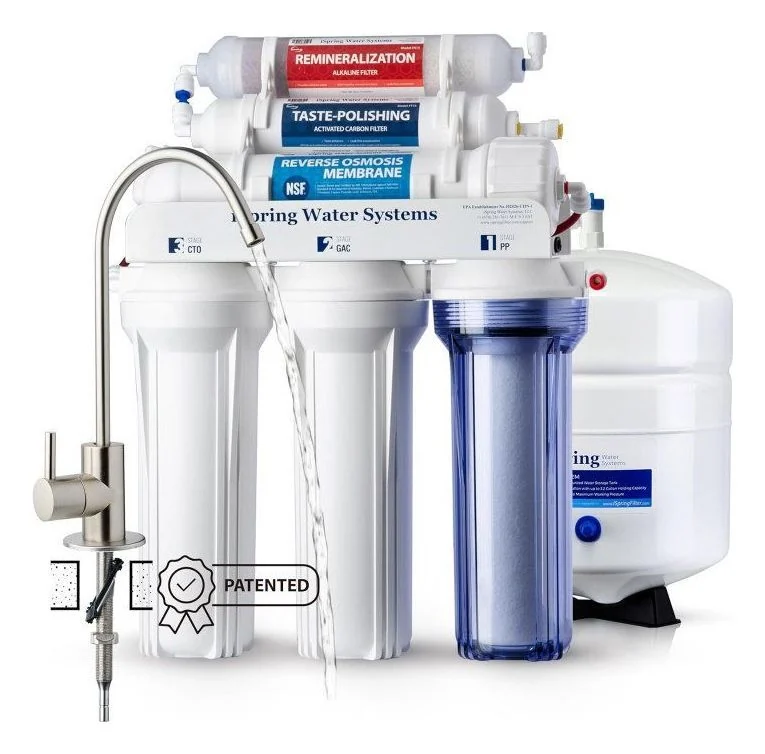
iSpring RCC7AK 6-Stage Reverse Osmosis System
Best for: A proven, cheap-to-run 6-stage under-sink RO with a very large owner base
- Stages
- 6 (with alkaline remineralization)
- Certification
- NSF/ANSI 58
- Waste ratio
- ~1:3 (classic tank design)
- Annual filter cost
- ~$100 to 110
Its reputation rests on volume. The Amazon listing (ASIN B005LJ8EXU) showed 21,596 ratings at 4.6 out of 5 on Oct 5, 2026, ranked #2 in Under-Sink & Countertop Filtration that day. It is often billed as Amazon's number one RO system, a ranking we could not confirm, so it stays out of our headline. We did not bench-test it. This review rests on iSpring's pages and manuals, NSF's listing, EPA, and our arithmetic.
What the Six Stages Do#
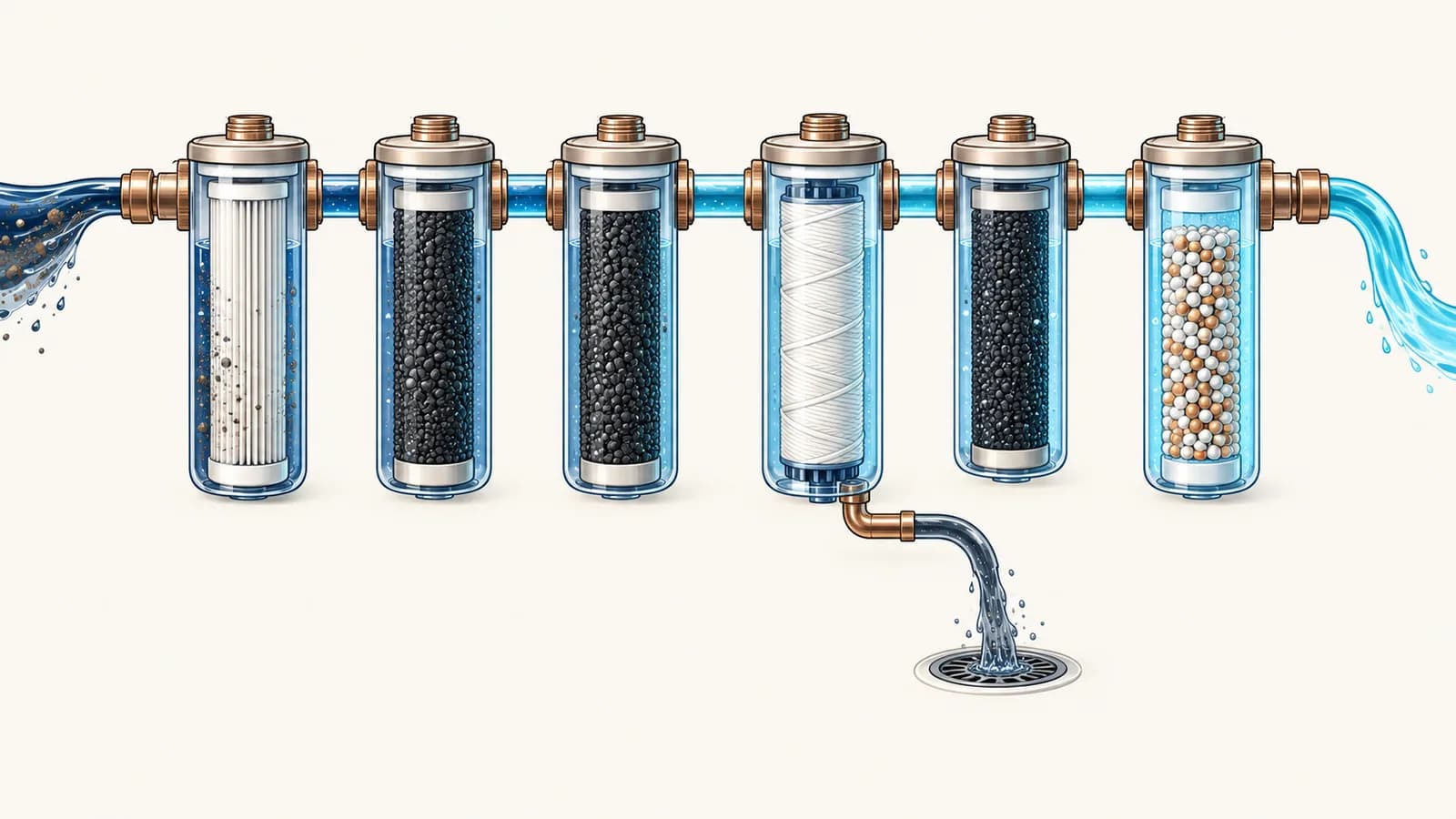
Three pre-filters protect the membrane, the membrane does the work, and two post-filters finish the water. You'll be buying these part numbers for as long as you own it.
Where the water goes
- Pre-filters6 to 12 monthsStages 1 to 3: FP15 sediment, FG15 granular carbon, FC15 carbon block. They keep grit and chlorine off the membrane.
- RO membrane2 to 3 yearsStage 4, the MC7, rated at 0.0001 micron and sold as a 75 GPD part.
- Post carbon6 to 12 monthsStage 5, the FT15 inline post-carbon, a final taste polish.
- Alkaline6 to 12 monthsStage 6, the FA15, which iSpring says adds back 30 to 60 mg/L of calcium and magnesium.
- The drain lineconcentrateEverything the membrane refuses leaves here. This pipe is why an RO system has a water bill attached to it, and why the pure-to-drain ratio belongs in any honest comparison.
From iSpring's RCC7AK page and RCC Series manual, read Oct 5, 2026. No drain ratio is drawn because iSpring publishes none.
One side effect catches owners out. Because stage 6 adds minerals back, a TDS meter at the faucet reads higher than water straight off the membrane, and that alone doesn't mean the membrane is failing. A meter counts charged minerals and nothing else, which our guide to what a TDS reading can and can't tell you unpacks.
RCC7AK vs RCC7: Is the Sixth Stage Worth It?#
On the sticker it's $10: $239.99 against $229.99 for the 5-stage RCC7, both on iSpring's store on Oct 12, 2026. Over five years, system included and cartridge packs at their Oct 5, 2026 prices, the gap grows to $146 to $170, about $2.43 to $2.83 a month, because the alkaline cartridge is changed as often as the pre-filters. iSpring pitches stage 6 on taste and pH, and NSF lists the same claims with or without it.
RCC7, 5 stages
- $229.99 (Oct 12, 2026)
- Same pre-filters and MC7 membrane, per NSF's listing
- $263.98 to $330.93 in cartridges over five years
RCC7AK, 6 stages
- $239.99 (Oct 12, 2026)
- Adds the FA15 alkaline cartridge
- $399.98 to $490.93 in cartridges over five years
Bottom line
Take the RCC7AK if you drink the water straight. If it mostly goes into coffee and cooking, the RCC7 filters the same for less.
Which RCC7AK Does NSF Actually Certify?#
Two versions, with two records. NSF's listing for NSF/ANSI 58, read on Oct 5, 2026, splits the RCC7 family between a facility in Taiwan and one in China, and the certified claims differ between them.
| Model, as named in NSF's listing | Daily production rate | Certified claims |
|---|---|---|
| RCC7AK, RCC7AK-UV, RCC7 | 21.04 gpd | TDS reduction only |
| RCC7AK-BN, RCC7AK-BLK | 25.41 gpd | Nine reduction claims, lead and fluoride among them |
iSpring's RCC7AK page credits NSF with all nine, quoting 97.4% for fluoride and 98.9% for lead. NSF gives those nine to the -BN and -BLK, also certified to NSF/ANSI/CAN 372 for lead-free materials. We report both; the fix is to buy the version whose entry names your contaminant and match the carton to the NSF listing. The Amazon listing we read is titled RCC7AK-BN, while iSpring's store sells the model as RCC7AK.
What you hear
An NSF/ANSI 58 certified RO system is certified for everything on its box.
What the numbers say
Certification covers the claims listed for one specific model. Across the RCC7 family that runs from one claim to nine, and no entry includes PFAS, which iSpring's page advertises.
How Much Water Does the RCC7AK Make?#
Well under 75 gallons a day, on NSF's numbers. The 75 is the MC7 membrane's rating, while NSF records 21.04 gallons a day for the RCC7AK and 25.41 for the -BN and -BLK under the standard's test conditions.
You'll notice it at the tank, which iSpring says holds 3.2 gallons and fills from empty in 1 to 2.5 hours, by its manual and FAQ. The manual wants 45 to 70 psi at the inlet and a booster pump below 45, which is what the RCC7P-AK at $349.99 (Oct 12, 2026) adds.
iSpring RCC7AK Price, and When It Drops#
$239.99 on Oct 12, 2026, with $241.99 struck through. It had read $241.99 with no strikethrough on our Sep 14 and Oct 5 readings. A 15% code ran from Sep 23 to Oct 7, 2026, bringing it to $205.69, the same promotional price we saw on Sep 1, so that's the discount to wait for. Amazon showed us no US-dollar offer on Oct 5, and we quote none.
The warranty is 1 year, limited, on registration. Extensions to 3, 5 or 10 years cost $145.19, $241.99 or $362.99 (Oct 5, 2026), so that day the 5-year cover cost as much as the system itself.
RCC7AK Filter Replacement Schedule and Cost#
Every 6 to 12 months for the five cartridges and every 2 to 3 years for the membrane, per iSpring. Its 3-year F28K75 pack holds six of each pre-filter and six alkaline cartridges, so iSpring plans on six-month changes for stages 1 to 3 and stage 6.
iSpring RCC7AK, five years on iSpring-brand packs
as of Oct 12, 2026- RCC7AK systemiSpring's own store, Oct 12, 2026
- $239.99
- F28K75 3-year cartridge setMembrane included, Oct 5, 2026
- $220.99
- F19K75 2-year cartridge setMembrane included, Oct 5, 2026
- $178.99
- Same five years on 1-year packsFive F9K sets at $80.99 plus two MC7 membranes at $42.99
- $490.93 in cartridges
Five-year total on multi-year packs
$639.97
Our arithmetic on iSpring's prices: the system read Oct 12, 2026, the multi-year packs Oct 5, 2026. The F9K set and MC7 membrane read the same on Oct 12, so the 1-year route totals $730.92.
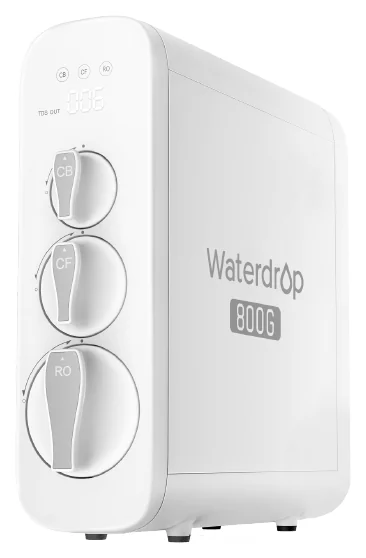
That's $80 to $98 a year, against $159.97 for the Waterdrop G3P800's proprietary set (Waterdrop's figure, read Oct 5, 2026), and above the $0.17 a day (about $62 a year) iSpring advertises. How that running cost compares with tankless, countertop and whole-house systems is laid out in our five-year reverse osmosis cost comparison.
iSpring RCC7AK Installation: What It Asks of Your Kitchen#
iSpring designs it for DIY and says every part needed is in the box; the countertop is the hard part. The manual sizes the faucet hole at 1/2 inch ideally, up to about 1 1/2 inches.
Check these five before you order
5 itemsStart-up takes patience rather than skill: three flushes, a cloudy first gallon, a first tank poured away, then daily leak checks for two weeks. If drilling a counter is the deal-breaker, our countertop water filter picks need no plumbing at all.
What Are the Common Problems With the iSpring RCC7AK?#
Three recur in iSpring's own troubleshooting guide, and two of them trace back to water pressure.
Leaking push-in fittings. The tubing must go about half an inch into each fitting, pushed hard and clipped. The tank thread wants 8 to 10 wraps of plumber's tape.
A tank that won't fill. Under 45 psi the membrane can't fill a pressurized tank, so the faucet trickles. The manual's fix is a booster pump.
Water running to the drain nonstop. A tank that never fills never shuts the system off. The manual names the usual causes: pressure under 45 psi, or a failed automatic shut-off or check valve.
How Much Water Goes Down the Drain?#
iSpring doesn't say. Its manual defines NSF's efficiency rating without printing the figure, while EPA's WaterSense page (updated Aug 21, 2026) puts a typical point-of-use RO system at five gallons or more to the drain per gallon treated, against 2.3 or less for a labeled one. With no label and no rating on the RCC7AK's page, we make no efficiency claim either way.
If drain water is your objection, look at tankless designs. The Waterdrop G3P800 publishes a 3:1 pure-to-drain ratio, as our G3P800 review details, and our tankless RO rankings cover the class.
RCC7AK vs the Alternatives#
The Aquasana SmartFlow costs about the same on a sale day with a longer certification list. The Waterdrop G3P800 costs four times as much and answers the drain question.
| iSpring RCC7AK | Aquasana SmartFlow | Waterdrop G3P800 | |
|---|---|---|---|
| Price (date read) | $239.99 (Oct 12, 2026) | $224.99 on sale, $449.99 list (Oct 12, 2026) | $999 (Oct 12, 2026) |
| Certification on record | NSF/ANSI 58: nine claims on -BN and -BLK, TDS only on plain RCC7AK | WQA: NSF/ANSI 42, 53 incl. P473, 58, 401 and CSA B483.1 | NSF/ANSI 58 and 372 on every Waterdrop page |
| Daily production | 21.04 to 25.41 gallons (NSF) | 25.7 gallons (Aquasana) | 800 GPD, tankless (Waterdrop) |
On a banner day the SmartFlow is $15 cheaper (Oct 12, 2026) and carries a PFAS protocol no RCC7 entry has; at its $449.99 list price, the iSpring costs $210 less. Our best reverse osmosis systems ranking sets the two side by side. The G3P800 asks about $759 more on those dated prices for tankless flow, and stops in a power cut. Tank against tankless is in our under-sink RO comparison, membrane against carbon in the under-sink filter guide.
What we like
- NSF/ANSI 58 certified, nine claims on the -BN and -BLK
- $239.99 (Oct 12, 2026), $10 over the 5-stage RCC7
- About $80 to $98 a year in cartridges (Oct 5, 2026 prices)
- No electricity needed
What to watch
- Plain RCC7AK certified for TDS reduction only
- No published drain ratio
- 1-year warranty, voided by aftermarket cartridges
- Needs 45 to 70 psi, or a pump model
What It Will Not Do#
It treats one tap, on city water. The manual warns against microbiologically unsafe water without disinfection, so a private well needs testing and treatment first, as our guide to treating well water explains. On very hard water, iSpring advises fitting it after a water softener.
Whole-house RO is a different machine and budget, covered in our whole-house reverse osmosis explainer. Unsure what your water needs? Our system quiz narrows it down.
Store prices come from each product's structured data and displayed price. Where iSpring and NSF disagree, both are reported. Five-year totals are our arithmetic.
More RCC7AK questions
What is the difference between the RCC7AK and the RCC7AK-UV?
A seventh, ultraviolet stage that needs an outlet, for $349.99 against $239.99 (Oct 12, 2026). iSpring suggests it when microorganisms are a concern. NSF lists the RCC7AK-UV for TDS reduction only.
Is the RCC7P-AK worth the extra money?
Only if your incoming pressure is under 45 psi, where iSpring's manual calls for a pump. It costs $349.99 against $239.99 (Oct 12, 2026) and needs a power outlet.
Does the iSpring RCC7AK remove fluoride and lead?
NSF certifies both for the RCC7AK-BN and -BLK only; the plain RCC7AK is listed for TDS reduction, whatever iSpring's page quotes. If either is your reason for buying, take the -BN or -BLK.
Which replacement filters fit the RCC7AK?
iSpring's F9K 1-year set ($80.99), F19K75 2-year set ($178.99) and F28K75 3-year set ($220.99), the last two with a membrane, all read Oct 5, 2026. The MC7 membrane alone is $42.99.
Frequently asked questions
Is the iSpring RCC7AK good?
Yes, as a budget tank system with a remineralizing stage. It cost $239.99 on iSpring's own store on Oct 12, 2026, it is certified to NSF/ANSI 58, and iSpring-brand cartridges run about $80 to $98 a year. Its weak points are on paper rather than in the hardware: iSpring publishes no drain ratio, and NSF certifies nine reduction claims for the -BN and -BLK versions but only TDS reduction for the model listed as plain RCC7AK.
What are common problems with the iSpring RCC7AK?
Three recur in iSpring's own troubleshooting guide. Push-in fittings leak when the tubing is not pushed about half an inch in and clipped; the tank will not fill when incoming pressure is under 45 psi; and water runs to the drain nonstop when the tank never fills or the shut-off or check valve fails. Low pressure sits behind two of the three, so measure it before you buy.
How long does the iSpring RCC7AK last?
iSpring publishes no lifespan for the system itself. It publishes a 1-year limited warranty on registration, extensions to 3, 5 or 10 years for $145.19, $241.99 or $362.99 (Oct 5, 2026), a 2 to 3 year interval for the MC7 membrane and a 6 to 12 month interval for the other five cartridges.
Does the iSpring RCC7AK remove microplastics?
iSpring says its 0.0001-micron membrane is small enough to filter out most microplastics, and adds that the system is not designed to disinfect water. No microplastics claim appears on any RCC7 family entry in NSF's listing read on Oct 5, 2026, so treat it as the manufacturer's statement rather than a certified result.
How often do you change the filters on an iSpring RCC7AK?
iSpring's product page says every 6 to 12 months for the sediment, two carbon, post-carbon and alkaline cartridges, and every 2 to 3 years for the MC7 membrane. Its own 3-year pack is built around a six-month change for stages 1 to 3 and stage 6, a yearly post-carbon, and one membrane.
Keep reading
Not sure what you need?
Answer 5 questions, get the right system for your water.
City or well, budget, household size, our quiz matches your answers against every system we track.