Hard Water Explained: What GPG and PPM Numbers Actually Mean
Hard water starts at 7 gpg on the USGS scale. What grains per gallon and ppm really measure, how much mineral that is per gallon, and how to get your number.
By Home Water Lab TeamUpdated Prices verified Oct 7, 2026
Hard water is water carrying a heavy load of dissolved calcium and magnesium, and the two numbers on any water report measure exactly that. Grains per gallon (gpg) is the unit the treatment industry sizes equipment in; ppm, identical to mg/L, is the unit labs and city reports use. One gpg equals 17.1 mg/L, and on the U.S. Geological Survey scale water turns hard at 121 mg/L, about 7 gpg.
That single figure decides everything that follows: whether you need equipment at all, what capacity to buy, and whether a salesperson standing in your basement is describing your house or a brochure. This page is the numbers page of our hard water hub: what the units mean, how much mineral they represent, where the hard water belt runs, and how to get your own reading.
The short answer
as of Aug 30, 2026What is hard water, in numbers?
Hard water is water above 121 mg/L (about 7 grains per gallon) of dissolved calcium and magnesium, per the USGS classification, and very hard above 180 mg/L (about 10.5 gpg). The conversion between the two units is fixed: 1 gpg = 17.1 mg/L. Hardness is not regulated by the EPA and is not a health risk; it is an equipment and cost problem that lives entirely on your side of the water meter.
Key takeaways
- The USGS bands: soft 0 to 60 mg/L, moderately hard 61 to 120, hard 121 to 180, very hard above 180.
- 1 gpg = 17.1 mg/L, and 1 grain is 64.8 mg of calcium carbonate, so 10 gpg water carries about 648 mg of mineral per gallon.
- The EPA sets no limit on hardness, so your utility will never fix it for you.
- Only ion exchange removes hardness; conditioners change how it behaves and leave the reading unchanged.
- Below 3.5 gpg treatment rarely pays, above 7 gpg the equipment case starts working.
What Is Hard Water, and Where Does It Come From?#
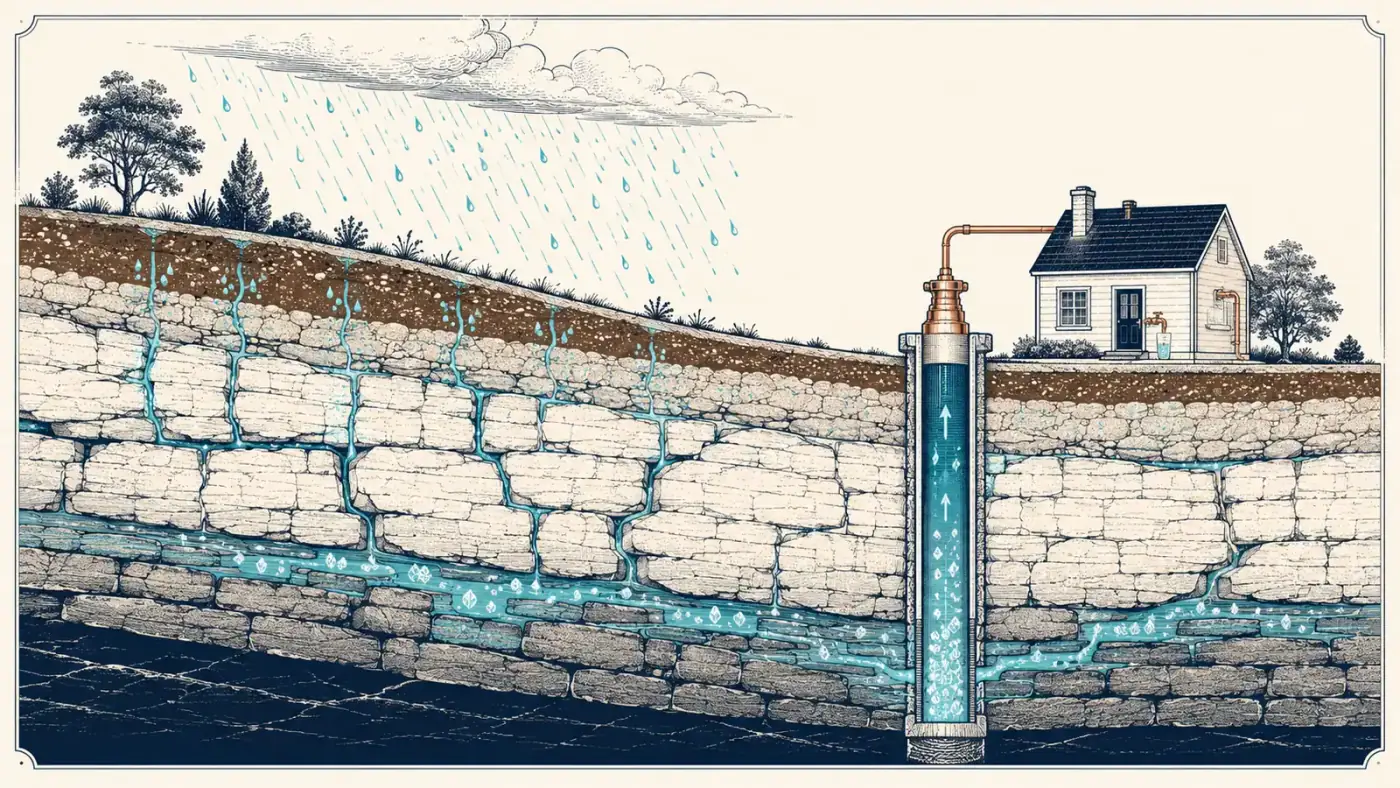
Hard water is groundwater that has been dissolving rock. Rain falls soft; as it moves through limestone, chalk and gypsum it picks up calcium and magnesium and carries them into aquifers, wells and municipal intakes. The more mineral-rich the geology under your county, the harder the water at your tap.
That makes hardness a geography problem rather than a plumbing one. Two houses in neighboring counties can draw wildly different water from the same kind of source, which is why our state-by-state hardness map exists and why a regional average is a starting point rather than an answer.
One thing hardness is not: a contamination issue in the regulatory sense. The EPA treats it as aesthetic and sets no limit, so water can be brutally hard and fully compliant at the same time.
What you hear
If the water were really that bad, the city would have to do something about it.
What the numbers say
The EPA does not regulate hardness at all. It is classed as an aesthetic characteristic, so a utility can deliver 20 gpg water indefinitely and remain in full compliance. Treatment is the homeowner's decision and the homeowner's bill.
What Do GPG and PPM Actually Mean?#
They measure the same thing in different units, and the conversion is the only piece of arithmetic worth memorizing on this page.
- gpg (grains per gallon) is the water treatment industry's unit. One grain is defined as 64.8 milligrams of dissolved calcium carbonate.
- ppm or mg/L (parts per million, milligrams per liter) is what labs and municipal reports publish. For hardness, the two are the same number.
The bridge: 1 gpg = 17.1 mg/L. A lab report in mg/L divides by 17.1 to become the figure a softener's control head wants. Our sizing calculator does that conversion and the capacity math in one pass.
| Classification | mg/L (ppm) | Grains per gallon |
|---|---|---|
| Soft | 0 to 60 | 0 to 3.5 |
| Moderately hard | 61 to 120 | 3.6 to 7.0 |
| Hard | 121 to 180 | 7.1 to 10.5 |
| Very hard | over 180 | over 10.5 |
USGS hardness bands
- Soft, 0 to 60 ppm0 to 3.5 gpg. No scale problem. A softener solves nothing here.
- Moderately hard, 61 to 120 ppm3.6 to 7.0 gpg. Spotting and light scale. Treatment is optional, not urgent.
- Hard, 121 to 180 ppm7.1 to 10.5 gpg. Scale in the water heater, soap that will not lather, film on the glassware.
- Very hard, over 180 ppmOver 10.5 gpg. Appliance territory: scale builds fast in anything that heats water, and it shortens the life of the thing doing the heating.
USGS classification of hardness as calcium carbonate, where 1 grain per gallon = 17.1 mg/L. A statewide or citywide figure is a wide typical range, never a reading at your address: the USGS says its national map is not built for decisions at the scale of one property. A test strip settles it in two minutes.
How Much Mineral Is That, Really?#
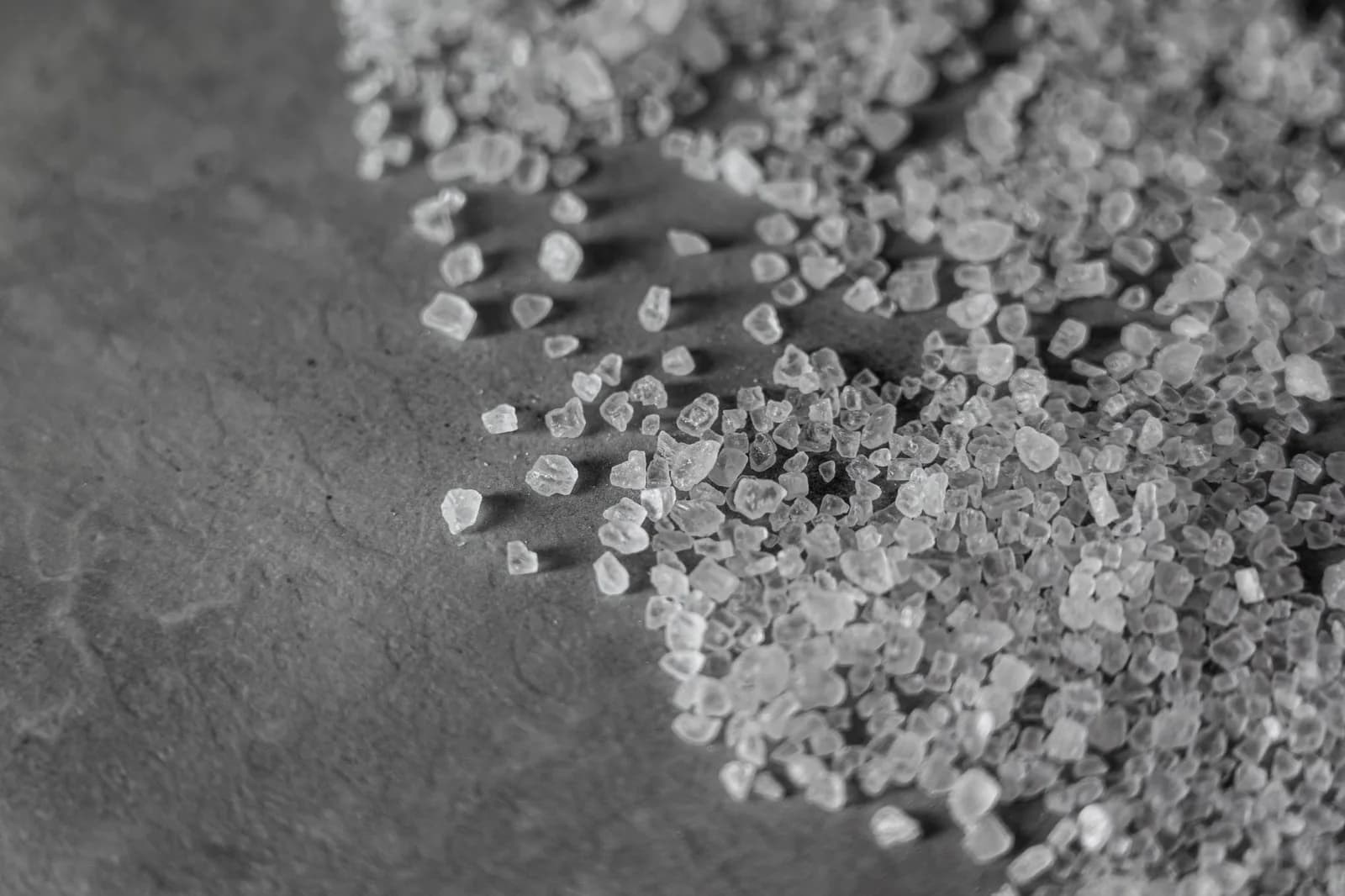
A reading of 10 gpg sounds abstract until you turn it into weight. Two definitions do it: one grain is 64.8 mg of calcium carbonate, and there are 3.785 liters in a gallon.
That leftover fraction is scale: calcium carbonate coming back out of solution wherever water is heated or left to evaporate. It is the reason a shower head crusts, a kettle furs and a water heater starts sounding like gravel in a tumble dryer.
What Do Those Minerals Do to a House?#
Scale forms on the hottest surfaces first, which is why the damage bill starts in the utility room and shows up in the bathroom.
- Water heaters take the worst of it. Scale coats heating elements and tank bottoms, forcing the heater to push energy through an insulating mineral layer. The Battelle study run for the Water Quality Research Foundation, industry funded and independently run, measured about 4 percent efficiency loss per 5 gpg of hardness in gas heaters, up to 48 percent over a service life.
- Tankless heaters are the extreme case. In the same testing, units on 26 gpg water clogged completely in roughly 1.6 years of equivalent use.
- Pipes and fixtures narrow as deposits build, cutting flow and blocking aerators.
- Soap stops working. Hardness minerals react with soap to form scum instead of lather, which is why hard-water homes use more detergent for worse results.
- Skin and hair carry a mineral film that many people experience as tightness or dullness after showering.
Industry funded, independently run. We label it that way every time, and cross-check its energy claims against the PNNL report on water quality and residential water heating.
None of this is dramatic on any given day, which is exactly why it goes unaddressed for years. The visible half of the list is catalogued symptom by symptom in 10 signs of hard water, and the money side is priced in is a water softener worth it.
Where Is the American Hard Water Belt?#
Hard water is the rule in the United States, not the exception, and the hardest band runs from the Dakotas down to Texas across the Midwest, the Great Plains and the Southwest.
- Midwest and Plains. Limestone-heavy groundwater puts Indiana, Illinois, Wisconsin, Minnesota, Iowa, Kansas and Nebraska in the very hard band, with typical high-end readings above 20 gpg.
- Southwest. Arizona, Texas, Utah and Nevada combine mineral geology with heavy groundwater reliance, which is how Phoenix, Las Vegas and San Antonio earned their reputations.
- Elsewhere. Florida's limestone aquifers test very hard, and much of inland California lands in the hard band.
The softest water is in New England, the Pacific Northwest and parts of the Southeast, where rainfall-fed surface water dominates. Even there, a private well can test hard, because geology does not follow state lines. Look up your own state on the water hardness map before you assume anything.
How Do You Test Your Own Water?#
Never size treatment equipment off a regional map. Three routes get you a real number, and which one you need depends on your water source.
Getting your gpg number
City water: read your Consumer Confidence Report
Every U.S. community water system publishes this annual quality report, and most include hardness even though it is not required. Search your utility's name plus CCR, or call and ask for hardness in gpg or mg/L. Free, and it takes ten minutes.Any water: run a test strip or a titration kit
Hardness strips cost a few dollars and give a usable range in about a minute. Drop-count titration kits take longer and are more precise, which is what you want if the number is about to decide a capacity purchase.Well water: order a state-certified lab test
Private wells are outside EPA rules and CCRs, so a certified panel is the only real answer. It also returns iron and manganese in ppm, and on a well those two figures change the equipment plan more than hardness does.
Write the result down in grains per gallon. Everything downstream, from capacity to salt consumption, is computed from it. Our walkthrough on how to test water hardness at home, from a soap bottle to a drop kit shows each method step by step. While the report is open, its violations and lead lines are worth a look too, and our walkthrough on checking whether your tap water is safe to drink explains how to read them.
What Does Your Number Mean for Treatment?#
Below about 3.5 gpg there is nothing worth removing. In the moderately hard band it is a comfort call. Above 7 gpg the scale, energy and appliance arithmetic starts favoring treatment, and above 10.5 gpg most households that can install equipment benefit from it.
What you install depends on one distinction that most marketing works hard to blur.
Salt-based softener (ion exchange)
- Removes calcium and magnesium from the water
- Hardness reading drops to near zero
- Soap lathers, spotting stops, scale stops accumulating
- Needs salt, a drain and about $50 to $150 a year
Salt-free conditioner (TAC and similar)
- Leaves the minerals in the water
- Hardness reading is unchanged after treatment
- Scale mostly stops sticking; spotting and soap behavior do not change
- No salt, no drain, no power, nothing to refill
Bottom line
If you want the test result to change, only ion exchange does it. If you want scale prevention without salt or a drain, a conditioner is a real answer to a narrower question.
The full head-to-head, including the WateReuse Research Foundation testing that put template-assisted crystallization above 88 percent scale reduction, is in our salt-based versus salt-free comparison, and the category overview sits at the salt-free hub.
Once you know which technology you want, two questions remain: what size, and what it costs. Capacity comes from your gpg number and household size in what size water softener do I need, the full menu of fixes from vinegar upward is in how to fix hard water, and the money is broken out layer by layer in our water softener cost guide. If you would rather compare finished systems, the ranked shortlist is in best water softeners.
Frequently asked questions
Is hard water dangerous to drink?
No. Hardness minerals are dissolved calcium and magnesium, and the World Health Organization has not found convincing evidence that drinking hard water harms health. The same minerals appear in food and supplements. Hard water is a comfort, appliance and cost problem, not a safety problem.
How many grains per gallon counts as hard water?
Using the USGS scale, water above about 7 gpg (121 mg/L) is considered hard, and above roughly 10.5 gpg (180 mg/L) it is very hard. Between 3.5 and 7 gpg is moderately hard, and many households in that range still notice spotting and scale.
How much mineral is actually in a gallon of hard water?
One grain is defined as 64.8 milligrams of dissolved calcium carbonate, so 10 gpg water carries about 648 mg of mineral in every gallon, which is the same concentration as 171 mg/L. A household running 300 gallons a day is moving roughly 194 grams of dissolved rock through its plumbing every day, our arithmetic on those two definitions.
Can I see hardness on my water bill or city report?
Often, yes. U.S. community water systems publish an annual Consumer Confidence Report (CCR), and many include hardness even though the EPA does not regulate it. If yours doesn't, a call to the utility or a test strip kit costing a few dollars will answer it.
Does boiling water remove hardness?
Boiling can drop out some temporary (carbonate) hardness as scale, which is exactly why kettles crust up, but it is not a practical treatment. It does nothing for permanent hardness, wastes energy, and leaves the minerals as deposits in your cookware instead of your pipes.
Keep reading
Not sure what you need?
Answer 5 questions, get the right system for your water.
City or well, budget, household size, our quiz matches your answers against every system we track.