Water Softener Salt Guide: Pellets vs Crystals vs Block (Which to Buy and How Much)
Water softener salt, decoded: pellets vs crystals vs block, which type to buy, how much you will use ($50 to $150 a year), and when potassium chloride wins.
By Home Water Lab TeamUpdated Prices verified Oct 7, 2026
Buy evaporated salt pellets. That is the answer for almost every modern water softener, and the reasoning takes one line: they are the purest common form, so they leave the least residue in the brine tank, and they cost $5 to $10 per 40 pound bag per Angi's 2026 figures. Budget $50 to $150 a year in salt for a typical home per HomeGuide's 2026 cost guide, roughly a bag a month.
Everything else on this page is the why, the exceptions, and the two questions everyone actually types: how much salt a softener goes through, and when to refill. It sits under our water softener hub as the consumables page, because salt is the only thing a softener asks you to buy again.
The short answer
as of Aug 28, 2026Which water softener salt should you buy?
Evaporated salt pellets, from any national brand. They are the purest of the five common forms and leave the least sludge in the brine tank, which is where every salt problem starts. Expect $5 to $10 per 40 lb bag (Angi, 2026) and $50 to $150 a year (HomeGuide, 2026). Switch to potassium chloride only for a medical sodium restriction, a septic preference, or local brine discharge rules.
Key takeaways
- Pellets by default, crystals only if the price gap is real and your usage is light, rock salt never.
- All sodium chloride softener salt regenerates resin identically; what differs is the residue left behind.
- Potassium chloride costs $50 to $70 a bag against $5 to $10 for salt, roughly 5 to 14 times the price.
- A typical household burns about one 40 lb bag a month, which is $60 to $120 a year at Angi's bag prices.
- A salt level that has not moved in weeks is a salt bridge, not a low-consumption month.

If your salt level has stopped moving entirely, jump to our maintenance checklist instead; that is a salt bridge, not a salt-buying problem.
Which Type of Water Softener Salt Should You Buy?#
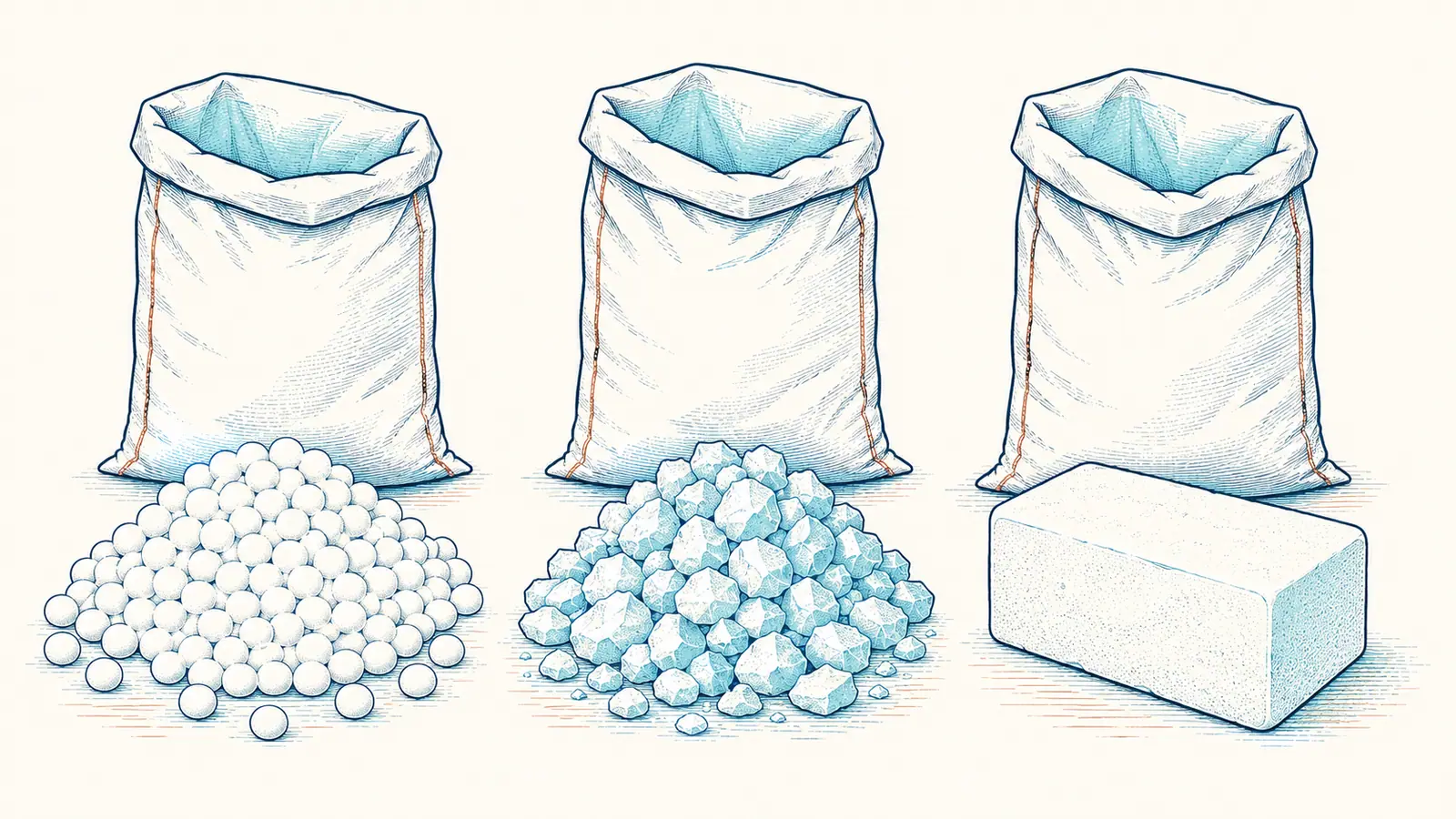
Every bag at the hardware store is one of five things, and only two of them belong in a modern softener.
| Type | What it is | Best for | Price signal |
|---|---|---|---|
| Evaporated salt pellets | Compacted, purified evaporated salt; the purest common form | Almost everyone; the modern default | $5 to $10 per 40 lb bag (Angi, 2026) |
| Solar salt crystals | Seawater or brine evaporated by sun and wind | Light-usage households; tolerable in most tanks | Similar range, often the cheaper bag |
| Rock salt | Mined salt, minimally processed, most insoluble residue | Nothing modern; the tank-sludge special | Cheapest per bag, priciest in cleaning time |
| Block salt | Salt pressed into large blocks | Only systems designed for blocks | Niche; match your manual |
| Potassium chloride | Sodium-free alternative (not actually salt) | Sodium restrictions, septic and brine-rule areas | $50 to $70 per 40 lb bag (Angi, 2026) |
Brand matters less than form: Morton and Diamond Crystal are the two names you will see on every shelf, and both sell the same forms. What you are choosing is purity and format, not chemistry. All sodium chloride softener salt regenerates resin identically; the impurities are what differ, and they end up as sludge at the bottom of your brine tank.
Pellets vs Crystals: Does It Actually Matter?#
For a light-usage household with a modern softener, honestly, not much. Both soften identically. The difference shows up over months, in the tank rather than in the water.
Evaporated pellets
- The purest common form; dissolves with minimal residue
- Fewer fine particles, so less bridging and less mushing
- Keeps the annual brine tank clean to an hour
- $5 to $10 per 40 lb bag (Angi, 2026)
Solar crystals
- Same softening performance, more natural sediment
- Sediment accumulates fastest in high-usage tanks
- Turns the yearly tank clean into a real chore
- Often the cheaper bag on the day
Bottom line
Pellets unless the price gap on the shelf is genuinely large and your household is small. In a big family on very hard water, the sediment difference is the one that will cost you an afternoon.
If a bag markets extra features (rust fighter formulas for iron-prone water, for instance), those target a real problem but solve it mildly. If you want the iron formulas priced against plain pellets on the same shelf, our bag-by-bag comparison of softener salts lines them up. Actual iron in your water is a treatment question, not a salt question: our maintenance guide covers resin cleaner for exactly that case, and real iron gets its own stage of equipment ahead of the softener rather than a different bag of salt.
Is Potassium Chloride Worth 10 Times the Price?#
Potassium chloride (KCl) regenerates resin the same way sodium chloride does, with potassium ions taking sodium's place. What differs is the receipt.
What you hear
Potassium chloride is the healthier salt, so it is the better choice for any household.
What the numbers say
It regenerates resin identically and costs $50 to $70 per 40 lb bag against $5 to $10 for sodium chloride, roughly five to fourteen times the price per bag on our arithmetic. It earns that premium in three specific cases, not as a general upgrade.
The three cases where it earns the money:
- Strict sodium restrictions in the household, when a doctor has said the added sodium from softening matters and a separate drinking-water tap is not enough. The cheaper version of that fix is usually a dedicated drinking tap, which is what our reverse osmosis hub covers.
- Septic or environmental preference, since you are discharging potassium rather than sodium with each regeneration.
- Brine discharge rules. California's AB 1366 (2009) lets local agencies restrict brine-discharging softeners, and Santa Clarita went as far as requiring existing units removed under its 2008 Measure S. If you are in a restricted district, the honest comparison is not KCl versus salt, it is softening versus a salt-free conditioner, which needs no salt at all.
For everyone else, sodium chloride pellets do the same job for a tenth of the money. If you are weighing the whole salt-versus-no-salt decision, our salt-based vs salt-free comparison is the full argument.
How Much Salt Does a Water Softener Use?#
$50 to $150
Your own number moves with four things, and only the last one is a hardware problem you can fix.
- Water hardness. Harder water exhausts resin faster, forcing more regenerations. A home at 20+ grains per gallon can use double the salt of one at 10. Look up your area with our water hardness tool, then confirm with a test strip, and read hard water explained if the units are new to you. Everything scale does to a house, and every way to stop it, sits on our hard water resource centre.
- Household size. Salt use scales with gallons used, so a family of six regenerates far more often than a couple in the same house.
- Softener capacity and sizing. An undersized unit regenerates constantly and burns salt doing it; the grain-capacity math is in what size water softener do I need.
- Regeneration logic. Metered, demand-initiated softeners regenerate only when needed. Old timer units regenerate on a clock, salt needed or not, and are the most common explanation for a salt budget twice the normal range. The metered heads we benchmark against are covered in our SpringWell softener review.
Regeneration, one full cycle
- Backwashto drainFlow reverses and runs up through the bed, lifting the resin, flushing out grit and iron, and unpacking a bed that has compacted under months of downward flow.
- Brine draw and slow rinseto drainThe valve pulls brine out of the salt tank and moves it slowly through the resin. Sodium floods the exchange sites, the captured calcium and magnesium are pushed off and leave with the waste water.
- Rapid rinseto drainA fast downflow clears the last of the brine and settles the bed back into place, so the first glass after a cycle does not taste of salt.
- Refillto brine tankFresh water flows back into the brine tank and starts dissolving salt for the next cycle. The softener returns to service, recharged.
Most control valves run the cycle in the early hours, when nobody is drawing water. A single tank cannot soften and recharge at the same time, so water drawn mid-cycle comes through untreated. That, and nothing else, is the argument for twin-tank systems.
Track your own refill rhythm for three months and you will have a better number than any published average. If salt spend suddenly rises with no change in the household, treat it as a symptom rather than inflation: something in the settings or the resin needs attention, and salt is only part of the $60 to $190 a year that running a softener actually costs. Whether that whole bill is worth paying is argued in is a water softener worth it.
When Should You Refill the Salt (and How Full)?#
Check monthly, refill when the tank drops below about one quarter full, and keep two rules: salt above the water line, and half full rather than packed. A tank crammed to the lid encourages bridging, where a crust of salt forms a dome with a void underneath and the softener silently stops working. Standard brine tanks hold far more than a month of salt anyway; SpringWell's 18 by 33 inch tank, for example, is rated for around 200 pounds, five bags at once.
The two-minute monthly salt check
5 itemsRefilling is the entire skill: cut the bag corner, pour, close the lid. The two minutes of looking first are what separate a working softener from an expensive brine bucket.
Why Is the Salt Not Going Down?#
A salt level frozen for weeks means the softener is not drawing brine, and the usual culprit is a salt bridge: a hardened crust hiding a void underneath, so the tank looks full while nothing dissolves. The fix costs nothing, a broom handle pushed down through the crust. Its cousin, salt mushing, is recrystallized sludge at the tank bottom that blocks the brine draw and calls for a tank cleanout.
Cheap high-residue salt and chronic overfilling make both problems more likely, which is the hidden argument for pellets. Meanwhile the water in the house goes back to hard without anything visibly failing, so the 10 signs of hard water return before any warning light does. If the tank is clean, the settings are right and hardness still comes through, the resin itself may be finished: how long water softeners last walks that call.
The Verdict: Which Salt to Buy#
Evaporated pellets, from either of the big two brands, bought a few bags at a time so you are never rationing. Switch to potassium chloride only if sodium, septic or local brine rules genuinely apply to you, and price a salt-free conditioner honestly if they do. Budget about $100 a year for a family of four, check the tank monthly, and if you are still shopping for the machine itself, the ranked field is in best water softeners.
Frequently asked questions
How much salt does a water softener use per month?
Roughly one 40 pound bag a month for a typical family, more with very hard water, a big household or an old timer-based softener. That is our arithmetic from HomeGuide's 2026 figure of $50 to $150 a year in salt and Angi's $5 to $10 per bag, not a lab measurement; your refill rhythm is the real number worth tracking.
What is the difference between water softener pellets and crystals?
Both are sodium chloride; the difference is form and purity. Pellets are compacted evaporated salt, the purest common form, and dissolve with the least residue. Crystals are solar-evaporated salt that costs a bit less but leaves more sediment, which matters in high-usage tanks. For most modern softeners, pellets are the default answer.
Can I switch salt types without draining the tank?
Yes. Any standard softener runs on any standard sodium chloride or potassium chloride, so you can change brands or forms at will. The clean way to do it is to let the tank run low first, so the old salt is mostly gone, then refill with the new type. Mixing is not harmful, it just makes it harder to judge how the new salt behaves.
What happens if my water softener runs out of salt?
Nothing breaks, but softening stops: with no salt there is no brine, so the resin cannot regenerate and hardness returns to your taps within a regeneration cycle or two. Refill the tank, run a manual regeneration, and the system recovers on its own. The monthly salt check exists precisely to avoid the silent hard-water weeks.
Is softened water safe to drink on a low-sodium diet?
Softening swaps hardness minerals for sodium, so softened water does carry some added sodium, and the amount rises with your water's hardness. It is not salty water, but people on strict sodium restrictions usually either switch the softener to potassium chloride or add a reverse osmosis tap for drinking and cooking. Ask your doctor where your limit sits.
Is potassium chloride better than salt for a water softener?
Not for most households. It regenerates resin the same way sodium chloride does and costs $50 to $70 per 40 pound bag against $5 to $10 for salt per Angi's 2026 figures, roughly five to fourteen times the price. It earns that premium in three cases: a medically strict sodium restriction, a septic or environmental preference, and local brine discharge rules.
Keep reading
Not sure what you need?
Answer 5 questions, get the right system for your water.
City or well, budget, household size, our quiz matches your answers against every system we track.