Water Softener Repair: 12 Problems, What Causes Them, and What a Fix Costs (2026)
Water softener repair averages $430 (HomeGuide) to $559 (Angi). 12 problems mapped to cause, DIY check and cost, and when to replace the softener instead.
By Home Water Lab TeamUpdated Prices verified Oct 7, 2026
This page contains affiliate links; buying through them costs you nothing extra.
Most water softener repairs are smaller than the first quote implies. HomeGuide's own summary is that most problems come down to an empty brine tank, a jammed valve or parts that need cleaning, and several of the twelve below cost nothing to fix. If you are still choosing a machine rather than rescuing one, start with our buyer's guide to home water softeners instead.
The short answer
as of Sep 28, 2026What does water softener repair cost, and is it worth it?
A professional repair averages $430 in HomeGuide's data and $559 across Angi's 8,441 projects, with most bills between $150 and $985 and a $40 to $100 service call on top. Many faults (a salt bridge, a blocked drain line, a plugged venturi) are free or part-priced DIY fixes. Replace instead when the repair passes half the price of a new installed system, Angi's 50% rule, which a sealed big-box valve out of warranty usually does.
Key takeaways
- A repair averages $430 per HomeGuide and $559 per Angi, plus a $40 to $100 service call before parts.
- Brine-side failures are the cheap ones: a salt bridge costs nothing to clear and a Whirlpool-type venturi listed at $56.83 on Sep 28, 2026.
- Normal brine tank water is model-specific: about 0 to 4 inches on Whirlpool units, up to 10 to 12 inches in HomeGuide's generic guide.
- Resin replacement runs $200 to $400 in both HomeGuide and Angi data, and resin beads in your taps mean a broken part inside the tank too.
- Angi's rule: replace when the repair passes 50% of the price of a new, installed system.
What Are the Common Problems With Water Softener Systems?#
Twelve symptoms cover the troubleshooting guides published by HomeGuide and by Whirlpool's support team, and nearly all of them trace back to the salt, the brine line, the drain or the valve seals. The table sorts them by who fixes them and what that costs. Each row has its own numbered section further down.
| # | Symptom | Usual cause | DIY or pro | What it costs |
|---|---|---|---|---|
| 1 | Water is hard again | Bypass on, salt empty, wrong hardness setting | DIY first | Free to check; service call $40 to $100 (HomeGuide) |
| 2 | Salt level never drops | Salt bridge, or the valve is not metering | DIY | Free |
| 3 | Brine tank full of water | Blocked drain or venturi, stuck float, worn seals | DIY clean, then a part | Venturi $56.83, seal kit $106.79 (EcoPure, Sep 28, 2026) |
| 4 | No water in the brine tank | Jammed float, clogged brine line | DIY | Free to clean |
| 5 | Salty water | Settings, partly blocked drain, leaking seal | DIY, then a part | Same parts as row 3 |
| 6 | Never regenerates | Power or clock, settings, meter, motor | DIY checks, pro for the motor | Labor $45 to $150 an hour (Angi) |
| 7 | Regenerates or drains nonstop | Valve stuck in rinse, pressure too high | Part or pro | Seal kit $106.79 (EcoPure) |
| 8 | Leaking | O-rings, bypass, drain hose, cracked tank | Depends on where | Leak repair $150 to $300 (Angi) |
| 9 | Low water pressure | Clogged pre-filter, fouled resin, undersized unit | DIY filter, pro for resin | Pre-filter $30 to $200 (HomeGuide) |
| 10 | Resin beads in the taps | Cracked distributor, torn screen | Pro | Resin $200 to $400 plus parts |
| 11 | Brown water or a smell | Iron or manganese fouling, dirty brine tank | DIY clean, treat iron upstream | Resin $200 to $400 if cleaning fails |
| 12 | Blank display, error code, grinding | Power, control board, motor | Maker's part or pro | Average repair $430 to $559 |
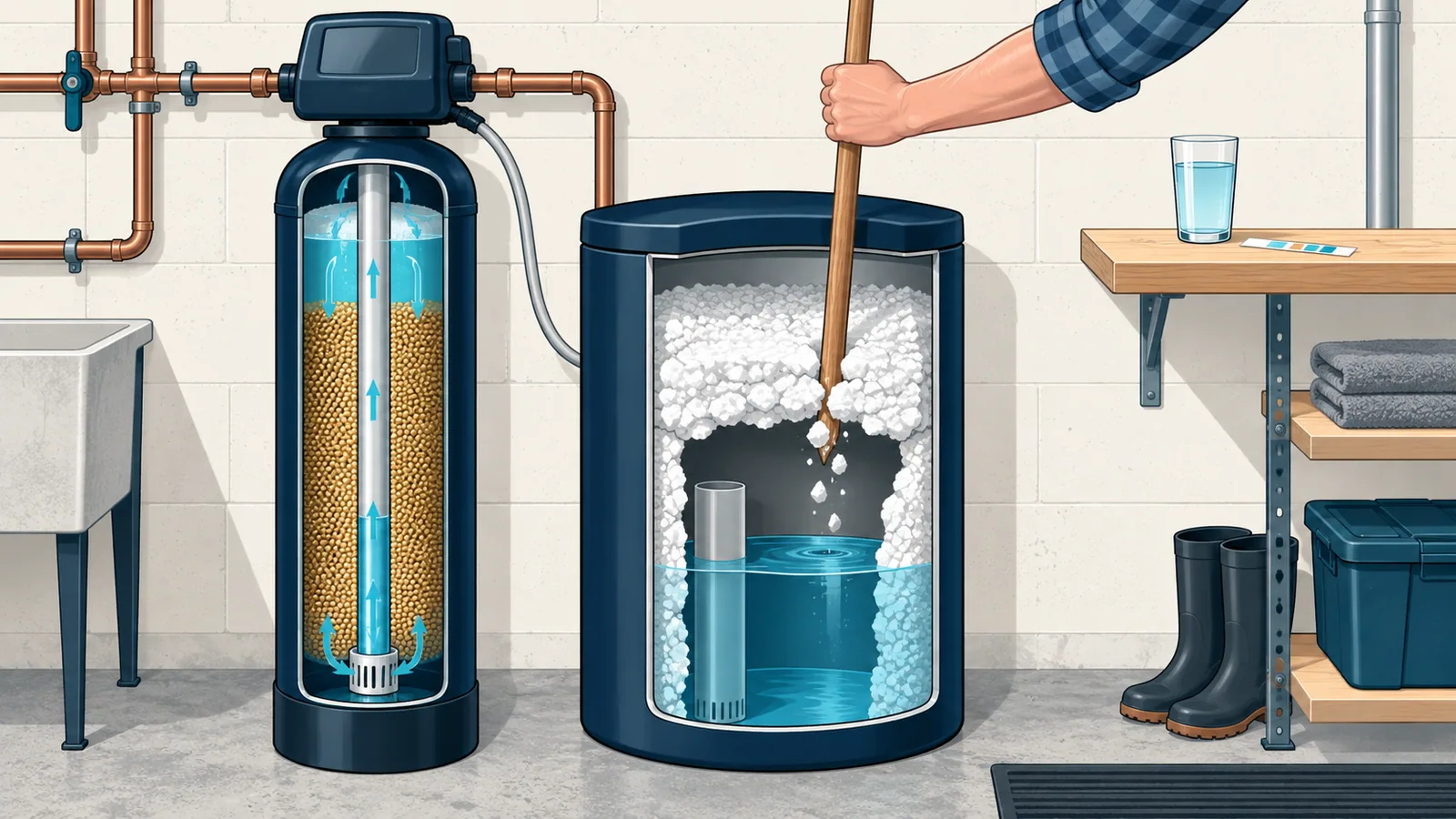
What is actually in the box
- Bypass valveSends water straight to the house. Every service call starts here: without it, touching the softener means shutting off the whole home.
- Control valveThe head that meters water and decides when to regenerate. A metered head counts gallons, a timer head only counts days, which is why metered heads use less salt.
- Riser tube and upper distributorWater enters at the top, works down through the bed, then returns up the centre tube. Screens at both ends keep resin in the tank and out of your plumbing.
- Resin bedThe working part. Beads loaded with sodium trade it for hardness as water passes. Capacity is rated in grains, which is what 32,000 or 48,000 on the box refers to.
- Drain line, with air gapBackwash water and spent brine leave here. Plumbing code wants a physical gap above the drain so nothing can siphon back into the softener.
- Lower distributor and gravel bedCollects treated water evenly across the tank floor. Uneven collection channels the flow through part of the resin and wastes capacity.
- Brine tankHolds the salt. Its job is to make brine for the recharge, not to add salt to your water: the two only meet inside the resin tank, during regeneration.
- Brine well and safety floatThe float caps how much water can enter the tank. It is what stops a stuck valve from putting the brine tank on your floor.
- Brine lineCarries brine to the valve during the draw, and fresh water back to the tank during refill. One tube, both directions.
Schematic, not to scale. Tank sizes and valve brands change, the order of the parts does not. A control valve needs a drain, a brine line and a power outlet within reach, and that is what decides where the pair can physically stand.
How Do You Troubleshoot a Water Softener?#
Run five free checks before anyone opens the valve, in this order. It's the same sequence HomeGuide's troubleshooting guide uses, and it clears the cheap causes before you pay a $40 to $100 call-out.
The five-minute check
Power and display
Confirm the unit is plugged in and the screen is not blank. A flashing clock after a power cut means the scheduled regeneration time is wrong too.Bypass position
A bypass left in bypass after a plumber's visit sends hard water to the whole house while the softener looks perfectly healthy.Salt, and what is under it
Look in the brine tank, then push a broom handle straight down in a few spots. A crust that gives way is a salt bridge.Settings
Check the programmed hardness against a fresh test. Whirlpool also has owners confirm the model code, which a reset can change. Use the manual for your exact valve version.Manual regeneration, then a strip test
Run a full cycle, then test a treated cold tap the next day. Softened water should read close to zero grains per gallon.
The routine that stops most of these from happening is in our softener upkeep calendar. This page starts where it ends.
1. Why Is My Water Softener Not Working?#
When hard water comes back, look upstream of any repair first. The bypass is on, the salt has run out or bridged, or the valve is programmed for somebody else's water.
Spots on glasses and soap that stops lathering are usually the first clues, and our hard water signs checklist confirms it is hardness rather than something else changing in the house. If a strip still reads hard after a manual regeneration on a full, unbridged tank, the problem has moved inside the machine: the resin (sections 10 and 11) or the valve (sections 6 and 12). HomeGuide prices a diagnostic visit at $40 to $100 before parts.
2. Why Is My Water Softener Not Using Salt?#
A salt level that hasn't moved in weeks means a salt bridge or a valve that isn't regenerating. Whirlpool's check order works on any brand: confirm the meter counts water when a treated tap runs, then look for a bridge, then check that the tank refills.
For the bridge, Whirlpool adds a knock test on the tank wall: hollow near the bottom is a bridge, solid is a fused block. On its own units it dissolves one with two to three gallons of hot tap water poured into the brine well, 45 to 60 minutes of waiting and a recharge. Humidity, the wrong salt, an overfilled tank and long gaps between regenerations are the causes it lists, which is why the salt you buy matters more than the brand. Cost: nothing.
3. Why Is My Water Softener Full of Water?#
A brine tank flooded far above its usual level means water goes in at refill and never leaves during the brine draw. The usual suspects, per HomeGuide and Whirlpool, are a blocked drain line, a plugged venturi (the injector that creates the suction), a sticking float or low house pressure, with worn valve seals last.
With the unit in bypass, check the drain hose for kinks and blow through it, which is Whirlpool's own method, then clean the venturi and test the suction. If water pushes out of the venturi port instead of being drawn in, Whirlpool's diagnosis is a failed seal inside the valve head. On EcoPure's parts store, where Whirlpool's support pages send US owners, a replacement nozzle and venturi listed at $56.83 and a rotor and seal kit for 1-inch valves at $106.79 on Sep 28, 2026. Your manual gives the part number, and the valve version decides what fits.
What you hear
There is one correct water level for every brine tank.
What the numbers say
Whirlpool's support pages call about 0 to 4 inches at the bottom normal on its units. HomeGuide's generic guide puts the ceiling at 10 to 12 inches. Both describe some machine correctly, so the only number that counts is the one in your manual, read at the same point in the cycle.
4. Why Is There No Water in My Brine Tank?#
No water means no brine, and the next regeneration runs on nothing. HomeGuide points at a jammed float or brine valve and a clogged brine line, all cleanable at home.
Clean the brine well and the float assembly, flush the brine line, and check it is seated at both ends. Before calling it a fault, compare with the manual: on Whirlpool units a few inches is normal, so what matters is whether the level rises and falls during a regeneration. A float that is actually broken becomes a part-number job.
5. Why Does My Softened Water Taste Salty?#
Salty water after a regeneration means brine is reaching the house instead of the drain. Whirlpool names three causes in this order: incorrect settings, a partial block in the drain line, a leaking seal.
Confirm the model code and salt settings, clear the drain route and the venturi, then run a full regeneration and taste a treated cold tap afterward. If it is still salty, Whirlpool's next step on its units is a distributor O-ring kit; on other valves a technician tests the seals. Don't raise the salt setting to compensate. And until it clears, drink from another source, because taste can't tell you what is in the water.
Video coming soon
We cover this topic on the Home Water Lab channel.
6. Why Is My Water Softener Not Regenerating?#
A softener that never regenerates has lost power or its clock, is programmed wrong, isn't counting water, or has a failed motor. HomeGuide calls the motor the rare case, so work through the cheap causes first.
Check the clock, the scheduled time and the hardness setting, then start a manual regeneration. Whirlpool says you should hear the motor turn within a few seconds; if nothing moves, the fault is in the valve head. How often it should regenerate follows from arithmetic rather than a calendar: a metered valve counts gallons against its programmed capacity, so the interval tracks your water use and your hardness. Our softener capacity calculator shows the number your unit should be close to. Labor for a head repair runs $45 to $150 an hour, and most jobs take one to three hours, per Angi.
Regeneration, one full cycle
- Backwashto drainFlow reverses and runs up through the bed, lifting the resin, flushing out grit and iron, and unpacking a bed that has compacted under months of downward flow.
- Brine draw and slow rinseto drainThe valve pulls brine out of the salt tank and moves it slowly through the resin. Sodium floods the exchange sites, the captured calcium and magnesium are pushed off and leave with the waste water.
- Rapid rinseto drainA fast downflow clears the last of the brine and settles the bed back into place, so the first glass after a cycle does not taste of salt.
- Refillto brine tankFresh water flows back into the brine tank and starts dissolving salt for the next cycle. The softener returns to service, recharged.
Most control valves run the cycle in the early hours, when nobody is drawing water. A single tank cannot soften and recharge at the same time, so water drawn mid-cycle comes through untreated. That, and nothing else, is the argument for twin-tank systems.
7. Why Does My Water Softener Keep Regenerating or Draining?#
Water running to the drain all day means the valve is stuck in a rinse position or the house pressure is above what it is built for. Those are Whirlpool's two named causes, and both end at the valve.
Unplug the unit, bypass it, plug it back in and step through a cycle by hand. If the drain still runs once it returns to service, Whirlpool's fix is the rotor and seal kit ($106.79 at EcoPure on Sep 28, 2026), and your pressure should be checked against the manual's limit. HomeGuide adds that a unit which cannot draw brine keeps cycling too, so rule out sections 2 and 3 first. Nightly regenerations for a two-person house are a settings or sizing question rather than a fault.
8. Why Is My Water Softener Leaking?#
Where the water appears tells you what failed, so find the leak before buying a part. Whirlpool's leak guide splits it six ways, and the map doubles as a checklist on other two-tank systems.
- Top of the valve head. Water between the ridges of the valve cover points at internal seals; water pooling at its base, at the distributor O-rings.
- Bypass valve. A leak at the clips needs new O-rings; at a thread, the threaded part; at either end of the sliding stem, a new bypass.
- Drain line. A split hose or a loose clamp at the adaptor. A drain that runs constantly is section 7.
- Overflow hose. The brine tank level is too high, which is section 3.
- Floor under the salt tank. Pour a gallon of water into the brine well and wait a few hours. If it drains away, the tank is cracked.
- Resin tank walls. Wipe off condensation first, then watch for a real drip from above.
HomeGuide adds one blunt rule: a leak on a new unit is an installation fault, and our start-to-finish installation walkthrough shows which connection usually gets it wrong. Angi puts a leak repair at $150 to $300 and a replacement brine tank at $125 to $700.
9. Why Did My Water Pressure Drop After the Softener?#
Check the sediment pre-filter first: a clogged cartridge drops pressure across the whole house, and HomeGuide prices replacements at $30 to $200. After that come a resin bed fouled by iron or sediment, resin broken down by chlorine, and a unit too small for the flow.
The quickest test is the bypass. If pressure comes back with the softener bypassed, the restriction is the softener or its filter; if it doesn't, look elsewhere in the plumbing. An undersized unit has no repair, only a replacement that is matched to the house's flow and hardness.
10. Why Are There Resin Beads in My Faucets?#
Tan or amber beads in aerators, toilet tanks or the dishwasher mean something inside the resin tank has broken. HomeGuide names a cracked distributor or basket, a broken screen or a failed seal, and adds that excess chlorine can eat the plastic.
The fix is a technician job on most tanks: bypass the unit, flush every fixture and appliance, replace the broken part and the lost resin. Resin replacement alone runs $200 to $400 in both HomeGuide and Angi data. On an old unit that number belongs in the repair-or-replace test below.
11. Why Is My Softened Water Brown or Smelly?#
Brown or discolored water after a regeneration usually means iron or manganese has fouled the resin. HomeGuide also lists sediment in the brine tank, unpurified salt and tannins from well water, and it ties a rotten-egg smell to bacterial fouling of the bed.
Clean the brine tank, switch to a high-purity salt and run a resin cleaner per its label. Sanitize only with the procedure in your manual. If the water carries real iron, cleaning is a bandage; treat it before the softener with one of our iron filter picks for well water. A bed past saving means the $200 to $400 resin job.
12. Why Is My Water Softener Display Blank or Showing an Error Code?#
A blank screen is power first: outlet, plug, transformer. An error code or a grinding motor is the valve naming a part, and the code table in your manual decides whether that is a part swap or a service call.
Whirlpool walks owners through reseating, and even replacing, the control board on its own units. Other makers want a technician on anything electrical, and HomeGuide advises a licensed professional wherever the warranty requires one. Check coverage before paying: the SpringWell SS1 covers its electronic head for 5 years, and the Whirlpool WHES44 covers the unit for 1 year, 2 with the maker's cleanser, as detailed in our Whirlpool warranty fine print. Light noise during a night regeneration is normal; a loud hiss, per HomeGuide, points at a clogged valve or line, a broken air valve or a worn timer.
How Much Does Water Softener Repair Cost?#
HomeGuide puts most repairs at $150 to $600 with a $430 national average. Angi's 8,441 projects average $559, with most bills between $162 and $985. Two datasets, two averages: budget for the range and ask for an itemized quote.
| Line item | Range | Source |
|---|---|---|
| Service call and inspection | $40 to $100, parts extra | HomeGuide |
| Labor | $45 to $150 an hour, 1 to 3 hours typical | Angi |
| Typical repair | $150 to $600, average $430 | HomeGuide |
| Typical repair | $162 to $985, average $559 | Angi, 8,441 projects |
| Leak repair | $150 to $300 | Angi |
| Resin replacement | $200 to $400 | HomeGuide and Angi |
| Brine tank | $125 to $700 | Angi |
| Sediment pre-filter | $30 to $200 | HomeGuide |
| Rotor and seal kit, 1-inch valve | $106.79, part only | EcoPure store, Sep 28, 2026 |
| Nozzle and venturi | $56.83, part only | EcoPure store, Sep 28, 2026 |
A good quote separates the visit, the parts, the labor and a proof of repair, meaning a hardness reading at a treated tap. Whirlpool gives its replacement parts a 90-day warranty, so ask the technician what theirs is. If the quote is really a new unit, compare it with what a plumber charges to swap one in rather than with the bare machine price.
Is It Worth Repairing a Water Softener?#
Usually yes when the unit is young, the fault is identified and the repair is well under half the price of a new installed system. That last test is Angi's 50% rule, and Fixr adds the obvious first move: under five years old, check the warranty before paying anyone.
Plan on 10 to 15 years of service, the range HomeGuide, Angi and SpringWell all give, and Angi treats a unit past ten years with problems as a replacement candidate. Age is context rather than a diagnosis, though. A new softener plumbed to the same blocked drain inherits the same symptom, and how long a softener realistically lasts depends mostly on the valve platform it sits on.
Repair usually wins
- The unit is still under warranty, which Fixr flags for anything under five years old
- The fault is identified and the part is listed for your valve
- The valve is an open, rebuildable platform with standard seal kits
- The quote is well under half of a new installed system
Replacement usually wins
- A sealed big-box valve fails out of warranty
- Resin and valve are failing at the same time
- The unit was never big enough for the household
- The quote passes half of a new installed system
The call
Repair the platform, replace the appliance. The valve you own decides which one a $430 quote is.
If replacement wins, our guide on when replacing beats repairing covers the swap itself, and the 10-year case for owning one is worth rereading if you are unsure the house needs a softener at all. These two are the benchmarks we would price first.
US Water Systems
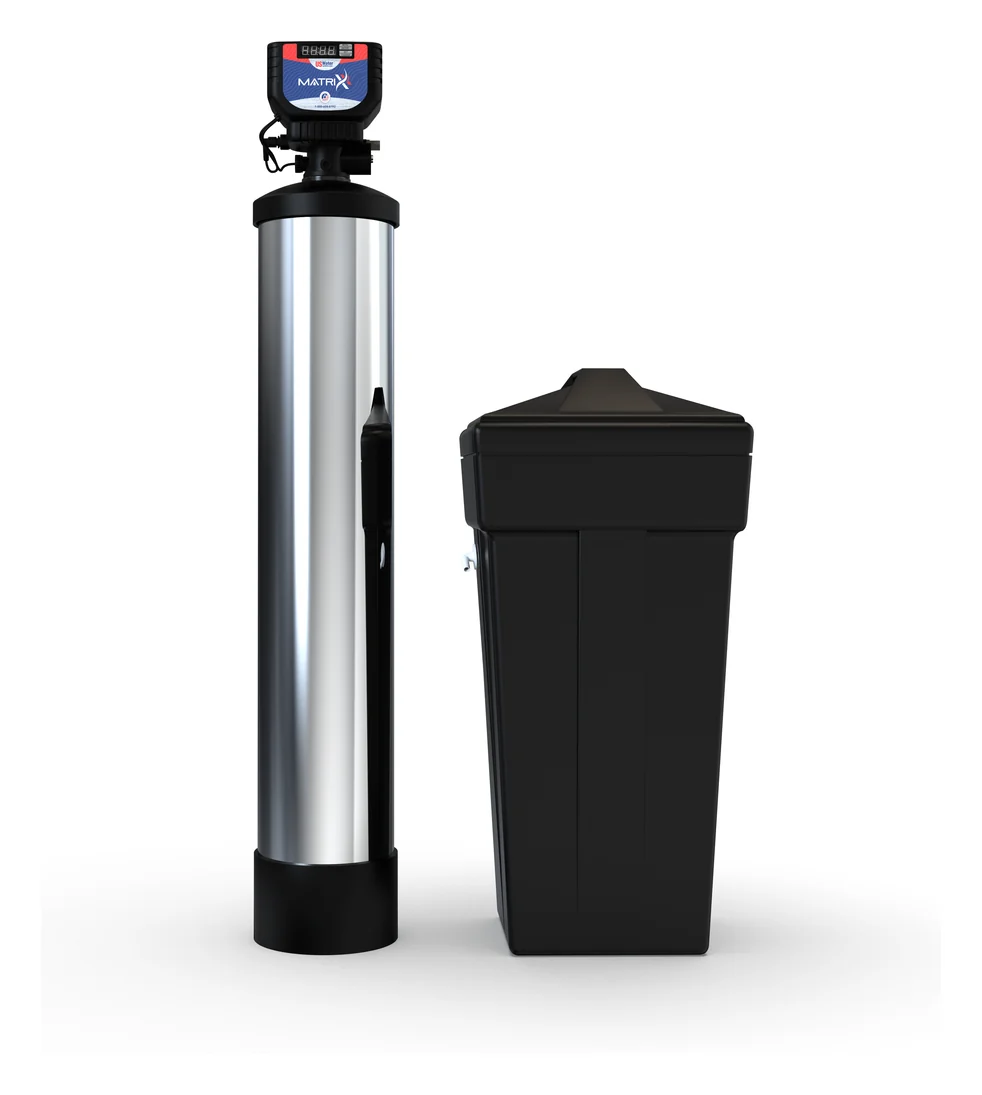
US Water Systems Matrixx Smart Metered Water Softener
Best for: Buyers who want a serviceable, open-valve softener backed by real technical support, the softener plumbers buy for themselves
- Valve
- Smart metered electronic valve with Bluetooth
- Valve platform
- Open standard, rebuildable, not proprietary
- Support
- 7-day hotline staffed by water technicians
SpringWell
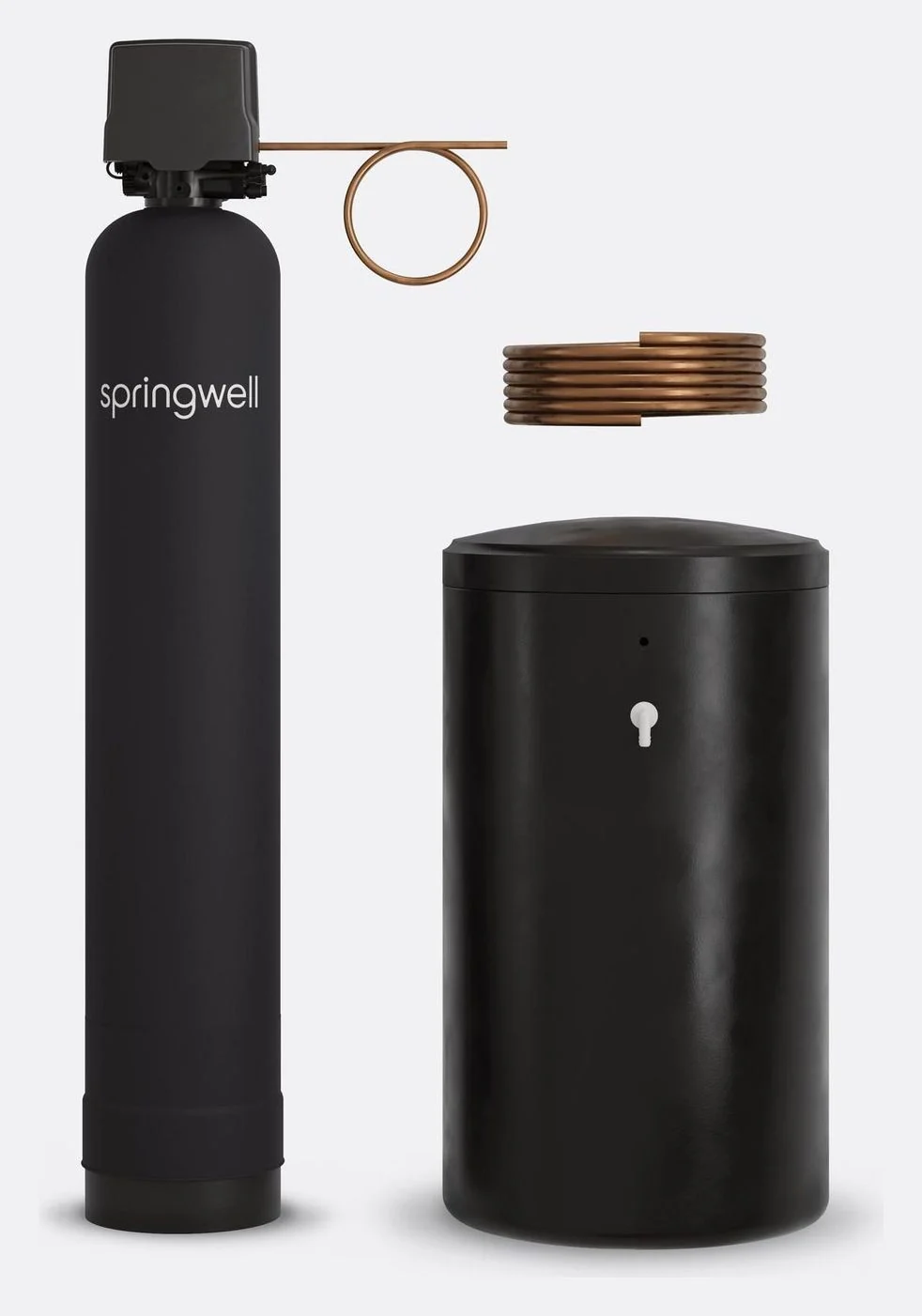
SpringWell SS1 Salt Based Water Softener
Best for: Homes with 1 to 3 bathrooms on hard city water that want true ion-exchange softening at a factory-direct price
- Grain capacity
- 32,000
- Service flow
- 11 GPM
- Bathrooms
- 1 to 3
- Tank
- 9" × 48" (57" with head)
- Connection
- 1"
- Brine tank
- 18" × 33" round (~200 lb salt)
The SpringWell SS1 read $1,606.50 on Sep 28, 2026, with the defect stated up front: its electronic head is covered for 5 years while the tank is covered for life. The wider shortlist of softeners we would replace it with and the whole-house softeners sized for real homes cover every budget.
HomeGuide's page is dated July 14, 2025 and Angi's September 17, 2026; both were read Sep 28, 2026. Water levels, cycle steps and part names quoted from Whirlpool apply to Whirlpool units only. We did not bench-test any repair on this page.
Water softener repair questions people search
How often should a water softener regenerate?
As often as its programmed capacity runs out, which a metered valve works out from the gallons it counts and the hardness you entered. That makes the interval a function of your water use and hardness rather than a fixed number of days. Whirlpool also suggests setting a maximum number of days between recharges so salt does not sit long enough to bridge.
Why is my water softener leaking from the bottom?
Check whether water is running down from above first: the valve head, the bypass or a drain connection. If the only water is under the salt tank, Whirlpool's test is to pour a gallon into the brine well and wait a few hours. If it drains away, the tank is cracked and needs replacing, which Angi prices at $125 to $700.
Why is my water softener bypass valve leaking?
It depends where. Around the retaining clips, the O-rings at that connection need replacing; at a threaded connection, the threaded part does; at either end of the sliding stem, Whirlpool's advice is to replace the bypass valve itself. Exercising the bypass twice a year keeps it from seizing when you need it.
Can you repair a water softener yourself?
Most of the brine-side jobs, yes: breaking a salt bridge, clearing the drain hose, cleaning the venturi, flushing the brine line and swapping a bypass O-ring. Valve seal kits are within reach on some units if the manufacturer publishes the procedure. Resin replacement, broken distributors and electrical faults are technician work on most systems.
Do plumbers repair water softeners?
Yes. HomeGuide notes that licensed plumbers repair water softeners, and water treatment specialists do too. Ask for an itemized estimate with the visit, parts, labor and a hardness test after the repair, and confirm the technician can source parts for your valve before booking.
Frequently asked questions
Is it worth repairing a water softener?
Usually, when the unit is still young, the fault has been identified and the repair costs well under half the price of a new installed system, which is Angi's 50% rule. It stops being worth it when a sealed big-box valve fails out of warranty: a $430 average repair against a $619 Whirlpool WHES44 (last read Sep 12, 2026) is about 70% of a new machine.
How much does water softener repair usually cost?
HomeGuide puts most repairs at $150 to $600 with a $430 national average, plus $40 to $100 for the service call. Angi's figure, from 8,441 projects, is a $559 average with most bills between $162 and $985. Both pages were read Sep 28, 2026.
What are the common problems with water softener systems?
Hard water coming back, salt that is never used, a brine tank full of water, salty water after a regeneration, a unit that never regenerates or never stops, leaks, low pressure, resin beads in the taps, discolored water and electronic faults. Most start on the brine side, at the drain line or at the valve seals.
What is the average life expectancy of a water softener?
Ten to fifteen years, a range HomeGuide, Angi and SpringWell all give. Where a unit lands depends on the valve platform, the water it treats and how it is maintained. Age alone does not diagnose anything: a softener that is ten years old with a blocked drain line needs a drain line, not a new tank.
Keep reading
Not sure what you need?
Answer 5 questions, get the right system for your water.
City or well, budget, household size, our quiz matches your answers against every system we track.