AquaTru Review 2026: The Countertop RO Everyone Advertises, Verified
AquaTru review: we checked the IAPMO certificates, the data sheets and the filter schedule. What the Classic and Carafe really carry, and what they cost a year.
By Home Water Lab TeamUpdated Prices verified Oct 7, 2026
This page contains affiliate links; buying through them costs you nothing extra.
AquaTru is the countertop reverse osmosis brand you've probably heard advertised, and its discount codes get searched almost as often as its reviews. So this review skips the taste test and reads the paperwork: the certificates, the performance data sheets and the filter schedule. The short version is better than the marketing deserves. For how countertop units fit the wider picture, start at our reverse osmosis explainer and buyer's guide.
The short answer
as of Oct 26, 2026Is AquaTru worth buying?
Yes, if you can't plumb. The AquaTru Classic ($475 on aquatru.com, Oct 26, 2026) is certified by IAPMO R&T to NSF/ANSI 42, 53, 58, 372 and 401, and its model appears in IAPMO's public directory under all five. Filters cost about $130 a year. The catch sits in the data sheet, not the ads: AquaTru caps feed water at 10 grains per gallon of hardness, so on hard water it needs softened water or it scales.
Key takeaways
- IAPMO R&T certifies both the Classic and the Carafe to NSF/ANSI 42, 53, 58, 372 and 401, and lists both models in its public directory (Oct 26, 2026).
- The data sheets rate the Classic at 54 gallons a day and 75% efficiency, the Carafe at 35 gallons a day and 63%.
- Filters cost about $129.83 a year at aquatru.com prices; the two-year pack works out the same.
- The Carafe's 600-gallon membrane lasts about 20 months at a gallon a day, not the 24 the ads imply.
- Both data sheets cap feed water at 10 gpg (171 mg/L) of hardness.
Is AquaTru Reverse Osmosis Legit? The Certificates, Checked#
It is. Both models carry a named certifier, named standards and a public listing you can check yourself, which puts AquaTru on the top rung of countertop paperwork.
The product pages themselves are vague: "independently tested and certified by IAPMO to NSF standards to reduce 84 contaminants", with no standard numbers in the text. The detail lives in the performance data sheets linked from those pages. The Classic's sheet (models AT2000 to AT2050) and the Carafe's (models AT100 to AT140) both state certification by IAPMO R&T to NSF/ANSI 42, 53, 58, 372 and 401. We then searched IAPMO R&T's public directory by model number on Oct 26, 2026. AT2000, AT2050, AT100 and AT140 all return AquaTru's active files for those five standards.
Data sheet and IAPMO directory agree
as of Oct 26, 2026- Classic5 of 5Data sheet rev. 10.24 R4 states all five; IAPMO's directory returns the model under all five files.
- Carafe5 of 5Data sheet rev. 09.25 R5 states all five, including NSF/ANSI 58; IAPMO's directory returns AT100 and AT140 under the 58 file.
Solid dot: the standard is stated on the model's performance data sheet and the model is returned under an active AquaTru, LLC file for it in IAPMO R&T's public directory, searched by listed model on Oct 26, 2026.
One correction belongs here. In September we read the Carafe's product page as listing NSF 42, 53 and 401 without NSF 58, and said so on this site. The current data sheet and IAPMO's directory both include 58 for the Carafe, so that's what we now report. A certificate trumps a marketing page, including our earlier reading of one.
What "84 Contaminants" Means on Paper#
It means 84 reduction claims spread across four performance standards, each with a tested percentage on the data sheet. The number sounds like marketing; the sheet behind it is specific.
87.1%
The NSF/ANSI 58 table on the Classic's sheet lists lead at a 99.1% average reduction, fluoride at 93.5%, hexavalent chromium at 97.2% and pentavalent arsenic at 98.0%. Microplastics in the 0.5 to 1 micron range sit under NSF/ANSI 401 at 96.48%, and PFOA and PFOS under NSF/ANSI 53. Those are lab figures under standard conditions, and the sheet says so: "actual performance may vary".
What you hear
Certified to remove 84 contaminants means it removes 84 contaminants from your water.
What the numbers say
It means the unit met a reduction threshold for each of 84 substances at a laboratory challenge level. Most of them won't be in your tap water at all, and the ones that are come out by the stated percentage, not to zero. Read the data sheet line for the contaminant you actually have.
AquaTru Classic vs Carafe#
Same four-stage design, same certifications, different capacity. The Classic is the household unit; the Carafe is the one-or-two-person unit with a glass jug.
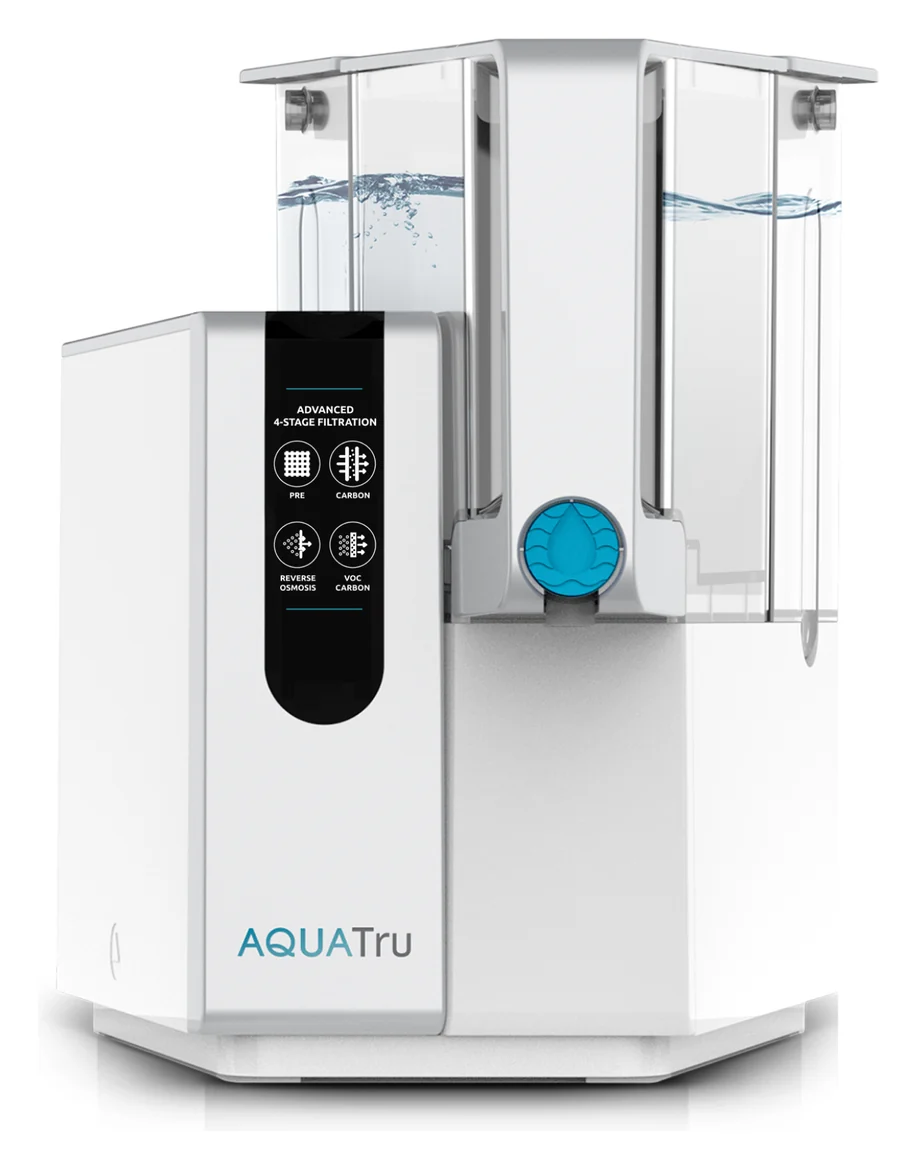
AquaTru
AquaTru Classic Countertop Reverse Osmosis Purifier
Best for: Renters and anyone who wants named, third-party RO certification without touching a pipe
- Install
- None, 120V plug and a countertop
- Stages
- 4 (pre/carbon, RO membrane, VOC carbon)
- Clean tank
- 0.75 gallon
- Certification
- Tested and certified by IAPMO to NSF 42, 53, 58 and 401 (data sheet adds 372)
- Filter life
- 6 months or 600 gal (pre/carbon), 24 months or 1,200 gal (RO), whichever comes first
- Replacement filters
- $59.95 RO, $39.95 VOC carbon, $49.95 Mineral Boost
Classic, $475
- 0.75 gallon clean tank
- 54 GPD rated, 75% efficiency
- Membrane: 24 months or 1,200 gal
- 12 x 14 x 14 in, about 17 lb
Carafe, $375
- 0.5 gallon tank plus a 64 oz glass carafe
- 35 GPD rated, 63% efficiency
- Membrane: 24 months or 600 gal
- 7.5 x 14 x 13 in, about 9 lb
Bottom line
Pick by people, not price. Three or more drinkers outrun the Carafe's tank and its 600-gallon membrane.
AquaTru
AquaTru Carafe Countertop Reverse Osmosis Purifier
Best for: One or two people in a small kitchen who want RO water in a glass carafe rather than a plastic tank
- Install
- None, 120V plug
- Stages
- 4 (pre/carbon, RO membrane, VOC carbon)
- Clean tank
- 0.5 gallon, plus a 64 oz glass carafe
- Certification
- Certified by IAPMO R&T to NSF/ANSI 42, 53, 58, 372 and 401 (data sheet rev. 09.25)
- Footprint
- 13 in H x 14 in D x 7.5 in W, about 9 lb
- Filter life
- Data sheet: 6 months or 300 gal (pre/carbon), 12 months or 300 gal (VOC), 24 months or 600 gal (RO)
Efficiency here is the data sheet's own term: the share of the water you pour in that comes out as purified water under typical use. At 75%, the Classic returns roughly three parts of clean water for one part of reject (our arithmetic); at 63%, the Carafe sends more back to its reject chamber. You pour that reject away by hand. Every time. Both units also offer a Smart version ($525 and $425) and an Alkaline Mineral Boost filter option ($495 and $395); the alkaline filter comparison covers whether that stage is worth it.
How Long Do AquaTru Filters Last?#
Months or gallons, whichever comes first. The ads quote the months; the gallons decide it on the Carafe.
Months or gallons, whichever comes first
as of Oct 26, 2026- Time limit on the data sheetThe outline runs to the month figure the maker prints, the one marketing quotes.
- Ends on timeAt 1 gallon a day this cartridge reaches its month limit before its gallon limit.
- Ends on gallonsAt 1 gallon a day the gallon limit arrives first, so the real interval is shorter than the month figure.
Limits from the AquaTru Classic (rev. 10.24 R4) and Carafe (rev. 09.25 R5) Performance Data Sheets, read Oct 26, 2026. Month equivalent of a gallon limit is our arithmetic at 1 gallon a day; a heavier household moves every amber bar to the left.
The Classic sheet sets the pre/carbon filter at 6 months or 600 gallons, the VOC carbon at 12 months or 600 gallons and the membrane at 24 months or 1,200 gallons. At a gallon a day, the months come first on all three. The Carafe halves every gallon figure (300, 300, 600), so the same household spends its VOC filter in about 10 months and its membrane in about 20.
One mismatch. The Carafe product page prints a filter life of "1200/600" gallons in its comparison table, while the data sheet says 300 and 600. We go with the data sheet. It's the document the certification rests on, and the product page isn't.
AquaTru Filter Cost per Year#
About $130, on either model. The cartridges are proprietary, priced the same across the Classic and Carafe on aquatru.com.
That compares fairly with tankless under-sink systems, which run $120 to $183 a year in cartridges on Waterdrop's own figures, as our Waterdrop reverse osmosis lineup shows. For the full picture across tank, tankless and countertop systems, see the reverse osmosis system cost guide.

The Hard Water Limit in the Fine Print#
Both data sheets set a maximum feed hardness of 10 grains per gallon (171 mg/L). Above it, AquaTru warns that scale "will build up rapidly on the membrane" and plug it, and says it does not recommend the unit unless the water is softened first.
USGS hardness bands
- Soft, 0 to 60 ppm0 to 3.5 gpg. No scale problem. A softener solves nothing here.
- Moderately hard, 61 to 120 ppm3.6 to 7.0 gpg. Spotting and light scale. Treatment is optional, not urgent.
- Hard, 121 to 180 ppm7.1 to 10.5 gpg. Scale in the water heater, soap that will not lather, film on the glassware.
- Very hard, over 180 ppmOver 10.5 gpg. Appliance territory: scale builds fast in anything that heats water, and it shortens the life of the thing doing the heating.
Limit from the AquaTru Classic and Carafe Performance Data Sheets, read Oct 26, 2026. Bands are the USGS hardness classes; 1 grain per gallon = 17.1 mg/L as calcium carbonate.
No ad mentions it. Yet it's the most useful line in the paperwork for anyone with hard water at home. Test before you buy: our guide to testing water hardness covers strips and drop kits that give a grains-per-gallon figure. If you're over 10, the fix is a softener on the main line, which a renter usually can't fit. Weigh that before paying for any countertop RO: of the countertop makers we read on Oct 26, 2026, AquaTru is simply the only one that prints the limit. A TDS meter won't settle the question, for the reasons in our TDS explainer.
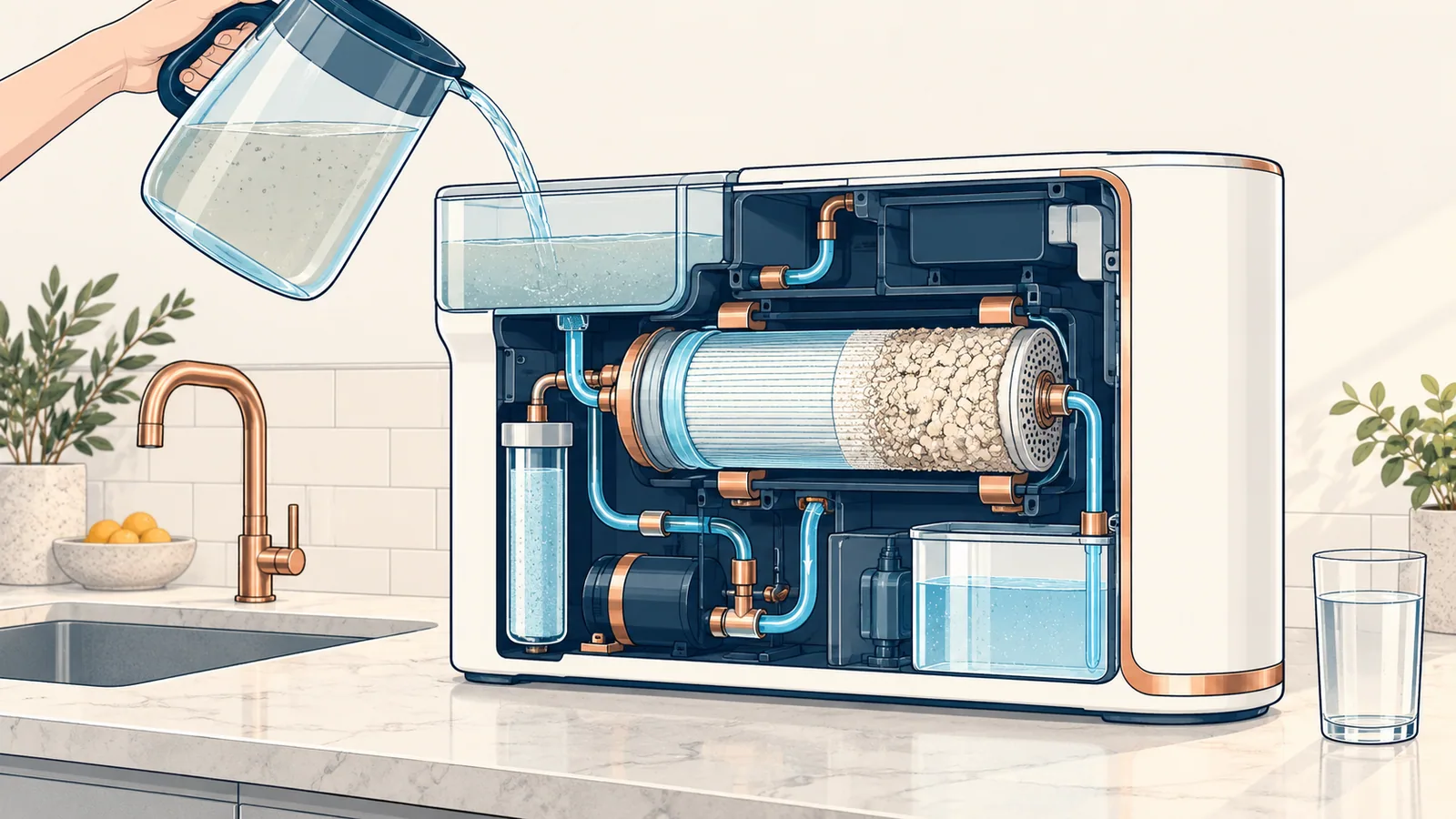
AquaTru vs a Plumbed RO System#
A plumbed system wins on cost and convenience; AquaTru wins on not touching the plumbing. That's the whole trade.
An under-sink RO certified to NSF/ANSI 58 can cost less than the Classic and never asks you to fill a tank or empty a reject chamber. Our under-sink reverse osmosis ranking has the options. If drilling is off the table, AquaTru competes with Waterdrop's M6SL, Bluevua's ROPOT and SimPure's Y7P, ranked on their paperwork in our best countertop reverse osmosis systems. And for a renter's view of countertop filters generally, our countertop water filter picks stay the shorter read.
Who Should Buy an AquaTru#
AquaTru makes sense if all of these hold
5 itemsAnd if your worry is what RO water does to you rather than what it removes, our guide to the health case for RO water answers the mineral question directly.
Prices, dimensions and warranties from aquatru.com. Certifications, reduction percentages, production rates, efficiency, filter limits and the hardness ceiling from the data sheets, cross-checked against IAPMO R&T's public directory by model number. The yearly filter cost is our arithmetic on AquaTru's own prices.
AquaTru questions people actually search
What warranty does AquaTru offer?
A 1-year limited warranty on every purifier, a 30-day money-back guarantee, and an optional 3-year extended warranty at $49.95 for the Classic or the Carafe. On returns, AquaTru says the customer pays shipping and processing fees.
Does the AquaTru need electricity?
Yes. Both countertop models run off a 120-volt wall plug: the pump is what pushes water through the membrane. No power, no purified water.
Is there an AquaTru under-sink model?
Yes, the AquaTru Under Sink at $395 on aquatru.com (Oct 26, 2026), which stores up to 1.7 gallons and uses the Classic's filter family. We did not read its data sheet, so we haven't placed it in the certification grid.
Can AquaTru be used with hot water?
No. The data sheets say cold water only, with an operating range of 39 to 100 F.
Why does my AquaTru need descaling?
Because minerals in the feed water deposit inside the unit, which is why AquaTru sells a descaling kit at $19.95. Harder water means more frequent descaling, and above 10 gpg the data sheet advises softening first.
Frequently asked questions
Is AquaTru really NSF certified?
Yes, by IAPMO R&T rather than by NSF International itself. AquaTru's data sheets state certification to NSF/ANSI 42, 53, 58, 372 and 401, and IAPMO's public directory returns the Classic (model AT2000) and the Carafe (model AT100) under active files for all five standards, searched Oct 26, 2026. NSF/ANSI is the standard; IAPMO is the body that tested it.
How long do AquaTru filters last?
On the data sheets: the Classic pre/carbon filter lasts 6 months or 600 gallons, the VOC filter 12 months or 600 gallons, and the RO membrane 24 months or 1,200 gallons, whichever comes first. The Carafe's limits are tighter at 300, 300 and 600 gallons. At a gallon a day, the Carafe's membrane is spent in about 20 months, not 24.
Does AquaTru remove fluoride?
Yes, and it is certified for it. The Classic's data sheet lists fluoride under NSF/ANSI 58 with a 93.5% average reduction from an 8 mg/L challenge. Lead averages 99.1% and total dissolved solids 87.1% on the same sheet.
What is the difference between the AquaTru Classic and the Carafe?
Size and output. The Classic holds 0.75 gallon of clean water and is rated at 54 gallons a day with a 75% efficiency; the Carafe holds 0.5 gallon plus a 64 oz glass carafe and is rated at 35 gallons a day with a 63% efficiency. Both carry the same five certifications on their data sheets. The Classic costs $475 and the Carafe $375 on aquatru.com, Oct 26, 2026.
Is AquaTru worth the money?
If you can't plumb anything, yes: few countertop units can show a certifier and a public listing this clearly. If you can drill a counter, an under-sink RO system with the same certification costs less and never asks you to fill a tank. Budget about $130 a year for filters either way.
Can I use AquaTru with hard water?
Only up to a point. Both data sheets cap feed water at 10 grains per gallon (171 mg/L) of hardness and say AquaTru does not recommend use above that unless the water is softened first, because scale plugs the membrane. Test your hardness before you buy.
Keep reading

Not sure what you need?
Answer 5 questions, get the right system for your water.
City or well, budget, household size, our quiz matches your answers against every system we track.