What Is TDS in Water? (And Why Your TDS Meter Is Lying to You)
TDS is everything dissolved in your water, in mg/L. The EPA's 500 mg/L figure is about taste, not safety, and a TDS meter can't see lead, PFAS or bacteria.
By Home Water Lab TeamUpdated Prices verified Oct 7, 2026
This page contains affiliate links; buying through them costs you nothing extra.
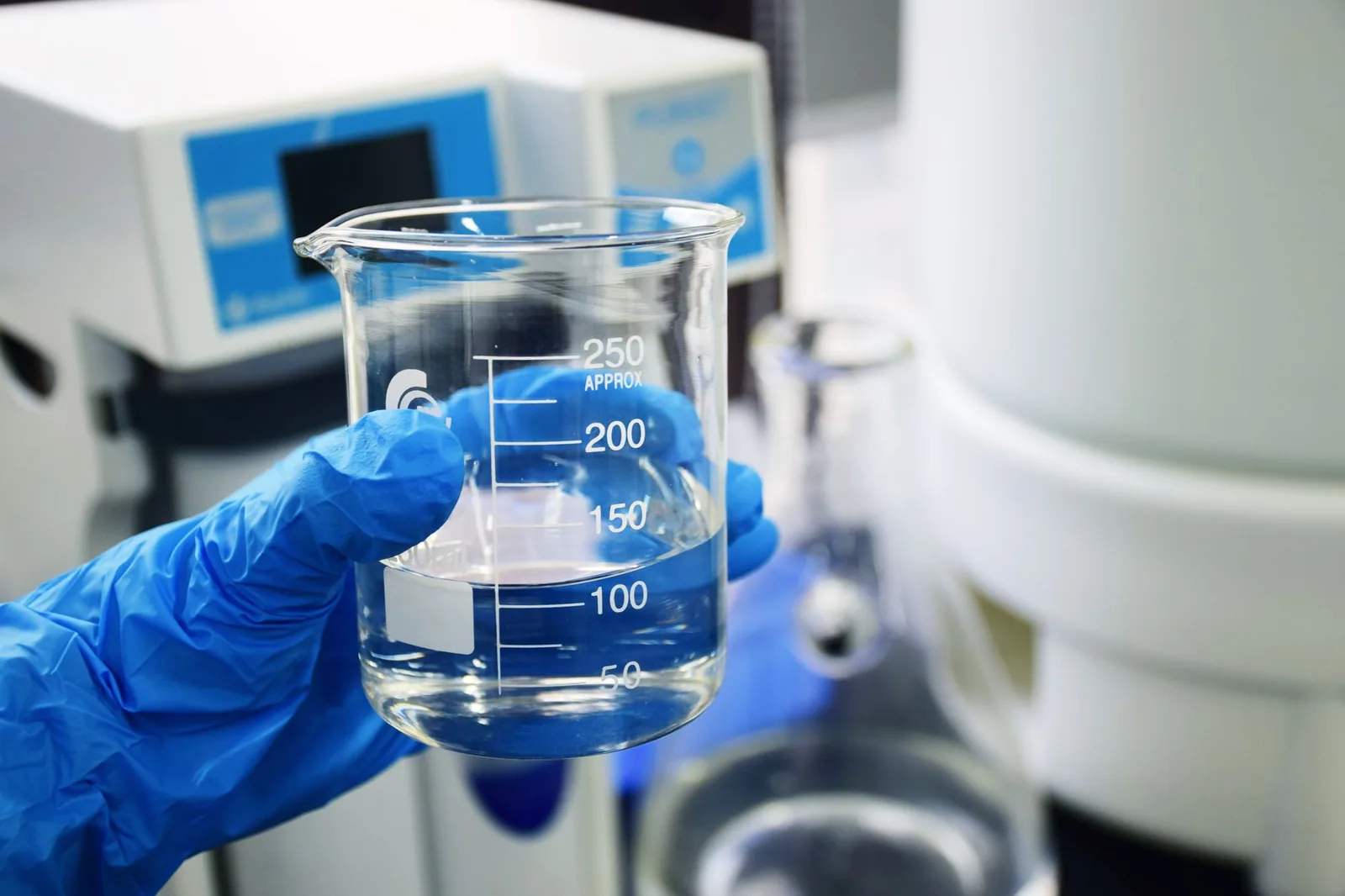
TDS means total dissolved solids, the combined weight of everything dissolved in your water, usually reported in milligrams per liter, which is the same number as parts per million. It's a real measurement and a useful one, but it answers "how much" and never "what." That gap is why a cheap TDS meter makes such a good sales prop, and why it pays to understand how reverse osmosis works and when it pays before a reading talks you into one.
The short answer
as of Oct 12, 2026What is TDS in water?
TDS is the total of all dissolved substances in water, in mg/L (ppm): mostly calcium, magnesium, sodium, potassium, bicarbonate, chloride, sulfate and nitrate (USGS). The EPA's 500 mg/L figure is a secondary, non-enforced standard for taste, staining and deposits, and the WHO proposes no health-based limit for TDS. A TDS meter reads conductivity, so it can't tell calcium from lead and misses bacteria, many pesticides and lead at regulated levels entirely.
Key takeaways
- The EPA lists TDS at 500 mg/L among 15 secondary standards it does not enforce, for nuisances like deposits and a salty taste.
- WHO taste panels rated under 300 mg/L excellent and over 1,200 mg/L unacceptable, and the WHO sets no health-based value for TDS.
- A TDS meter converts conductivity with a factor near 0.5 on a sodium chloride curve; other meters use 0.51 or 0.7, so the same glass can read differently.
- Lead's action level, 0.015 mg/L, is about one sixty-seventh of the 1 ppm step on an HM Digital TDS-3 display.
- Aquasana's SmartFlow RO page lists 96.4% membrane TDS reduction, and adds that TDS meters are not an accurate measure of contamination.
What Does TDS Mean in Water?#
TDS is the sum of all the substances, organic and inorganic, dissolved in water, in the USGS's own definition. In most tap and well water, the bulk of it is a handful of ions: calcium, magnesium, sodium, potassium, bicarbonate, sulfate, chloride, nitrate and silica.
Most of it comes from rock and soil. The USGS traces dissolved solids to water's contact with soils and rocks, then to human sources led by road salt, which it calls a major manmade source of chloride; farm runoff and wastewater add more. That is why TDS varies so much from one supply to the next.
Hardness is a slice of TDS, not a synonym. Calcium and magnesium count toward both numbers, but sodium, chloride and sulfate count only toward TDS, which is why what grains per gallon and mg/L hardness really mean needs its own test.
What Does a TDS Meter Actually Measure?#
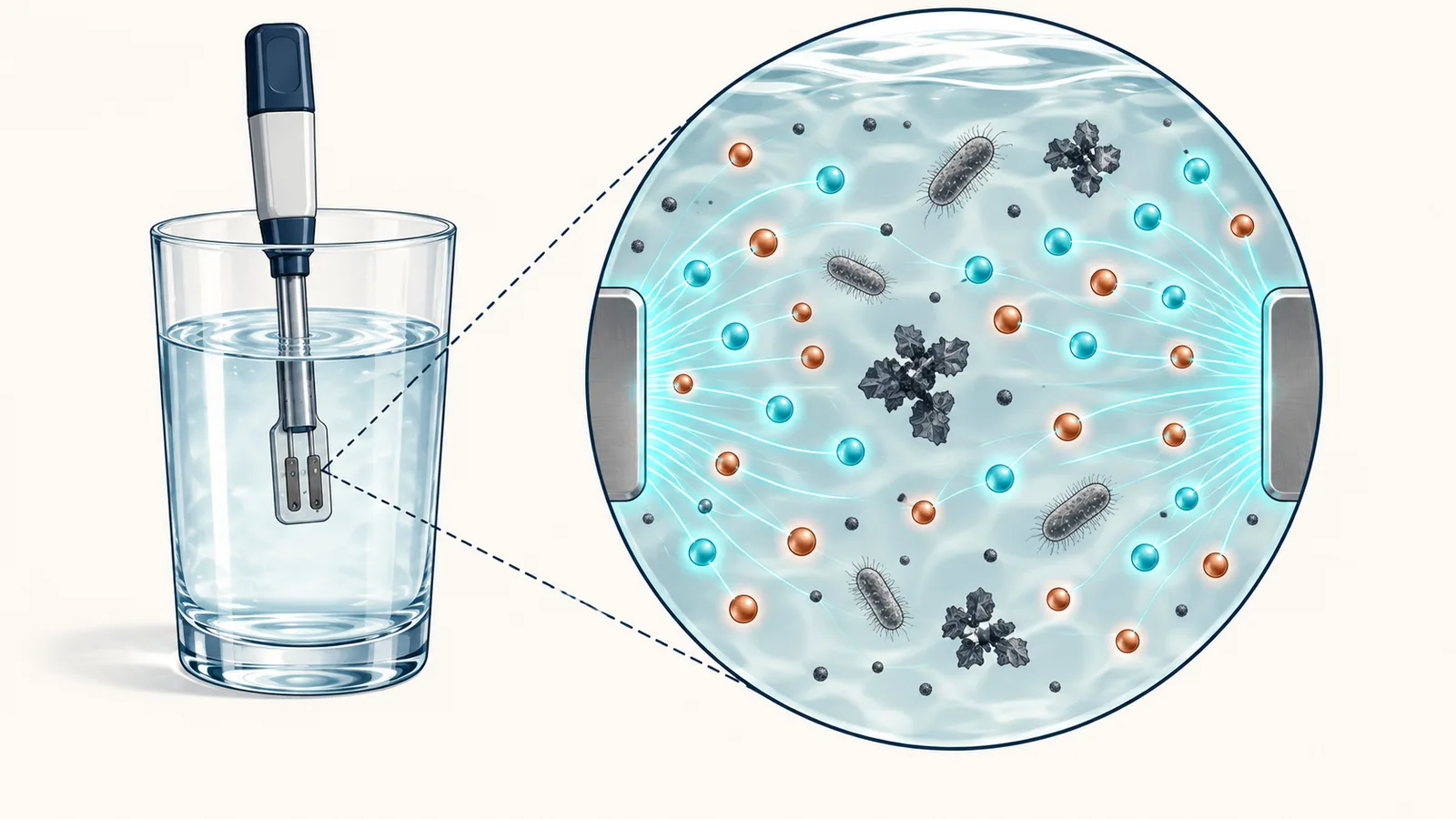
Electrical conductivity, then a conversion. HM Digital's own usage sheet calls TDS meters "conductivity meters" and says they convert microsiemens to ppm by a factor of about 0.5 on a sodium chloride curve, while other meters use a potassium chloride standard (0.51) or the "442" standard (0.7).
So the meter assumes your water behaves like salt water of a known recipe. HM Digital adds that no meter can tell different ionic salts apart, and that even pure water can show 1 or 2 ppm because carbon dioxide from the air dissolves into it. The same sheet suggests calibrating for drinking water somewhere between 90 and 700 ppm.
Inside a TDS reading
- Moves the readingcharged ionsThe USGS lists calcium, magnesium, sodium, potassium, bicarbonate, sulfate, chloride, nitrate and silica as the ions that typically make up most dissolved solids. A meter senses the charged ones as conductivity and converts it to ppm with a fixed factor.
- Invisible to the meterper the makerHM Digital's usage sheet says its meters detect only mobile charged ions: no neutral compounds such as many pesticides, no particles like iron oxide flakes, no bacteria or viruses.
- Too small to registerour arithmeticLead is an ion, but the EPA action level is 0.015 mg/L, and a TDS-3 displays whole ppm from 0 to 999. A glass at the action level moves the display by about one sixty-seventh of one step.
Sources: USGS, Chloride, Salinity, and Dissolved Solids, and USGS Water Science School, Saline Water and Salinity (fresh water under 1,000 ppm); HM Digital TDS meter usage sheet and TDS-3 specifications; WHO background document WHO/SDE/WSH/03.04/16 (taste panel bands, no health-based guideline for TDS); EPA secondary standards (TDS 500 mg/L, not enforced) and National Primary Drinking Water Regulations (lead action level 0.015 mg/L). All read Oct 12, 2026.
HM Digital's sheet says it plainly: "Total charged ions" is a better name for what the meter reads. That is good enough to compare one water with another, and nowhere near enough to call a glass safe.
Is High TDS in Water Bad?#
Not on its own. The EPA lists TDS at 500 mg/L among its secondary standards, which it describes as non-mandatory and does not enforce, and the effects it names run from hardness and deposits to colored water, staining and a salty taste.
The WHO goes further. Its background document on TDS concludes that "no health-based guideline value is proposed for TDS," and it advises that where TDS is very high, the individual constituents should be identified. Limits do exist for some of those constituents: nitrate has an EPA maximum of 10 mg/L.
What you hear
A high TDS reading means your water is unsafe to drink.
What the numbers say
The EPA's 500 mg/L figure is a non-enforced taste and staining guideline, and the WHO sets no health limit for TDS. A high reading means a lot is dissolved; whether any of it matters depends on what it is, which only a lab panel answers.
What a high number does predict is nuisance. Water above 500 mg/L tends to taste salty, in the USGS's words, and hard water at the top of the range scales kettles and water heaters. Those are real costs, just not health ones.
Does a Low TDS Reading Mean Your Water Is Safe?#
No, and this is where the meter misleads people most. The contaminants with the strictest limits sit at concentrations far below anything a TDS display can show, and some of them carry no charge at all.
Bacteria and viruses don't register either, and HM Digital's sheet lists them alongside neutral compounds such as many pesticides and particles like rust flakes as things its meters don't detect. Even a company that sells reverse osmosis says so: Aquasana's SmartFlow FAQ states that TDS meters "are not an accurate measurement for contamination." To check what actually matters in a glass, start with how to check whether your tap water is safe.
What Is a Good TDS Level for Drinking Water?#
There is no health target, only a taste scale. The WHO's background document reports how panels of tasters rated water by its TDS level.
| TDS (mg/L) | WHO taste panel rating |
|---|---|
| Under 300 | Excellent |
| 300 to 600 | Good |
| 600 to 900 | Fair |
| 900 to 1,200 | Poor |
| Over 1,200 | Unacceptable |
Very low TDS has its own drawback: the WHO says water with extremely low TDS can taste flat and insipid and is often corrosive to water supply systems. That is the reason RO units ship with remineralizers, and why a reading of 25 mg/L is a taste result, not a safety grade. Whether very low mineral water is a health problem is covered in our look at whether reverse osmosis water is good for you.
Why Do Reverse Osmosis Sellers Love the TDS Number?#
Because a membrane moves it dramatically, and a dramatic number sells. Aquasana lists 96.4% membrane TDS reduction for the SmartFlow, and TDS reduction is a claim NSF certifies under NSF/ANSI 58; for the plain iSpring RCC7AK it is the only claim NSF lists. A before-and-after reading is an easy demonstration.
The demonstration is honest about one thing only: the membrane is passing fewer ions. It says nothing about what was in the water before, and a remineralizing stage pushes the reading back up on purpose, which is why the iSpring RCC7AK's faucet reading climbs after remineralization and why that alone isn't a fault. Faucets with a live TDS display are a fair way to watch a membrane over time, as long as you remember what they can't see.
What a TDS reading is good for
- Comparing the same water before and after an RO membrane
- Spotting a sudden change in a supply you already know
- Confirming that very salty or brackish water is the problem
What it can't tell you
- Whether lead, arsenic, nitrate or PFAS is present
- Whether bacteria or viruses are present
- Your hardness in grains per gallon
- Whether your water is safe to drink
The call
Use the meter as a before-and-after gauge on a filter you already own. Never use it to decide whether you need one.
How Do You Lower TDS in Water?#
Reverse osmosis is the household tool for it, and distillation is the other. A membrane rated under NSF/ANSI 58 for TDS reduction is the claim to look for, and the reverse osmosis systems we rank by certification all list it.
Aquasana
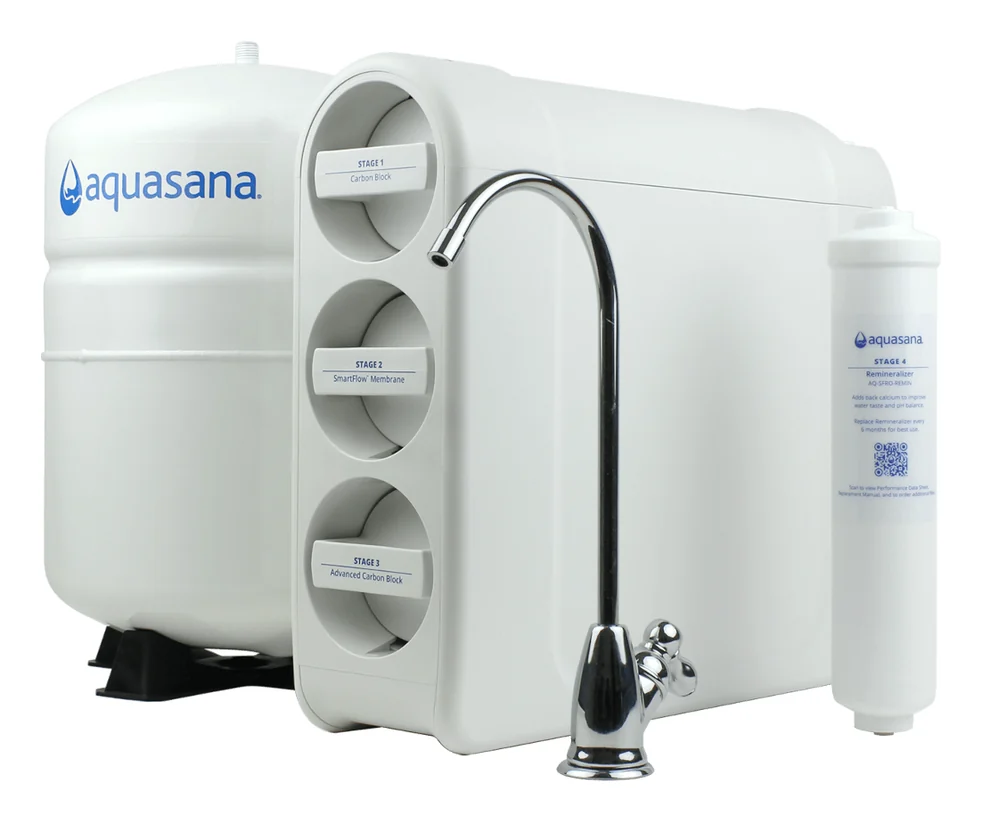
Aquasana SmartFlow Reverse Osmosis System
Best for: Drinking-water protection (PFAS, fluoride, lead) at the best certifications-per-dollar ratio on the market
- Contaminants reduced
- 99.99% of 90 contaminants
- PFAS / fluoride / arsenic
- 96% PFAS (P473), 90% fluoride, 96% arsenic
- Production
- 25.7 gallons/day
- Faucet flow
- 0.7 GPM
- Design
- Compact holding tank (3.2 gallons total, 1.4 to 3.2 usable), remineralizer included
- Filter schedule
- Cartridges 6 months, membrane 12 months
The SmartFlow was $224.99 on Oct 12, 2026 under a 50% off banner and $449.99 at list on Oct 19, certified by WQA to four NSF/ANSI standards, 58 among them. It makes a modest 25.7 gallons a day through a 0.7 GPM faucet, and its remineralizer adds some minerals back. For tank and tankless alternatives, see under-sink reverse osmosis units ranked on certified claims, and for the full bill, what a reverse osmosis system costs to buy and run.
Two common treatments don't lower TDS at all. A salt-based softener trades calcium and magnesium for sodium, so the hardness falls while the dissolved total stays about the same; that's how an ion exchange softener swaps calcium for sodium. Salt-free conditioners, which leave TDS untouched, don't remove the minerals either, as SpringWell and Aquasana both state. Treating every tap for TDS is rarely worth it, which is the argument behind whole house reverse osmosis, and why it rarely makes sense.
Which Test Should You Use Instead of a TDS Meter?#
Match the test to the question. For hardness, a titration kit; for safety, your utility's report or a certified lab panel that names each contaminant; for TDS itself, a meter is fine.
Four tests, four questions
- Test stripa rangeReads total hardness as a color band. The WaterWorks chart steps from 120 to 180 to 250 to 425 ppm, so a strip tells you which band you are in, not where inside it.
- Drop titrationthe home standardCounts drops of titrant until the sample turns blue. Hach rates its 5-B kit at 1 drop = 1 gpg and Hanna rates the HI38033 in 1 gpg steps: a number you can program a softener with.
- TDS meternot a hardness testMeasures conductivity and converts it as if every dissolved ion were sodium chloride (HM Digital calibrates its TDS-3 on a 342 ppm NaCl solution). Calcium, magnesium and sodium all land in the same number.
- Certified labthe only full answerMeasures calcium and magnesium separately, then reports hardness in mg/L and gpg alongside iron, manganese, nitrate and bacteria, on a panel that lists them. The EPA's annual well test list is total coliform, nitrates, TDS and pH.
Solid dot: answers it. Half dot: answers it as a range only. Ring with a bar: cannot answer it. Column heads, left to right: total hardness (calcium plus magnesium), a reading precise to 1 grain per gallon, total dissolved solids, and a health panel (bacteria, nitrate, metals). Sources: Hach, Hanna Instruments, Industrial Test Systems, HM Digital and Tap Score product pages, and the EPA private well testing page, all read Oct 5, 2026.
The hardness test kits we compared, strips to titration, cover the hardness side, and if a membrane is where you're headed, a short quiz that matches a system to your water narrows the field.
All read Oct 12, 2026: USGS, Chloride, Salinity, and Dissolved Solids (2019) and the Water Science School pages on salinity and conductivity (Aug 24, 2026); the WHO background document on total dissolved solids (WHO/SDE/WSH/03.04/16, 2003, first published 1996); EPA secondary drinking water standards (updated May 26, 2026) and the National Primary Drinking Water Regulations table (Aug 31, 2026); HM Digital's TDS-3 specifications and its TDS meter usage and calibration sheet; Aquasana's SmartFlow RO product page and FAQ. The softener and conditioner points come from Crystal Quest and from SpringWell and Aquasana pages logged on this site earlier. We did not bench-test any meter for this page.
TDS questions people ask
Is 25 TDS safe for drinking water?
TDS doesn't measure safety, so the number can't answer that. A reading of 25 mg/L sits in the WHO taste panels' excellent band. Whether that water is safe depends on contaminants a TDS meter can't see.
What if TDS is less than 50?
It is very low in mineral content, as RO, distilled or very soft water can be. The WHO notes that extremely low TDS water can taste flat and is often corrosive to water supply systems, which is why many RO units add a remineralizer stage.
Who sets the TDS standard for drinking water?
In the US, the EPA lists 500 mg/L as a secondary standard, a non-enforced guideline for taste and staining. The WHO publishes taste ratings by TDS band and proposes no health-based guideline value. The USGS calls water fresh below 1,000 ppm.
How do you reduce TDS in water without RO?
Distillation also removes dissolved solids. Softeners and salt-free conditioners do not lower TDS: a softener swaps calcium and magnesium for sodium, and a conditioner leaves the minerals in place.
Frequently asked questions
What is TDS in water?
TDS stands for total dissolved solids: the sum of all the substances, organic and inorganic, dissolved in water, in milligrams per liter (the same as ppm). The USGS lists calcium, magnesium, sodium, potassium, bicarbonate, sulfate, chloride, nitrate and silica as the usual bulk of it. It tells you how much is dissolved, not what, and not whether any of it is harmful.
Is high TDS in water bad?
Not by itself. The EPA's 500 mg/L figure for TDS is a secondary standard it does not enforce, set for hardness, deposits, colored water, staining and salty taste. The WHO proposes no health-based guideline value for TDS at all. A high reading is a reason to find out which constituents make it up, because limits exist for some of them, such as nitrate.
Does a low TDS reading mean my water is safe?
No. A TDS meter is a conductivity meter, and its maker's own usage sheet says it does not detect bacteria, viruses or neutral compounds such as many pesticides. Lead at the EPA action level is 0.015 mg/L, far below the 1 ppm step a common meter displays. Aquasana's own FAQ says TDS meters are not an accurate measurement for contamination.
What is a good TDS level for drinking water?
There is no health target, only taste. WHO taste panels rated water under 300 mg/L as excellent, 300 to 600 good, 600 to 900 fair, 900 to 1,200 poor and above 1,200 unacceptable. Very low TDS can taste flat, and the WHO notes it is often corrosive to pipes.
Keep reading

Not sure what you need?
Answer 5 questions, get the right system for your water.
City or well, budget, household size, our quiz matches your answers against every system we track.