Is Reverse Osmosis Water Good for You? What the Science Says
RO water is safe to drink with a normal diet, per Germany's BfR. What the WHO says about minerals, why RO water reads acidic, and when remineralizing helps.
By Home Water Lab TeamUpdated Prices verified Oct 7, 2026
This page contains affiliate links; buying through them costs you nothing extra.
Reverse osmosis water is good for you in the way clean water is good for you: it removes things you don't want, and the minerals it also removes are a small part of what your body gets from food. That's the conclusion Germany's federal risk assessment institute reached in 2020, and the World Health Organization sets no minimum mineral level for drinking water. The real trade-offs are fluoride, wastewater and taste, which is where how a reverse osmosis system works starts to matter.
The short answer
as of Oct 19, 2026Is reverse osmosis water good for you?
Yes, for anyone eating a balanced diet. Germany's BfR concluded in 2020 that very low mineral water has no long-term adverse health effects at normal drinking quantities, because food is the main source of minerals, and the WHO proposes no minimum or maximum mineral level. RO removes parasites, bacteria, viruses, lead, copper and sodium (CDC). The honest downsides: it removes most fluoride (ADA), reads mildly acidic, and a typical unit drains 5 gallons or more per gallon made (EPA).

Key takeaways
- Germany's BfR (Opinion 041/2020) found no long-term health effect from very low mineral water with a balanced diet and normal drinking.
- The WHO's guidelines propose no guideline value for calcium or magnesium in drinking water: the evidence 'does not prove causality'.
- The CDC lists parasites, bacteria, viruses, lead, copper, chromium, chloride and sodium among what reverse osmosis removes.
- RO permeate can read as low as pH 5 (AIChE, 2014), because dissolved carbon dioxide passes the membrane.
- A typical RO unit drains 5 gallons or more per gallon of drinking water; WaterSense models are capped at 2.3 (EPA).
Is Reverse Osmosis Water Safe to Drink?#
Yes. Removing contaminants is the point of the membrane, and the CDC lists parasites, bacteria and viruses alongside chemicals such as lead, copper, chromium, chloride and sodium among what reverse osmosis takes out. It adds that RO may also reduce arsenic, fluoride, nitrate, radium and sulfate.
Two caveats keep that claim honest. The CDC's own advice is to check the system's label for the specific chemicals it removes, which in practice means the NSF/ANSI 58 claims list. And home units aren't sold as disinfection: iSpring's FAQ for the RCC7AK says its system "is not designed to disinfect your water," and Aquasana's data sheets warn against use with water that is microbiologically unsafe. On a private well with a bacteria problem, RO is not the fix.
Through the membrane
- RemovedCDCThe CDC lists parasites, bacteria and viruses, plus chemicals including lead, copper, chromium, chloride and sodium. Home units are still not sold as disinfection: iSpring and Aquasana both say so in their own documents.
- May be reducedcheck the labelArsenic, fluoride, radium, sulfate, calcium, magnesium, potassium, nitrate and phosphorus. The CDC's advice is to check the system's label for the specific chemicals it removes.
- Passes througha gasDissolved carbon dioxide crosses the membrane while most bicarbonate stays behind, so the treated water reads more acidic. A 2014 AIChE paper measured permeate as low as pH 5.
Sources: CDC, About Home Water Treatment Systems (Apr 10, 2024); Mallick et al., pH of Reverse Osmosis Permeate Water, AIChE 2014 Annual Meeting; USGS Water Science School, pH and Water; EPA secondary drinking water standards (pH 6.5 to 8.5, not enforced). Read Oct 19, 2026. Columns show a selection of each CDC list.
Is Drinking Demineralized Water Bad for You?#
Not for people who eat normally. The worry comes mostly from a 2005 paper on demineralized water that the WHO published in its Nutrients in Drinking Water report, and it is the source behind most "RO water leaches minerals" posts.
Germany's Federal Institute for Risk Assessment (BfR) took that paper apart in Opinion No 041/2020. It noted that the paper rests largely on older studies written in Russian and a 1980 WHO document described only as an internal working document, and it called the paper's statements "outdated." Its own conclusion: water with very low mineral content does not have any long-term adverse effects on health, "assuming a balanced diet and normal drinking quantities."
What you hear
RO water pulls minerals out of your body.
What the numbers say
Germany's BfR reviewed the evidence in 2020 and found no long-term adverse health effect from very low mineral water for people with a balanced diet. The one human study it found showing harm involved 9.2 liters of demineralized water in seven hours, which the BfR judged of limited relevance.
The WHO's current position is the same in more cautious words. Its guidelines, quoted by the BfR, say drinking water "can be a contributor to calcium and magnesium intake and could be important for those who are marginal" in those minerals, that the heart-health evidence "is being debated and does not prove causality," and that "no guideline values are proposed."
Who Should Think Twice About Drinking Only RO Water?#
People whose diet leaves them short on minerals, if RO water is their main drink for a long time. The BfR names them: people with very unbalanced diets, people who avoid whole food groups such as dairy (vegans, lactose intolerance), people on long fasts, and pregnant or breastfeeding women.
It adds one more case. For prolonged exercise or strenuous physical work beyond about 90 minutes, it advises against very low mineral water as the sole drink to replenish fluids. None of that is a reason to avoid RO; it is a reason to pay attention to calcium and magnesium in food, or to pick a system that adds some back.
What Is the pH of RO Water, and Is It Acidic?#
Mildly acidic, usually somewhere below 7. Carbon dioxide is a dissolved gas, and it passes through the membrane while most of the bicarbonate that buffers it stays behind, so the treated water's pH drops. A paper presented at the 2014 AIChE annual meeting by a New Mexico State University team found that permeate pH "can get as low as 5," and that the carbon dioxide and bicarbonate balance of the feed water is one of the main factors.
That flat, slightly sour taste is also what the WHO describes in its background document on dissolved solids, which says water with extremely low TDS can taste flat and insipid and is often corrosive to supply systems. It is the reason many RO systems end with a mineral stage, and what a TDS reading can and can't tell you explains why that stage pushes the meter back up on purpose.
Does Reverse Osmosis Remove Fluoride?#
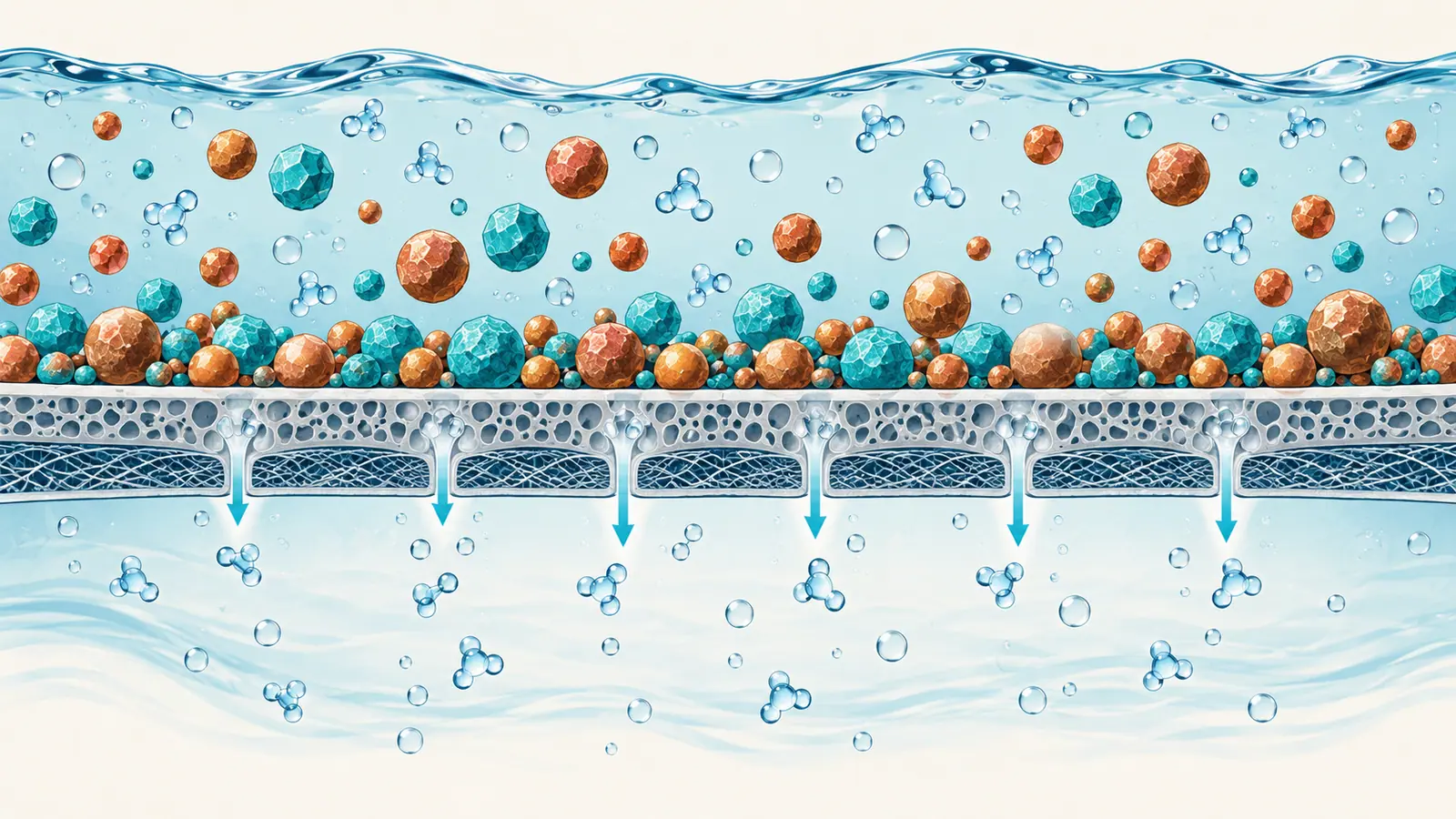
Yes, most of it. The American Dental Association's Fluoridation Facts says almost all reverse osmosis systems and distillation units remove most of the fluoride from water when working properly, and that most carbon filters do not.
That cuts both ways. If you want fluoride out, RO is one of the few home methods that does it. If your utility fluoridates on purpose and RO water becomes your family's main drink, the ADA suggests checking local fluoride levels and talking to your dentist, because you may be giving up its decay-preventive effect. A carbon filter, like the ones in our under-sink filter comparison, leaves it in.
Is Reverse Osmosis Water the Same as Distilled Water?#
No. Both end up very low in minerals, but they get there differently: RO pushes water through a membrane with pores of about 0.0001 micron, per the CDC, while distillation boils water and collects the steam as it condenses.
Reverse osmosis
- Membrane under household water pressure
- Removes most dissolved minerals and many contaminants
- Dissolved carbon dioxide passes, so pH drops
- Sends reject water to the drain
Distillation
- Boils water, condenses the steam
- Leaves dissolved minerals behind in the boiler
- Needs power for every batch
- Slow, countertop scale
For a kitchen
RO is the practical one for daily drinking water. Distillation makes sense for small volumes, like a humidifier or a CPAP.
How Do You Add Minerals Back to RO Water?#
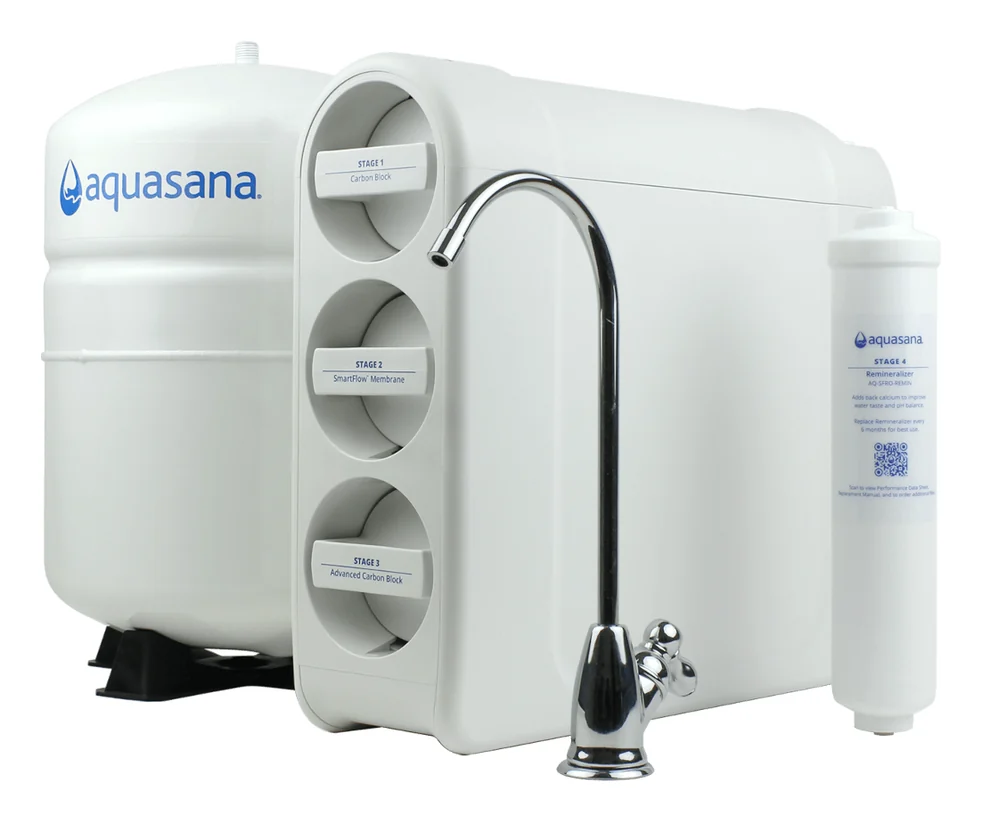
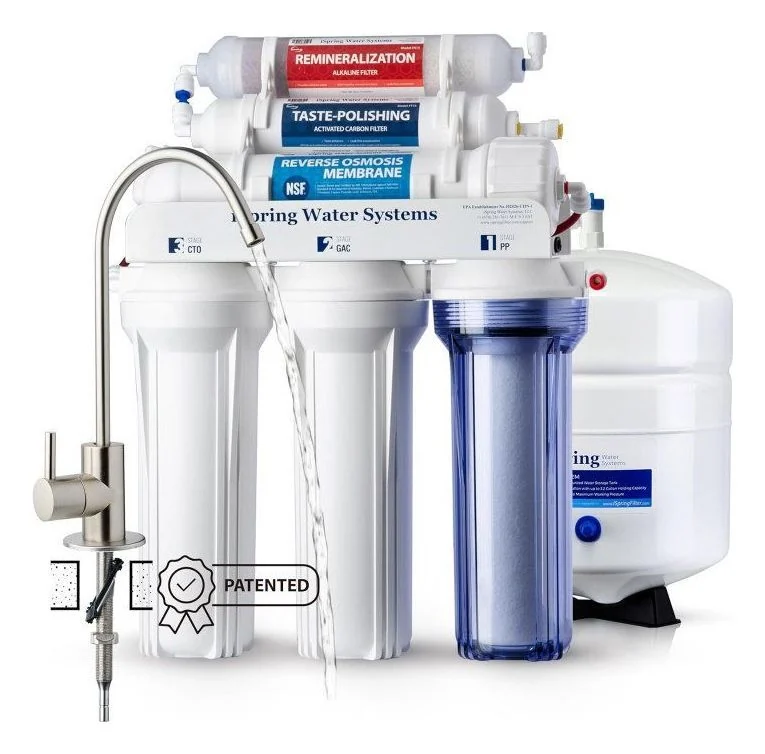
Pick a system with a remineralization stage. Aquasana says the SmartFlow's remineralizer is "designed to replace healthy minerals lost in the reverse osmosis process," and iSpring says the alkaline stage of its RCC7AK uses calcite and magnesium oxide to add 30 to 60 mg/L back.
Aquasana
Aquasana SmartFlow Reverse Osmosis System
Best for: Drinking-water protection (PFAS, fluoride, lead) at the best certifications-per-dollar ratio on the market
- Contaminants reduced
- 99.99% of 90 contaminants
- PFAS / fluoride / arsenic
- 96% PFAS (P473), 90% fluoride, 96% arsenic
- Production
- 25.7 gallons/day
- Faucet flow
- 0.7 GPM
- Design
- Compact holding tank (3.2 gallons total, 1.4 to 3.2 usable), remineralizer included
- Filter schedule
- Cartridges 6 months, membrane 12 months
The SmartFlow read $449.99 at list on Oct 19, 2026, and $224.99 on sale on Oct 5, and it showed out of stock on the 19th. The iSpring read $239.99 on Oct 12, 2026 and costs less to feed each year, as our iSpring RCC7AK review works through. For every option side by side, see the reverse osmosis systems we rank by certification, and for countertop units that need no plumbing, our countertop filter picks. If it's an alkaline stage specifically you're after, our guide to alkaline water filters weighs the health claims before ranking the systems that have one.
iSpring
iSpring RCC7AK 6-Stage Reverse Osmosis System
Best for: A proven, cheap-to-run 6-stage under-sink RO with a very large owner base
- Stages
- 6 (with alkaline remineralization)
- Certification
- NSF/ANSI 58
- Waste ratio
- ~1:3 (classic tank design)
- Annual filter cost
- ~$100 to 110
What About the Water It Wastes?#
This is the downside that is easiest to measure. The EPA says a typical point-of-use RO unit generates five gallons or more of reject water for every gallon of treated water, and some go up to ten; a WaterSense-labeled system must send 2.3 gallons or less down the drain per gallon.
Tankless designs with better ratios exist, and our tankless RO rankings compare them on drain ratio. What doesn't make sense, for health or for water, is treating the whole house: whole house reverse osmosis multiplies the waste to protect taps you never drink from.
Before you buy an RO system
6 itemsThe yearly filter bill is usually bigger than people expect, which is why what an RO system costs to own is worth a look before checkout. If you're not sure your water needs RO at all, start with how to tell whether your tap water is safe, or let our quiz match a system to your water.
BfR Opinion No 041/2020, Health risk assessment of mineral water with very low mineral content (Sep 14, 2020), which quotes the hardness chapter of the WHO Guidelines for Drinking-water Quality; WHO background document on total dissolved solids (WHO/SDE/WSH/03.04/16); CDC, About Home Water Treatment Systems (Apr 10, 2024); EPA WaterSense, Point-of-Use Reverse Osmosis Systems (Aug 21, 2026) and secondary drinking water standards; ADA, Fluoridation Facts (2025); USGS Water Science School, pH and Water; Mallick et al., AIChE 2014 Annual Meeting; Aquasana SmartFlow and iSpring RCC7AK product pages. This page is general information, not medical advice.
Reverse osmosis water questions
Is it healthy to drink reverse osmosis water every day?
For people with a balanced diet, yes. Germany's BfR found no long-term adverse effect from very low mineral water at normal drinking quantities. It suggests that people with very unbalanced diets, those avoiding food groups, long fasters and pregnant or breastfeeding women watch their mineral intake if such water is their main drink.
Is reverse osmosis water hard on kidneys?
We found no health agency saying so. The BfR and WHO documents we reviewed discuss mineral intake and heart health, not kidney harm, and the BfR found no long-term adverse effect for people with a balanced diet. Anyone with kidney disease should follow their doctor's advice on fluids and minerals.
Does RO water have minerals?
Very few unless the system adds them back. The CDC lists calcium, magnesium and potassium among the substances RO may reduce. Systems with a remineralization stage, such as the Aquasana SmartFlow or the iSpring RCC7AK, put some calcium and magnesium back after the membrane.
Can you drink reverse osmosis water without remineralizing?
Yes. Remineralizing is mostly about taste and pH; the WHO proposes no minimum mineral level for drinking water, and the BfR found very low mineral water safe with a balanced diet. Some people find unremineralized RO water flat, which the WHO's background document also describes.
Frequently asked questions
Is reverse osmosis water good for you?
For most people it is simply clean water. Germany's Federal Institute for Risk Assessment (BfR) concluded in 2020 that water with very low mineral content has no long-term adverse health effects, assuming a balanced diet and normal drinking quantities, because food supplies most of our minerals. What RO water does well is remove contaminants: the CDC lists parasites, bacteria, viruses, lead, copper and sodium among the things it removes.
Is there a downside to drinking reverse osmosis water?
Three real ones, none of them dramatic. It strips calcium and magnesium along with the contaminants, which matters mainly for people whose diet is short on both. It removes most fluoride, according to the American Dental Association. And a typical system sends five gallons or more down the drain for every gallon it makes, per the EPA, unless it carries the WaterSense label (2.3 gallons or less).
Is reverse osmosis water the same as distilled water?
No, though both end up very low in minerals. Reverse osmosis pushes water through a membrane with pores of about 0.0001 micron, per the CDC; distillation boils water and collects the steam as it condenses. Dissolved carbon dioxide passes through an RO membrane, so RO water usually reads a little acidic; how pure each one is depends on the system.
Is RO water acidic?
Mildly. Carbon dioxide dissolved in the feed water crosses the membrane while most of the bicarbonate that buffers it is held back, so the pH drops. A 2014 paper presented at the AIChE annual meeting measured permeate as low as pH 5. For comparison, the USGS puts normal rain at about 5.6 for the same reason. It is a taste and plumbing question, not a stomach one.
Does reverse osmosis remove fluoride?
Mostly, yes. The American Dental Association says almost all reverse osmosis systems and distillation units remove most of the fluoride from water when working properly, while most carbon filters do not. If your utility fluoridates and RO water is your main drink, the ADA suggests checking with your dentist about whether you are missing its decay-preventive effect.
Is RO water banned in Europe?
We found no such ban. The claim usually traces back to a 2005 paper published by the World Health Organization on demineralized water. When Germany's BfR reviewed that question in 2020, it called the paper's statements outdated and found no long-term risk from very low mineral water for people eating a balanced diet. German law even has a label for it: mineral water with 50 mg/L or less of dissolved solids can be sold as having very low mineral content.
Keep reading
Not sure what you need?
Answer 5 questions, get the right system for your water.
City or well, budget, household size, our quiz matches your answers against every system we track.