Best Alkaline Water Filters 2026 (And Whether Alkaline Is Worth It)
Alkaline filters add a little calcium and magnesium; Mayo Clinic says alkaline water isn't better for most people. The certified picks, and what the claims skip.
By Home Water Lab TeamUpdated Prices verified Oct 7, 2026
This page contains affiliate links; buying through them costs you nothing extra.
An alkaline water filter adds a small dose of calcium and magnesium to your water and nudges its pH above neutral. That part works. What it won't do is change your body's pH or prevent cancer, and Mayo Clinic's answer to the question is short: for most people, alkaline water isn't better than plain water. If you want it anyway, for taste or because RO water tastes flat to you, the right buy is a certified reverse osmosis system with a mineral stage, not a pitcher with a pH sticker.
The short answer
as of Oct 26, 2026What is the best alkaline water filter?
The iSpring RCC7AK at $239.99 (iSpring's store, Oct 26, 2026): an NSF/ANSI 58 certified under-sink RO system whose sixth stage adds 30 to 60 mg/L of calcium and magnesium back, per iSpring. Renters should look at the AquaTru Classic with the Alkaline Mineral Boost filter at $495, certified by IAPMO to NSF 42, 53, 58 and 401. Buy either for clean water that tastes rounder. Don't buy one for health: Mayo Clinic says alkaline water is not better than plain water for most people, and a 2016 systematic review found promoting it against cancer not justified.
Key takeaways
- Mayo Clinic: for most people, alkaline water is not better than plain water, and claims about cancer and stroke need more research.
- A 2016 BMJ Open systematic review screened 8,278 citations, found no randomized trial, and called promoting alkaline water for cancer not justified.
- The reflux study everyone cites tested pH 8.8 water on pepsin in a lab dish in 2012, not on patients.
- Mayo flags safety concerns especially above pH 9.8, including high blood potassium, a risk it calls greatest for people with kidney disease.
- Our pick is the iSpring RCC7AK at $239.99 (Oct 26, 2026): NSF/ANSI 58, with an alkaline stage iSpring rates at 30 to 60 mg/L of minerals.
| Rank | Filter | Price (Oct 26, 2026) | Certification | Best for |
|---|---|---|---|---|
| 1 | iSpring RCC7AK | $239.99 | NSF/ANSI 58 | Best overall, under the sink |
| 2 | AquaTru Classic, Alkaline Mineral Boost | $495 | IAPMO to NSF 42, 53, 58, 401 | No plumbing |
| 3 | Aquasana SmartFlow RO | $224.99 on sale, $449.99 at list | WQA to NSF/ANSI 42, 53, 58, 401 | Longest certification list |
| 4 | AquaTru Carafe, Alkaline Mineral Boost | $395 | IAPMO to NSF 42, 53, 58, 401 | One or two people |
| 5 | Bluevua ROPOT | $325.50 at checkout, $434 on the page | Claimed, no standard named | Glass carafe on a budget |
Do Alkaline Water Filters Really Work?#
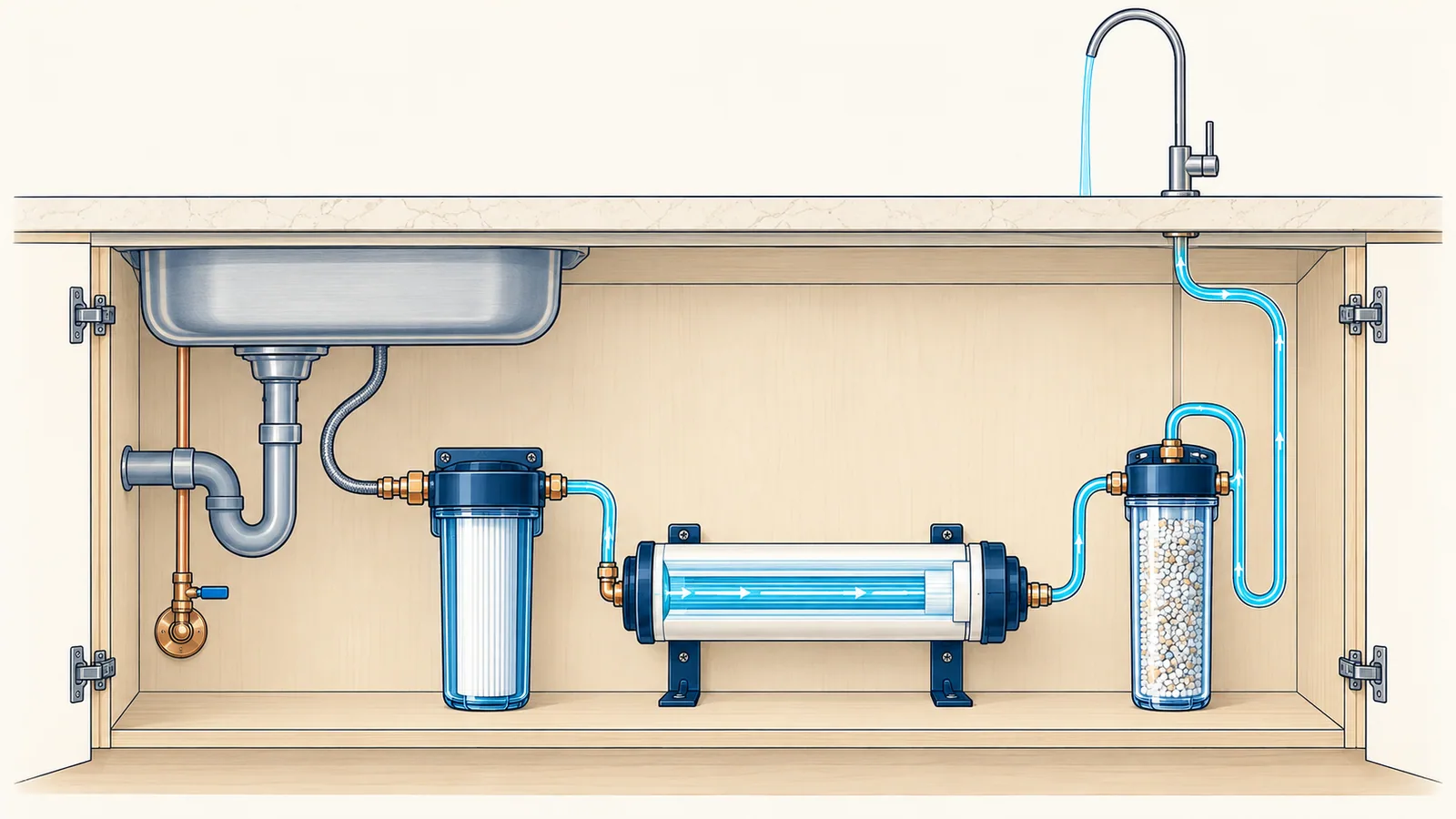
They raise the pH and mineral content a little, which is all they're built to do. The cartridge holds minerals such as calcite, and water picks some up as it passes: iSpring says the alkaline stage on its RCC7AK adds back 30 to 60 mg/L, and AquaTru says its Mineral Boost filter adds magnesium and calcium "to alkalize your water." If you already own an RO system, the cheaper route is a cartridge, ranked in our remineralization filters for RO.
What they can't do is the thing most labels imply. Your body doesn't take its pH from your glass. "Your body is a smart machine. It regulates pH very well on its own," says Cleveland Clinic dietitian Anthony DiMarino, who adds that the lungs and kidneys work to keep body pH where it needs to be.
pH of drinking water
- RO water, no mineral stage: as low as 5Dissolved carbon dioxide crosses the membrane while the bicarbonate that buffers it is held back (AIChE 2014 annual meeting paper).
- Normal rain: about 5.6Slightly acidic for the same reason, carbon dioxide from the air (USGS Water Science School).
- Most tap and bottled water: 6.7 to 7.4The typical range quoted by Koufman and Johnston in their 2012 reflux paper.
- Alkaline water in the reflux study: 8.8Natural bicarbonate artesian water that inactivated human pepsin in a lab dish. No patients were treated in that study (Koufman and Johnston, 2012).
- Mayo Clinic's caution line: above 9.8Mayo Clinic links alkaline water to safety concerns, including high blood potassium, especially above this pH and especially for people with kidney disease.
- EPA secondary standard: 6.5 to 8.5A non-enforced guideline about taste and pipe corrosion, not a health limit.
Readings from AIChE (2014), USGS, Koufman and Johnston (Annals of Otology, Rhinology and Laryngology, 2012), EPA secondary drinking water standards and Mayo Clinic, all read Oct 19 to Oct 26, 2026. pH is logarithmic: each whole step is a tenfold change in hydrogen ion activity.
Is Alkaline Water Good for You?#
Not better than plain water, for most people. That's Mayo Clinic's answer, and the research behind the bigger claims is thin enough that two review papers ten years apart reach the same place.
The 2016 review in BMJ Open, by Tanis Fenton and Tian Huang, went looking for any trial of alkaline water or an alkaline diet against cancer. Out of 8,278 citations it found one usable study and no randomized trial, and concluded that promoting alkaline water to the public for cancer prevention or treatment "is not justified." A June 2026 review in Frontiers in Medicine looked at hydration and bone health, then at metabolism and immunity. It found "limited, context-specific benefits," modest effects that are "likely driven more by mineral composition than pH alone," and said alkaline water "should not be routinely recommended in primary care."
What you hear
Alkaline water neutralizes acid in your body and helps prevent disease.
What the numbers say
Mayo Clinic says that for most people alkaline water is not better than plain water, and that claims about preventing cancer and stroke need more research. A 2016 systematic review found no randomized trial and called promoting it for cancer not justified.
Mineral content is the part with a plausible mechanism, which is also why we rank these filters on certification and mineral stage rather than on the pH printed on the box. If the mineral question is what worries you about RO water, our look at whether reverse osmosis water is good for you covers what Germany's risk agency and the WHO say about it.
Does Alkaline Water Help With Acid Reflux?#
Possibly a little, and that's the most promising lead in the whole category. In a 2012 lab study, Jamie Koufman and Nikki Johnston found that pH 8.8 artesian water rich in natural bicarbonate "irreversibly inactivated human pepsin (in vitro)," the enzyme behind reflux damage. They wrote that most tap and bottled waters, typically pH 6.7 to 7.4, would not be expected to affect pepsin.
Keep two limits in view. It was a test tube, not a trial on patients. And the 2026 Frontiers review, while calling reflux its most consistent finding, describes the effects it found as modest and most often reported with bicarbonate-rich formulations, which is a mineral water rather than what a calcite cartridge produces. Mayo Clinic's verdict on reflux is that there's not enough research to say for sure. Treat a filter as a taste purchase and reflux as a conversation with your doctor.
What Are the Disadvantages of Alkaline Water?#
Cost, mostly, plus one medical caution. Mayo Clinic links alkaline water to safety concerns, including high blood potassium, "especially if the water's pH is higher than 9.8," a risk it calls greatest for people with kidney disease. The 2026 Frontiers review adds people on acid-suppressing medication, pregnant women and children to the list for caution.
The other disadvantage is subtler. A filter that sells on pH tempts you to judge it by pH, and pH says nothing about lead, PFAS or arsenic. The certification is what tells you whether the filter does the job you actually need, and a TDS meter can't help either, for reasons our guide to TDS readings explains.
The Best Alkaline Water Filters in 2026#
Every pick below is a reverse osmosis system with a mineral stage, because RO is what removes the contaminants and the mineral stage is what makes it alkaline. We left out pitchers for a reason given further down, and ranked on named certification first, then running cost. For the full RO field without the alkaline angle, see our ranked reverse osmosis systems.
Best Overall: iSpring RCC7AK#
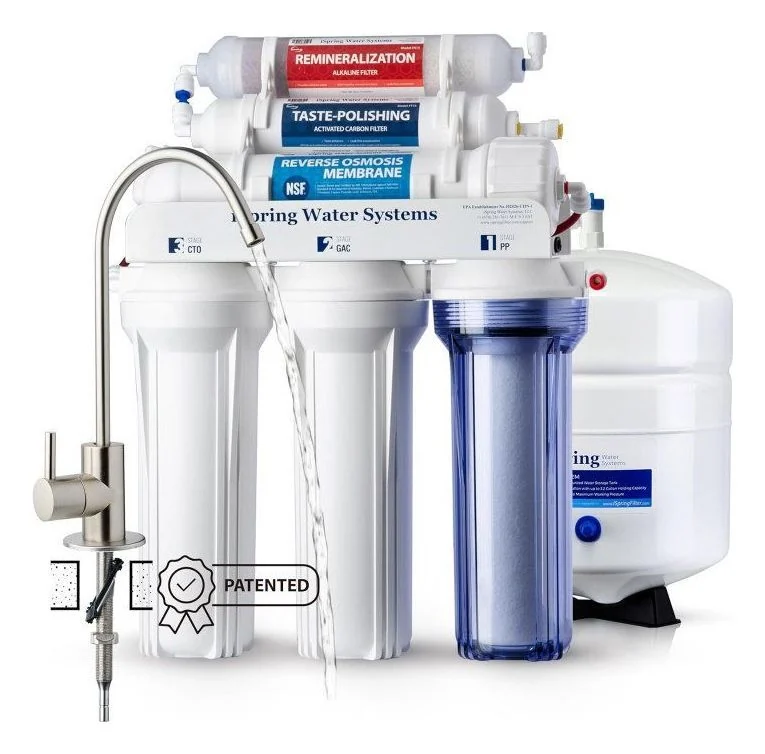
The RCC7AK is a six-stage under-sink RO system, NSF/ANSI 58 certified, with the alkaline cartridge as stage six. It read $239.99 against a struck-through $241.99 on iSpring's store on Oct 26, 2026, the same price as on Oct 12. iSpring describes the stage as calcite, mineral stones and Corosex adding 30 to 60 mg/L.
iSpring
iSpring RCC7AK 6-Stage Reverse Osmosis System
Best for: A proven, cheap-to-run 6-stage under-sink RO with a very large owner base
- Stages
- 6 (with alkaline remineralization)
- Certification
- NSF/ANSI 58
- Waste ratio
- ~1:3 (classic tank design)
- Annual filter cost
- ~$100 to 110
Its weakness is water. It's a classic tank design at about one gallon made for three drained, so a tankless system wastes less. Buy the version NSF lists for the claims you care about: our iSpring RCC7AK review shows which suffix carries the lead and fluoride certification and which carries TDS alone.
Best Without Plumbing: AquaTru Classic with Alkaline Mineral Boost#
The AquaTru Classic sits on the counter, plugs into a wall socket and needs no drill. The Alkaline Mineral Boost version read $495 on AquaTru's store on Oct 26, 2026, against $475 with the standard carbon filter, and the Classic is tested and certified by IAPMO to NSF 42, 53, 58 and 401.
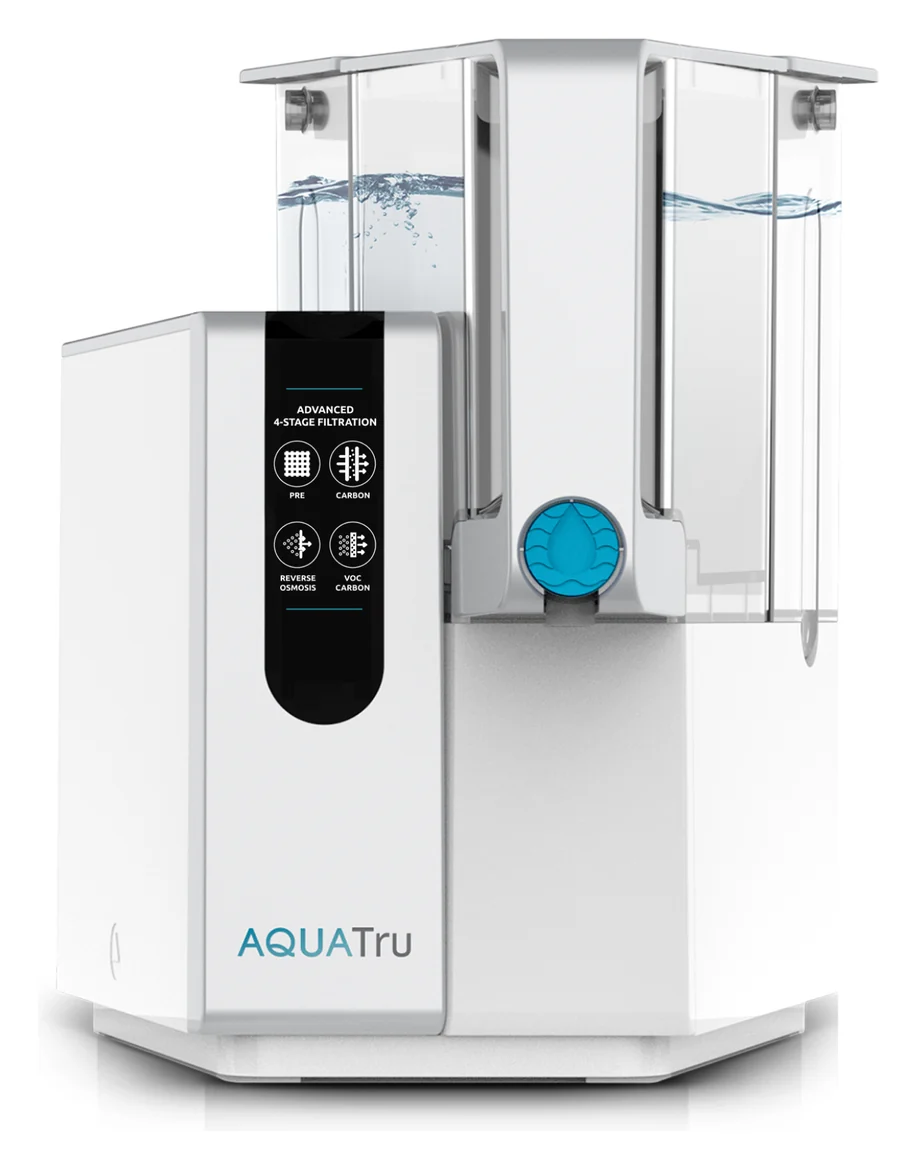
AquaTru
AquaTru Classic Countertop Reverse Osmosis Purifier
Best for: Renters and anyone who wants named, third-party RO certification without touching a pipe
- Install
- None, 120V plug and a countertop
- Stages
- 4 (pre/carbon, RO membrane, VOC carbon)
- Clean tank
- 0.75 gallon
- Certification
- Tested and certified by IAPMO to NSF 42, 53, 58 and 401 (data sheet adds 372)
- Filter life
- 6 months or 600 gal (pre/carbon), 24 months or 1,200 gal (RO), whichever comes first
- Replacement filters
- $59.95 RO, $39.95 VOC carbon, $49.95 Mineral Boost
One thing we couldn't confirm is whether the Mineral Boost cartridge was part of the tested configuration. AquaTru's page certifies "AquaTru Classic" and offers the cartridge as an option. Ask before you buy if that matters to you. The AquaTru review goes through the whole range.
Longest Certification List: Aquasana SmartFlow RO#
The SmartFlow ships with a remineralizer that Aquasana says is "designed to replace healthy minerals lost in the reverse osmosis process," and WQA certifies it to the same four NSF/ANSI standards as the AquaTru Classic. On Oct 26, 2026 it read $224.99 on sale and $449.99 at list, under a 50%-off banner that has come and gone since August, and it showed out of stock.
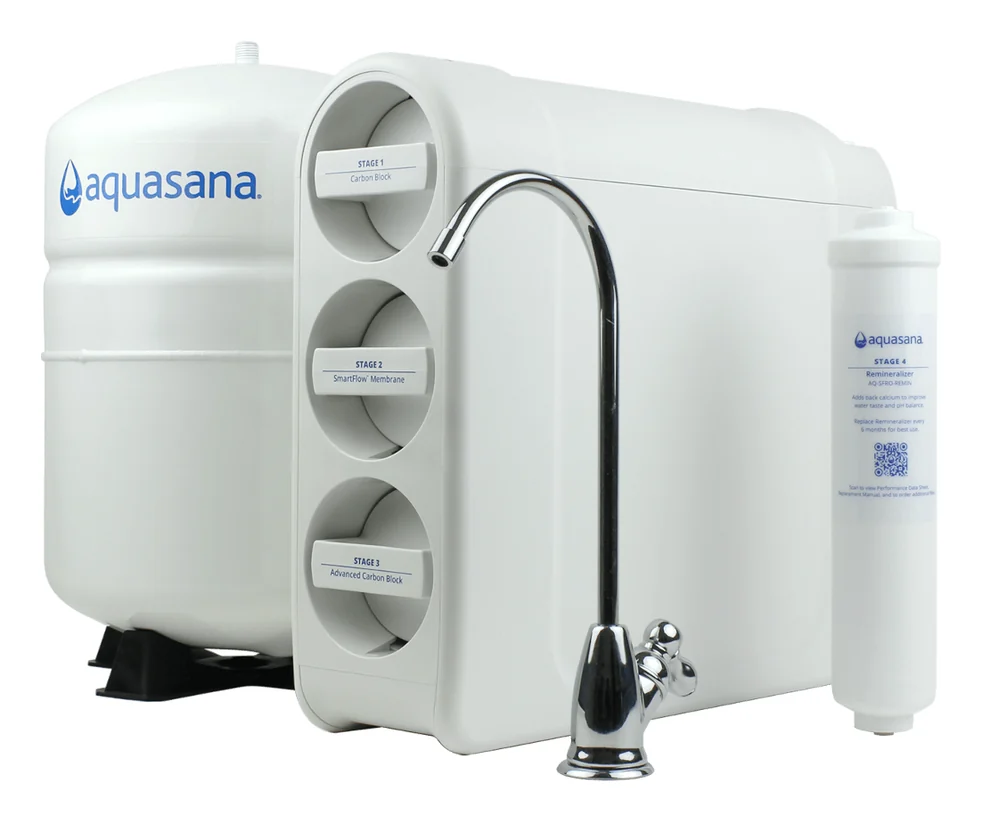
Aquasana
Aquasana SmartFlow Reverse Osmosis System
Best for: Drinking-water protection (PFAS, fluoride, lead) at the best certifications-per-dollar ratio on the market
- Contaminants reduced
- 99.99% of 90 contaminants
- PFAS / fluoride / arsenic
- 96% PFAS (P473), 90% fluoride, 96% arsenic
- Production
- 25.7 gallons/day
- Faucet flow
- 0.7 GPM
- Design
- Compact holding tank (3.2 gallons total, 1.4 to 3.2 usable), remineralizer included
- Filter schedule
- Cartridges 6 months, membrane 12 months
Don't let the banner make the decision. At list price the iSpring does the same alkaline job for less, and the SmartFlow's filters cost more to run: about $310 a year on Aquasana's schedule, which what an RO system costs to own lays out over five years.
Best for One or Two People: AquaTru Carafe with Alkaline Mineral Boost#
The Carafe is AquaTru's smaller countertop unit with a glass carafe, and the Alkaline Mineral Boost version read $395 on Oct 26, 2026 ($375 standard). IAPMO's directory and its data sheet list the base Carafe under NSF 42, 53, 58 and 401, the same set as the Classic (Oct 26, 2026); whether that listing covers the Mineral Boost cartridge, AquaTru doesn't say.
AquaTru
AquaTru Carafe Countertop Reverse Osmosis Purifier
Best for: One or two people in a small kitchen who want RO water in a glass carafe rather than a plastic tank
- Install
- None, 120V plug
- Stages
- 4 (pre/carbon, RO membrane, VOC carbon)
- Clean tank
- 0.5 gallon, plus a 64 oz glass carafe
- Certification
- Certified by IAPMO R&T to NSF/ANSI 42, 53, 58, 372 and 401 (data sheet rev. 09.25)
- Footprint
- 13 in H x 14 in D x 7.5 in W, about 9 lb
- Filter life
- Data sheet: 6 months or 300 gal (pre/carbon), 12 months or 300 gal (VOC), 24 months or 600 gal (RO)
Budget Glass Carafe: Bluevua ROPOT#
The ROPOT has a remineralization stage and a borosilicate carafe, and it priced at $325.50 at checkout against $434 on the page on Oct 26, 2026. The catch is certification: Bluevua says "NSF & WQA Certified" without naming a standard or a certificate number, so we can't check it. Our countertop RO comparison puts it against the other plug-in units.
Bluevua
Bluevua ROPOT Countertop Reverse Osmosis System (RO100ROPOT)
Best for: Buyers who want a remineralization stage on a countertop unit and will accept a vaguer certification record
- Install
- None, 120V plug
- Stages
- 5 (PP 5 micron, carbon block, RO membrane, post carbon, remineralization)
- Carafe
- 60 oz borosilicate glass
- Filter life
- 12 to 24 months, per Bluevua
- Certification claim
- Bluevua states NSF and WQA certification without naming a standard
- Warranty
- 1 year limited
What About Alkaline Water Pitchers?#
We didn't rank one, because we couldn't verify a certification for any alkaline pitcher on the day we checked. NSF's public listings were unreachable on Oct 26, 2026, and a pitcher's box isn't proof. If you'd rather buy a pitcher, check it yourself before paying.
Before you buy an alkaline pitcher
6 itemsThose definitions come from the certifiers themselves. NSF describes Standard 42 as covering aesthetic impurities such as chlorine taste, and Standard 53 as covering contaminants with a health effect. The EPA describes 372 as the lead-free materials standard. The NSF 42 claims list we read covers chlorine, taste and odor, chloramine, particulate, iron, manganese, zinc and TDS, with no pH claim, and we found no certification that vouches for the "alkaline" part of a filter. The countertop filter picks apply the same test to non-alkaline units.
Is It Good to Drink Alkaline Filtered Water?#
Yes, and almost all of the good is in the word filtered. The CDC lists lead, copper, chromium and sodium among the chemicals reverse osmosis removes, along with parasites, bacteria and viruses. That's the part of these systems a certification can actually prove, and it's the reason every pick above is an RO system first.
The alkaline stage earns its place on taste. RO water stripped of minerals reads slightly acidic, as low as pH 5 according to a 2014 paper from New Mexico State University, and the WHO's background document on dissolved solids describes very low TDS water as tasting flat and insipid. Putting some calcium and magnesium back is the fix filter makers have settled on, and it's a reasonable one.
Where it stops being worth the money is when your tap water is already fine and you'd be paying for a mineral cartridge to change a number. The EPA calls the water from US public suppliers some of the safest in the world. If a water report or a test shows nothing you need removed, a glass of tap water does everything an alkaline filter can promise about your health. Spend the money on a test first, and buy the filter only for what the test finds.
Alkaline Filter or Water Ionizer?#
A filter is the more modest choice. What sells as an "alkaline water machine" is usually an electric ionizer, the product AlkaViva, fourth on Google for this search, is built around. It's a powered appliance rather than a cartridge, and we didn't test or price one.
Alkaline filter stage
- A mineral cartridge, often after RO
- Makers state a mineral dose in mg/L
- Certified as part of an RO system
- Replaced on the filter schedule
Electric ionizer
- A powered appliance, not a cartridge
- Outside the filter claims lists we read
- Check its highest setting against Mayo's 9.8 line
- Not tested or priced here
Our take
If you want alkaline water at all, a mineral stage on a certified RO system is the version with the fewest open questions. The higher the pH a device promises, the less there is to gain and the more there is to check.
How We Picked#
We started from what a filter can prove. Each pick had to remove contaminants under a named certification, add minerals through a stage the maker describes, and show a price on its own store on Oct 26, 2026. We excluded health claims from the scoring entirely, because none survived the sources above.
If you're not sure your water needs RO at all, read how to tell whether your tap water is safe first, or let our quiz match a system to your water. The under-sink field without the alkaline filter is in our under-sink RO rankings, and if a dealer is quoting you a mineral cartridge as an add-on, what Culligan charges for an RO system shows how that option gets priced.
Mayo Clinic, Alkaline water: Better than plain water? (FAQ-20058029); CDC, About Home Water Treatment Systems; WHO background document on total dissolved solids; EPA WaterSense, Point-of-Use Reverse Osmosis Systems; Cleveland Clinic, What Is the Alkaline Diet, and Is It Safe? (Anthony DiMarino, RD); Fenton and Huang, Systematic review of the association between dietary acid load, alkaline water and cancer, BMJ Open 2016; Koufman and Johnston, Potential benefits of pH 8.8 alkaline drinking water as an adjunct in the treatment of reflux disease, Ann Otol Rhinol Laryngol 2012; Alebrahim et al., The health benefits of alkaline water: is it a fact or marketing myth?, Frontiers in Medicine 2026; NSF, Standards for Water Treatment Systems; EPA, How to Identify Lead Free Certification Marks (June 2024); iSpring, AquaTru, Aquasana and Bluevua product pages. This page is general information, not medical advice.
Frequently asked questions
Do alkaline water filters really work?
They do what the chemistry allows, which is less than the marketing says. An alkaline cartridge dissolves minerals such as calcite into the water, so the pH and the calcium and magnesium content go up a little: iSpring says its stage adds 30 to 60 mg/L. What no filter does is change the pH of your body. Cleveland Clinic's dietitian puts it plainly: your lungs and kidneys keep body pH where it needs to be.
What is alkaline water?
Water with a pH above 7, the neutral point. Mayo Clinic notes that bottled water sold as alkaline may have minerals such as calcium and magnesium added to reach that pH. Most tap and bottled water already sits around neutral, typically pH 6.7 to 7.4 according to a 2012 paper in the Annals of Otology, Rhinology and Laryngology.
Is alkaline water good for your kidneys?
There's no evidence it helps them, and kidney disease is the one case where Mayo Clinic flags a risk. It links alkaline water to safety concerns, including high blood potassium, especially above pH 9.8, and says that risk is greatest for people with kidney disease. A 2026 review in Frontiers in Medicine also urges caution for people with chronic kidney disease. If you have it, ask your nephrologist before buying anything.
Can you drink alkaline water every day?
Water from a remineralizing filter is filtered water with some calcium and magnesium added back. Mayo Clinic ties its safety concerns to alkaline water especially above pH 9.8. The 2026 Frontiers in Medicine review advises extra caution for people with chronic kidney disease, people on acid-suppressing medication, pregnant women and children. For everyone else, the open question is whether it's worth paying for, not whether it's safe.
How do you make alkaline water at home?
The filter route is a mineral cartridge after the main filter, which is how the iSpring RCC7AK and AquaTru's Mineral Boost option work: water passes over calcite and other minerals and picks some up. An RO system without that stage does the opposite and makes slightly acidic water, as low as pH 5 according to a 2014 AIChE paper, because dissolved carbon dioxide passes the membrane.
Is reverse osmosis water alkaline?
No, it usually reads slightly acidic. The membrane holds back the bicarbonate that buffers water but lets dissolved carbon dioxide through, so the pH drops. That's why many RO systems add an alkaline or remineralization stage at the end, mostly for taste.
Keep reading

Not sure what you need?
Answer 5 questions, get the right system for your water.
City or well, budget, household size, our quiz matches your answers against every system we track.