Waterdrop Reverse Osmosis Lineup 2026: G3 vs X Series vs K6, Explained
Waterdrop reverse osmosis lineup compared: G3, X Series and K6 on output, drain ratio, filter cost and what IAPMO's directory actually lists for each model.
By Home Water Lab TeamUpdated Prices verified Oct 7, 2026
This page contains affiliate links; buying through them costs you nothing extra.
Waterdrop sells reverse osmosis in three families: the G3 tankless systems, the X Series high-output systems and the K6, an under-sink unit that also makes hot water. They share a membrane technology and very little else, and choosing between them is mostly about one question the catalogue buries. How much water do you actually draw? This page sits under our complete guide to reverse osmosis systems and leaves the deep G3P800 verdict to its own review.
The short answer
as of Oct 26, 2026Which Waterdrop reverse osmosis system should you buy?
For most kitchens, the G3P600 at $539 (store record, Oct 26, 2026): 600 gallons a day, a 2:1 drain ratio and, in IAPMO R&T's public directory, NSF/ANSI 42, 53, 58 and 372. Step up to the G3P800 ($999) only for its 3:1 ratio, and to the X12 ($1,299) only for a large household or built-in remineralization. Skip the K6 ($799) if certification matters to you: it carries NSF/ANSI 372 only, no reverse osmosis standard.
Key takeaways
- G3P600 is the sensible default: $539 store record, 600 GPD, and the fullest IAPMO listing in the line (42, 53, 58, 372).
- Only the G3P800, X12 and X16 reach a 3:1 pure-to-drain ratio; the G3P600, X8 and K6 run at 2:1.
- The X Series adds remineralization and a 2-year warranty but drops NSF/ANSI 53 in IAPMO's directory.
- The K6 makes 104 to 203 F water at the faucet and is certified to NSF/ANSI 372 only.
- Waterdrop's own yearly filter costs run from $119.99 (K6) to $182.97 (X16), proprietary on every model.
Waterdrop Reverse Osmosis: How the Line-Up Is Built#
The line is a ladder of output. Each step up buys more gallons a day, sometimes a better drain ratio, and always a bigger cartridge bill, so the useful comparison runs across all three numbers at once.
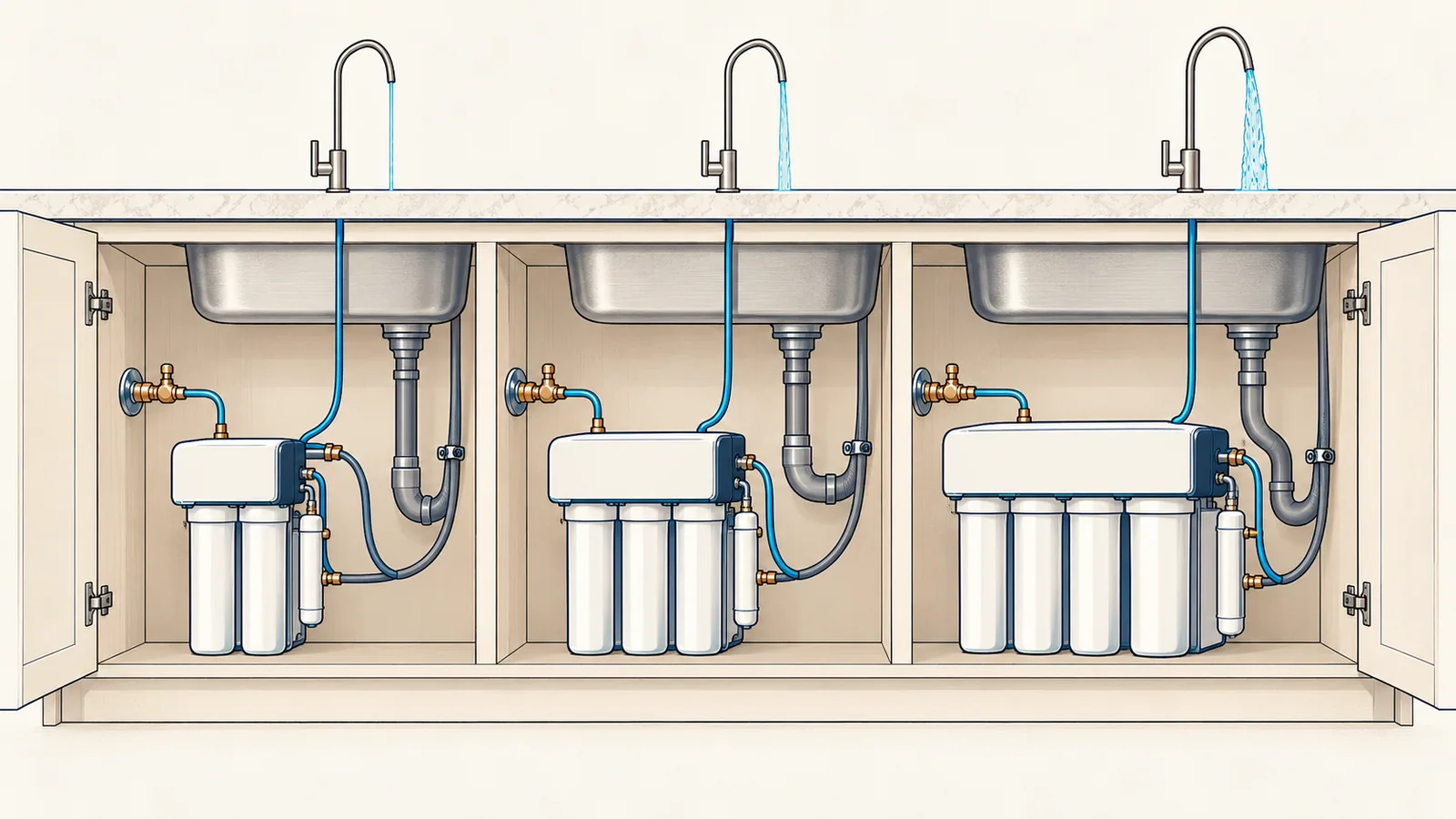
All six systems here are tankless: water crosses the membrane under pump pressure when you open the faucet, so nothing waits in a storage bladder and the cupboard keeps most of its shelf. That design is shared with every tankless competitor we rank in our best tankless reverse osmosis systems, and it carries the same condition everywhere. There's a plug under the sink, and no power means no filtered water.
One line-up, three numbers
as of Oct 26, 2026- Rated production, gallons per dayThe maker's own rating at favourable feed pressure and temperature. A household drinking and cooking with a few gallons a day uses a small fraction of even the smallest bar.
- Pure-to-drain ratioGallons delivered for each gallon sent to the drain, as published. Green chips are 3:1, the efficient end; the others are 2:1.
- Cartridges per yearThe maker's published average annual filter cost. Proprietary cartridges, so this is the number that outlives the purchase.
Production, ratio and annual filter cost as printed on each Waterdrop product page and its Compare table, read Oct 26, 2026. The annual cost is Waterdrop's own average, not our arithmetic. Bars are drawn to scale against the largest rating shown.
The chart makes the pattern plain. Output climbs almost threefold from the G3P600 to the X16, while the yearly cartridge bill rises by about $38. The drain ratio doesn't follow the model number either. The X8 matches the G3P800's 800 gallons a day for $200 less in the store record, and sends half as much again to the drain per gallon delivered (2:1 against 3:1).
G3 Series: The G3P600 and G3P800#
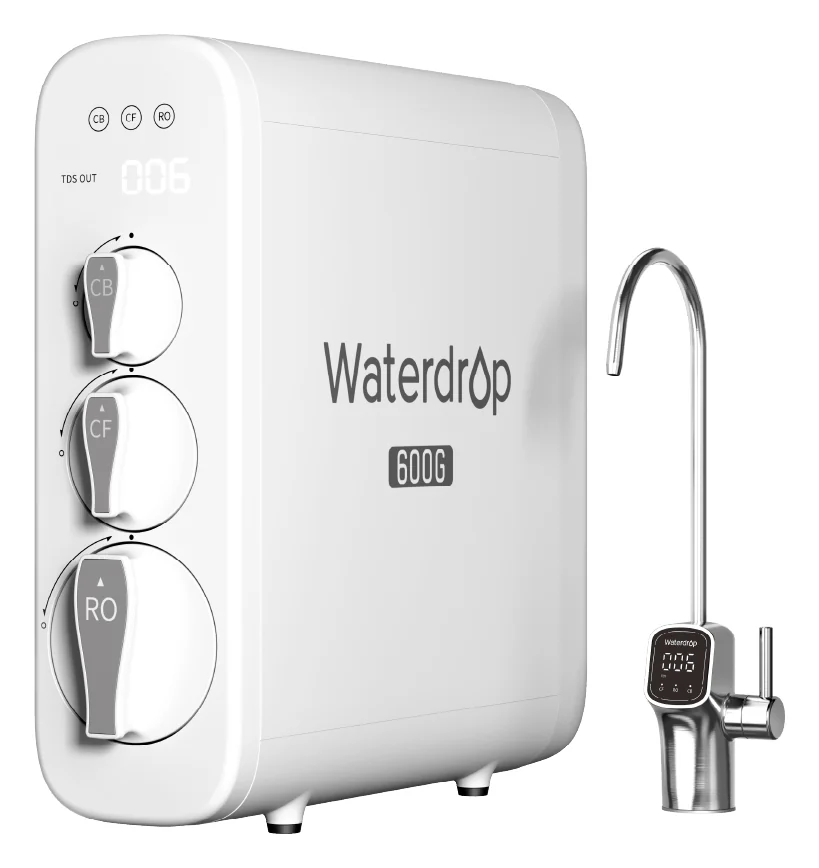
The G3 pair is where most buyers should stop. Both are compact tankless bodies with three twist-off cartridges, a smart faucet that reads out TDS, and a one-year warranty.
Waterdrop
Waterdrop G3P600 Tankless Reverse Osmosis System
Best for: Most kitchens that want tankless RO on demand without paying for the G3P800's extra 200 GPD
- Production
- 600 GPD, tankless
- Pure-to-drain ratio
- 2:1
- Annual filter cost
- $144.97 (Waterdrop figure, Oct 5, 2026)
- Certification
- NSF/ANSI 58 and 372, credited to IAPMO R&T by Waterdrop
- Feed pressure
- 14.5 to 87 psi
- Power
- Plug-in pump, needs an outlet under the sink
The G3P600 rates 600 gallons a day at a 2:1 ratio and costs $144.97 a year in cartridges by Waterdrop's figure. Its store record reads $539; on Oct 26, 2026 the page also printed $429 with a checkout code. We publish the record and mention the code, because the code comes and goes.
The G3P800 adds 200 gallons a day and moves the ratio to 3:1, for $999 in the store record ($759 with a code the same day). Those two numbers are the whole argument for it, and they're worth it only if drain water is a real cost to you, on a meter or on principle. We've already taken that system apart in our G3P800 review, with five years of costs, so this page won't repeat the verdict.
G3P600, $539 (record)
- 600 GPD, 2:1 drain ratio
- $144.97 a year in cartridges
- IAPMO directory: NSF/ANSI 42, 53, 58, 372
- 1-year warranty
G3P800, $999 (record)
- 800 GPD, 3:1 drain ratio
- $159.97 a year in cartridges
- IAPMO directory: the same four files
- 1-year warranty
Bottom line
Same paperwork, same footprint. The $460 gap buys 200 gallons a day and a better ratio, nothing else.
X Series: X8, X12 and X16#
The X Series is the high-output end, sold on speed: Waterdrop says the X12 fills a 6 oz cup in 3 seconds and the X16 in 2. It's also the only family with a two-year warranty, and the X12 and X16 put alkaline remineralization in the box.
Waterdrop
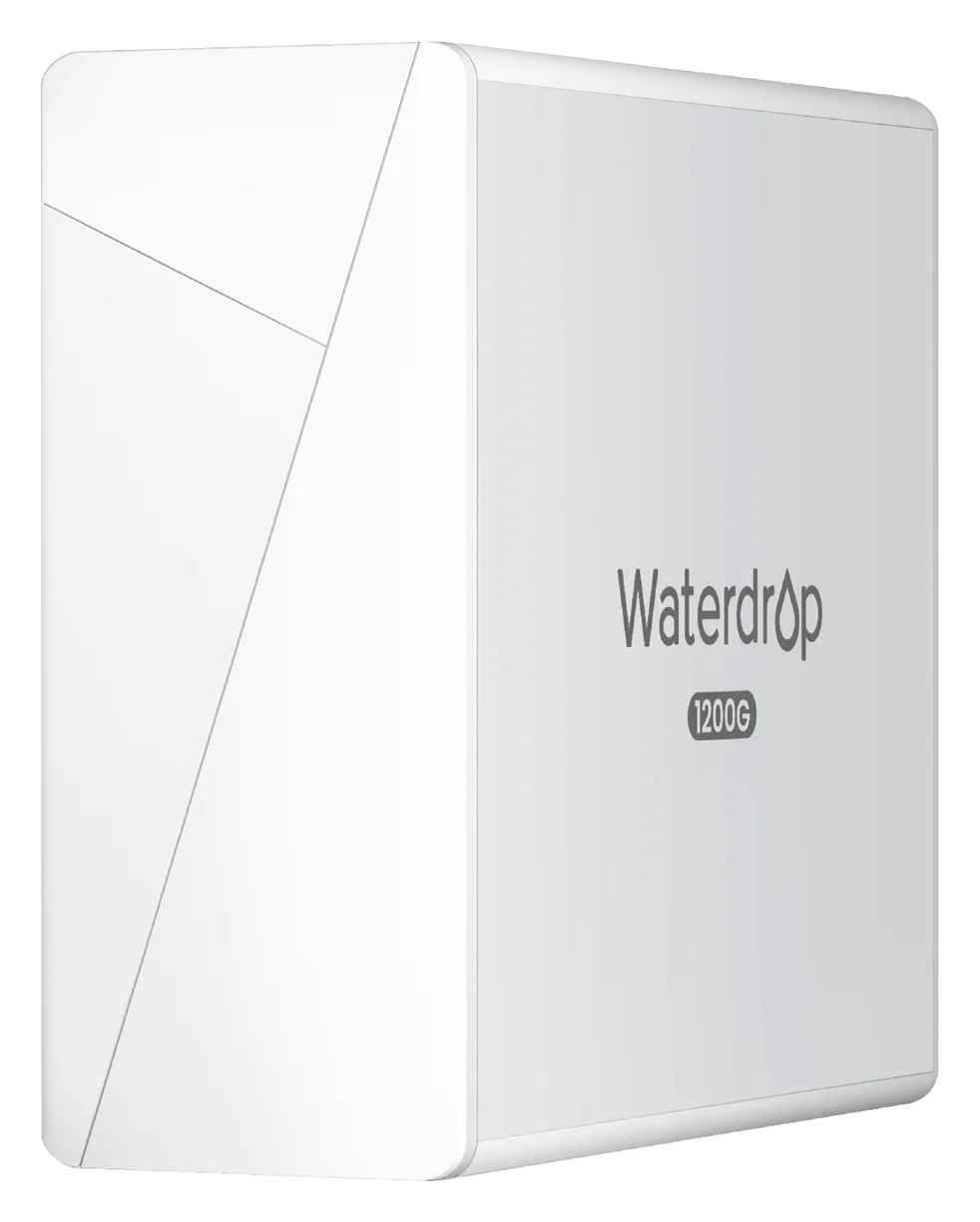
Waterdrop X12 Tankless Reverse Osmosis System with Alkaline Remineralization
Best for: Large households that outrun a 600 or 800 GPD system and want remineralization in the box
- Production
- 1,200 GPD, tankless
- Pure-to-drain ratio
- 3:1
- Annual filter cost
- $172.97 (Waterdrop figure, Oct 26, 2026)
- Certification
- NSF/ANSI 42, 58 and 372; IAPMO R&T lists the X Series under 42, 58 and 372
- Stages
- 11, alkaline remineralization included
- Power
- Plug-in, needs an outlet under the sink
The X12 is the one to look at. It rates 1,200 gallons a day at 3:1, with remineralization included and $172.97 a year in cartridges. The store record says $1,299; the page printed $1,039 with a code on Oct 26, 2026. The X16 doubles down at 1,600 GPD for $1,999 (record) and $182.97 a year, and the X8 sits at 800 GPD, 2:1, $799 (record), where the G3P800 matches its output with a better ratio.
If remineralization is the draw, know that Waterdrop also sells a mineral cartridge for the G3 line, and that the flat taste of RO water is a separate question from safety. Our guide on whether reverse osmosis water is good for you sets out what the minerals do and don't change, and the best alkaline water filters compares the cartridges that add them back.
K6: Reverse Osmosis With Instant Hot Water#
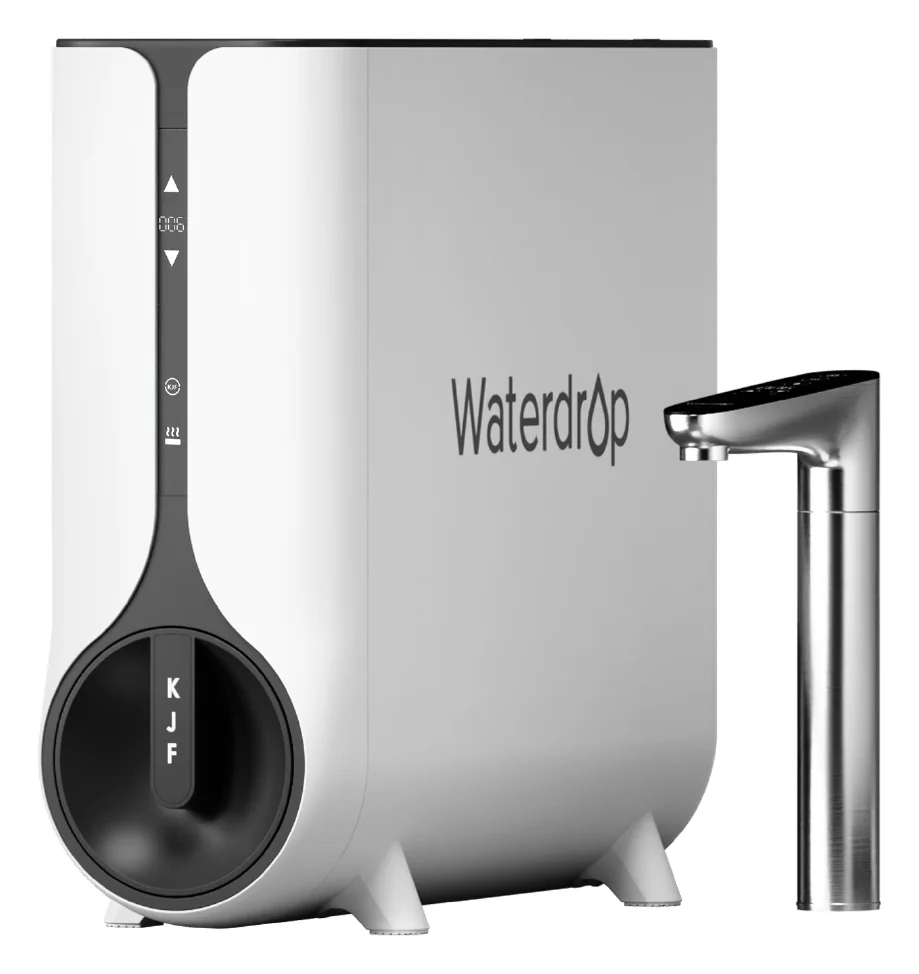
The K6 is the odd one out. It's a 600 GPD under-sink system whose faucet also dispenses water from 104 to 203 F, which turns it into a kettle replacement as much as a filter.
Waterdrop
Waterdrop K6 Under-Sink Reverse Osmosis System with Instant Hot Water
Best for: Kitchens that want filtered hot water from the faucet and accept a lighter certification record
- Production
- 600 GPD, tankless
- Hot water
- 104 to 203 F at the faucet
- Pure-to-drain ratio
- 2:1
- Annual filter cost
- $119.99, one KJF cartridge a year (Waterdrop figure)
- Certification
- NSF/ANSI 372 (lead-free materials) only, by IAPMO R&T
- Power
- Plug-in, needs an outlet under the sink
It runs on one KJF cartridge a year, $119.99 by Waterdrop's figure, the lowest bill in the line. Waterdrop lists child lock, temperature alerts and dry-burn protection among its safety features, and the store record reads $799 ($559 with a code on Oct 26, 2026).
Then the paperwork. The K6 page says "System Certified by IAPMO R&T to NSF/ANSI 372 for low lead", and that's the whole list. NSF/ANSI 372 covers the materials the water touches. It doesn't test what comes out of the faucet. The fluoride, PFAS and TDS reductions on the same page are attributed to a third-party laboratory, which is useful data and not a certification.
What the Certification Records Actually Show#
Waterdrop's pages contradict each other, and the review of the G3P800 documented three different lists for one model in September. So on Oct 26, 2026 we went past the pages to the source: IAPMO R&T's public product listing directory, searched by model.
IAPMO R&T directory, by model
as of Oct 26, 2026- G3P6004 filesListed under IAPMO files for NSF/ANSI 42, 53, 58 and 372. Its own page prints three different versions of that list.
- G3P8004 filesSame four files as the G3P600. The page now matches them; in September, two other Waterdrop pages did not.
- X83 filesListed under 42, 58 and 372, matching its page. Its FAQ also credits SGS, a testing lab.
- X123 filesListed under 42, 58 and 372. Its FAQ says certified by SGS, which is a lab, not the certifier named in its own certification block.
- X163 filesListed under 42, 58 and 372 when searched as WD-X16.
- K6372 onlyListed under 372 only, the lead-free materials standard, exactly as its page says.
Solid dot: the model is returned under an active IAPMO R&T file for that standard. Ring with a bar: no file returned. Searched in IAPMO R&T's public product listing directory by listed model on Oct 26, 2026; the certificate holder is Qingdao Ecopure Filter Co. Ltd. The directory search matches model text, so we report what it returns rather than the certificate scope, which needs a login.
Two things change once you read the directory rather than the marketing. First, the G3 models come out better than their own pages suggest: the four standards Waterdrop sometimes lists and sometimes drops are all there under IAPMO files, so the G3P800 review's caution about 42 and 53 can now be settled in Waterdrop's favour. Second, the X Series lacks NSF/ANSI 53 in the directory. That only matters if a claim certified under 53 is the reason you're buying, so check the performance data sheet for the contaminant you care about before paying for the bigger model.
1 of 6
Waterdrop Prices: The Record and the Code#
Every Waterdrop page we read on Oct 26, 2026 showed two prices: a struck-through figure that matches the store's product record, and a lower one unlocked by a checkout code. We publish the record and date the code.
| Model | Store record | Page price with code | Code shown |
|---|---|---|---|
| G3P600 | $539 | $429 | WDG3P600 |
| G3P800 | $999 | $759 | WDG3P800 |
| X8 | $799 | $599 | WDX8 |
| X12 | $1,299 | $1,039 | WDX12 |
| X16 | $1,999 | $1,499 | WDX16 |
| K6 | $799 | $559 | WDK6 |
The record is what the store's product data says the item costs, with no compare-at price set. The code price is real if you use the code, and it has carried different labels on different days (a member offer on one page, a fall sale on another). It's the same discipline we apply to every brand that runs standing promotions: compare records, then enjoy whatever the cart takes off.
Waterdrop vs the Alternatives#
Against other brands, Waterdrop's strength is the drain ratio and the speed; its weakness is the locked cartridge bill. Three comparisons cover most shoppers.
Waterdrop
Waterdrop G3P600
- Production
- 600 GPD, tankless
- Pure-to-drain ratio
- 2:1
- Annual filter cost
- $144.97 (Waterdrop figure, Oct 5, 2026)
- Certification
- NSF/ANSI 58 and 372, credited to IAPMO R&T by Waterdrop
- Feed pressure
- 14.5 to 87 psi
- Power
- Plug-in pump, needs an outlet under the sink
- Extras
- N/A
- Stages
- N/A
- Hot water
- N/A
Waterdrop
Waterdrop G3P800
- Production
- 800 GPD, tankless
- Pure-to-drain ratio
- 3:1
- Annual filter cost
- $159.97
- Certification
- N/A
- Feed pressure
- N/A
- Power
- N/A
- Extras
- Smart TDS faucet; UV is claimed on some Waterdrop pages for this model and denied on others
- Stages
- N/A
- Hot water
- N/A
Waterdrop
Waterdrop X12
- Production
- 1,200 GPD, tankless
- Pure-to-drain ratio
- 3:1
- Annual filter cost
- $172.97 (Waterdrop figure, Oct 26, 2026)
- Certification
- NSF/ANSI 42, 58 and 372; IAPMO R&T lists the X Series under 42, 58 and 372
- Feed pressure
- N/A
- Power
- Plug-in, needs an outlet under the sink
- Extras
- N/A
- Stages
- 11, alkaline remineralization included
- Hot water
- N/A
Waterdrop
Waterdrop K6
- Production
- 600 GPD, tankless
- Pure-to-drain ratio
- 2:1
- Annual filter cost
- $119.99, one KJF cartridge a year (Waterdrop figure)
- Certification
- NSF/ANSI 372 (lead-free materials) only, by IAPMO R&T
- Feed pressure
- N/A
- Power
- Plug-in, needs an outlet under the sink
- Extras
- N/A
- Stages
- N/A
- Hot water
- 104 to 203 F at the faucet
Prices checked Oct 26, 2026.
Against a classic tank system. The iSpring RCC7AK is NSF/ANSI 58 certified, cheap to buy and runs on generic-compatible cartridges. It also drains far more water per gallon and fills the cupboard with a bladder tank. Our tank versus tankless under-sink comparison weighs that trade properly.
Against the rest of the market. In our overall best reverse osmosis systems the G3P600 competes with certified systems from Aquasana and iSpring; the Waterdrop wins on ratio and flow, not on price.
Against not plumbing at all. Renters can't drill a counter. Waterdrop also sells countertop units (the M6SL holds an NSF/ANSI 58 listing; the C2SL holds none for performance), and we rank them against AquaTru and others in our best countertop reverse osmosis systems.
Which Waterdrop Fits Your Kitchen#
Match the model to the household
5 itemsThat last line deserves a sentence. A reverse osmosis membrane fed hard or iron-laden water scales and fouls faster, and none of these systems softens anything. If your water is hard, the fix is a whole-house softener where the supply enters the house, and our explainer on what TDS in water means shows why the number on the smart faucet isn't a hardness reading.
Specifications, ratios, warranties and yearly cartridge costs are Waterdrop's own figures. Prices are the store's product records; checkout-code prices are reported as a second, dated state. Certification marks come from IAPMO R&T's public directory, searched by listed model.
Waterdrop RO questions people actually search
Waterdrop G2 vs G3: which is better?
The G3 line is the current one on Waterdrop's store, with the IAPMO listings described above. The G2 still appears, including as refurbished units, but we did not read its certification record, so we can't compare the paperwork. On specs alone, buy the current G3.
Can a Waterdrop connect to a fridge or ice maker?
Yes, with an accessory. Waterdrop sells a small pressure tank kit (the PMT for G3 models, the XT for the X Series) built for that connection. The X8 page names fridges and ice makers as a use directly.
Does Waterdrop have a countertop reverse osmosis system?
Several. The M6SL is the one with an NSF/ANSI 58 listing in IAPMO's directory; the C2SL is cheaper and lists only lead-free materials. Both are ranked in our countertop comparison.
Is the Waterdrop smart faucet reading accurate?
It reads total dissolved solids, which is useful to see the membrane working and to spot when it needs changing. It isn't a contaminant test and it isn't a hardness test, so a low number doesn't prove a specific contaminant is gone.
Frequently asked questions
Are Waterdrop filters good?
The under-sink reverse osmosis systems are, on paper. IAPMO R&T's public directory lists the G3P600 and G3P800 under NSF/ANSI 42, 53, 58 and 372, and the X Series under 42, 58 and 372, which is a better record than most direct-to-consumer brands can show. The exception is the K6 instant-hot unit, certified for lead-free materials (NSF/ANSI 372) only. Read the model, not the brand.
Is Waterdrop a Chinese company?
IAPMO R&T's directory lists the Waterdrop certificates under Qingdao Ecopure Filter Co. Ltd, a company based in Qingdao, China. That is where the certification paperwork sits. It says nothing about filtration quality either way: the certificate is what tests the product, and the certificate is public.
What is the difference between the Waterdrop G3 and the X Series?
Output, warranty and remineralization. The G3P600 and G3P800 deliver 600 and 800 gallons a day with a one-year warranty; the X12 and X16 deliver 1,200 and 1,600 with two years and an alkaline remineralization stage built in. The G3 models carry one more certification in IAPMO's directory (NSF/ANSI 53), and they cost less to run: $144.97 and $159.97 a year in cartridges against $172.97 and $182.97, by Waterdrop's own figures read on Oct 26, 2026.
Does the Waterdrop K6 have NSF 58 certification?
No. Its own page lists NSF/ANSI 372 only, which covers lead-free materials, and IAPMO's directory returns that single file for the K6 on Oct 26, 2026. The fluoride, PFAS and TDS reduction claims on its page rest on third-party lab tests, not on a reverse osmosis certification. That is the trade for the hot water.
How long do Waterdrop RO filters last?
The membrane is rated for 24 months across the line, the carbon and sediment cartridges for 6 to 12 months, with gallon limits alongside on the X Series (2,200 gallons for the F3 membrane, 550 for the F2, 1,100 for the F1A). The K6 uses one KJF cartridge rated for 12 months. Whichever limit comes first ends the cartridge.
What is the downside of a Waterdrop RO system?
Every model in the line needs mains power under the sink, so an outage stops the water, and every cartridge is proprietary, so the yearly bill of $119.99 to $182.97 is fixed by Waterdrop. Prices on the site also run in two states: the store record and a lower checkout-code price. Compare the record.
Keep reading

Not sure what you need?
Answer 5 questions, get the right system for your water.
City or well, budget, household size, our quiz matches your answers against every system we track.