How Long Do Water Softeners Last? (And 5 Signs Yours Is Dying)
How long do water softeners last? 10 to 15 years with the resin, 8 to 12 on big-box valves. The 5 signs yours is dying, and when to stop repairing it.
By Home Water Lab TeamUpdated Prices verified Sep 12, 2026
This page contains affiliate links; buying through them costs you nothing extra.
A salt-based water softener lasts 10 to 15 years, resin included, per SpringWell's maintenance guidance read Aug 29, 2026. The spread inside that range is not luck: big-box units on proprietary control valves realistically run 8 to 12 years, while standard rebuildable valve platforms reach 15 to 20, based on the platform service data in our research.
Nothing fails all at once. A softener dies component by component, and the gap between a $430 repair and a new system usually comes down to which component went and how old the tank is. Here is the life of each part, what shortens it, the five signs yours is on the way out, and the repair-or-replace line we use. If you are shopping rather than troubleshooting, start at the water softener hub instead.
The short answer
as of Aug 29, 2026How long do water softeners last?
Plan on 10 to 15 years for a salt-based softener including its resin bed. The hardware sets where you land inside that: 8 to 12 years for big-box units on proprietary valves, 15 to 20 for standard rebuildable valve platforms. The electronic control head is the usual first failure, which is why even lifetime-warrantied brands cap it at 5 years.
Key takeaways
- 10 to 15 years for the system and the resin together, per the manufacturer guidance we read Aug 29, 2026.
- Proprietary big-box valves: 8 to 12 years. Open rebuildable platforms: 15 to 20.
- The electronic head fails first, and warranty terms admit it: 5 years where the tank is covered for life.
- Chlorine, iron and sediment are what kill resin early, and all three are preventable upstream.
- A $430 average repair on a $489 machine is not a repair decision, it is a replacement decision.

How Long Does Each Part of a Water Softener Last?#
The resin bed and the control valve set the lifespan. The tanks normally outlive both, and the electronic head is the first thing to die on most modern units.
Service life, part by part
as of Aug 29, 2026- Resin bed
- 10 to 15 years
- Whole unit, proprietary big-box valve
- 8 to 12 years
- Whole unit, standard rebuildable valve
- 15 to 20 years
- Electronic control head, warranty
- 5 years
- Resin and brine tanks
- Lifetime warranty, factory-direct
- Sediment pre-filter cartridge
- 3 to 6 months
Resin, lifespan and warranty figures from SpringWell maintenance and warranty terms read Aug 28 and 29, 2026; valve platform lives from the Fleck and Clack class service data in our research; cartridge interval from HomeGuide 2026, at $30 to $200 per cycle.
The warranty asymmetry is the most useful thing on that list, because it is the manufacturer betting its own money on which part fails.
What you hear
It has a lifetime warranty, so it will last a lifetime.
What the numbers say
The lifetime terms cover the tank, valve body and fittings. The electronic control head, which is the part that actually fails first on a modern softener, is capped at 5 years by the same manufacturer. A warranty is not a lifespan, it is a statement about which components the maker expects to survive.
What Kills a Water Softener's Resin?#
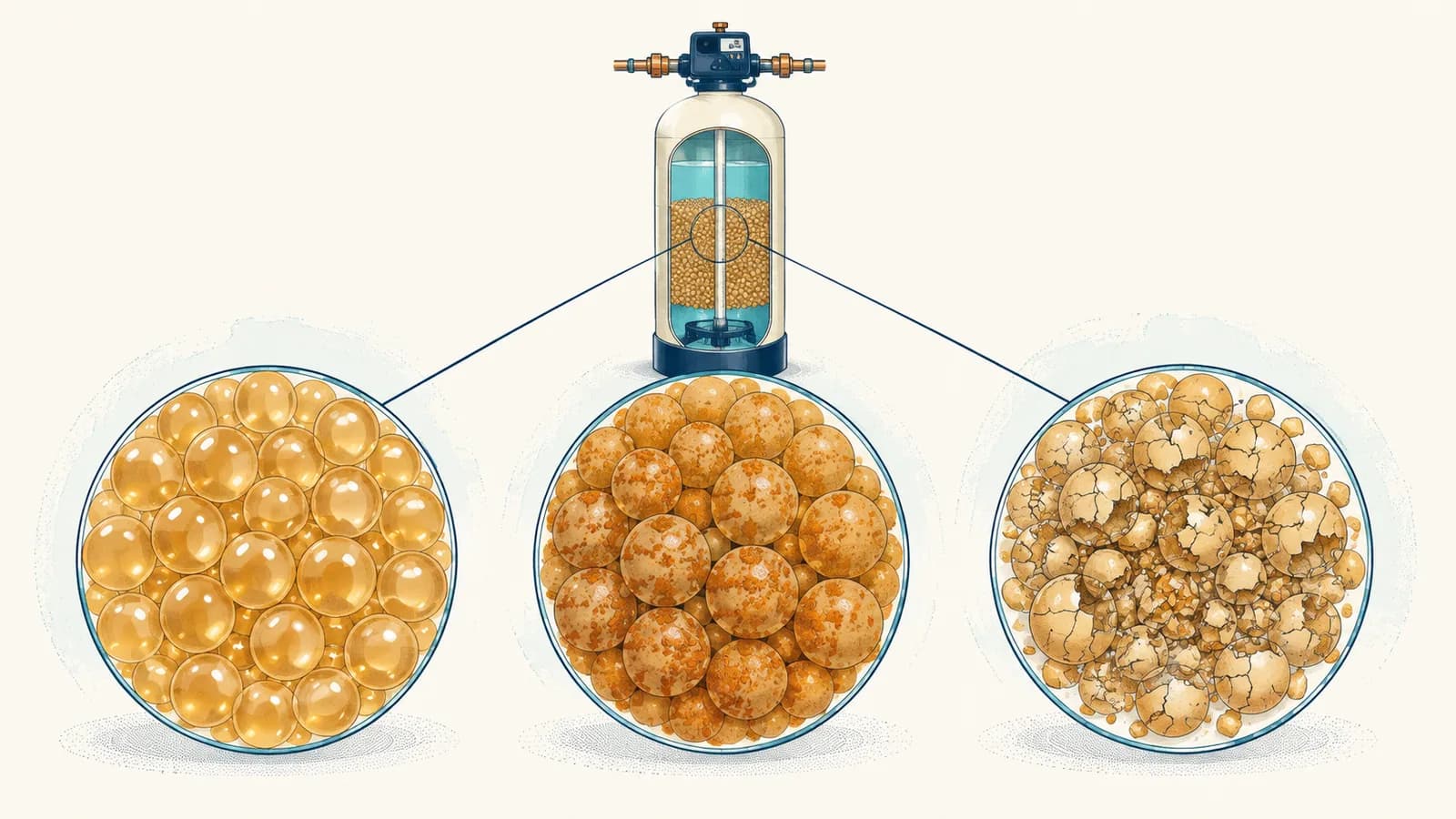
Three things, in this order: free chlorine, iron and sediment. All three attack the resin bed rather than the tank, and all three are preventable with hardware that costs less than a re-bed.
- Chlorine. Ion exchange resin is a polymer, and the free chlorine your utility adds by design oxidizes it slowly over years. This is why filter-plus-softener combos exist and why the carbon filter always sits ahead of the softener in the line, never after it. The filtration side of that pairing is covered on our whole house water filter hub.
- Iron. Iron coats the beads and takes exchange sites out of service, which is why softeners publish iron ratings at all: the Whirlpool WHES44 is rated to 12 ppm, while SpringWell sells a separate air-injection iron filter rated 7 ppm to sit ahead of a softener. On well water the rule is simple: iron gets treated before the softener, not by it, and the hardware is ranked in our best iron filter guide.
- Sediment. Grit channels the bed so water finds a path around the resin instead of through it, and it chews valve seals on the way. A sediment pre-filter every 3 to 6 months is the cheapest insurance in the system.
Salt quality belongs on the same list. High-residue salt leaves a sludge in the brine tank that blocks the brine draw, and the softener then keeps running while quietly softening nothing. Which salt to buy, and how much, is covered in our water softener salt guide.
What is actually in the box
- Bypass valveSends water straight to the house. Every service call starts here: without it, touching the softener means shutting off the whole home.
- Control valveThe head that meters water and decides when to regenerate. A metered head counts gallons, a timer head only counts days, which is why metered heads use less salt.
- Riser tube and upper distributorWater enters at the top, works down through the bed, then returns up the centre tube. Screens at both ends keep resin in the tank and out of your plumbing.
- Resin bedThe working part. Beads loaded with sodium trade it for hardness as water passes. Capacity is rated in grains, which is what 32,000 or 48,000 on the box refers to.
- Drain line, with air gapBackwash water and spent brine leave here. Plumbing code wants a physical gap above the drain so nothing can siphon back into the softener.
- Lower distributor and gravel bedCollects treated water evenly across the tank floor. Uneven collection channels the flow through part of the resin and wastes capacity.
- Brine tankHolds the salt. Its job is to make brine for the recharge, not to add salt to your water: the two only meet inside the resin tank, during regeneration.
- Brine well and safety floatThe float caps how much water can enter the tank. It is what stops a stuck valve from putting the brine tank on your floor.
- Brine lineCarries brine to the valve during the draw, and fresh water back to the tank during refill. One tube, both directions.
Schematic, not to scale. Tank sizes and valve brands change, the order of the parts does not. A control valve needs a drain, a brine line and a power outlet within reach, and that is what decides where the pair can physically stand.
What Are the Signs a Water Softener Is Dying?#
Hardness coming back after you have ruled out salt and settings is sign one. The other four are about how the machine behaves rather than how the water feels. Tick what you recognize.
Five signs of a dying softener
5 itemsSign one is the ambiguous one, because the cheap causes look identical: check the salt level, break any salt bridge and confirm the hardness setting first, all in the maintenance checklist, and confirm the number you programmed against the reading for your area in our hardness lookup. If a test strip still reads hard after a manual regeneration on a full, unbridged tank, the problem is the resin or the valve.
Signs two and three point at different parts. A salt level that drops normally while hardness returns means the resin is exhausted or fouled. A level that does not drop at all means brine is not being drawn: a bridge, mushed salt or a failed injector. Cycles that misbehave point at the control valve every time.
Signs four and five are terminal. Resin beads in the plumbing mean a cracked distributor tube or a failed screen, and the bed does not go back in the tank. Leaks and motor noise at the head are late-stage. One sign alone can be a $150 part. Three of them together on a unit past year ten is a machine telling you it is finished, and the returning signs of hard water in the house are the confirmation. What the water is doing to the plumbing while you decide is laid out in our hard water resource centre.
Repair or Replace: Where Is the Line?#
Repairs run $150 to $600 with a national average of $430, plus a $40 to $100 diagnostic visit, per HomeGuide's 2026 repair data. Our line: repair almost anything before year 8, replace a proprietary big-box unit that fails after year 8, and replace anything past year 15 whatever the platform.
| Situation | What we would do |
|---|---|
| Year 3 to 7, one failed part | Repair. A $430 fix on a system with most of its life left is the cheap outcome. |
| Year 8 to 12, big-box proprietary valve | Replace. The repair is close to the price of the machine. |
| Year 8 to 12, open rebuildable valve | Repair. That platform exists to be rebuilt, and parts are standard. |
| Past year 15, any platform | Replace. You are funding the next failure. |
| Second repair inside 12 months | Replace, regardless of age. |
That ratio is the whole decision, and it is set on the day you buy rather than the day it breaks.
Proprietary big-box valve
- $489 to $619 at retail, as of Aug 28, 2026
- 1 year of warranty, extensible to 2 on some models
- Parts come from one supplier, service through the retailer
- Realistic life 8 to 12 years, resin not economically replaceable
Open, rebuildable valve
- $1,232 to $2,300 factory-direct, as of Aug 28, 2026
- Lifetime tank coverage, 5 years on the electronic head
- Standard rebuild kits, any water treatment pro can service it
- Realistic life 15 to 20 years with the resin re-bedded once
Bottom line
The cheap machine is genuinely cheaper for eight years. Past that, the platform you chose decides whether a failed part is a repair or a replacement.
Replacing is also not the same job as a first install: the loop, drain and bypass already exist, which pushes the total toward the cheaper end of the ranges in our water softener cost breakdown and the installation cost guide.
SpringWell
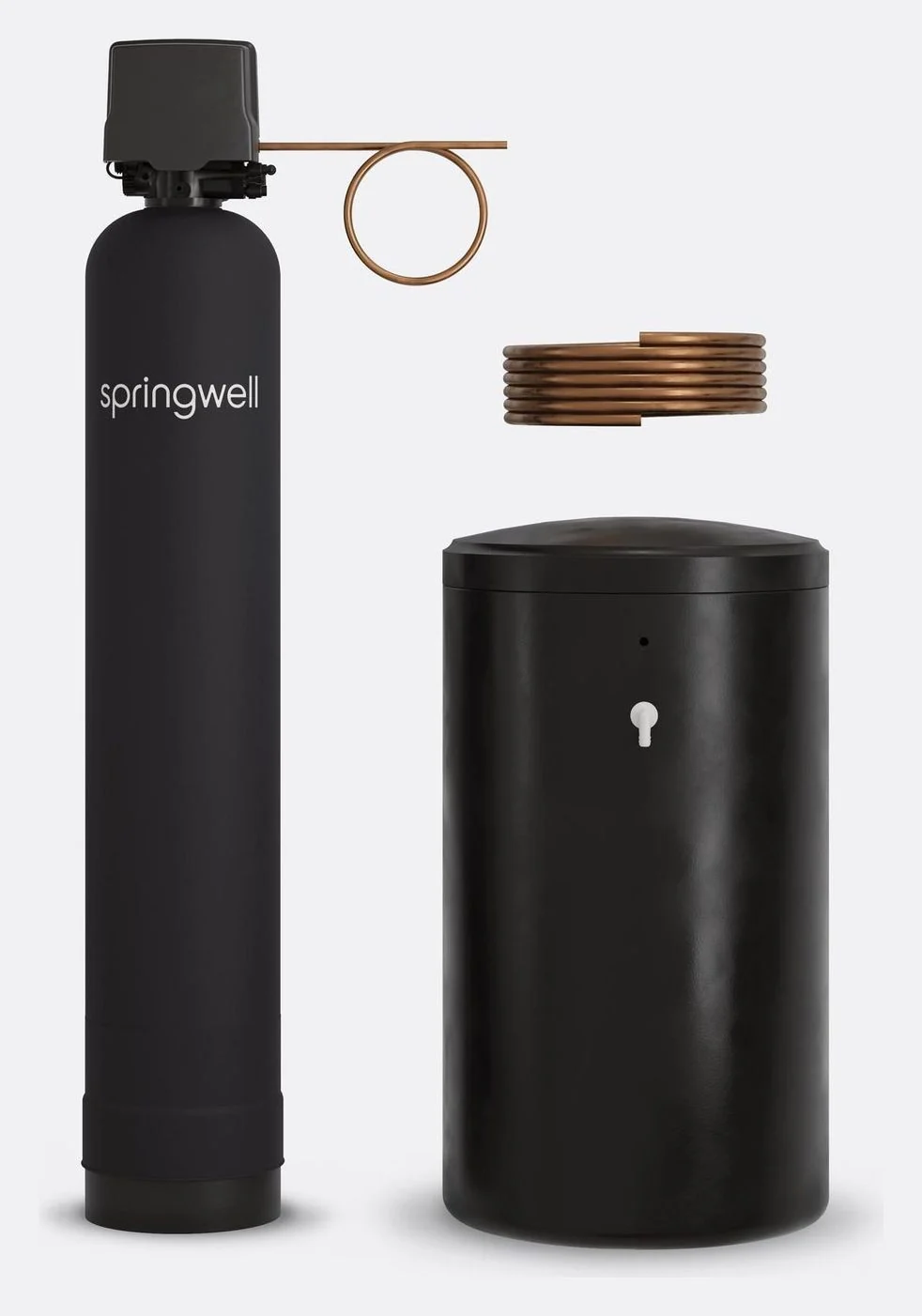
SpringWell SS1 Salt Based Water Softener
Best for: Homes with 1 to 3 bathrooms on hard city water that want true ion-exchange softening at a factory-direct price
- Grain capacity
- 32,000
- Service flow
- 11 GPM
- Bathrooms
- 1 to 3
- Tank
- 9" × 48" (57" with head)
- Connection
- 1"
- Brine tank
- 18" × 33" round (~200 lb salt)
The SS1 is the system we benchmark replacements against for 1 to 3 bathroom homes, with the defect stated up front: the electronic head carries 5 years of coverage despite the lifetime marketing on the tank, and returns are uninstalled only with a 10% restocking fee. Size the replacement rather than copying the old label, using our sizing guide. The full shortlist at every price point is in our best water softeners guide.
What Maintenance Actually Extends a Softener's Life?#
Four habits, all cheap, and they act on the things that kill softeners early: brine that stops flowing, resin that gets fouled, and a valve that cycles more than it needs to.
- Keep the brine flowing. Hold the tank between a quarter and half full, poke for bridges monthly, and wash the tank once a year. A softener with a bridged tank protects nothing while looking perfectly healthy.
- Keep iron and sediment off the resin. Change the sediment pre-filter every 3 to 6 months and run a resin cleaner on iron-prone water, per the product label.
- Program the real hardness. A head set well above your actual grains per gallon burns salt on every cycle; set too low, it lets hardness through.
- Size it correctly in the first place. An undersized unit regenerates far more often, and every regeneration is a cycle of wear on the valve and the resin bed.
Regeneration, one full cycle
- Backwashto drainFlow reverses and runs up through the bed, lifting the resin, flushing out grit and iron, and unpacking a bed that has compacted under months of downward flow.
- Brine draw and slow rinseto drainThe valve pulls brine out of the salt tank and moves it slowly through the resin. Sodium floods the exchange sites, the captured calcium and magnesium are pushed off and leave with the waste water.
- Rapid rinseto drainA fast downflow clears the last of the brine and settles the bed back into place, so the first glass after a cycle does not taste of salt.
- Refillto brine tankFresh water flows back into the brine tank and starts dissolving salt for the next cycle. The softener returns to service, recharged.
Most control valves run the cycle in the early hours, when nobody is drawing water. A single tank cannot soften and recharge at the same time, so water drawn mid-cycle comes through untreated. That, and nothing else, is the argument for twin-tank systems.
The complete task-by-task schedule is the checklist linked above, and whether the whole exercise earns its keep in your house is argued in is a water softener worth it.
The Verdict#
Plan on 10 to 15 years, and budget the resin on the same horizon rather than treating it as a surprise. Big-box units with proprietary valves: 8 to 12. Standard rebuildable platforms: 15 to 20. If yours is past year ten, softening is fading and a $430 quote is on the table, price a replacement before you authorize the repair, because that quote is most of a new budget machine and a fraction of a good one.
Frequently asked questions
How long does a water softener last on average?
Ten to fifteen years, resin included, per SpringWell's maintenance guidance read in August 2026. The spread inside that range is set by the hardware: big-box units on proprietary control valves realistically run 8 to 12 years, while standard rebuildable valve platforms reach 15 to 20 based on the platform service data in our research.
How long does water softener resin last?
The same 10 to 15 years as the system itself in normal service. Free chlorine, iron and sediment all shorten it, sometimes to a few years on untreated well water. Re-bedding is a real job on a serviceable tank, and on a cheap big-box unit it is rarely worth doing: the resin is not economically replaceable on those platforms.
What usually fails first on a water softener?
The parts with electronics and moving pieces: the control head and the brine draw assembly. Warranties tell you the same story. SpringWell warranties its tank, valve and fittings for life but the electronic head for 5 years only, as read on Aug 28, 2026, and big-box units like the Rheem RHS32 carry 1 year on the whole machine.
Is it worth repairing a 12-year-old water softener?
Usually not on a proprietary big-box valve. HomeGuide's 2026 repair data puts a repair at $150 to $600 with a national average of $430, plus a $40 to $100 diagnostic visit, and the machines in that tier cost $489 to $619 as of Aug 28, 2026. On an open, rebuildable valve platform the same repair often buys several more years.
Does a pre-filter make a water softener last longer?
It protects the two things that kill resin beds early: sediment and iron. A sediment pre-filter runs $30 to $200 per replacement cycle every 3 to 6 months per HomeGuide's 2026 data, which is cheap next to a resin bed, and real iron in well water needs its own treatment stage ahead of the softener rather than a filter cartridge.
Does a lifetime warranty mean the softener lasts a lifetime?
No. Read which part it covers. SpringWell's lifetime terms cover the tank, valve body and fittings, while the electronic head that actually fails first is capped at 5 years, as read Aug 28, 2026. A lifetime tank warranty on a machine whose control head is the usual failure point is a statement about metal and plastic, not about service life.
Keep reading


Not sure what you need?
Answer 5 questions, get the right system for your water.
City or well, budget, household size, our quiz matches your answers against every system we track.