Is Tap Water Safe to Drink? How to Check Your City's Water Quality
For most Americans on public water, yes by EPA standards. How to find and read your water quality report, what the lead and PFAS rules say, and when to filter.
By Home Water Lab TeamUpdated Prices verified Oct 7, 2026
This page contains affiliate links; buying through them costs you nothing extra.
For most people in the United States, tap water is safe to drink: the CDC says 9 out of 10 of us get it from a public water system, and those systems must meet the EPA's legally enforceable standards. The honest answer for your own glass takes ten minutes, because your utility publishes its results every year and the weak points sit in places that report can't see. If your real worry is the crust on your faucets rather than your health, that's hardness, which the EPA doesn't regulate, and our guide to hard water, its signs and its fixes covers it separately. Some cities publish 16 gpg or more, as our list of the hardest-water US cities shows from each utility's own report.
The short answer
as of Oct 12, 2026Is tap water safe to drink?
For most US households, yes. Public water systems serve 90 percent of Americans (EPA) and must meet EPA drinking water standards, which they report in an annual Consumer Confidence Report due by July 1. Check yours for violations and for the lead result against the 0.015 mg/L action level. The two places a clean report can still miss are a lead service line and lead-bearing plumbing inside your house, so ask your utility about the line and test the tap if your home predates 1986.
Key takeaways
- 9 out of 10 people in the US drink from a public water system (CDC), held to the EPA's legally enforceable standards.
- Every community system sends a Consumer Confidence Report by July 1; from 2027, systems serving 10,000 or more people send a second one by December 31 (EPA).
- The lead action level is 0.015 mg/L at the 90th percentile of home samples today and drops to 0.010 mg/L on November 1, 2027.
- PFOA and PFOS are capped at 4.0 parts per trillion; EPA proposed on May 18, 2026 to let systems ask for two more years, to 2031.
- Over 23 million households drink from private wells, which the Safe Drinking Water Act does not cover (EPA).
Is Tap Water Safe to Drink in the US?#
Yes, in the large majority of homes, and the reason is regulatory rather than reassuring. The EPA's National Primary Drinking Water Regulations are legally enforceable standards and treatment techniques for public water systems, and the CDC describes utilities as removing harmful germs and chemicals to make tap water safe to drink.
148,000+
The caveat is scale. A standard tells you what a system must achieve, and the report tells you whether it did, across the whole system. Neither one samples your kitchen. Most of the useful work in this guide happens in two places: the report your utility already mails you, and the short run of pipe between the street and your faucet.
What Makes Tap Water Unsafe?#
Three things: germs after a treatment or main failure, contaminants already in the source water, and lead picked up inside the plumbing on the way. The first two are the utility's job and show up in its report or in an advisory. The third mostly happens on your side of the meter.
Source to glass
- Source waterA river, a lake or an aquifer. Your Consumer Confidence Report names it, which tells you what the plant is up against.
- Treatment plantWhere the utility removes harmful germs and chemicals (CDC) to meet EPA's legally enforceable standards for public water systems.
- Mains and storagein the CCRStill the utility's pipes and towers, and still inside its report: detected contaminants, violations and the health language that goes with them.
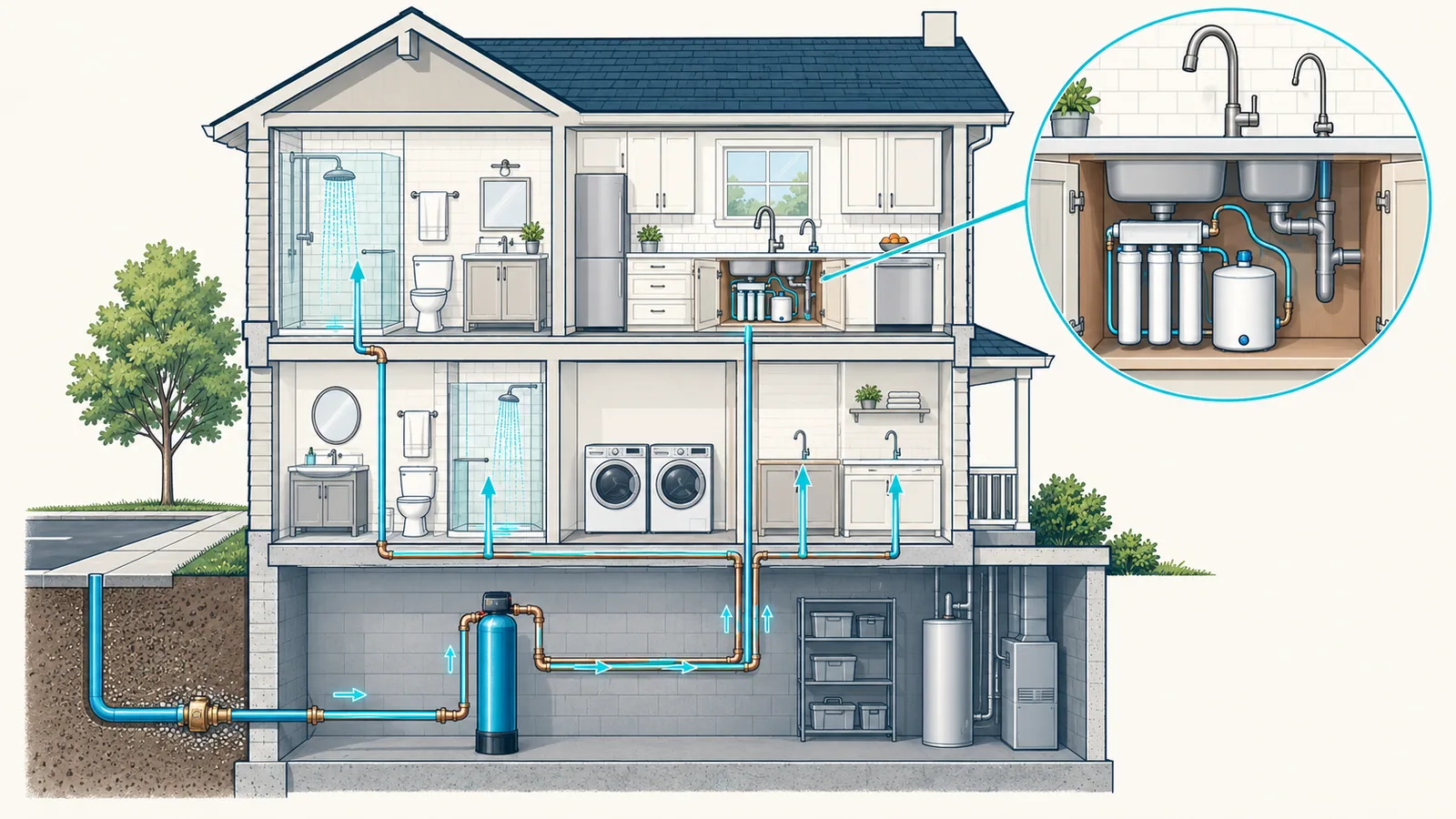
- Service lineask the utilityThe pipe from the main to your house. EPA says lead service lines are more likely in older cities and homes built before 1986, and its Lead and Copper Rule Improvements give utilities 10 years to replace lead pipes.
- Home plumbing and faucetyours to testIn homes without a lead line, EPA names brass or chrome-plated brass faucets and lead solder as the most common lead problems. A city-wide report cannot test your kitchen; only a sample from your own tap can.
Sources: EPA Consumer Confidence Report Rule Revisions Q&A; CDC, About Drinking Water; EPA National Primary Drinking Water Regulations; EPA, Basic Information about Lead in Drinking Water; EPA, Lead and Copper Rule Improvements. All read Oct 12, 2026.
The EPA puts it plainly: lead enters drinking water when plumbing materials that contain lead corrode. Lead service lines are more likely in older cities and in homes built before 1986, and in homes without one, brass or chrome-plated brass faucets and lead solder are the most common sources. The EPA also states that there is no known safe level of lead in a child's blood, which is why this one contaminant deserves a check at the tap itself.
How Do I Check My City's Water Quality?#
Start with the report your utility is required to publish, then close the two gaps it leaves. The whole sequence is free except the last step, and most households can stop after step 3.
Check your tap water in five steps
Find your Consumer Confidence Report
Search your utility's name plus water quality report, or use the EPA's Find Your CCR tool at sdwis.epa.gov/fylccr: pick your state, then narrow by county or system name. EPA notes that reports for all systems may not be available there, so the utility's own site is the fallback.Read the violations section first
A report summarizes the source of the water, detected contaminants, any rule violations and health information (EPA). A system with no violations in the reporting year has met the federal standards it was tested against.Find the lead line
Lead is reported as a 90th percentile from home tap samples and compared with the action level, 0.015 mg/L. Above it is an action level exceedance, and the report has to say what the system is doing about it.Ask what your service line is made of
The EPA's advice is to ask your water utility whether the pipe connecting your home to the main is lead. If the utility doesn't know, a licensed plumber can check where the line enters the house.Test your own tap if anything points at lead
An old home, a lead or unknown service line, or brass fixtures are reasons to test water from your own faucet, because a system-wide 90th percentile says nothing about one house.
The state pages on this site answer a different question. Each one gives the typical hardness range for its state from USGS data, so they tell you about scale and soap, not safety: Arizona's statewide hardness data and Florida's limestone-fed water sit at the very hard end, Massachusetts and its soft reservoir water at the other, and New York, soft in the city and hard upstate spans both. The full list lives in our hardness lookup for all 50 states and DC. For the number at your own tap, a strip costing around $10 settles it, and our ranked picks of hard water test kits compare strips with titration.
How to Read Your Consumer Confidence Report#
Look at three columns: the legal limit, the highest level your system detected, and whether it was a violation. Everything else in the table explains those three, and our column-by-column guide to reading a water quality report walks through each one.
| Term on the report | What it means | Source |
|---|---|---|
| MCL | The highest level of a contaminant allowed in drinking water | EPA |
| MCLG | The level below which there is no known or expected risk to health; zero for lead, arsenic and total coliforms | EPA |
| Action level (AL) | The lead or copper level that, if exceeded, requires the system to act: 0.015 mg/L for lead, 1.3 mg/L for copper | EPA |
| 90th percentile | The figure reported for lead and copper; over the action level means more than 10 percent of samples were above it | EPA |
| ppm, ppb, ppt | Parts per million (mg/L), per billion (µg/L), per trillion (ng/L) | Unit conversions |
An MCLG of zero next to a nonzero MCL looks alarming and usually isn't. The goal is a health ideal, the MCL is the enforceable limit, and a detection below the MCL is compliant.
Five lines to find on your report
5 itemsTwo dates on the report matter. Community systems deliver it by July 1 for the previous calendar year, and under the EPA's revised rule, systems serving 10,000 or more people deliver a second report by December 31 starting in 2027. Systems serving at least 50,000 people must also keep reports on a public website for at least three years.
What About Lead and PFAS in Tap Water?#
Both have federal limits, and both rules have moved recently, so the dates matter. On the EPA's regulations table, the lead action level is 0.015 mg/L today and becomes 0.010 mg/L on November 1, 2027, and the Lead and Copper Rule Improvements require systems to identify and replace lead pipes within 10 years.
PFAS is less settled. The EPA's 2024 rule set enforceable limits of 4.0 parts per trillion each for PFOA and PFOS, with five years, to 2029, for systems to fix exceedances. On May 18, 2026, the EPA proposed two changes: one keeps the PFOA and PFOS limits but lets systems request two more years, to 2031; the other would rescind the limits for PFHxS, PFNA, GenX and a four-PFAS mixture. As of Oct 12, 2026, the EPA's page presents both as proposals, so read the PFAS lines on your report rather than a headline. If they show PFAS and you want it handled at every tap, only a few whole house filters certified for PFAS carry that claim as a finished system.
What you hear
If my water report shows no violations, nothing needs checking at my house.
What the numbers say
The report covers the system. Lead is sampled at a set of homes and reported as a 90th percentile, and the EPA says lead usually comes from service lines, solder and fixtures on the customer side. An older home with a lead or unknown service line is worth a tap test even under a clean report.
Other databases rank the same utility results differently. The Environmental Working Group's Tap Water Database compares them with EWG's own health guidelines, which the group says are stricter than federal limits in many cases and are not legally enforceable. That makes it a useful second opinion and a poor substitute for your report, which states what the law actually requires.
Does Boiling Tap Water Make It Safe to Drink?#
Boiling kills germs and does nothing else. Under a boil water advisory, the CDC's instruction is a full rolling boil for 1 minute, or 3 minutes at elevations above 6,500 feet, and it says to boil your tap water even if you filter it.
When Should You Filter Your Tap Water?#
Filter when a report or a test names something you want lower, and pick the filter by that contaminant. A filter bought for a vague worry usually targets the wrong thing, and the certification is what tells you a filter does the job it claims.
Whole-house carbon
- Chlorine or chloramine taste and smell at every tap
- PFAS on the report and you want it out of showers too
- City water only, not for microbiologically unsafe sources
- Does not address hardness, bacteria or dissolved lead
Reverse osmosis at the sink
- Lead, PFAS, nitrate, arsenic or fluoride in drinking water
- Certified claims you can check against NSF/ANSI 53 and 58
- Treats the one tap you drink and cook from
- Sends part of the water to drain and needs filter changes
The call
Taste and chlorine across the house: carbon at the main line. Something on the health side of your report: a certified membrane at the kitchen tap.
For city water with a chlorine or chloramine complaint, our buyer's guide to whole-house water filters walks through the options. The system we keep coming back to is below.
SpringWell
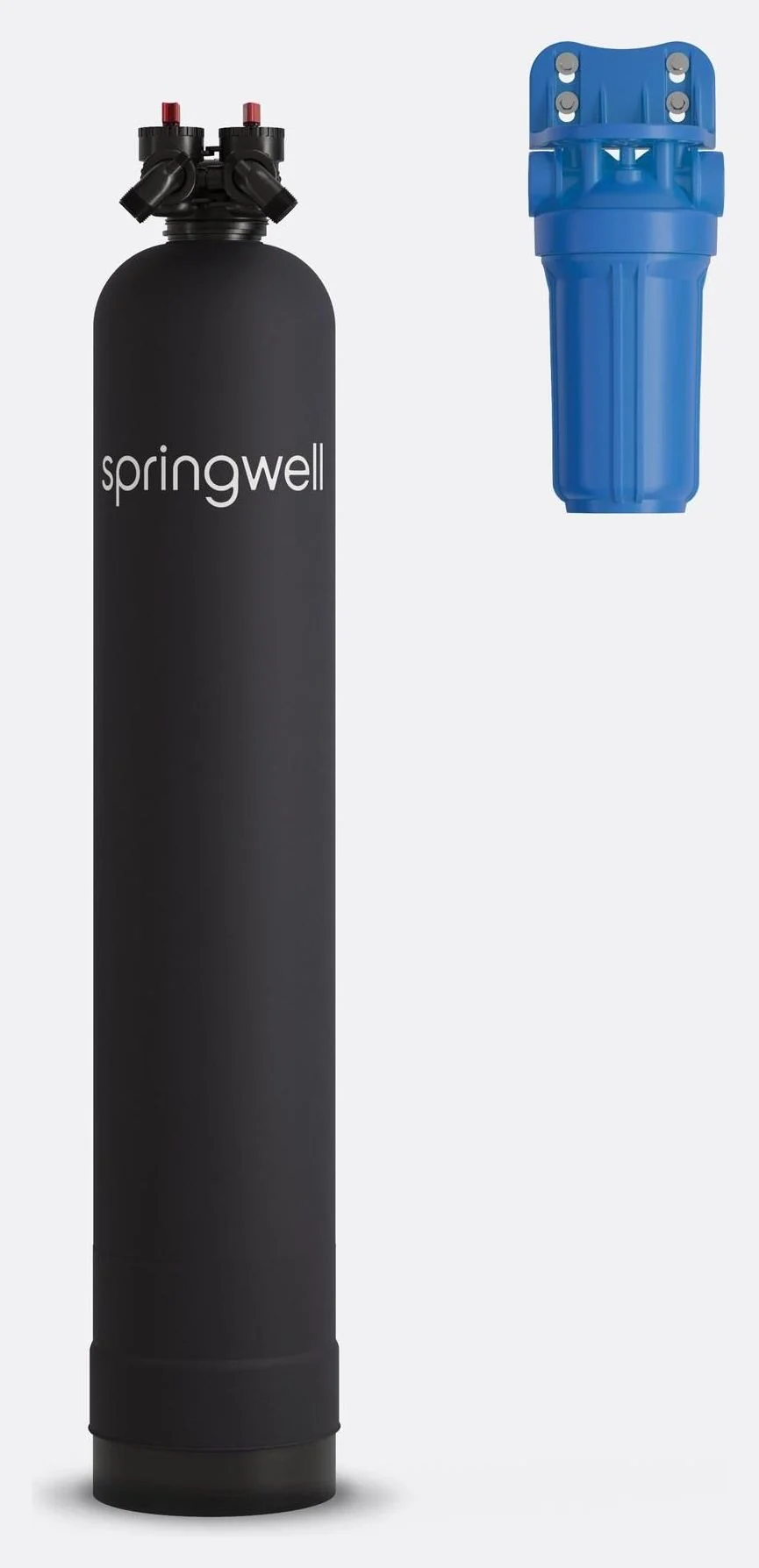
SpringWell CF1 Whole House Water Filter
Best for: City-water homes that want chlorine, chloramine and PFAS handled house-wide with the lowest 10-year cost of ownership
- Capacity
- 1,000,000 gallons / ~10 years
- Flow rate
- 9 GPM
- Bathrooms
- 1 to 3
- Media
- Catalytic carbon + KDF + sediment, 4 stages
- Reduces
- Chlorine, chloramine, PFAS/PFOA/PFOS, VOCs
- Sediment pre-filter
- Replace every 6 to 9 months (~$40/yr)
SpringWell's page says the CF1 removes chlorine, chloramine, PFAS, PFOA and PFOS from city water, and it read $1,092 on Nov 2, 2026 against a $1,365 list price. Lead isn't on that list; SpringWell sells a separate lead system. The long-term numbers are in our in-depth review of the SpringWell CF1 system.
For lead, PFAS or nitrate in the glass, the membrane does the work. Our guide to how reverse osmosis filters drinking water explains what it removes and what it wastes, and our ranked list of reverse osmosis systems compares the models on certifications.
Aquasana
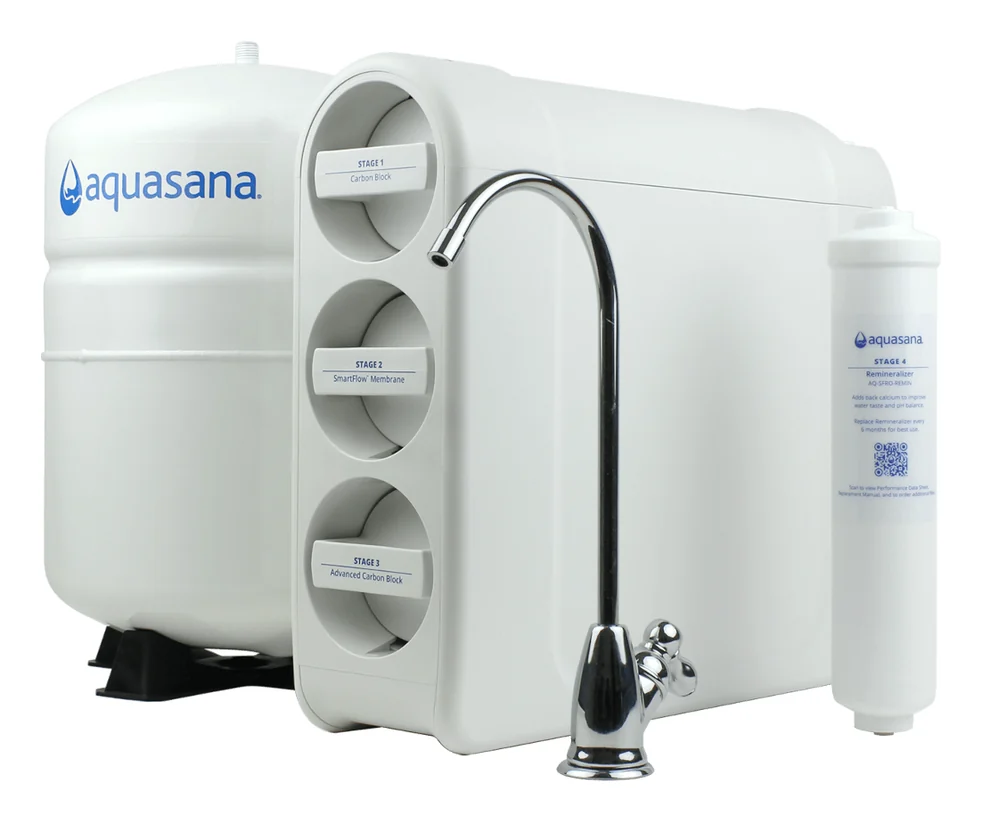
Aquasana SmartFlow Reverse Osmosis System
Best for: Drinking-water protection (PFAS, fluoride, lead) at the best certifications-per-dollar ratio on the market
- Contaminants reduced
- 99.99% of 90 contaminants
- PFAS / fluoride / arsenic
- 96% PFAS (P473), 90% fluoride, 96% arsenic
- Production
- 25.7 gallons/day
- Faucet flow
- 0.7 GPM
- Design
- Compact holding tank (3.2 gallons total, 1.4 to 3.2 usable), remineralizer included
- Filter schedule
- Cartridges 6 months, membrane 12 months
The SmartFlow was $224.99 on Oct 12, 2026 under a 50% off banner and $449.99 at list on Oct 19, and Aquasana claims 99% lead reduction. Its weak spots are a 0.7 GPM faucet and a modest 25.7 gallons a day. If you'd rather skip a membrane, our comparison of under-sink carbon and RO filters maps which contaminants each one reaches.
What If Your Water Comes From a Private Well?#
Then no report exists, and the safety check is yours. The EPA says private well water is not regulated by the federal government under the Safe Drinking Water Act, and that more than 23 million households rely on private wells.
The first test belongs with a certified lab, and our well water testing guide lists what to order and how often. A TDS number from a pocket meter is not that test, for reasons our explainer on what TDS in water really measures lays out.
EPA pages read Oct 12, 2026: National Primary Drinking Water Regulations (updated Aug 31, 2026), Information about Public Water Systems (Mar 16, 2026), Consumer Confidence Report Rule Revisions (Nov 21, 2025) and the rule's Q&A (Dec 2024), Find Your CCR, the lead 90th percentile FAQ, Basic Information about Lead in Drinking Water (Jun 18, 2026), Lead and Copper Rule Improvements (Dec 29, 2025), the PFAS rule page (May 18, 2026) and Private Drinking Water Wells (Aug 25, 2026). CDC: About Drinking Water (Jan 30, 2025) and Drinking Water Advisories (Mar 4, 2024). EWG's database page refused automated access; its description comes from EWG's own published pages. Prices were read on the makers' pages. Not medical advice: for a health question about your water, ask your utility, your state drinking water program or your doctor.
Tap water safety questions people ask
Is tap water 100% safe to drink?
Nothing is guaranteed at every tap. A public system meeting EPA standards has met enforceable limits across its system, but lead can still enter through a service line or household plumbing, and a main break or treatment failure can trigger a boil water advisory. Your report plus a look at your own pipes is the realistic check.
How often do I get a water quality report?
At least once a year, by July 1, covering the previous calendar year. Under EPA's revised rule, community systems serving 10,000 or more people add a second report by December 31, starting in 2027. Smaller systems stay on one report a year.
Can I check my tap water by zip code?
Not through the EPA: its Find Your CCR tool searches by state, then county, city or system name. EWG's database does search by zip code or utility name. Either way, match the system name printed on your water bill so you read the right report.
Is hard water safe to drink?
Hardness is calcium and magnesium, and the EPA does not regulate it as a health contaminant. It causes scale, spotting and soap that won't lather. A hardness strip or titration kit gives you the number in minutes if you want to size a softener.
Frequently asked questions
Is tap water safe to drink in the US?
For most households, yes. The CDC says 9 out of 10 people in the United States get tap water from a public water system, and those systems must meet the EPA's legally enforceable drinking water standards. Safe in general is not the same as safe at your address: your utility's annual Consumer Confidence Report shows its own results, and lead can still enter through a service line or household plumbing the utility does not own.
How do I find out if my tap water is safe?
Read your Consumer Confidence Report, the water quality report your utility must deliver every year by July 1. The EPA's Find Your CCR tool at sdwis.epa.gov/fylccr searches by state, county or system name. Check the violations section, the lead 90th percentile against the action level, and any line marked as exceeding its limit. For lead at your own faucet, ask the utility whether your service line is lead and test your tap.
Does boiling tap water make it safe to drink?
Only against germs. The CDC's instruction under a boil water advisory is a full rolling boil for 1 minute, or 3 minutes above 6,500 feet. Boiling does not remove chemicals, and the EPA states plainly that boiling does not remove lead. The CDC also says to boil your tap water during an advisory even if you filter it.
Should I filter my tap water?
Filter for a reason you can name. If your report or your own test shows lead, PFAS, nitrate or another contaminant you want lower, buy a filter certified for that exact contaminant. If the issue is chlorine taste, a carbon filter handles it, and chloramine needs a carbon filter rated for it. If the report is clean and the water tastes fine, a filter is a preference, not a safety purchase.
Keep reading

Not sure what you need?
Answer 5 questions, get the right system for your water.
City or well, budget, household size, our quiz matches your answers against every system we track.