Best Whole House Water Filters for Well Water 2026 (Cartridge Systems)
Three-housing cartridge filters for well water compared: iSpring WGB32BM, Express Water and PRO+AQUA, their iron limits, flow, filter costs, and when to buy a tank.
By Home Water Lab TeamUpdated Prices verified Oct 7, 2026
This page contains affiliate links; buying through them costs you nothing extra.
The best whole house water filter for a well with light iron is a three-housing cartridge stack, and the iSpring WGB32BM at $535.99 (Nov 2, 2026) is the one we'd fit, because it is the only system here that prints an iron limit. Cartridge stacks are the budget end of a full well treatment plan, stage by stage: cheap to buy, simple to plumb, and costly to feed. This page covers that end, and where it stops working. If your water comes from a utility, our city water whole house filter rankings are the page you want.
The short answer
as of Nov 2, 2026What is the best whole house water filter for well water?
For a well that tests at 3 ppm of iron or less, the iSpring WGB32BM at $535.99: sediment, carbon and an iron cartridge rated to 3.0 ppm iron and 1.0 ppm manganese. The Express Water WH-300RS-ICS is cheaper at $449.99 but publishes no iron limit. The PRO+AQUA PRO-100-E ($489.95) suits taste, odor and metals more than iron. Above 3 ppm, or with a sulfur smell, skip cartridges and buy a backwashing tank. Prices read Nov 2, 2026.

Key takeaways
- iSpring's WGB32BM is the only cartridge stack of the three that publishes an iron ceiling: 3.0 ppm on its FM25B cartridge.
- Express Water's iron stack was $449.99 on Nov 2, 2026, the lowest price here, with no ppm rating printed.
- Replacement sets ran $151.95 to $186.99 on Nov 2, 2026; at one to two sets a year, cartridges cost more than the system within a few years.
- PRO+AQUA rates its GEN2 unit up to 7 GPM and uses its own cartridge size; standard 4.5 x 20 in filters do not fit.
- Above 3 ppm of iron, any sulfur smell, or 3+ bathrooms, a backwashing tank such as the $2,231.25 SpringWell WS1 is the better buy.
Do You Need a Whole House Filter for Well Water?#
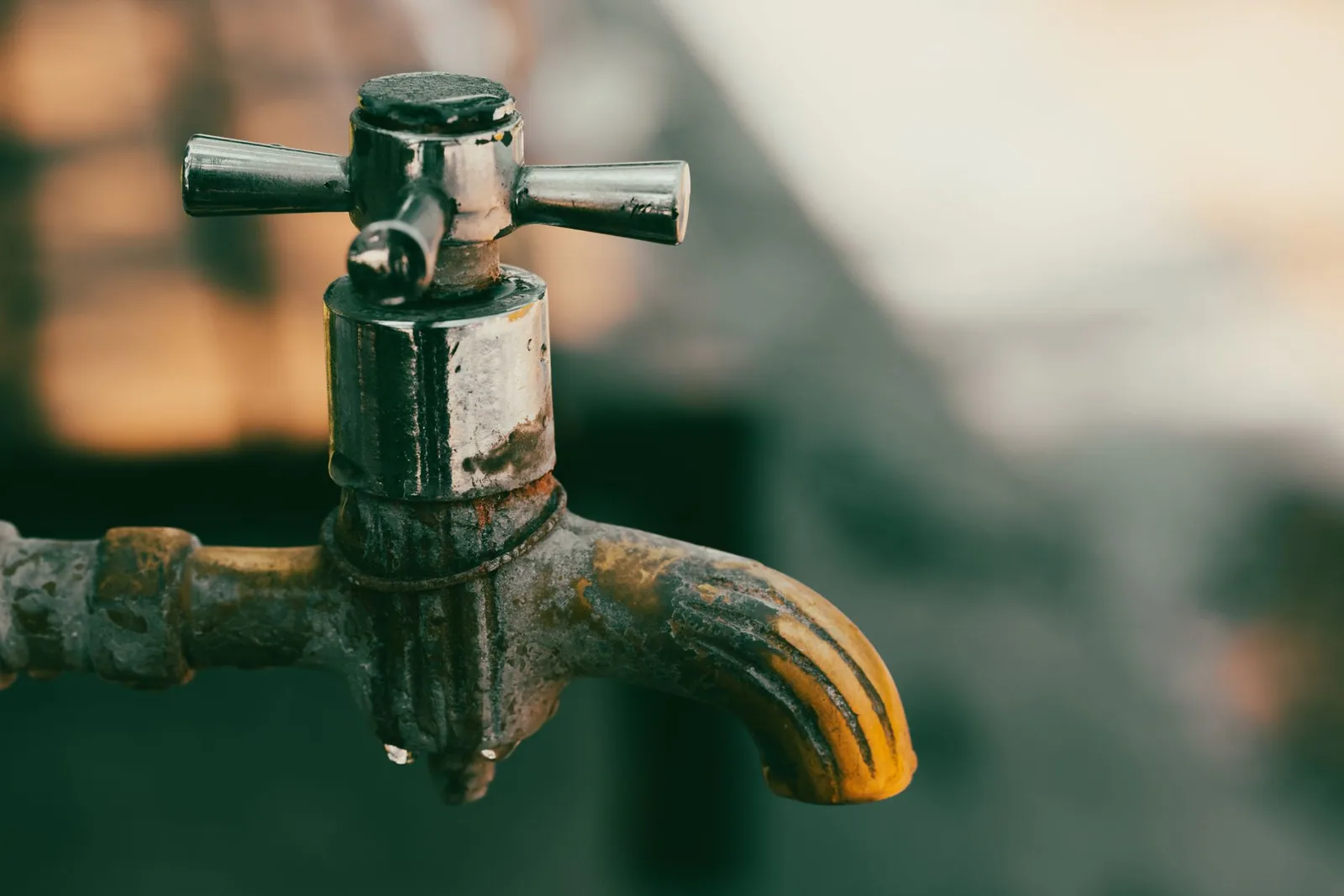
You need one when a lab test or your fixtures say so. A well with clear water, no stains and a clean report may need nothing more than a sediment screen. Iron, manganese, a metallic taste or an odor are the signals that justify a full stack.
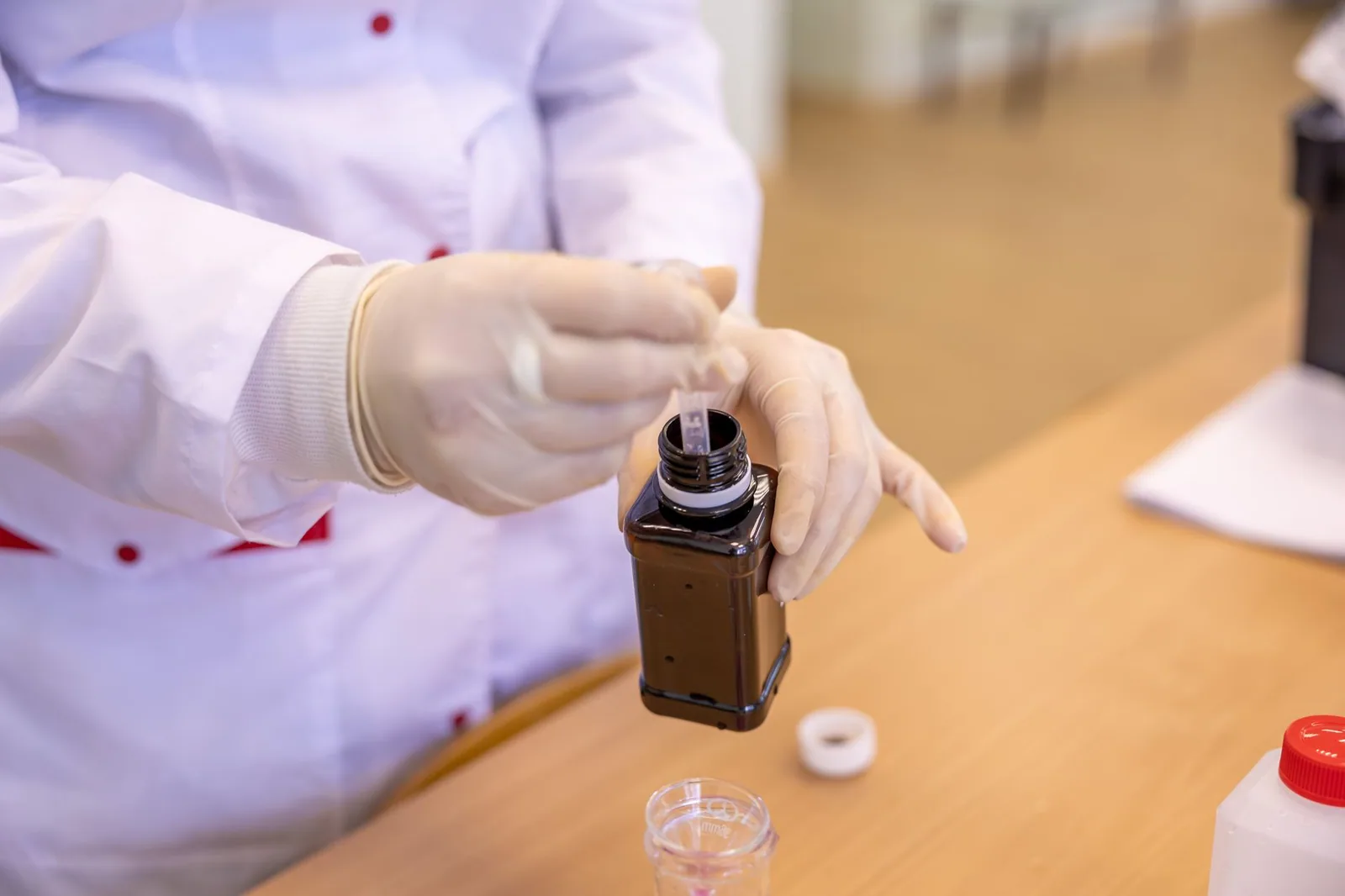
The test comes first because the right system depends on numbers you cannot see. The EPA sets secondary, non-enforceable standards of 0.3 mg/L for iron and 0.05 mg/L for manganese: above them, water stains and tastes, even when it is safe. Our step-by-step guide to testing a private well covers which lab panel to order, and the mail-in and strip kits we ranked cover the cheaper first look.
Signs a well needs more than a sediment screen
4 itemsHow We Chose These Three Systems#
We started from what well owners actually see when they search: the shopping results for this query are full of three-housing kits sold as well filters, from iSpring, Express Water and PRO+AQUA among others. We kept the systems sold on the maker's own store with a readable price, then read each product page for four things.
The first was a published iron or manganese limit, because a well filter without one cannot be matched to a lab report. The second was rated flow, since a cartridge that chokes the shower is a cartridge you will bypass. The third was the price of a full refill set, read the same day as the system. The last was whether the cartridges are a standard size you can buy elsewhere.
No system scored on all four. That is the honest state of this category, and it is why the verdicts below are tied to your lab numbers rather than to a single winner. We did not install or bench-test these units; every rating quoted is the maker's own, with the day we read it.
Cartridge Stack or Backwashing Tank: Which Does Your Well Need?#
A cartridge stack is right for light iron and modest flow. Past about 3 ppm of iron, or in a large house, cartridges clog fast and a backwashing tank wins on cost and on water pressure.
The difference is how each system gets rid of what it catches. A cartridge holds it until you throw the cartridge away. A tank such as an air injection iron filter flushes it to a drain every night, so its media lasts for years. That is why the cartridge systems below cost a quarter of a tank and then keep costing.
Iron in ppm, flow in GPM
as of 2026-11-02- Under 0.3 ppm ironno iron stageBelow the EPA's secondary standard for iron. A sediment screen and, if you want it, carbon for taste. No iron cartridge needed.
- 0.3 to 3 ppm ironcartridge stackThe cartridge zone. iSpring rates its FM25B iron cartridge to 3.0 ppm; it is the only stack of the three we compared that prints a number.
- 3 to 7 ppm irontankPast every cartridge rating we found. An air injection tank such as the SpringWell WS1, rated to 7 ppm, backwashes instead of clogging.
- Above 7 ppm ironbigger tankA larger oxidizing system with a higher published ceiling, sized from the lab report by the seller.
Zone edges are published figures: the EPA secondary standard for iron (0.3 mg/L), iSpring's FM25B rating (3.0 ppm, read Oct 12, 2026) and SpringWell's WS1 rating (7 ppm). Flow bars are the makers' ratings (PRO+AQUA read Nov 2, 2026; iSpring Oct 12, 2026), not measurements.
Best Cartridge Filter for Iron on a Well: iSpring WGB32BM#
The iSpring WGB32BM is our pick for wells with light iron because it states what it can handle. Its third stage, the FM25B cartridge, is rated to 3.0 ppm of iron and 1.0 ppm of manganese, ahead of a 5 micron sediment stage and a coconut carbon block, on standard 20 x 4.5 inch Big Blue housings.
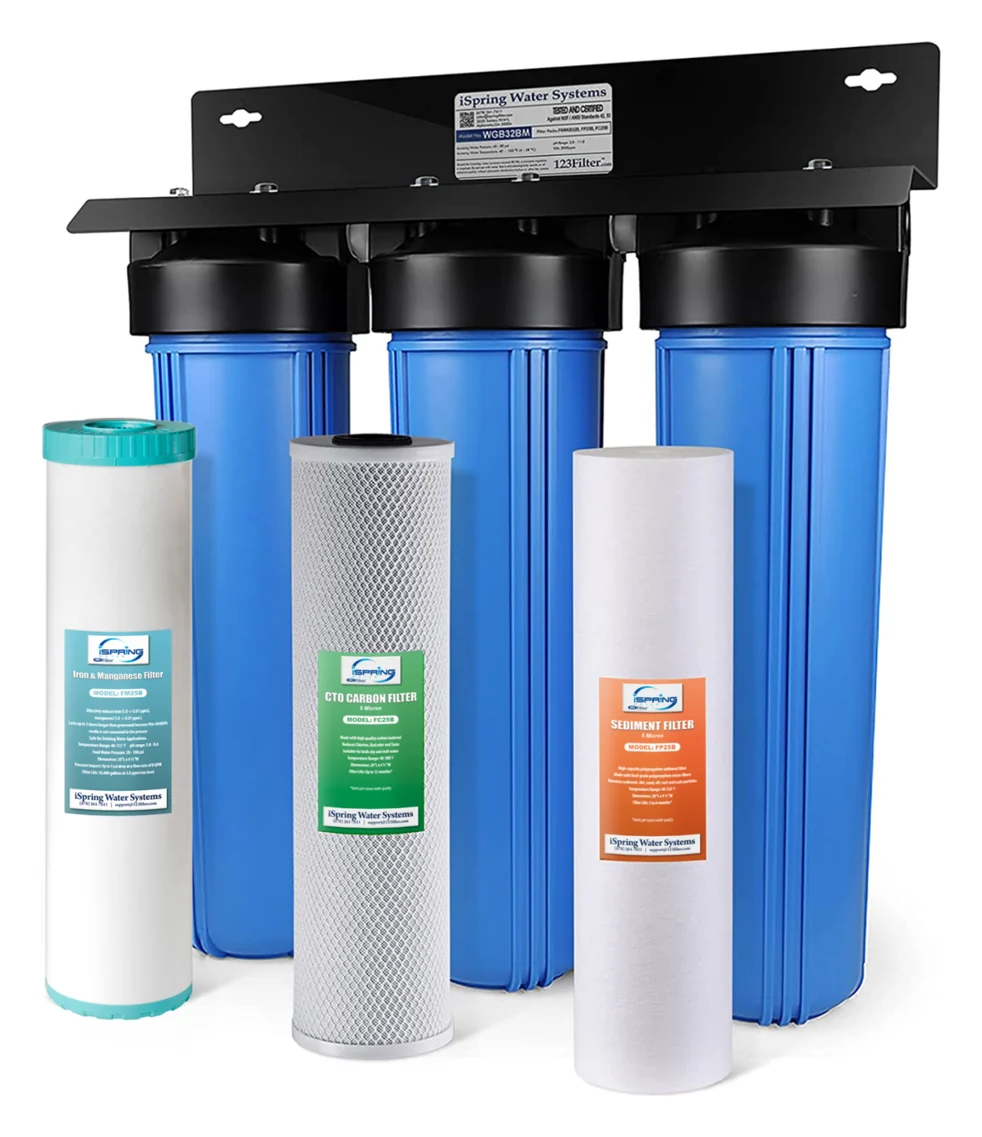
iSpring
iSpring WGB32BM 3-Stage Whole House Iron and Manganese Filter
Best for: Wells with light iron, at or under 3 ppm on a lab test, where a backwashing tank is more machine than the problem needs
- Type
- 3-stage Big Blue cartridge filter, 20 x 4.5 in
- Stages
- 5 micron sediment, coconut carbon block, FM25B iron and manganese
- Iron rating
- 3.0 ppm max (FM25B cartridge)
- Manganese rating
- 1.0 ppm max
- Flow
- Up to 15 GPM system; FM25B cartridge rated 4 to 8 GPM
- Iron cartridge life
- 50,000 gallons at 3.0 ppm iron
The fine print is in the cartridge, not the system. iSpring rates the whole unit up to 15 GPM, but the FM25B is rated 4 to 8 GPM with up to a 5 psi drop at 8 GPM, so the iron stage sets the real ceiling. It lasts 50,000 gallons at 3.0 ppm, which is about 250 days for a household using 200 gallons a day, our arithmetic on iSpring's figures. The full replacement pack was $159.99 and the iron cartridge alone $104.99 on Oct 12, 2026.
The housings are the same size as iSpring's city filter, which our WGB32B review covers in detail, so generic cartridges fit when you want to shop around.
Cheapest Iron Cartridge Stack: Express Water WH-300RS-ICS#
The Express Water WH-300RS-ICS is the cheapest iron and manganese stack we found, at $449.99 on Nov 2, 2026. It runs an iron cartridge (IRN), an activated carbon block and a sediment stage on 1 inch connections.
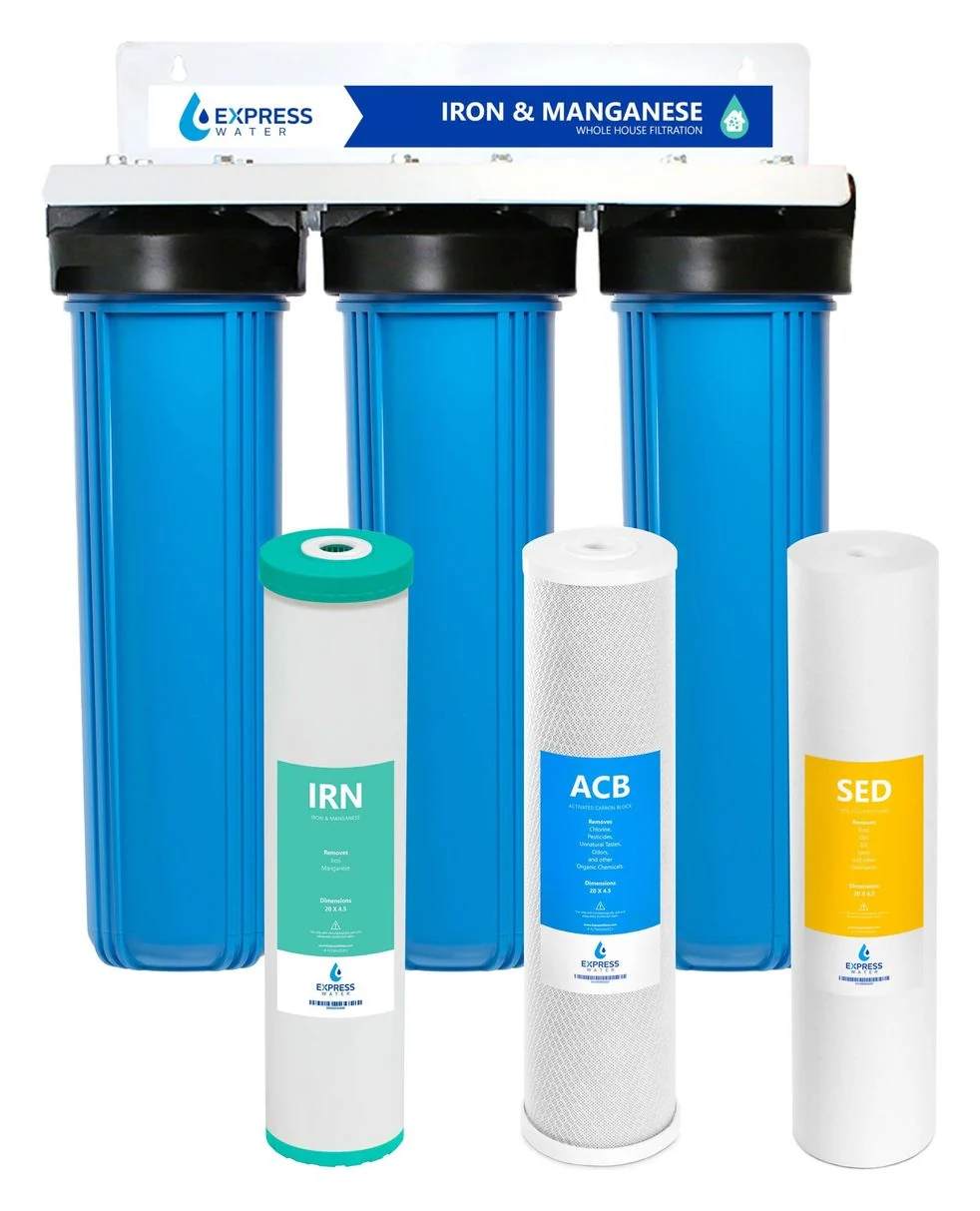
Express Water
Express Water WH-300RS-ICS 3-Stage Whole House Iron and Manganese Filter
Best for: A cheaper three-housing iron and manganese stack for a well that tested light, when you accept an unpublished iron limit
- Type
- 3-stage 20 x 4.5 in cartridge filter
- Iron stage
- IRN Zeomangan cartridge (iron and manganese)
- Ports
- 1 in standard connections
- Pressure
- 40 to 80 psi (Express Water spec table)
- Filter life
- Up to 100,000 gallons or 6 to 12 months (Express Water)
- Replacement set
- $186.99 (Nov 2, 2026)
Its weakness is the missing number. The product page says it removes iron and manganese but prints no limit in ppm, so you cannot check it against your lab report. Its spec table also lists filters belonging to another model in the WH300 range, which is why we only quote the 40 to 80 psi range and the one-year limited warranty from it. A full iron replacement set was $186.99 and the IRN cartridge $109.99, each rated up to 100,000 gallons or 6 to 12 months.
iSpring WGB32BM
- $535.99 on Nov 2, 2026
- Iron rated to 3.0 ppm, manganese to 1.0 ppm
- Iron cartridge rated 4 to 8 GPM
- Replacement pack $159.99 (Oct 12, 2026)
Express Water WH-300RS-ICS
- $449.99 on Nov 2, 2026
- No iron or manganese limit published
- 1 inch standard connections
- Replacement set $186.99 (Nov 2, 2026)
Our call
Pay the $86 more for the iSpring if your lab result sits near 3 ppm. The Express stack only makes sense when the iron reading is low and the budget is tight.
Best for Taste, Odor and Metals: PRO+AQUA PRO-100-E GEN2#
The PRO+AQUA ELITE GEN2 PRO-100-E is the stack to choose when the complaint is a metallic taste or a faint odor rather than orange stains. It was $489.95 on Nov 2, 2026, against a $559.99 compare-at figure on the same page.
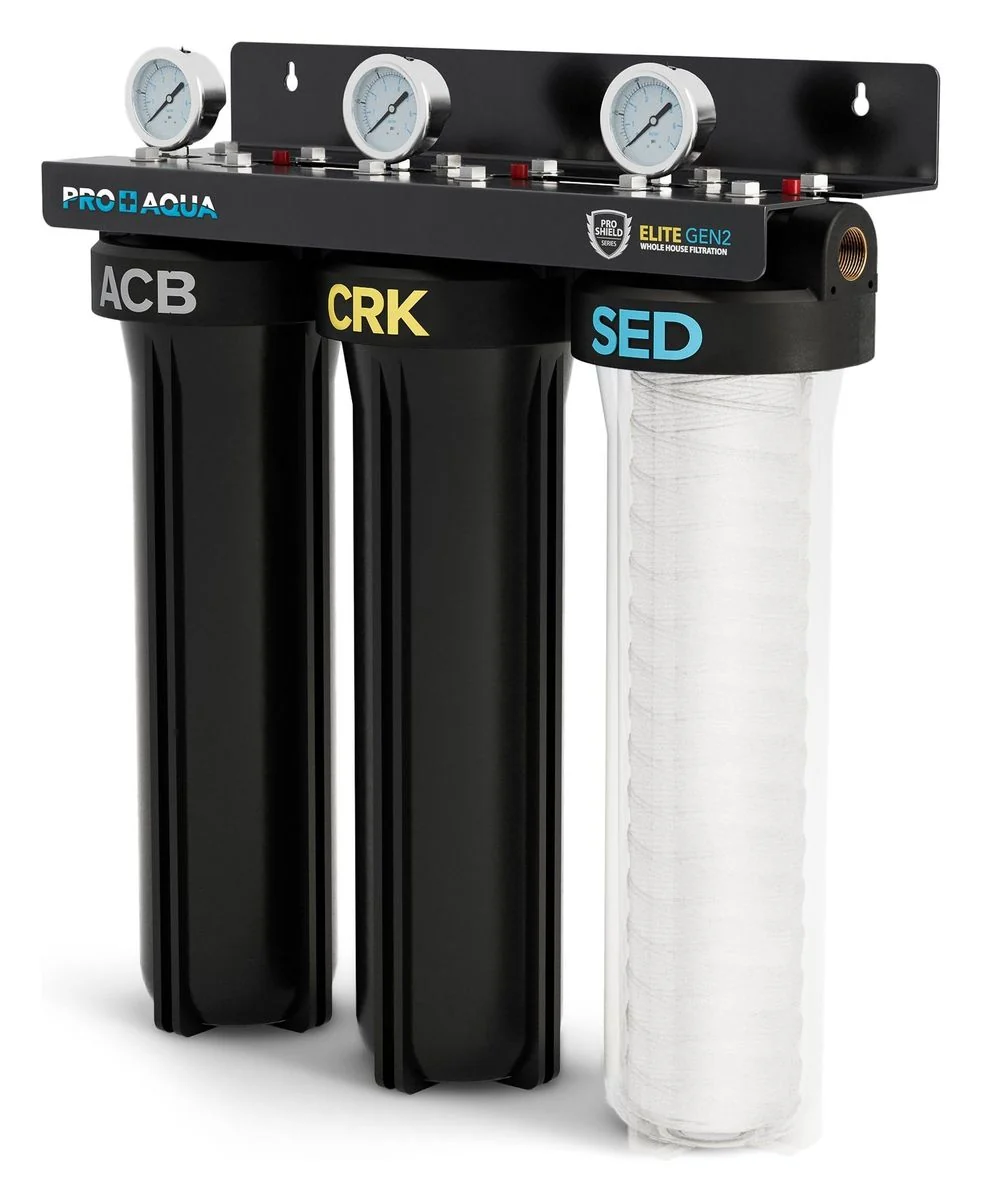
PRO+AQUA
PRO+AQUA ELITE GEN2 PRO-100-E 3-Stage Whole House Well Water Filter
Best for: Wells with a metallic taste or a light odor, where KDF and carbon matter more than an iron rating
- Stages
- String-wound sediment, KDF and carbon mixed media, 5 micron carbon
- Flow rate
- Up to 7 GPM (PRO+AQUA)
- Ports
- 1 in
- Pressure
- 45 to 80 psi
- Filter life
- Up to 100,000 gallons or 6 to 12 months (PRO+AQUA)
- Extras
- Stainless gauges, pressure relief buttons, wrench
The middle stage is a mixed KDF and carbon cartridge, and the last a 5 micron carbon filter, with a string-wound sediment cartridge first. Stainless gauges on each housing show a clogging cartridge before the shower does. Two defects matter. PRO+AQUA rates the unit up to 7 GPM, about half the iSpring headline. And the GEN2 cartridges are proprietary: the maker states that standard 4.5 x 20 inch filters do not fit, so the $151.95 set it sells is the only refill.
It publishes no iron limit either, so treat it as a taste and metals filter, not an iron filter.
Why a Spin-Down Screen Goes in Front of Any Cartridge Stack#
Because sand kills cartridges. A reusable spin-down screen such as the iSpring WSP-50SL, $79.99 on Nov 2, 2026, stops grit before it packs the first cartridge, and you flush it instead of replacing it.
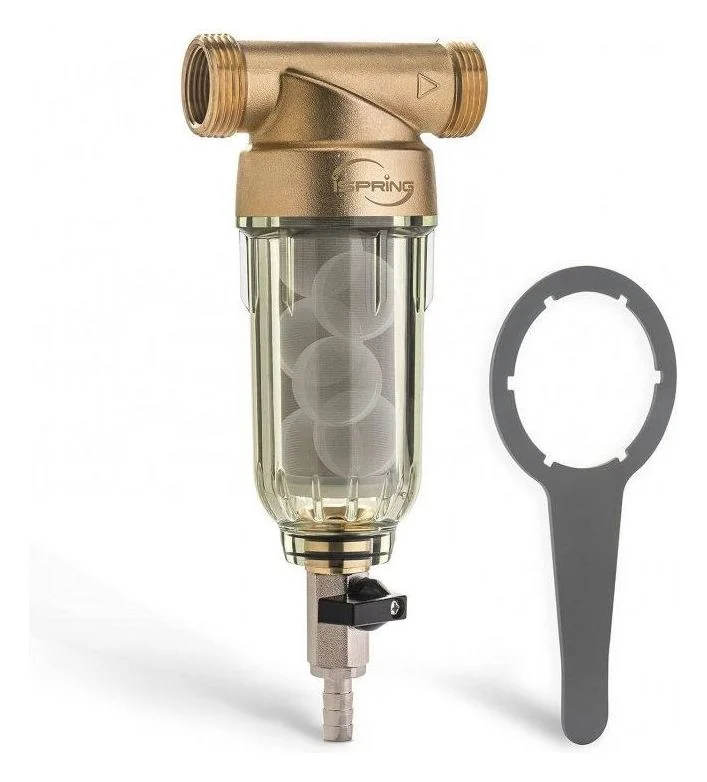
iSpring
iSpring WSP-50SL Reusable Spin-Down Sediment Prefilter
Best for: Putting a flushable, never-replaced screen in front of a softener, an iron filter or a cartridge stack
- Micron options
- 50, 100, 200, 500 and 1,000 on the same body
- Ports
- 1 in MNPT and 3/4 in FNPT, both ends
- Pressure range
- 20 to 100 PSI
- Temperature range
- 40 to 100 F
- Screen
- Reusable 316L stainless, flushed by valve
- Siliphos cartridge
- Replace every 3 to 6 months
On a sandy well, the screen is the difference between changing a sediment cartridge twice a year and every few weeks. It comes in 50 to 1,000 micron on the same body. Our comparison of screens, cartridges and backwashing sediment tanks explains how to size it for your well.
Where Does a Whole House Filter Go on a Well?#
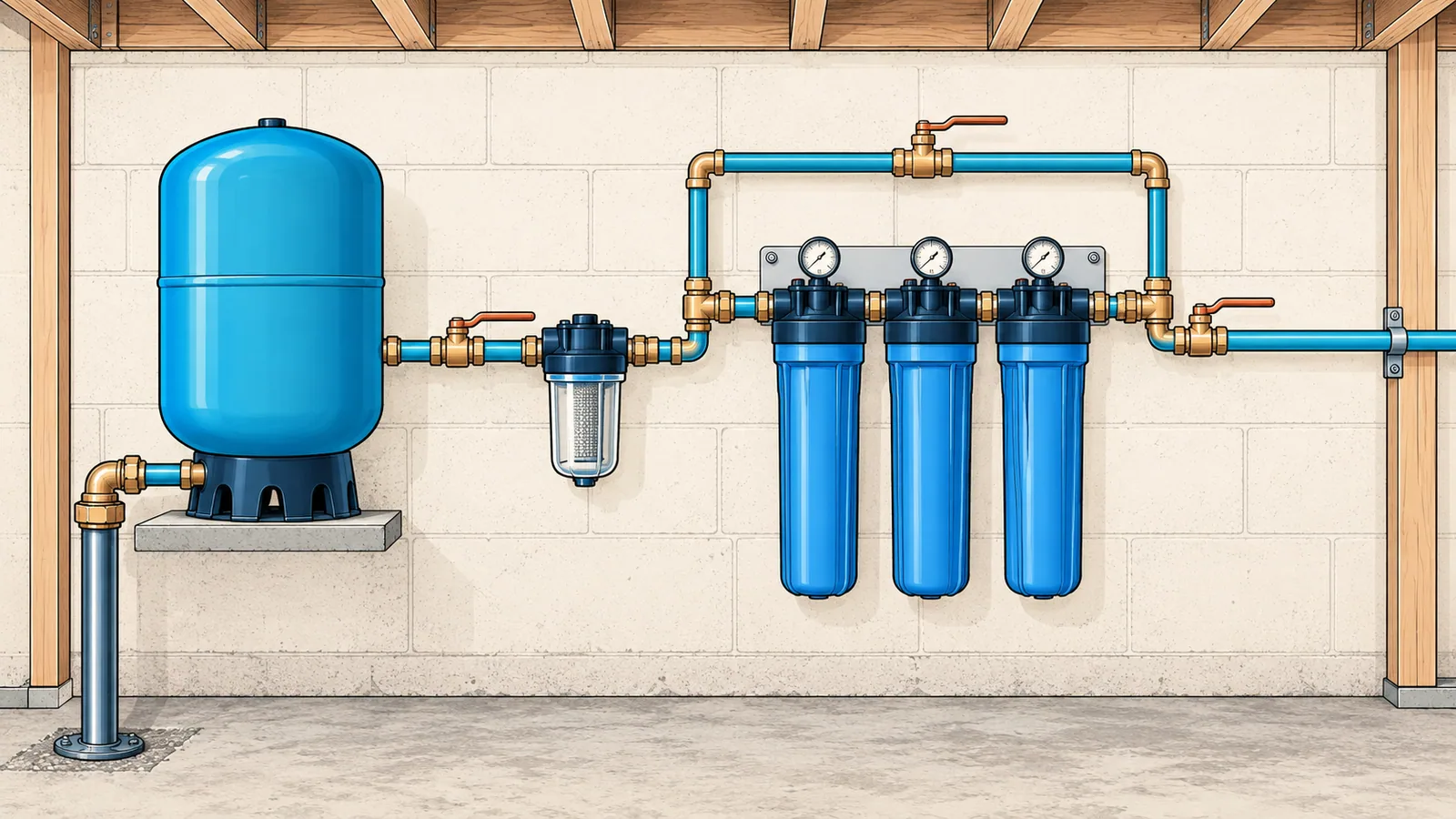
After the pressure tank, before a softener and before the water heater. Orange water that runs orange straight from the tap is a particle problem first, as our guide to the four kinds of well rust shows. On placement, Boshart, a maker of well fittings, warns against putting a filter between the pump and the pressure tank: as it clogs, the pressure switch cannot see the blockage and the pump keeps running against it.
Plumbing order for a cartridge stack on a well
Pressure tank and switch
Leave the well side untouched, so the switch always reads true pressure.Spin-down screen
Takes sand and grit, flushed through its valve.Cartridge stack
Sediment, then the iron or KDF stage, then carbon, with a shutoff valve on each side and a bypass loop around the group.Softener, if the water is hard
Behind the filters, so iron and grit never reach the resin.UV last, if bacteria showed up
The final stage before the house, on water already cleared of particles.
A bypass loop matters more on a well than in a city: when a housing leaks or a cartridge clogs, it keeps water running to the house while you fix it.
How Much Does a Whole House Water Filter for Well Water Cost?#
Buying one costs $449.99 to $535.99 at the makers we read on Nov 2, 2026. Running one costs about $150 to $375 a year in cartridges, depending on the brand and on how fast your water uses them up.
Cartridge stacks for wells, priced at the maker
as of Nov 2, 2026- Express Water WH-300RS-ICS systemReplacement set $186.99, one or two a year
- $449.99
- PRO+AQUA PRO-100-E GEN2 systemProprietary set $151.95, one or two a year
- $489.95
- iSpring WGB32BM systemReplacement pack $159.99 on Oct 12, 2026
- $535.99
- iSpring WSP-50SL spin-down screenFlushed, not replaced
- $79.99
- SpringWell WS1 backwashing tank, for comparisonRead Nov 9, 2026; no cartridges
- $2,231.25
iSpring WGB32BM plus a spin-down screen, parts only
$615.98
Prices read on ispringfilter.com, expresswater.com and proaquawater.com on Nov 2, 2026, except where dated otherwise. Yearly cartridge cost is our arithmetic on the makers' 6 to 12 month guidance: one set a year at the low end, two at the high end. Installation is not included.
Two sets a year on the Express stack cost $373.98, our arithmetic on its $186.99 set. At that pace, system plus cartridges passes the WS1's $2,231.25 price in under five years, while the tank needs no cartridges at all. On a light well that uses one set a year, the cartridge stack stays the cheaper route for much longer. Our breakdown of installed well treatment costs prices the tank route in full.
When Is a Cartridge System the Wrong Buy?#
When the lab report goes past what a cartridge is rated for, or the house uses more water than one can pass. Cartridges are a light-load tool; on a heavy well they clog in weeks and cost more than the tank you were avoiding.
A cartridge stack fits
- Iron at or under 3 ppm on a lab test
- No more than a faint odor
- One or two bathrooms
- A budget under $600 up front
Buy a tank instead
- Iron above 3 ppm, or manganese above 1 ppm
- A clear rotten-egg smell
- Three or more bathrooms in use at once
- Cartridges clogging within weeks
The rule
If your result is near any rated limit, size up. A tank that is too big costs money once; a cartridge that is too small costs money every month.
The tank route starts with the SpringWell WS1, rated to 7 ppm of iron, 1 ppm of manganese and 8 ppm of hydrogen sulfide at 12 GPM, and our SpringWell WS1 review weighs its limits against its price. For higher readings, our ranking of iron filters by their rated ppm compares air injection, greensand and Katalox systems. If the smell is the main problem, start with what causes a sulfur smell in well water. Hard well water also needs a softener after the filter, and our softener picks for well owners put the two in order.
Prices were read on each maker's own store on Nov 2, 2026, except the iSpring replacement parts (Oct 12, 2026) and the SpringWell WS1 (Nov 9, 2026). Ratings are the makers' published figures. We did not bench-test these systems. None of the three cartridge systems claims an NSF/ANSI certification for the finished unit.
Whole house well water filters: what people ask
What is the best whole house filter for well water with iron?
For light iron, at or under 3 ppm, the iSpring WGB32BM, whose FM25B cartridge is rated to 3.0 ppm of iron and 1.0 ppm of manganese. For more iron than that, a backwashing iron tank such as the SpringWell WS1, rated to 7 ppm, is the better tool.
Do you need a whole house filter for well water?
Only if the lab report or your fixtures show a problem. Clear water with a clean test may need just a sediment screen. Iron, manganese, a taste or an odor justify a full stack.
How often do you change whole house well water filters?
Express Water and PRO+AQUA rate their sets at up to 100,000 gallons or 6 to 12 months. iSpring rates its FM25B iron cartridge at 50,000 gallons at 3.0 ppm of iron. A sandy or high-iron well uses them up sooner, which a gauge on each housing makes visible.
Is a whole house sediment filter enough for well water?
It is enough when sediment is the only problem. A sediment filter stops particles but not dissolved iron, manganese, odor or hardness, which need their own stage.
Will a whole house filter lower water pressure on a well?
Some drop is normal and grows as cartridges clog. iSpring states up to a 5 psi drop at 8 GPM for its FM25B. Pick a system whose rated flow covers the fixtures you run at the same time, and change cartridges when the gauges show the drop rising.
Frequently asked questions
What is the best whole house water filter for well water?
For a well with light iron, at or under 3 ppm on a lab test, the iSpring WGB32BM at $535.99 (Nov 2, 2026) is the cartridge system we would buy, because it is the only one of the three we compared that publishes an iron limit. A well with more iron than that, or with a rotten-egg smell, needs a backwashing tank such as the SpringWell WS1 rather than cartridges.
Do you need a whole house filter for well water?
Not always. A well whose lab report is clean and whose water runs clear may need only a sediment screen. You need more when the test shows iron, manganese, a metallic taste or an odor, or when grit and stains show up in fixtures. The lab report decides, not the fact that the water comes from a well.
How much does a whole house water filtration system cost for well water?
A three-housing cartridge system costs $449.99 to $535.99 at the makers we read on Nov 2, 2026, plus about $150 to $190 per replacement set, one or two sets a year. A backwashing iron tank such as the SpringWell WS1 was $2,231.25 on Nov 9, 2026, with no cartridges to buy. Full multi-stage well systems cost more.
What type of water filter is best for deep well water?
Depth does not pick the filter; the lab report does. Two wells of the same depth a mile apart can carry very different water, and only a certified lab test shows which you have. Light iron suits a cartridge stack; heavier iron, manganese or sulfur suits a backwashing tank; bacteria need UV.
Can a whole house cartridge filter remove iron from well water?
Light iron, yes, with an iron-specific cartridge. iSpring rates its FM25B iron cartridge to 3.0 ppm of iron and 1.0 ppm of manganese, with a life of 50,000 gallons at that load. A plain sediment and carbon stack stops rust particles but not dissolved iron.
Keep reading

Not sure what you need?
Answer 5 questions, get the right system for your water.
City or well, budget, household size, our quiz matches your answers against every system we track.