Water Softener Resin: What It Is, How Long It Lasts, When to Replace It
Softener resin lasts about 10 years on chlorinated water and often longer on clean water. How to tell it has failed, 8% vs 10% resin, and the cost to re-bed.
By Home Water Lab TeamUpdated Prices verified Oct 7, 2026
This page contains affiliate links; buying through them costs you nothing extra.
Softener resin is the bed of small plastic beads inside your softener's tall tank, and it does all of the softening. It is also the part that ages: on chlorinated city water, resin typically needs replacing after about 10 years, while on clean, chlorine-free water it can outlast the control valve. If you are still working out what hard water does to a home and why a softener fixes it, start with our hard water guide and come back here when the resin is the question.
The short answer
as of Nov 2, 2026How long does water softener resin last, and when do you replace it?
Expect about 10 years on chlorinated city water and often far longer on clean water: one parts retailer reports resin over 20 years old still softening. Replace it when it fails, not on a schedule. The signs are hard water despite normal salt use, pressure loss through the softener, or beads at your faucets. A pro re-bed runs $200 to $400 (HomeGuide, Angi); doing it yourself, 1 cubic foot of 10% crosslink resin cost $189 on Nov 2, 2026.
Key takeaways
- Chlorine is the main thing that wears resin out: beads swell, then fragment, usually after about 10 years on city water.
- Iron fouling coats the beads but leaves them whole, so a cleaner can often bring it back. Broken beads cannot be cleaned.
- One cubic foot of resin regenerated at 15 lb of salt yields about 30,000 grains of capacity; at 6 lb, about 20,000.
- Most home softeners hold about 1 cubic foot of resin, which is what a 9 by 48 inch tank takes.
- DIY resin cost $80 per half cubic foot (8%) to $189 per cubic foot (10%) on Nov 2, 2026; a pro charges $200 to $400.
What Is Water Softener Resin?#
It is a bed of tiny amber beads made of polystyrene crosslinked with divinylbenzene, carrying sulfonic acid groups that hold sodium ions. ResinTech's CG8, a common softening resin, is sized between 16 and 50 mesh, roughly 0.3 to 1.2 millimeters across.
The beads are negatively charged and come loaded with sodium. As hard water flows down through the bed, calcium and magnesium push the sodium off and take its place, which is the whole trick of a softener. That's it. When the beads are full of hardness, the valve runs a regeneration: strong brine floods the bed, the sodium takes its seats back, and the hardness goes down the drain. Our overview of how salt-based softeners work walks through the full system around the tank.
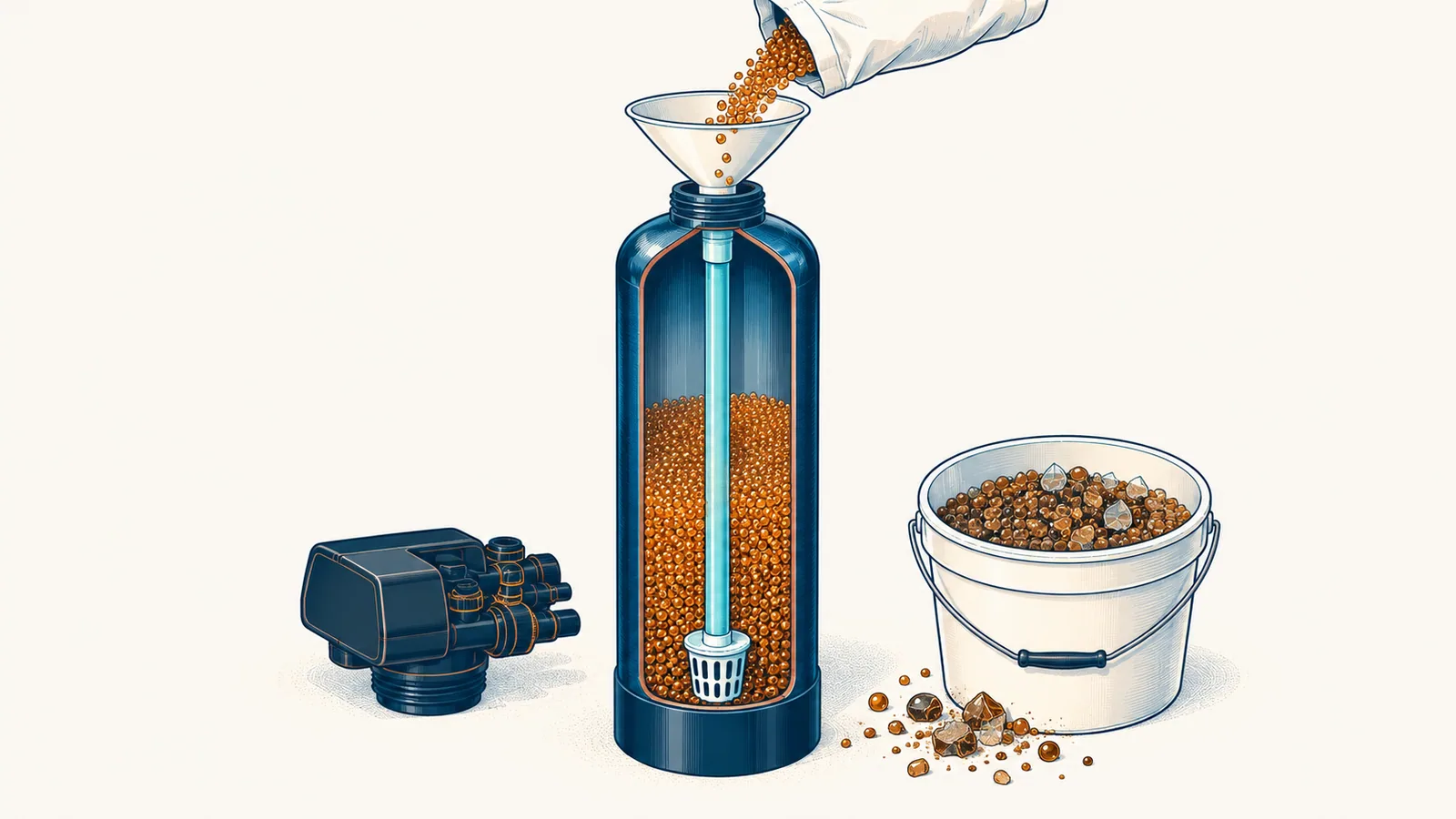
One tank, four ways the bed fails
as of Nov 2, 2026- Chlorine breaks the beadsReplaceOn chlorinated city water the beads swell and then fragment, usually after about 10 years. That is the main reason resin gets replaced.
- Fines and sand pack the bottomReplaceBroken bits and well sand settle on the bottom distributor and choke the flow. Low water pressure through the softener is the sign.
- Iron coats the beadsCleanIron and organics foul the surface but leave the bead whole. A resin cleaner usually brings the capacity back.
- Cracked distributor leaks beadsRepairBeads in faucet screens or toilet tanks mean the screen at the foot of the riser has failed. Replace the distributor with the resin.
Fill level (55 to 60% on tanks 44 in. and taller) and failure modes from the softenerparts.com Resin Replacement Guide; 50% bed expansion during backwash from ResinTech's regeneration data sheet. Both read Nov 2, 2026. Drawing not to scale.
How much hardness one cubic foot can hold depends on how much salt you give it. A Clack seminar excerpt published by softenerparts.com puts it at 30,000 grains at 15 lb of salt per cubic foot, 27,000 at 10 lb, 24,000 at 8 lb and 20,000 at 6 lb. The lighter doses squeeze more softening out of each pound of salt, which is why efficient settings matter more than raw capacity.
30,000 grains
How Long Does Water Softener Resin Last?#
On chlorinated city water, plan on about 10 years. Sometimes less. On chlorine-free water with no iron or sand, resin routinely lasts as long as the softener itself, and softenerparts.com reports beds over 20 years old that still exchange ions.
The published ranges agree on the shape, if not on the exact number, and the reason they disagree is that nobody can tell you how much chlorine, iron or sand your particular bed has been eating since the day it was installed. Angi puts resin replacement at every 10 years or more on city water and 5 to 10 years on well water with heavy iron, manganese or bacteria. SpringWell gives 10 to 15 years for the system with its resin. Our breakdown of what ends a softener's service life compares the resin with the valve, which often fails first.
How to Tell If Water Softener Resin Is Bad#
Bad resin shows up as hard water while the salt level drops normally, as low pressure through the softener, or as beads in your faucet screens. Rule out the cheap causes first. A salt bridge looks exactly like dead resin, and so does a clogged injector, a disconnected brine line or a hardness setting someone changed years ago and forgot about.
Before you blame the resin
5 itemsIf the softened water still tests hard right after a good regeneration, with salt being drawn, the resin is exhausted or fouled. A cheap test kit does this in a minute; our guide to testing your water's hardness at home shows which reading to trust. For every other symptom, from salty water to a tank that will not drain, the softener troubleshooting guide goes part by part.
Can You Clean Water Softener Resin Instead of Replacing It?#
Often, yes. When the problem is iron or organic fouling, the coating sits on beads that are still whole, and a resin cleaner dissolves it. Beads broken by chlorine or a bed full of sand cannot be cleaned and have to come out.
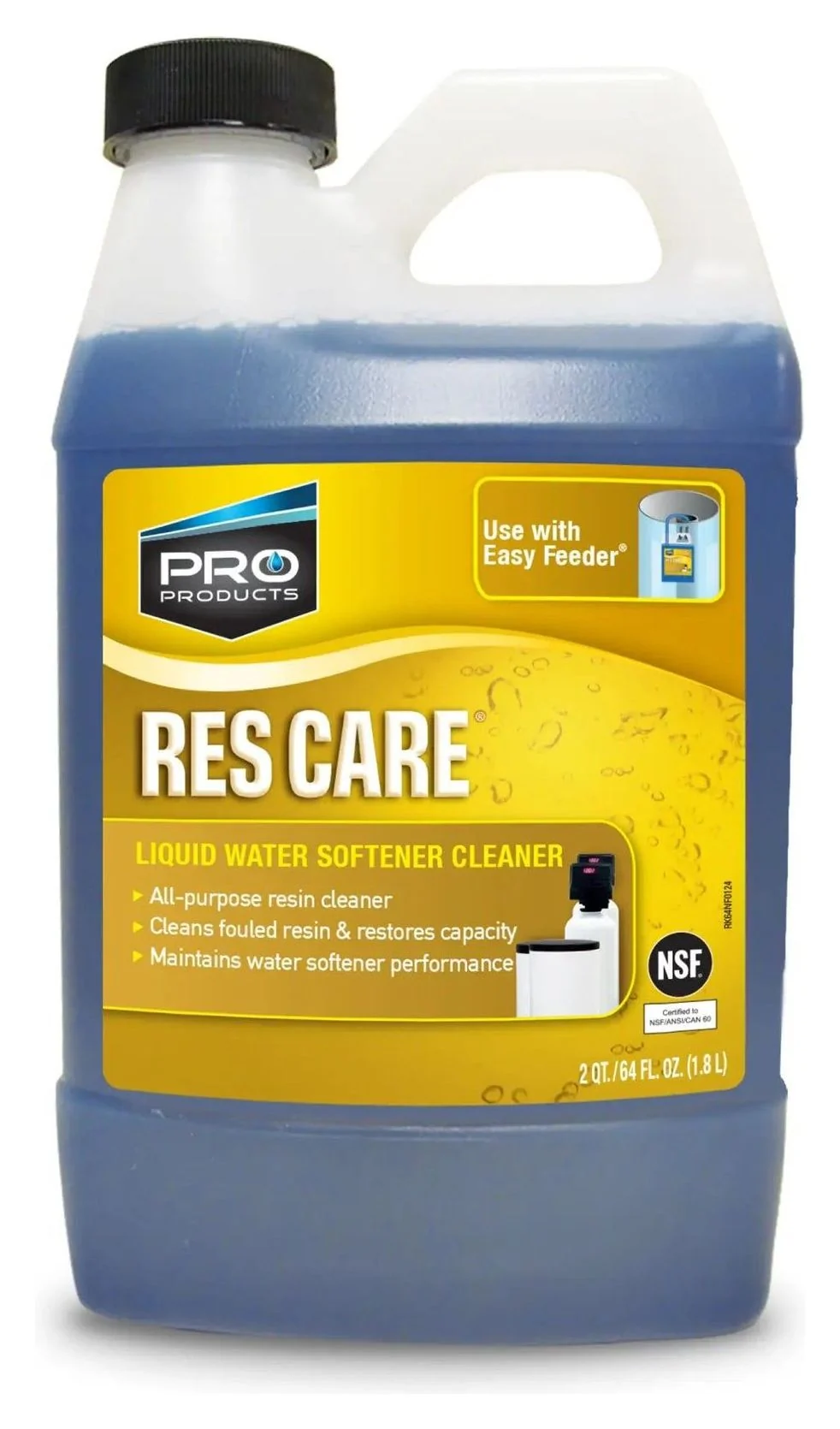
Pro Products
Pro Products Res Care Liquid Water Softener Cleaner (RK64N, 1/2 gal)
Best for: Routine resin cleaning on any salt softener, city or well, dosed by the cubic foot of resin
- Form
- Liquid, 1/2 gallon (64 fl oz)
- Removes
- Iron, manganese, silt, metal particles (maker)
- Fouled unit
- 4 oz (1/2 cup) per cubic foot of resin
- Maintenance
- 4 oz per cubic foot at each regeneration
- Main ingredient
- Phosphoric acid, 10 to 30% (SDS)
- Certification
- NSF/ANSI/CAN 60
The dose, the chemistry and the warranty rules for each bottle are in our guide to softener cleaners. If iron keeps coming back, the softener is doing a filter's job: these iron removal methods fix the cause upstream.
What Type of Resin Do You Need for a Water Softener?#
Standard strong acid cation resin in the sodium form, sold for softening and certified for drinking water. The real choice is between 8% and 10% crosslink, and between that and nothing else, the volume your tank holds.
8% crosslink (standard)
- What most softeners ship with
- $80 per half cubic foot at softenerparts.com
- Fine on chlorine-free well water
10% crosslink (premium)
- Tighter polymer, sold as more chlorine resistant
- $189 per cubic foot at US Water Systems
- Worth it on chlorinated city water
Our call
City water with chlorine: buy 10%. Well water without chlorine: 8% does the job for less.
US Water Systems describes its ResinTech CNS10 as having "a longer life" and being "more chemical and chlorine resistant" than 8% resin. That is a seller's claim, and no maker we read puts a number of years on it. The same listing pitches 10% resin for situations "where additional chlorine resistance is necessary," which is exactly what treated city water is.
Volume matters too. Softenerparts.com lists 0.75 cubic feet for an 8 by 44 inch tank, 1 cubic foot for a 9 by 48, 1.5 for a 10 by 54 and 2 for a 12 by 52. Tall tanks are only 55 to 60% full when new, so do not top the tank up: that empty space is where the bed expands during backwash. Some brands use finer beads by design; WaterBoss, for one, builds its compact units around fine mesh resin, which our WaterBoss review looks at in practice.
How Much Does It Cost to Replace Water Softener Resin?#
A plumber or dealer charges $200 to $400 per HomeGuide and Angi. Doing it yourself, the resin is the only real cost: $80 to $189 for most home tanks at the prices we read on Nov 2, 2026.
Re-bedding a 1 cubic foot softener yourself
as of Nov 2, 2026- ResinTech CNS10, 10% crosslink, 1 cu ftUS Water Systems; the half cubic foot bag was $89.95
- $189
- Gravel underbeddingOnly for tanks over 12 to 13 inches wide; 25 lb was $49.95
- usually none
- Bottom distributorPrice depends on your valve and tank
- only if beads escaped
Parts for the job
$189
Prices from US Water Systems' own catalog, read Nov 2, 2026. Professional re-bed range from HomeGuide and Angi. A 9 by 48 inch tank takes 1 cubic foot per softenerparts.com.
Now weigh it against the machine. If the valve is a proprietary big-box head near the end of its own life, $400 into new resin buys little, and our guide to replacing a softener helps you call it. On a standard Fleck or Clack valve that still works, a re-bed is the cheaper fix by far. When a dealer quotes the work, our numbers on what softener service visits cost show what a fair invoice looks like.
How Do You Replace Water Softener Resin?#
Bypass and depressurize the softener, unscrew the valve, empty the tank, pour in new resin, then reassemble and backwash for 10 minutes. Most of the effort goes into moving a wet, heavy tank: new resin alone ships at about 50 lb per cubic foot.
Re-bedding a softener, start to finish
Bypass and unplug
Put the valve in bypass, shut off the water, unplug the head, and disconnect the inlet, outlet, drain and brine lines.Unscrew the valve
It can take two people. Softenerparts.com reports owners using a strap around the tank like a jar opener when it sits in a cabinet.Empty the tank
Lay it down and tip the resin into buckets, or pull it out with a shop vacuum if the tank has to stay upright.Check the riser and distributor
If beads ever reached your faucets, replace the bottom distributor now, while the tank is empty.Pour in the new resin
Use a funnel. Go slowly. Without gravel, fill with resin, cover it with water, then push the riser tube down through the bed to the bottom.Reassemble and backwash
Reconnect everything, run a 10 minute backwash, then open a tap to clear air. New resin ships fully charged, so no regeneration is needed.
If gravel is part of your tank's design, the riser goes in first with its top taped or bagged shut, and the gravel goes in before the resin. For most residential tanks under 13 inches wide, softenerparts.com recommends no gravel at all. Our yearly softener upkeep routine covers the checks that keep a fresh bed working, and comes with a video.
Why Are There Resin Beads in Your Water?#
Beads in faucet aerators, the toilet tank or a shower head mean the screen at the bottom of the riser tube, the distributor, has cracked or come loose. The resin is escaping the tank, so the fix is a new distributor, usually with fresh resin, because the bed does not go back in.
Fines are the other version. They are small enough to pass where whole beads cannot and they pile up against the distributor, choking flow. Well owners can add sand to that pile, which a sediment filter ahead of the softener keeps out.
Is Water Softener Resin Dangerous?#
No. Softening resins are made for drinking water, and the certifications printed on their data sheets say so plainly: ResinTech's CG8 is certified to NSF/ANSI/CAN 61, 44 and 372, and Purolite's C100E is certified to NSF/ANSI 61 and conforms to the FDA rule for ion exchangers used on food.
A stray bead in a glass of water is a nuisance. It tells you a part broke, and that is all it tells you. Spent resin goes out with the household trash: softenerparts.com calls it a non-toxic plastic. Check whether your town has its own rule before you spread it anywhere.
Resin chemistry, bead size and certifications from the ResinTech CG8 and Purolite C100E product pages; regeneration steps, the 6 to 15 lb salt range and the 50% backwash expansion from ResinTech's regeneration data sheet. Capacity per salt dose, tank volumes, fill levels, failure modes and the replacement steps from softenerparts.com, a parts retailer. Resin prices from the US Water Systems and softenerparts.com catalogs. All read Nov 2, 2026. Professional re-bed costs from HomeGuide and Angi, and resin service intervals from Angi, as recorded in our earlier cost research.
Water softener resin questions
Can I add more resin to my water softener for more capacity?
Not usefully. Tall tanks are filled to only 55 to 60% so the bed can expand during backwash, and that room is part of the design. For more capacity, raise the salt dose within the 6 to 15 lb per cubic foot range or move to a larger tank.
Does new resin need to be regenerated before use?
No. Softening resin ships in the sodium form, fully charged. Backwash it for about 10 minutes after re-bedding to settle the bed and flush fines, then put the valve back in service.
What does bad water softener resin look like?
Healthy resin is round, amber and uniform. Old chlorine-damaged resin breaks into fragments and fine grit that settle at the bottom of the tank. The reliable test is still a hardness reading right after a regeneration.
Is fine mesh resin better?
It packs more beads into the same tank, which is why compact brands like WaterBoss use it. It is not a must-have upgrade for a standard softener, and it is not what to buy for a tank designed around standard mesh.
Frequently asked questions
How often should you replace the resin in your water softener?
Only when it fails, not on a calendar. On chlorinated city water that tends to be around 10 years, sooner or later depending on the chlorine level. Angi gives every 10 years or more on city water and 5 to 10 years on well water with heavy iron, manganese or bacteria, and a parts retailer reports resin over 20 years old still softening.
What is the resin in a water softener?
Small amber plastic beads, a polystyrene gel crosslinked with divinylbenzene and carrying sulfonic acid groups. The beads hold sodium, trade it for calcium and magnesium as water passes, and get recharged with brine during each regeneration.
How much does it cost to replace the resin in a water softener?
A pro re-bed runs $200 to $400 per HomeGuide and Angi. Doing it yourself, one cubic foot of 10% crosslink resin cost $189 at US Water Systems on Nov 2, 2026, and 8% resin was $80 per half cubic foot at softenerparts.com the same day.
What type of resin do I need for my water softener?
Standard strong acid cation resin in the sodium form, in the volume your tank holds. Pick 10% crosslink on chlorinated city water, since its sellers market it as more chlorine resistant, and plain 8% on chlorine-free well water. Fine mesh resin is a design choice of some brands, not a required upgrade.
Is water softener resin dangerous?
No. Softening resins like ResinTech CG8 and Purolite C100E are certified to NSF/ANSI 61 for drinking water system components and conform to the FDA rule for ion exchangers used on food. Loose beads in your plumbing are a sign of a broken part, not a health hazard.
How do you dispose of old water softener resin?
Bag it and put it in the household trash unless your town has a rule saying otherwise. Softenerparts.com describes spent resin as a non-toxic plastic. Drain it first, because wet resin is heavy: new resin ships at about 50 lb per cubic foot.
Keep reading

Not sure what you need?
Answer 5 questions, get the right system for your water.
City or well, budget, household size, our quiz matches your answers against every system we track.