Water Softener Cleaners: Do You Actually Need One? (+ How to Clean Yours)
Most softener cleaners are phosphoric acid from one Indiana maker. When resin needs one, which to use for iron, the Whirlpool and Rheem warranty rules, and how.
By Home Water Lab TeamUpdated Prices verified Oct 7, 2026
This page contains affiliate links; buying through them costs you nothing extra.
You need a water softener cleaner when something besides hardness is fouling the resin, mainly iron, and when your softener's warranty asks for one. On clean, iron-free city water, the salt keeps the resin working and a cleaner is optional upkeep. What you'll find on the shelf is narrower than it looks: most liquid cleaners are a phosphoric acid solution whose safety data sheet names the same Indiana maker. Hardness itself, and everything it does around the house, is covered in our guide to hard water and its fixes.
The short answer
as of Oct 26, 2026Do you need a water softener cleaner?
Use one if your water carries iron or manganese, if softening fades and salt alone doesn't bring it back, or if your warranty requires it: Rheem extends its 1-year parts and labor warranty to 5 years with its cleaner every four months, and Whirlpool's page takes the WHES44 from 1 year up to 5 with use of its cleanser (Nov 2, 2026). For iron water, Rust Out is made for the job; for routine resin cleaning, Res Care is certified to NSF/ANSI/CAN 60. Most cleaners are acids: wear gloves and eye protection and never mix them with other chemicals.
Key takeaways
- Res Care is 10 to 30% phosphoric acid with a pH under 1, per its Nov 2025 safety data sheet; Whirlpool's cleanser is 3 to 7%.
- Whirlpool, A.O. Smith, Aquasana, WaterBoss and Culligan liquid cleaners all have SDS naming Pro Products LLC as supplier.
- Rust Out is 30 to 60% sodium dithionite, an iron reducer: 1 1/2 cups to start, then 1/2 cup per 40 lb of salt.
- Rheem: 1-year parts and labor extends to 5 years with its cleaner every four months; some manuals also ask you to register it.
- Whirlpool, Rheem and Morton all say every four months for their bottled cleaners.
Do Water Softener Cleaners Really Work?#
They do what they're built for: dissolving iron, manganese, silt and scale that build up in the resin and valve where salt does not reach. They will not revive a softener that has a mechanical fault or is simply too small for the house.
Salt only swaps calcium and magnesium back off the resin. Iron is the usual problem, because it coats the beads and the valve, and softening fades even with a full salt tank. Pro Products says Res Care removes "iron, manganese, silt and metal particles from the resin bed," and is unusually frank about the limits: it "will not fix mechanical issues, undersized systems, failed components, or water problems that require additional treatment."
What none of the makers we read publish is a measured result, such as grains of capacity regained. So treat a cleaner as maintenance that keeps fouling from building up, and go through our softener troubleshooting guide before you blame the resin when softening drops.
What Is in a Water Softener Cleaner?#
Mostly acid. The liquid cleaners we checked are phosphoric acid solutions at different strengths, the iron cleaners are sulfite chemistry, and one city-water powder is citric acid. Here is what their safety data sheets say, read Oct 26, 2026.
Read off the safety data sheets
as of Oct 26, 2026- Res Care: phosphoric acid, 10-30%DangerSDS issued Nov 17, 2025: pH under 1, causes severe skin burns and eye damage, may be corrosive to metals. Certified to NSF/ANSI/CAN 60, per the maker.
- Culligan liquid: phosphoric acid, 10-30%DangerSDS revised Nov 18, 2025, supplier Pro Products LLC. Same strength band and hazard class as Res Care.
- Aquasana cleaner: phosphoric acid, 5-10%WarningSDS revised Feb 11, 2026, supplier Pro Products LLC. Corrosive to metals, skin and eye irritant.
- WaterBoss cleaner: phosphoric acid, 5-10%WarningSDS revised Nov 17, 2025, supplier Pro Products LLC.
- A.O. Smith cleaner: phosphoric acid, 5-7%WarningSDS revised May 13, 2025, supplier Pro Products LLC. May be corrosive to metals.
- Whirlpool cleanser: phosphoric acid, 3-7%DangerSDS issued Mar 16, 2015, manufacturer Pro Products LLC: pH 2.5 at 1%, causes serious eye damage. The weakest acid here still carries Danger because of the eyes.
- Rust Out: sodium dithionite, 30-60%WarningSDS issued Nov 18, 2025: sodium dithionite plus sodium metabisulfite and soda ash, pH 5.5 to 6.5, serious eye irritant. Keep away from oxidizers; the label adds that the vapor is harmful.
- Softener Mate: citric acid, n/aWarningSDS issued Nov 19, 2025: citric acid is the only listed ingredient, concentration withheld. Eye and respiratory irritant, made for city water.
Concentrations are the ranges printed on each safety data sheet (the exact figure is withheld as a trade secret). Every SDS here names Pro Products LLC, Fort Wayne, Indiana, as supplier or manufacturer. Read Oct 26, 2026.
The surprise is the supplier line. Whirlpool's cleanser, and the cleaners sold under the A.O. Smith, Aquasana, WaterBoss and Culligan names, all have safety data sheets naming Pro Products LLC of Fort Wayne, Indiana, the company that also sells Res Care and Rust Out under its own label. The concentrations differ, from 3 to 7% phosphoric acid in Whirlpool's bottle to 10 to 30% in Res Care, so they are not identical products. They are close cousins.
Whirlpool Water Softener Cleanser#
Whirlpool's cleanser, model WHE-WSC, is a phosphoric acid liquid meant for its own softeners every four months. Its maker page says it reduces "the contaminants, iron, and scale buildup that can clog your valve."
The safety data sheet linked from Whirlpool's page names Pro Products LLC as manufacturer and lists phosphoric acid at 3 to 7%, with a Danger signal word for serious eye damage. The page gives no dose; follow the bottle and your manual. Buying it also matters for coverage: Whirlpool's page says the WHES44's 1-year parts and labor warranty may be extended up to 5 years with use of this cleanser (read Nov 2, 2026; it said 2 years on Aug 31), as our Whirlpool softener review details.
Rheem Water Softener Cleaner#
Rheem's cleaner is a 16 oz bottle, "ready to use, no mixing required," recommended every four months and sold exclusively at Home Depot. Rheem's help page describes it as "a diluted Phosphoric Acid solution."
The reason to buy this one is the warranty. Rheem's RHS42 manual says the 1-year parts and labor warranty "can be extended to five (5) years from the date of purchase" if you use one bottle of its RHWSC cleaner every four months and keep proof of purchase, and another Rheem manual also asks you to register the purchase at rheemwatertreatment.com. The softener's status light even flashes a reminder three times a year. Our Rheem softener review covers the rest of those terms.
Which Water Softener Cleaner Is Best?#
The one your warranty names, if it names one. Otherwise, pick by your water: an iron cleaner for well water with iron, a resin cleaner for routine upkeep on city water.
Pro Products
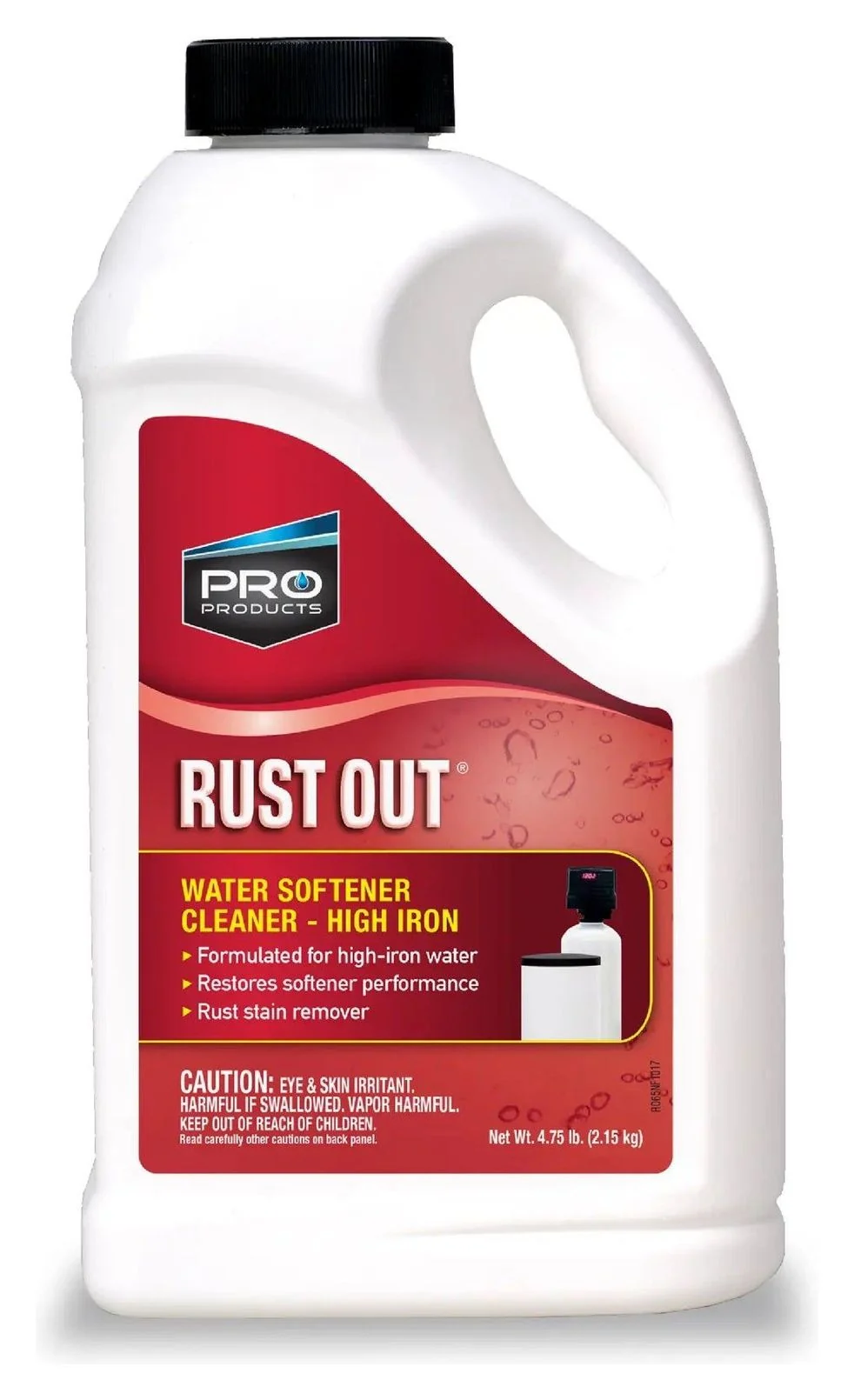
Pro Products Rust Out Water Softener Cleaner (RO65N, 4 lb 12 oz)
Best for: Well owners whose softener sees iron, as a regular dose layered with the salt
- Form
- Powder, 4 lb 12 oz jug
- Made for
- Softeners on iron-bearing water
- First dose
- 1 1/2 cup in 1/2 gal cold water, into the brine well
- Maintenance
- 1/2 cup per 40 lb of salt, layered
- Main ingredient
- Sodium dithionite, 30 to 60% (SDS)
- SDS signal word
- Warning (eye irritant)
Rust Out is the iron product. Its maker says "all softeners on iron bearing water require Rust Out as preventative maintenance," with a first dose of 1 1/2 cups dissolved in half a gallon of cold water, then 1/2 cup per 40 lb of salt layered in. Resellers print different doses; we quote the maker's. Cabinet softeners should only get it as a periodic clean, per the label.
Pro Products
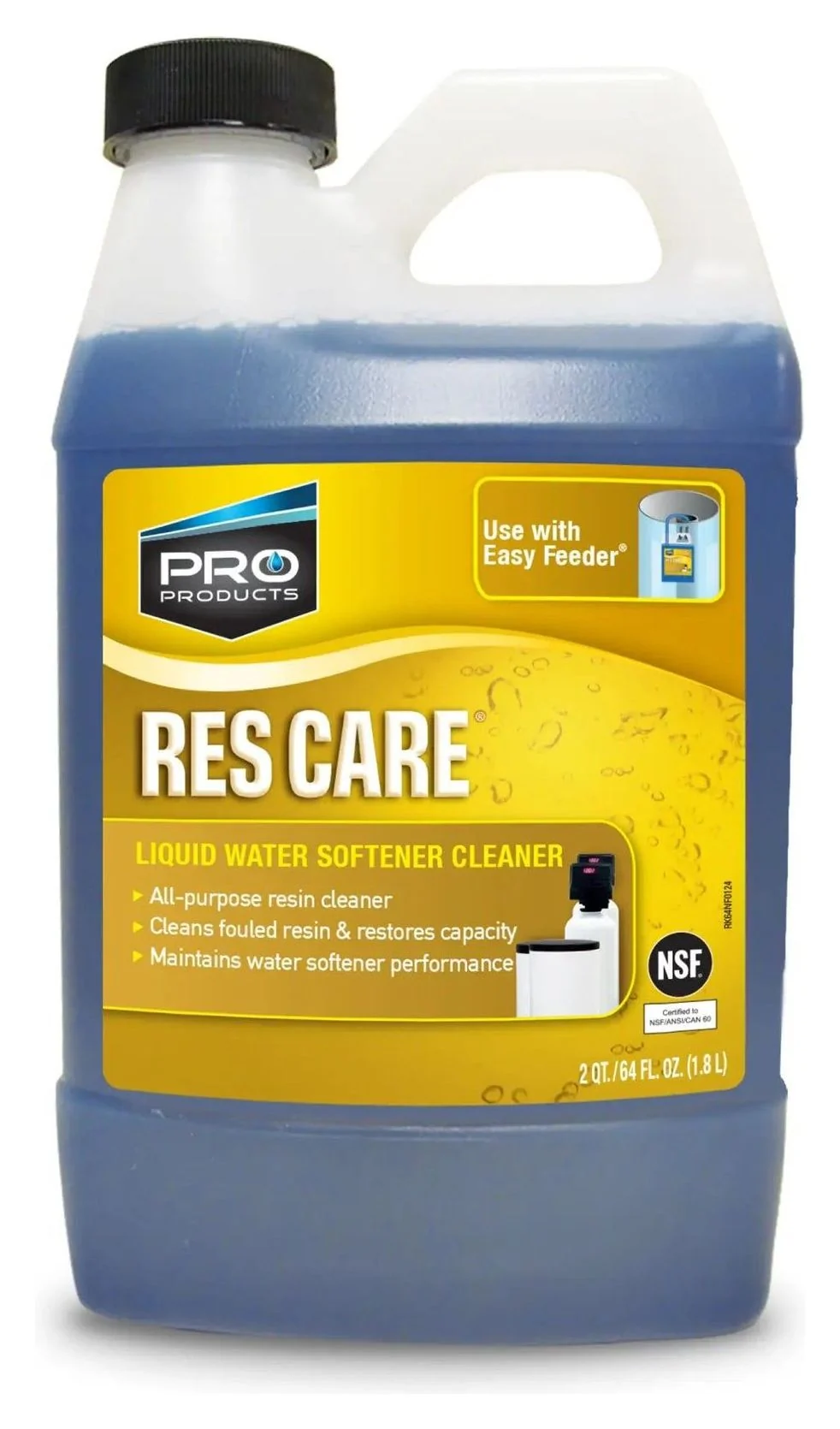
Pro Products Res Care Liquid Water Softener Cleaner (RK64N, 1/2 gal)
Best for: Routine resin cleaning on any salt softener, city or well, dosed by the cubic foot of resin
- Form
- Liquid, 1/2 gallon (64 fl oz)
- Removes
- Iron, manganese, silt, metal particles (maker)
- Fouled unit
- 4 oz (1/2 cup) per cubic foot of resin
- Maintenance
- 4 oz per cubic foot at each regeneration
- Main ingredient
- Phosphoric acid, 10 to 30% (SDS)
- Certification
- NSF/ANSI/CAN 60
Res Care is the general-purpose liquid. Pro Products doses a fouled unit at 4 oz, half a cup, per cubic foot of resin, noting that "most residential softeners contain approximately 1 cubic foot," and the same dose at each regeneration for maintenance. Morton's MWSC cleanser is the simpler bottle: pour all 16 oz into the brine well and regenerate, every four months.
Res-Up is a name you'll see at many dealers, but we found no maker page or safety data sheet for it on Oct 26, 2026, so we don't quote a dose or an ingredient. A.O. Smith's own cleaner also ties to its warranty, which our A.O. Smith softener review explains.
How to Clean a Water Softener With a Cleaner#
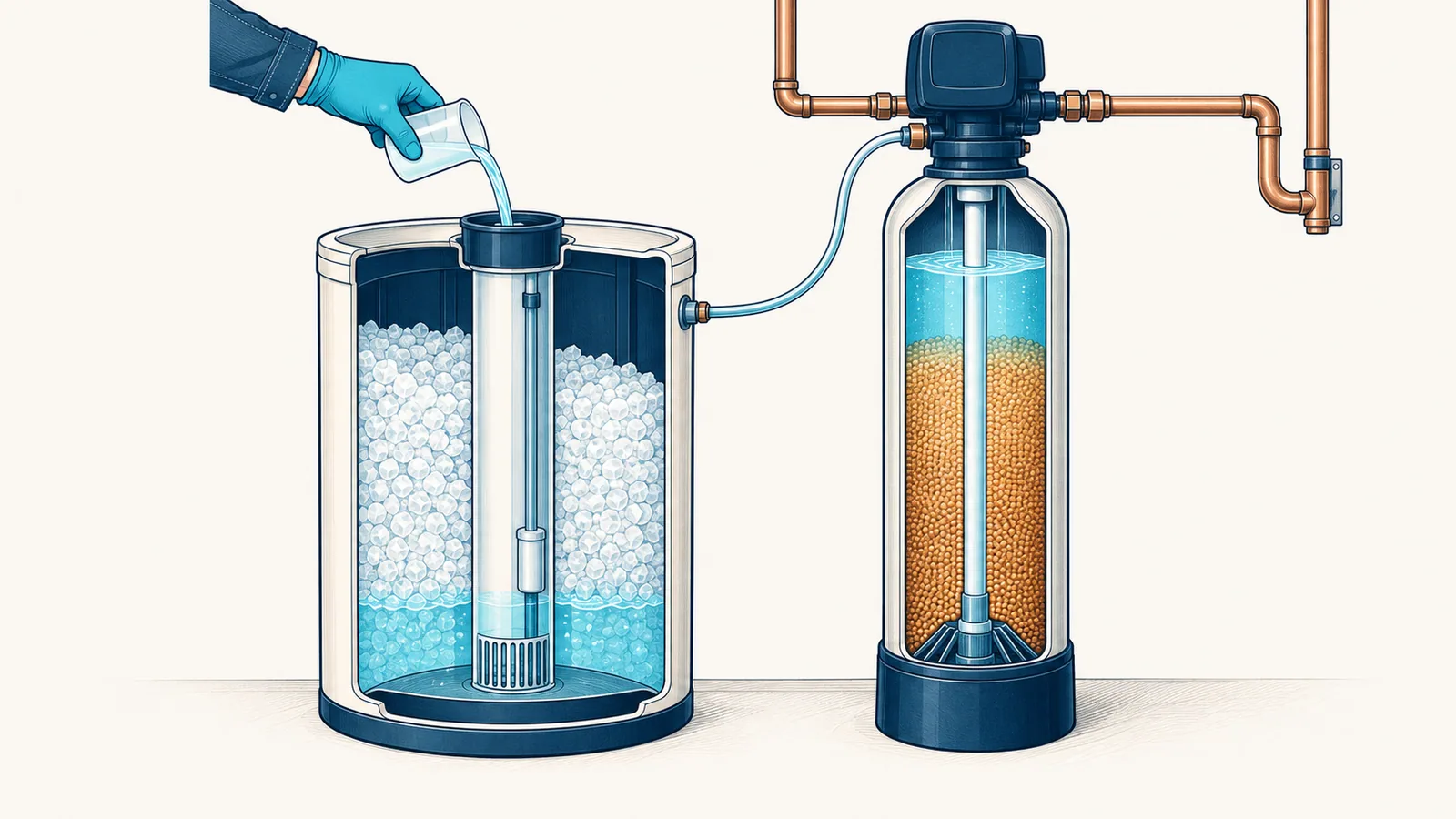
Dose the brine well, run a manual regeneration, then flush a cold tap. The cleaner rides into the resin with the brine and leaves through the drain line, which is why it never goes straight into the resin tank.
Cleaning the resin, start to finish
Check the manual and the warranty
Use the cleaner it names if your coverage depends on it, and note its dose. Make sure the softener isn't in bypass.Let the salt run low
Rheem wants the salt between 2 and 5 on the brine well's scale; Morton and Pro Products say to pour into the salt tank when the salt is low if there's no brine well.Pour the labeled dose into the brine well
That's the narrow tube with a cap inside the salt tank. Wear gloves and eye protection, and don't mix the cleaner with anything else.Start a manual regeneration
Hold the recharge or regen button until the motor starts, and avoid using water until the cycle finishes.Flush a cold tap
Rheem says run cold water for 5 to 10 minutes after the recharge. If you taste or smell the cleaner, regenerate again and run the water until it clears, per Pro Products.
That cleans the resin, not the salt tank. Sludge, mushy salt and bridges in the brine tank are a separate job, done far less often and laid out in our complete softener maintenance checklist, which also comes as a video.
Are Water Softener Cleaners Safe?#
They are safe at the labeled dose once they've rinsed through, and hazardous in the bottle. Res Care's safety data sheet gives a pH under 1 and the warning "Causes severe skin burns and eye damage"; Whirlpool's, at a weaker strength, still carries Danger for eye damage.
A cleaner is not a sanitizer, either. Pro Products sells Sani-System separately as an EPA-registered sanitizer for softeners; if your manual calls for sanitizing, use what it specifies.
How Often Should You Clean a Water Softener?#
Every four months for the bottled cleaners, by the makers' own schedules, and with each bag of salt for iron products like Rust Out. On iron-free city water, many owners can treat it as occasional upkeep rather than a fixed date.
If you are cleaning more often because iron keeps coming back, the cleaner is treating a symptom. A softener is not an iron filter, and our ranking of iron filters by the ppm they handle and the methods in removing iron from well water put the fix ahead of the softener. For softeners that have to live with some iron, see our picks for well water softeners.
Clean resin also lasts longer, and our look at what shortens a softener's working life ties that to iron and chlorine. The salt you pour on top matters too: rust-fighting pellets are compared bag by bag in our softener salt comparison, and if you'd rather not carry it, here's what salt delivery costs.
Doses and claims come from the makers' own pages; ingredients, concentrations and hazard statements from the safety data sheets published by Pro Products and linked by Whirlpool, all read Oct 26, 2026. Rheem's warranty wording is from its RHS42 and RHS32-series manuals and its help center, read the same day. Whirlpool's warranty terms are from our review, read Aug 31, 2026. Prices are Pro Products' own storefront.
Water softener cleaner questions
Can you use too much water softener cleaner?
Stick to the label. Doses are set per cubic foot of resin or per bag of salt, and Pro Products' instructions say to regenerate again and run cold water if you taste or smell the cleaner at the tap.
Does Rheem's warranty require Rheem's cleaner?
To get the extension, yes. Rheem's manual extends the 1-year parts and labor warranty to 5 years if you use its RHWSC cleaner every four months and keep proof of purchase; some Rheem manuals also require registering the cleaner purchase online.
How do I clean my water softener brine tank?
Empty the salt, scoop out the sludge, wash the tank and refill. It's a different job from cleaning the resin and needed far less often; our maintenance checklist has the full routine.
Is water softener resin cleaner safe for drinking water?
Res Care and Pro Softener Mate are certified to NSF/ANSI/CAN 60 for drinking water treatment, which covers the cleaner once it's rinsed through the softener. Run cold water after the regeneration as the makers direct.
Frequently asked questions
Do water softener cleaners really work?
They dissolve deposits that salt leaves behind, mainly iron, manganese and silt in the resin bed, and the acid ones also clear scale from the valve. Their makers say so, and the chemistry on their safety data sheets fits: phosphoric or citric acid, or a sulfite reducer for iron. No maker we read publishes a measured capacity gain, and Pro Products says its Res Care will not fix mechanical faults, failed parts or an undersized softener.
How do you use water softener cleaner?
Pour the labeled dose into the brine well, the narrow tube inside the salt tank, or into the salt tank when the salt is low if there is no brine well. Then start a manual regeneration so the cleaner is drawn through the resin and rinsed to drain, and run cold water at a tap afterward. Rheem says 5 to 10 minutes; Pro Products says until any taste or odor is gone.
How often should you clean a water softener?
Whirlpool, Rheem and Morton all say every four months for their bottled cleaners. Pro Products doses Res Care at each regeneration for maintenance and Rust Out at 1/2 cup per 40 lb of salt on iron water. The brine tank itself needs a cleaning far less often, which our maintenance checklist covers.
What can I put in my water softener to clean it?
A cleaner sold for water softener resin, used at the dose on its label. Every safety data sheet we read says not to mix it with other chemicals, and Rust Out's label adds not to use it with bleach or peroxide. If your manual names a specific cleaner, use that one, especially when the warranty depends on it.
Is Whirlpool water softener cleanser the same as other brands?
Its safety data sheet names Pro Products LLC as the manufacturer and lists 3 to 7% phosphoric acid. A.O. Smith, Aquasana and WaterBoss cleaners have SDS from the same supplier with 5 to 10% phosphoric acid. The bottles differ in strength and in what the warranty asks for, so buy the brand your manual names if you want the extended coverage.
Keep reading

Not sure what you need?
Answer 5 questions, get the right system for your water.
City or well, budget, household size, our quiz matches your answers against every system we track.